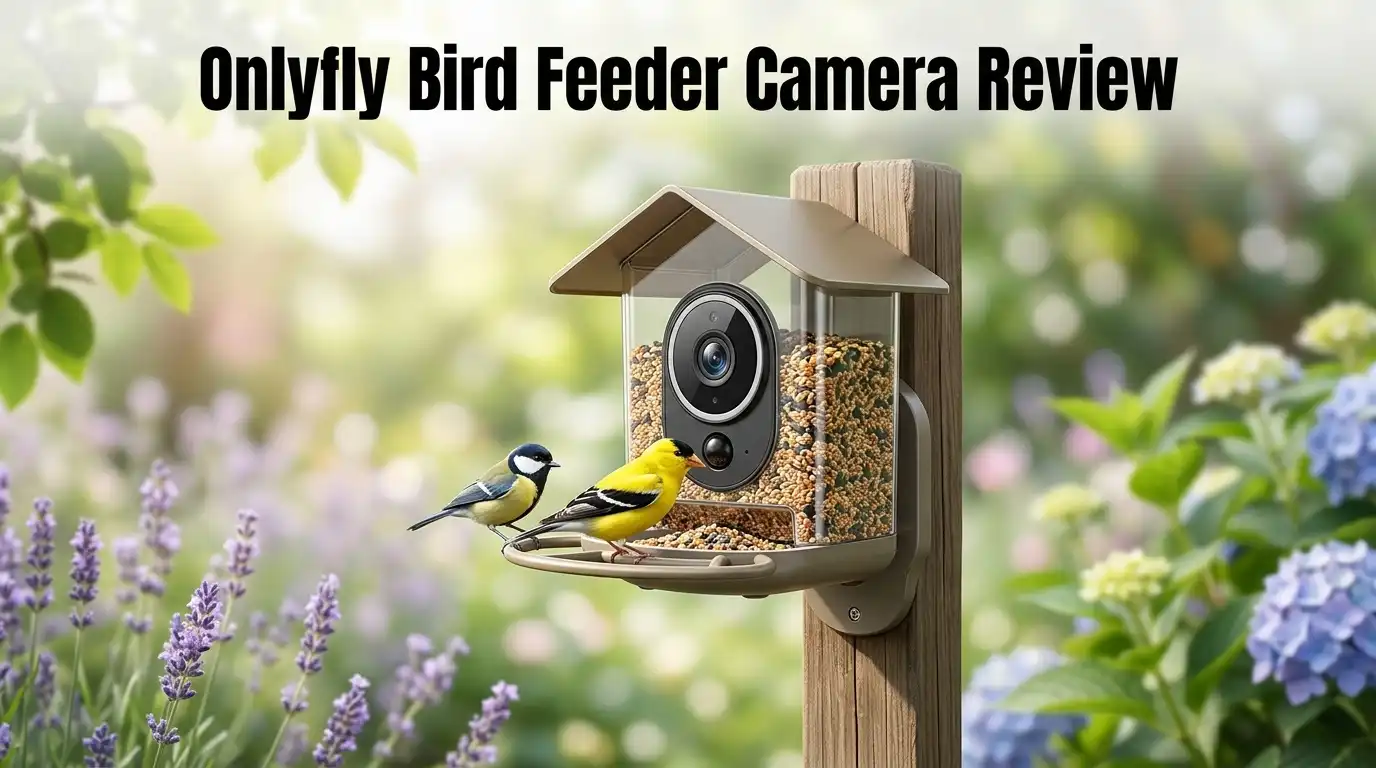
Onlyfly Bird Feeder Camera Review 2026: Worth Watching?
I bought a smart feeder for one selfish reason. I wanted to know what was eating $40 of birdseed a month while I was at work.
The Onlyfly Smart Bird Feeder with Camera promises to answer that question with a 2K camera, AI species identification, and dual solar panels that supposedly keep it running for months. At around $118 on Amazon, it undercuts Birdfy and Birdbuddy by a wide margin.
That price gap is the whole story here. After months of rain, heat, squirrel raids, and a very chatty VicoHome app, I have a clear sense of where Onlyfly delivers and where it quietly cuts corners.
In a Nutshell
- Camera performance is the strongest part. The 2K video and 5MP stills are sharp enough to count the barbs on a cardinal’s crest. Colors run slightly warm, but detail holds up well in daylight.
- The 160° wide angle is generous. Most competing feeders sit between 120° and 140°. You get whole birds in frame instead of heads and tails cropped at the edges.
- Solar charging genuinely works. Dual 4W panels plus a 5200mAh battery kept mine topped up through a cloudy stretch. I have not reached for the USB-C cable since week one.
- AI identification is roughly 80 to 85% accurate. Common visitors like chickadees, cardinals, and house finches land correctly. Sparrows and juvenile birds confuse it badly.
- The VicoHome app is the weak link. Sign-in glitches, occasional session conflicts between family members, and a subscription prompt that appears more often than any bird.
- Free tier is usable. You get live view, notifications, and a rolling 3-day cloud history. A microSD card up to 128GB removes the storage limit entirely.
- The squirrel deterrents do not work. The siren and strobe are loud and bright. Squirrels simply do not care.
Onlyfly Smart Bird Feeder With Camera Solar Powered 2K

Last update on 2026-08-28 / Affiliate links / Images from Amazon Product Advertising API Some of the links on this website are affiliate links, which means that at no additional cost to you, I earn a commission if you click through and make a purchase. I only recommend products and services that I believe will add value to my readers. Thank you for your support!
This is the model I tested, currently sitting at 4.4 stars across roughly 1,100 ratings. It holds 1.8 liters of seed, which works out to about a week for a moderately busy yard.
The body is ABS plastic with a plastic-coated iron base. It ships in eight colorways, and the two-tone white and blue version hides seed dust better than the solid colors.
Core specs are straightforward. 2K video, 5MP photos, 160° field of view, 2.4GHz Wi-Fi only, and motion-triggered clips that default to ten seconds.
Onlyfly also sells a newer metal-bodied model at a lower price point, which is worth knowing before you click buy. The version reviewed here has the longer track record and the deeper review pool.
Included accessories are a genuine bonus at this price. You get two hummingbird nectar cups, two fruit forks, and a jelly dish that clip onto the perch area.
Mounting hardware covers trees, walls, fences, and poles. There is even a standard tripod thread on the base if you want an odd placement.
Unboxing, Packaging, and What You Actually Get
The box arrives in its own shipping carton with no outer Amazon packaging. Inside, everything sits in molded pulp trays rather than foam, which I appreciated.
The feeder itself comes in two main pieces. The hopper body and the solar roof snap together with a hinge that clicks audibly when seated.
First thing I noticed was the smell. Fresh ABS plastic has a faint chemical odor out of the box that faded completely after two days outdoors.
Weight is modest at just under three pounds empty. It feels lighter than the photos suggest, which is fine for pole mounting but makes tree straps a better choice in wind.
The camera lens sits behind a small recessed hood. That hood is a smart bit of design because it keeps rain off the glass without blocking the wide angle.
Two USB-C ports live on the underside. One is sealed with a rubber plug, and the recess is deep enough that a thick cable head will not fit.
Assembly took me under fifteen minutes with no tools beyond the included screws. The printed manual is thin but the diagrams are clear.
Build Quality, Feel, and Weather Resistance
The plastic is thicker than I expected for the price. Press on the hopper wall and it flexes slightly, but there is no creaking or hollow rattle.
The clear seed window is the best functional detail. You can check the fill level from a kitchen window without opening the app.
Onlyfly rates the feeder as rainproof, not waterproof. Mine sat through heavy storms with no water intrusion and no fogging on the lens.
Sun exposure is the longer-term question. The roof has a UV protective coating, and after a summer in direct light my white panels showed no yellowing yet.
The snap-on base is my one build complaint. Separating the feeder from the mount takes real force, then releases suddenly and scatters loose seed everywhere.
I learned to empty the hopper before removing it. That single habit saved me a lot of sweeping.
Cleaning is easy enough. The hopper interior is smooth with no deep corners, so a bottle brush and warm soapy water handle the monthly scrub.
The perch is molded plastic with shallow ridges. Smaller songbirds grip it fine. Heavier visitors like grackles tend to slide and give up quickly.
Top 3 Alternative for Onlyfly Bird Feeder Camera

Last update on 2026-07-01 / Affiliate links / Images from Amazon Product Advertising API Some of the links on this website are affiliate links, which means that at no additional cost to you, I earn a commission if you click through and make a purchase. I only recommend products and services that I believe will add value to my readers. Thank you for your support!
NETVUE Birdfy Lite Smart Bird Feeder with Camera


Last update on 2026-07-01 / Affiliate links / Images from Amazon Product Advertising API Some of the links on this website are affiliate links, which means that at no additional cost to you, I earn a commission if you click through and make a purchase. I only recommend products and services that I believe will add value to my readers. Thank you for your support!
Birdfy 2 Smart Bird Feeder with Camera, Dual-Lens

Last update on 2026-07-01 / Affiliate links / Images from Amazon Product Advertising API Some of the links on this website are affiliate links, which means that at no additional cost to you, I earn a commission if you click through and make a purchase. I only recommend products and services that I believe will add value to my readers. Thank you for your support!
HARYMOR Bird Feeder with Camera Solar Powered 2K
Setup and the VicoHome App
Onlyfly does not have its own app. It runs on VicoHome, a white-label platform shared by several budget feeder brands.
Pairing took about ten minutes. The app walks you through Wi-Fi credentials, then displays a QR code that the camera scans with an audible chirp.
Remember the 2.4GHz requirement. If your router broadcasts a merged network, you will need to split the bands temporarily or setup will fail.
The interface itself is functional rather than charming. A live view tab, a timeline of clips, and a settings panel covering motion sensitivity, night vision, notifications, and video resolution.
Now the friction. Signing back in sometimes requires tapping through two or three consecutive screens, and other times drops you straight into the feed.
Family sharing works, but imperfectly. In my testing, one account logging in occasionally bumped the other out of the live stream.
Notifications are aggressive by default. I dialed motion sensitivity down two steps to stop getting alerts every time a branch moved.
None of this is a dealbreaker. It is simply less polished than what Birdbuddy and Birdfy owners get for their extra hundred dollars.
Camera Quality, Night Vision, and Field of View
This is where Onlyfly earns its keep. The 2K sensor resolves feather detail that genuinely surprised me on a $118 device.
Daylight footage is crisp with accurate color on high-contrast birds. Yellow finches and red cardinals pop without oversaturating.
The 160° wide angle is the standout number. Competing feeders at 122° to 132° crop birds at the frame edge constantly, and this one rarely does.
There is a tradeoff. Wide-angle lenses introduce barrel distortion, so birds at the perch edges look slightly stretched.
Motion triggering is quick but not instant. You occasionally lose the first half second of a landing, which matters if you want takeoff shots.
Night vision produces monochrome infrared footage. It is clear enough to identify a raccoon or an opossum, but not detailed enough for nocturnal bird identification.
Audio capture is decent. Birdsong comes through cleanly, though wind noise overwhelms the microphone above a light breeze.
Clips default to ten seconds with no option to extend them on the free tier. Busy feeding sessions get chopped into a frustrating series of fragments.
AI Bird Identification Accuracy
Set your expectations here before you buy. The AI is a fun feature, not an ornithological reference.
In my experience it correctly names common backyard species around 80 to 85% of the time. Cardinals, blue jays, chickadees, and mourning doves are reliably handled.
Where it fails is predictable. Sparrows of any kind, juvenile birds, and females of dimorphic species trip it up regularly.
The more entertaining errors involve geography. Other reviewers have reported Florida cardinals identified as Abert’s towhees, a bird found two thousand miles west.
The database claims over 10,000 species. That breadth is arguably the problem, since a regional filter would eliminate most misidentifications instantly.
There is no way to correct the AI and teach it. Some competing apps let you submit a fix, and Onlyfly does not.
My workaround was simple. I treat the AI label as a starting guess and confirm anything unusual against a regional field guide.
For casual watchers this is plenty. For serious birders logging sightings, it will annoy you within a week.
Solar Charging, Battery Life, and the Subscription Catch
The dual 4W solar panels are the feature that quietly justifies this purchase. Mine has not needed a manual charge since the initial top-up.
Onlyfly claims up to 180 days of operation. That figure assumes moderate activity, and heavy summer traffic will drain it faster.
Position matters enormously. My first mount was under a maple canopy and the battery slowly declined until I moved it to partial sun.
The 5200mAh battery provides a real buffer. Through a week of overcast weather the charge level dropped only a handful of percentage points.
Now the subscription. New buyers get a 30-day free trial of the full feature set, after which advanced AI functions sit behind a paywall.
The free tier remains genuinely usable. You keep live viewing, motion alerts, sharing, and a rolling 3-day cloud history of recorded clips.
The smarter play is a microSD card. The camera accepts cards up to 128GB, which stores footage locally with no recurring cost.
I run a card and skip the subscription entirely. Losing the AI labels costs me a little convenience and saves roughly $48 a year.
Squirrels, Seed Waste, and the Alarm That Does Nothing
Onlyfly advertises a siren and spotlight you can trigger from the app to scare off squirrels. I was genuinely excited about this.
It does not work. My squirrels sat through the full-volume alarm and kept eating without so much as a flinch.
The strobe fared no better. One squirrel briefly looked at the light, then went back to emptying the hopper.
What actually worked was safflower seed, which most squirrels dislike while cardinals and finches happily eat it. Hot pepper seed blends are the other proven option.
A baffle is the real fix. Onlyfly sells a bundle with a brushed squirrel baffle, and a pole-mounted feeder with a baffle is far harder to raid.
Seed waste is moderate. The open tray design lets birds kick seed out, so expect a small pile below the feeder.
Larger birds create the biggest mess. Grackles and starlings sweep seed aside looking for favorites and empty the hopper fast.
Plan on refilling every five to seven days in an active yard. The 1.8L capacity is average, not generous.
Pros and Cons
Pros
- Excellent price to image quality ratio. The 2K video and 5MP stills rival feeders costing twice as much.
- The widest field of view in its class at 160°, which means fewer cropped birds and better group shots.
- Built-in dual solar panels that actually maintain charge, unlike auxiliary panels that must be mounted separately.
- Generous accessory bundle including nectar cups, fruit forks, and a jelly dish that attract a wider variety of species.
- Usable without a subscription thanks to the free 3-day cloud history and microSD card support up to 128GB.
- Flexible mounting with straps, screws, pole clips, and a tripod thread all included in the box.
Cons
- The VicoHome app is clumsy, with repeated sign-in prompts and occasional conflicts between shared accounts.
- AI identification misses regularly, especially with sparrows, juveniles, and female birds.
- Squirrel deterrents are decorative. The siren and strobe produced zero reaction in my yard.
- Ten-second clip limit on the free tier chops longer feeding sessions into fragments.
- 2.4GHz Wi-Fi only, which requires router adjustments on many modern mesh systems.
- Customer support is difficult to reach. Reviewers report unanswered phone lines and slow email responses.
Who This Feeder Is Not For and My Verdict
Skip this if you are a serious birder who logs sightings. The AI error rate will frustrate you and there is no correction mechanism.
Skip it if your yard has no reliable sun. Without solar input you are hauling the unit down for USB-C charging every few weeks.
Skip it if you have a 5GHz-only mesh network and no appetite for splitting bands. Setup will simply fail.
Skip it if you expect the feeder to solve a squirrel problem. Buy a baffle and safflower seed instead, then add the camera.
Buy it if you want the most camera for the least money. The image quality genuinely competes with premium brands.
Buy it as a gift for a parent or grandparent who watches birds from a window. The joy per dollar here is very high.
Last update on 2026-08-28 / Affiliate links / Images from Amazon Product Advertising API Some of the links on this website are affiliate links, which means that at no additional cost to you, I earn a commission if you click through and make a purchase. I only recommend products and services that I believe will add value to my readers. Thank you for your support!
My verdict is a qualified recommendation. The hardware punches above its price and the software drags it back down.
At $118 that trade feels fair. At $200 it would not.
Frequently Asked Questions
Does the Onlyfly bird feeder camera require a subscription?
No. Live viewing, motion alerts, sharing, and a rolling 3-day cloud history all work permanently on the free tier. A subscription unlocks extended cloud storage and the full AI identification suite, and a microSD card up to 128GB replaces that storage entirely for a one-time cost.
Will it work on 5GHz Wi-Fi?
It will not. The camera supports 2.4GHz networks only, which is standard across nearly all smart feeders because the lower frequency travels farther through walls and outdoor distance. If your router merges both bands under one name, split them temporarily during setup.
How long does the battery actually last?
With decent sun exposure, the dual solar panels keep the 5200mAh battery topped up indefinitely. Mine has run months without a manual charge. In heavy shade or northern winters, expect to recharge via USB-C every three to five weeks.
Is the AI bird identification accurate?
Mostly, for common species. It handles cardinals, blue jays, chickadees, and finches well, and struggles with sparrows, juveniles, and female birds. Accuracy in my testing hovered around 80 to 85%, so verify anything unusual against a regional field guide.
Can it keep squirrels away?
Not effectively. The app-triggered siren and spotlight produced no reaction from my squirrels. A pole-mounted baffle combined with safflower or hot pepper seed is the approach that actually protects the hopper.
How often will I need to refill it?
The 1.8L hopper lasts roughly five to seven days in a moderately busy yard. Larger birds like grackles empty it considerably faster, and refilling is easiest with the feeder detached from its base.
Is it waterproof?
It is rainproof rather than waterproof. Continuous rain is fine and the recessed lens hood keeps the glass clear. Do not submerge it or pressure-wash it during cleaning.

Hello, I’m Emily Price, the founder of Birds Affection. As a passionate bird enthusiast and spiritual seeker, I’ve always been fascinated by the symbolic meanings and mystical connections between birds and our lives. On this website, I share my knowledge and insights on the spiritual significance of various bird species, exploring their roles as messengers, guides, and teachers. Through my writing, I aim to inspire and educate others on the profound wisdom and beauty that birds bring to our world. Join me on this journey as we delve into the enchanting realm of bird symbolism and discover the hidden meanings behind these magnificent creatures.