Gilbertson Bluebird House Review: Sparrow Proof?
You put up a nest box in March. By April, a pair of house sparrows has claimed it, and your bluebirds have vanished.
That single problem is the reason the Gilbertson box exists. Steve Gilbertson of Aitkin, Minnesota built the first version in 1989 after watching too many nests fail.
This review covers the PVC and cedar Gilbertson nest box sold today by DutchCrafters and several bluebird societies. I looked at the original design notes, the specs from current sellers, and what long-time trail monitors say about living with it.
In a Nutshell
- Sparrow resistance is real, not marketing. The 4 inch diameter tube and shallow 4.5 inch hole to floor depth leave house sparrows no room to build their bulky tunnel nest. Bluebirds accept it. Sparrows usually lose interest.
- The body pops off by squeezing it. Two outward pins hold the PVC cavity to the roof. Squeeze the sides, slide it down, and the whole nest is in your hands at eye level.
- It is genuinely light. At roughly 1.5 to 2.5 pounds, it mounts on cheap half inch electrical conduit instead of a heavy post.
- Weather handling is strong. The recessed wooden floor blocks capillary moisture, the drain hole clears blown rain, and the wide cedar or poly roof shades the entrance.
- Monitoring is the weak point. Removing the tube to check a nest is clumsy, and pulling blow fly larvae or replacing soiled nesting material is much harder than in a side opening wooden box.
- Best for Eastern bluebirds, chickadees and tree swallows. Western bluebirds and anyone in extreme heat should think twice.
Gilbertson Bluebird House Design and Specs

Last update on 2026-08-02 / Affiliate links / Images from Amazon Product Advertising API Some of the links on this website are affiliate links, which means that at no additional cost to you, I earn a commission if you click through and make a purchase. I only recommend products and services that I believe will add value to my readers. Thank you for your support!
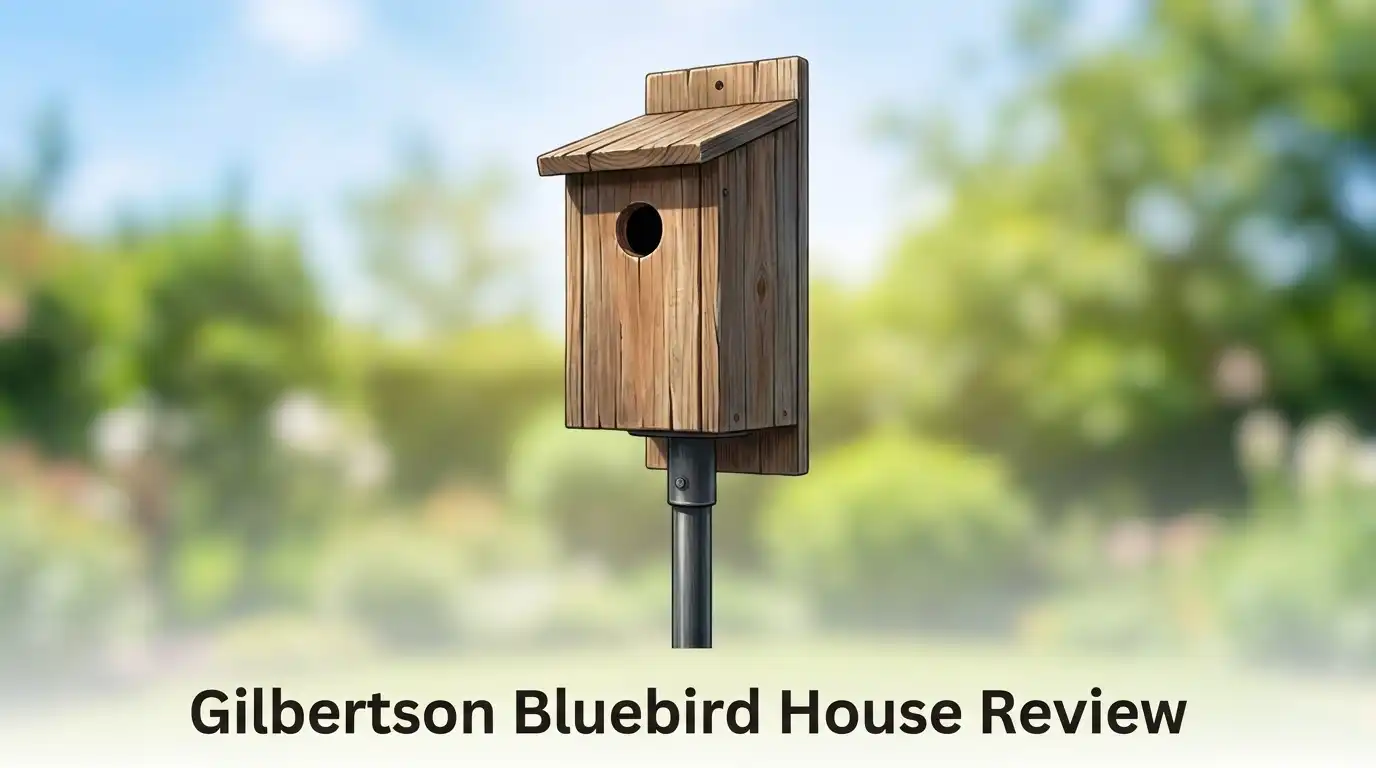
The body is thin wall 4 inch PVC sewer and drain pipe, painted brown inside and mottled outside to read as birch bark. Walls measure barely more than 1/16 inch.
The entrance is a clean 1.5 inch round hole, correct for Eastern bluebirds and small enough to exclude starlings.
Depth from the bottom of the hole to the floor runs about 4.5 to 4 5/8 inches. That number is the entire design. Gilbertson tested depths until sparrows quit and bluebirds stayed.
Overall the box stands roughly 8 inches tall and 4.5 inches wide. The roof measures about 9 by 7.25 inches, giving a deep overhang plus a circular drip edge.
Inside you get a recessed wooden base with one drain hole, toe holds under the entrance so fledglings can climb out, and two half moon vents at the rear.
It carries NABS approval, and it mounts on your own half inch conduit through a hole in the roof overhang.
Unboxing, Texture and First Impressions
The package is small enough that you will assume something is missing. It arrives as two pieces: a painted tube and a roof.
Pick up the tube and the first reaction is it feels like plumbing, because it is. The PVC has a slight satin grain from the paint rather than a glossy finish.
The birch effect is convincing from ten feet away. Up close it reads as brown stain flicked over white plastic, which is exactly what it is.
There is no chemical smell after the first day outdoors. New boxes carry a faint solvent note from the exterior stain that fades within a week.
Squeezing the body for the first time is the moment that sells the design. The tube flexes, the pins clear their holes, and the cavity slides free with almost no force.
The cedar roof is the only part that feels like furniture. It is solid, sanded, and heavier than the entire tube beneath it.
No pole, no rebar, no hardware. Plan on a hardware store trip the same day.
Top 3 Alternative for Gilbertson Bluebird House
If the small cavity or the awkward nest checks rule this one out, these three are the boxes most bluebird landlords buy instead.

Last update on 2026-08-27 / Affiliate links / Images from Amazon Product Advertising API Some of the links on this website are affiliate links, which means that at no additional cost to you, I earn a commission if you click through and make a purchase. I only recommend products and services that I believe will add value to my readers. Thank you for your support!
Nature’s Way Bird Products CWH3 Cedar Bluebird Box House

Last update on 2026-08-02 / Affiliate links / Images from Amazon Product Advertising API Some of the links on this website are affiliate links, which means that at no additional cost to you, I earn a commission if you click through and make a purchase. I only recommend products and services that I believe will add value to my readers. Thank you for your support!
Woodlink NABB Audubon Cedar Bluebird House

Last update on 2026-07-11 / Affiliate links / Images from Amazon Product Advertising API Some of the links on this website are affiliate links, which means that at no additional cost to you, I earn a commission if you click through and make a purchase. I only recommend products and services that I believe will add value to my readers. Thank you for your support!
Kingsyard Recycled Poly Lumber Bluebird House
Each of these gives you a larger interior, a side or front opening door, and easier blow fly removal. None of them resist house sparrows the way the Gilbertson does.
That is the trade you are making. Comfort of monitoring on one side, sparrow deterrence on the other.
Buyers in areas with heavy house sparrow pressure should stay with the PVC design. Buyers who mainly want an easy, attractive box for a quiet suburban yard will be happier with cedar.
Cedar Roof Version Worth the Upgrade

Last update on 2026-08-02 / Affiliate links / Images from Amazon Product Advertising API Some of the links on this website are affiliate links, which means that at no additional cost to you, I earn a commission if you click through and make a purchase. I only recommend products and services that I believe will add value to my readers. Thank you for your support!
Sellers offer the same body under either a western red cedar roof or a recycled poly lumber roof. The price gap is usually a few dollars.
Cedar looks better. It weathers to silver, it feels substantial, and it is what Gilbertson specified at roughly 7/8 inch thick.
Poly wins on maintenance. It will not check, split, or need a coat of sealer in year four, and it shrugs off hail and freeze cycles without complaint.
My honest observation after handling both: the cedar roof is the better shade provider because the wood stays cooler in direct sun than dark poly does.
If your box sits in full afternoon sun, take cedar and add a coat of clear sealer to the top surface.
If your box sits on an exposed prairie fence line and you want to ignore it for a decade, take poly.
Neither version changes how the birds behave. This is a decision about your maintenance patience, not about occupancy.
Does It Really Stop House Sparrows
Mostly yes, and the reason is physical rather than clever.
House sparrows build a deep, messy nest with a tunnel leading to the cup. They need volume. A 4 inch tube with only 4.5 inches of depth does not give them that volume, so they inspect it and move on.
Bluebirds Across Nebraska and several state societies push this box specifically for that reason, and retailers report it as their most sparrow-resistant model.
Now the honest caveat. Sparrow resistance is not sparrow immunity.
Experienced monitors report sparrows entering, claiming, and occasionally attacking birds inside any box that suits bluebirds. On some trails the deterrent effect is close to total. On others it only reduces the pressure.
The box also has real appeal beyond bluebirds. Chickadees, tree swallows and house wrens use it readily, and chickadees seem to like the tight cavity.
Treat it as a strong tool, not a guarantee. You still need to monitor.
Mounting on Conduit and Rebar
This is where the design earns its reputation, and where most first-time buyers get stuck.
Nothing is included. You supply half inch electrical conduit, which costs a few dollars at any hardware store.
Method one: drive a 7 to 8 foot length of conduit about 18 to 24 inches into the ground and slide the roof hole over the top.
Method two, which Gilbertson preferred: drive a 4 or 5 foot piece of half inch rebar partway in, then slide a 5 foot conduit over it and clamp the two together.
The rebar version is easier to install, easier to move, and easier to pull for winter storage.
Then do the step everyone skips. Rub the conduit with coarse steel wool and wax it. A smooth, slick pole is a serious barrier to raccoons, cats and snakes.
One practical annoyance: a lightweight box on a smooth pole can spin in wind. A wrap of duct tape at the contact point fixes it in about thirty seconds.
Nest Checks and Monitoring in Practice
The pitch is that you squeeze, lower the tube, and see the whole nest at chest height. That part is true and it is wonderful with kids present.
The reality is more awkward. Use both hands. Monitors who use one hand eventually drop a tube full of eggs, and that story comes up often enough to take seriously.
Seeing the nest is easy. Working on the nest is not.
Checking for blow fly larvae under the nest cup means lifting the entire nest out of a narrow tube. Doing a nest change is harder still, and removing a dead nestling from the bottom is genuinely unpleasant work.
You also cannot fit a Van Ert style in-box trap. A universal trap that hangs on the entrance hole is the workaround.
Mounting a nest cam is close to impossible in the curved cavity. Many owners solve monitoring with a cheap wifi endoscope instead, which gives a five second peek with almost no disturbance.
Heat, Rain and Ventilation Reality
Rain performance is the strongest part of this box. The wide overhang, the circular drip edge and the recessed floor keep driven water out better than most wooden boxes I have handled.
The single drain hole works, but check it. Grass stems and debris block it, and a plugged drain turns the floor into a shallow bowl.
Ventilation comes from two small half moon vents at the rear. That is modest, which suits northern trails and is less generous than boxes built for the South.
Heat is the genuine concern. Those 1/16 inch PVC walls hold less thermal mass than three quarter inch pine, so the interior tracks the outside temperature quickly.
In Minnesota or Wisconsin this is a non-issue. In Texas or Arizona sun, a small plastic cavity can climb fast.
The fix is placement, not hardware. Put the box where it gets afternoon shade, and face the entrance away from the prevailing wind and away from west sun.
Who This Nest Box Is Not For
Skip this one if you host Western or Mountain bluebirds. The cavity is small, and larger western birds are better served by a 5 by 5 inch floor.
Skip it if nest changes matter to you. Anyone running a trail in a blow fly heavy region will fight this design every season.
Skip it if you want a nest cam. There is no clean way to mount one.
Skip it if you live somewhere with brutal, shadeless summer heat and no good placement option.
Skip it if you want a decorative garden piece. This looks like painted pipe on a metal rod, because that is what it is.
Also be aware there is no commercially available metal hole guard sized for it, so squirrel or woodpecker chewing at the entrance is harder to prevent than on a wooden box.
Finally, some monitors simply report slower adoption of PVC boxes than wood on the same trail. Birds have opinions.
Pros and Cons
Pros
- The best commercially available house sparrow deterrence, driven by cavity size rather than gimmicks.
- Extremely light at around 1.5 to 2.5 pounds, so cheap conduit is enough support.
- Recessed floor, drip edge and generous overhang keep the interior dry in driven rain.
- PVC will not rot, split, warp or need repainting for many seasons.
- Smooth surfaces give predators nothing to grip.
- Nest viewing at eye level is excellent for children and field trips.
- No visible screws, which frustrates casual vandals.
- Inexpensive, usually in the mid thirties, and NABS approved.
Cons
- Small interior that some monitors find too tight, and likely unsuitable for Western bluebirds.
- Blow fly checks and nest changes are difficult and messy.
- Removing a dead nestling from the tube is awkward.
- The box can be dropped if handled with one hand.
- Thin walls offer less heat buffering than wood in hot climates.
- No nest cam mounting and no Van Ert trap compatibility.
- Pole, rebar and clamp are all sold separately.
- Can spin on a smooth pole without a tape shim.
Price and Value in 2026
Current pricing sits around $34 to $36 from bluebird specialty retailers, with Amazon listings from DutchCrafters typically running higher for the pole mount versions.
Add roughly $8 to $15 for conduit, rebar and a clamp. Budget about $50 total for a complete, properly mounted setup.
Against a $30 cedar box from a big box store, this is not a price win on paper. It is a value win on outcomes.
A cheap cedar box that a sparrow claims in April produces zero bluebirds. This box gives you a real chance at multiple broods, which is the only metric that counts.
Longevity helps the math. PVC does not rot, and a cedar roof sealed once every few years will outlast several wooden boxes.
My rating is 8 out of 10. It loses points purely on monitoring ergonomics, not on results.
If sparrows have beaten you two seasons running, buy it. If you have never seen a sparrow in your yard, buy a wooden box you enjoy opening.
Frequently Asked Questions
Is the Gilbertson box actually sparrow proof?
No box is sparrow proof. It is strongly sparrow resistant because the shallow, narrow cavity denies sparrows the nest volume they want. Most owners see a large drop in sparrow claims, but determined birds occasionally still enter, so monitoring stays necessary.
How high should I mount it?
Roughly 5 to 6 feet to the entrance hole, on a waxed half inch conduit pole. That height keeps nest checks comfortable and puts the cavity above easy reach for most ground predators.
Will bluebirds actually use a plastic box?
Yes. Eastern bluebirds, chickadees and tree swallows all nest in it regularly, and six egg clutches are common. Some monitors do report slower first year adoption compared with wooden boxes on the same trail, so give it a full season before judging.
Do I need to paint or seal it?
The body arrives finished. Gilbertson insisted on brown oil based exterior stain rather than latex, which peels. If you build your own, never leave white PVC unpainted. A cedar roof benefits from a clear sealer every few years.
How do I clean it out?
Squeeze the sides with both hands, slide the tube off the pins, and tip the old nest out. Rinse the interior, clear the drain hole, and let it dry before reattaching. Do this after each brood fledges.
Can I hang it from a tree instead?
You can, but do not. Hanging boxes swing, and tree mounting gives raccoons and snakes a direct route to the nest. A free standing waxed pole is the whole point of the Gilbertson system.
Is it suitable for hot southern climates?
With caution. The thin PVC walls hold less heat buffer than wood, so place it where it gets afternoon shade and choose the cedar roof for better shading.

Hello, I’m Emily Price, the founder of Birds Affection. As a passionate bird enthusiast and spiritual seeker, I’ve always been fascinated by the symbolic meanings and mystical connections between birds and our lives. On this website, I share my knowledge and insights on the spiritual significance of various bird species, exploring their roles as messengers, guides, and teachers. Through my writing, I aim to inspire and educate others on the profound wisdom and beauty that birds bring to our world. Join me on this journey as we delve into the enchanting realm of bird symbolism and discover the hidden meanings behind these magnificent creatures.