MEWANG Nature’s Elegance Bird Feeder Review 2026: Worth Buying?
Bird feeders sell on looks. Most buyers pick one because it matches the garden, then hope the birds agree. The MEWANG Nature’s Elegance Bird Feeder leans hard into that instinct.
It is a small wooden cottage with a pitched roof, a jute hanging rope, and a price tag under thirty dollars. Amazon shows it as an Amazon’s Choice pick with a 4.6 star rating across more than 900 ratings, which is a strong signal for a budget decorative feeder.
But charm and function are two different things. A feeder can look perfect on a branch and still soak seed in the rain, host squirrels all afternoon, or fall apart by the second winter.
In a Nutshell:
- Price and value: The feeder sells for around $24.99, marked down from a $35.99 list price. That is fair money for a solid wood decorative feeder, though you are paying partly for the looks, not for engineering.
- Size reality check: Dimensions run roughly 7.3 x 7.3 x 9.7 inches. This is a small feeder. It holds a modest scoop of seed, not a multi day supply, so plan on refilling every two or three days during busy season.
- Zero assembly: It arrives fully built with the jute rope already attached. You hang it and fill it in under two minutes, which makes it a genuinely easy gift for a beginner birder.
- Bird traffic: Small perching birds take to it fastest. Chickadees, finches, titmice, nuthatches, and juncos all use it. Larger birds like cardinals and jays struggle with the tight opening, which is a real limitation.
- Weakness to know: Weather protection is average. The painted wood handles sun and light rain fine, but prolonged wet weather can dampen seed and fade the finish. It is a decorative feeder first, a working feeder second.
- Best fit: Gardeners, gift buyers, apartment balcony birders, and anyone who wants a pretty feeder near a window. Serious bird feeders who want capacity and squirrel defense should look elsewhere.
What Is the MEWANG Nature’s Elegance Bird Feeder?

Last update on 2026-08-29 / Affiliate links / Images from Amazon Product Advertising API Some of the links on this website are affiliate links, which means that at no additional cost to you, I earn a commission if you click through and make a purchase. I only recommend products and services that I believe will add value to my readers. Thank you for your support!
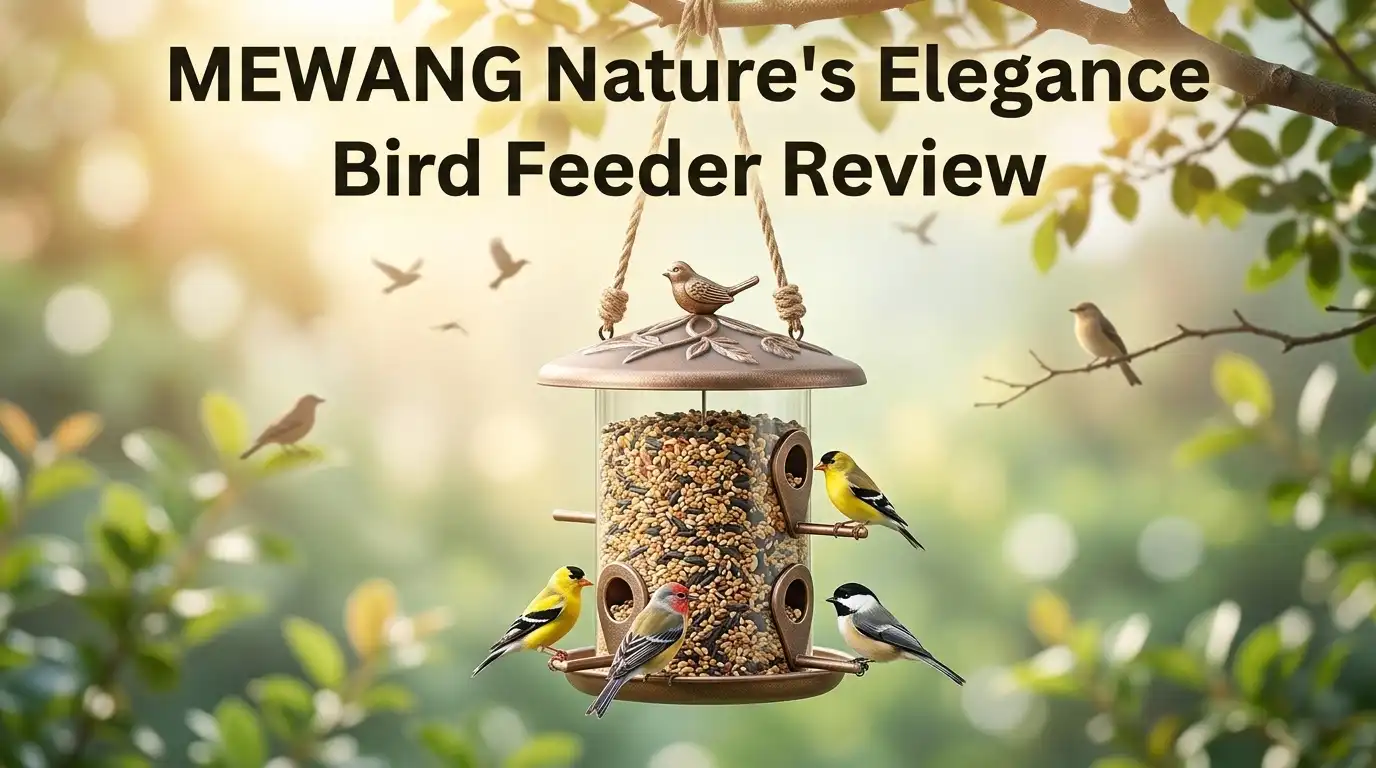
The MEWANG Nature’s Elegance Bird Feeder is a hanging wooden birdhouse style feeder built for backyard use. MEWANG is a small business seller on Amazon that specializes in decorative wooden garden pieces, and this model sits near the top of their catalog. The company markets it as both a feeder and a garden ornament, which tells you exactly where the priorities sit.
The structure is simple. A square wooden base forms the seed tray. Four short walls rise from that base with open sides that let birds land and feed. A pitched roof caps the whole thing and shelters the seed underneath. A jute rope loops through the roof peak for hanging.
The vintage cottage styling is the main selling point. The white version has a washed, slightly distressed paint finish that reads as farmhouse or cottage core. MEWANG also sells light yellow, red, and green versions of the same body, so you can match a fence, a porch, or a garden theme.
The listed dimensions are 7.3 inches wide by 7.3 inches deep by 9.7 inches tall, with Amazon’s spec table showing a slightly different 7.6 x 9.99 x 7.6 measurement depending on how the roof overhang is counted. Either way, this is a compact piece. It weighs almost nothing empty.
No assembly is required. That single detail separates it from a large chunk of the wooden feeder market, where you often get a flat pack of panels and a bag of screws. This one comes ready to hang.
Unboxing Experience: What Arrives at Your Door
The box is small and plain. Mine showed up in a brown Amazon mailer roughly a foot square, light enough that I checked the label twice to be sure something was inside.
Inside the outer box sits a fitted cardboard sleeve with molded corner protection. The feeder itself is wrapped in a thin plastic sheet and cushioned with foam sheeting at the roof edges, which are the most fragile part. My unit arrived without a single chip or crack, and that matches most of the feedback I read from other buyers. MEWANG clearly knows painted wood corners are the vulnerable point.
Lift it out and the first impression is lightness. The feeder feels almost like balsa in the hand, though it is a firmer wood than that. The weight is low enough that a strong gust will swing it noticeably, something to keep in mind when you choose a spot.
The paint finish is the second thing you notice. It is not a flawless factory coat. There are brush texture marks, small tonal variations, and slightly uneven distressing around the edges. Some buyers read that as handmade charm. Others read it as sloppy. I fall into the charm camp, but I understand the complaint.
The jute rope comes pre threaded and pre knotted at the roof. It measures long enough for a normal branch hang without extra hardware.
There is no instruction sheet, no seed sample, and no mounting hardware for pole or wall installation. Hanging is the only supported setup method. For a two minute product, the lack of paperwork is not a real problem.
Design and Build Quality: Honest Assessment
The wood feels like a lightweight softwood, likely fir or a similar plantation timber, rather than the cedar used by premium brands. Cedar naturally resists rot and insects. This wood relies entirely on its paint coat for protection, and that difference matters over multiple seasons.
Joinery is a mix of glue and small nails or staples. I could see the fastener heads on close inspection under the roof line. Nothing was loose out of the box, and nothing has worked free with normal handling. But this is not heirloom furniture construction. A hard fall from height would likely split a joint.
The roof overhang is the smartest part of the design. It extends past the walls on all four sides, which keeps direct rainfall off the seed tray and gives feeding birds a little shade. The pitch is steep enough to shed water rather than pool it.
The open side walls create easy access from any direction. Birds do not need to squeeze through a hole, which many decorative birdhouse feeders get wrong. This one gets the access geometry mostly right for small species.
Drainage is where the design falls short. The tray floor is flat with no drilled drain holes. Water that blows in sideways sits there. I drilled four small holes in the base myself with a 3mm bit, which took two minutes and fixed the issue completely. It is a shame the factory does not do this.
The paint appears to be a water based finish. It does not smell chemical, which suggests it is bird safe, but MEWANG does not publish a specific coating certification.
Top 3 Alternatives for MEWANG Nature’s Elegance Bird Feeder

Last update on 2026-08-29 / Affiliate links / Images from Amazon Product Advertising API Some of the links on this website are affiliate links, which means that at no additional cost to you, I earn a commission if you click through and make a purchase. I only recommend products and services that I believe will add value to my readers. Thank you for your support!
Kingsyard Wild Bird Feeder for Outdoors Hanging, All Metal

Last update on 2026-08-27 / Affiliate links / Images from Amazon Product Advertising API Some of the links on this website are affiliate links, which means that at no additional cost to you, I earn a commission if you click through and make a purchase. I only recommend products and services that I believe will add value to my readers. Thank you for your support!
Solution4Patio US Cedar Hopper Bird Feeder for Outdoors Hanging


Last update on 2026-10-12 / Affiliate links / Images from Amazon Product Advertising API Some of the links on this website are affiliate links, which means that at no additional cost to you, I earn a commission if you click through and make a purchase. I only recommend products and services that I believe will add value to my readers. Thank you for your support!
Perky Pet Squirrel Be Gone II Country Style Bird Feeder
Seed Capacity and Refill Frequency
Capacity is the number MEWANG does not advertise, and there is a reason for that. The tray holds roughly one to one and a half cups of seed, or about half a pound depending on the seed type. Sunflower hearts pack denser than a light mixed blend.
For comparison, a standard tube feeder holds two to three pounds. A hopper feeder can hold six or more. This feeder holds a fraction of that.
What does that mean day to day? In a quiet yard with light traffic, one fill lasts three to four days. In an active yard during autumn or a cold snap, one fill can disappear in a single afternoon. I emptied mine in under six hours once when a chickadee flock found it.
Refilling is easy at least. You lift the feeder off the hook, tip seed in through the open side, and rehang it. No latches, no removable roof, no fiddly panels. That simplicity is genuinely pleasant compared to feeders that require unscrewing a lid every time.
There is a practical upside to small capacity. Seed does not sit long enough to go stale or mouldy. High turnover keeps the food fresh, which is better for bird health than a giant hopper that slowly ferments in humid weather.
The downside is obvious. If you travel, or if you want a feeder you top up once a week, this is the wrong product. Consider buying two and hanging them a few feet apart to double your effective capacity.
Which Birds Actually Visit This Feeder?
Small perching birds dominate. Within four days of hanging mine with black oil sunflower seed, I logged black capped chickadees, house finches, goldfinches, tufted titmice, and white breasted nuthatches.
Chickadees adapted fastest. They grab a seed, fly to a branch, crack it, and return, which is their normal pattern and it suits this feeder perfectly. Finches settle in and eat on the tray for longer stretches.
Juncos and sparrows arrived a week later, mostly to feed on spillage below the feeder rather than on the tray itself. Ground feeding species treat this as a seed dispenser more than a dining table.
Cardinals are the frustrating case. They came, they looked, and they mostly gave up. The open side height is too low for a cardinal to sit comfortably upright, and the tray is too small for their preferred sideways perch and shuffle feeding style. A few managed awkward visits. Most moved to my platform feeder instead.
Blue jays and grackles could not use it meaningfully, which some people will count as a feature rather than a fault.
Hummingbirds do not use this feeder at all. Despite MEWANG mentioning hummingbirds in listings for related models, this is a dry seed feeder with no nectar reservoir. Hummingbirds need a separate nectar feeder.
Seed choice matters. Black oil sunflower and sunflower hearts pull the widest crowd. Nyjer falls through gaps. Cheap mixes with red milo get kicked out and wasted.
Setting It Up in Your Yard
Last update on 2026-08-29 / Affiliate links / Images from Amazon Product Advertising API Some of the links on this website are affiliate links, which means that at no additional cost to you, I earn a commission if you click through and make a purchase. I only recommend products and services that I believe will add value to my readers. Thank you for your support!
Setup takes about ninety seconds. Untie or adjust the jute rope, loop it over a branch or hook, and pour in seed.
Placement determines everything about your results. Hang the feeder between six and eight feet off the ground. That height keeps it out of easy cat reach while staying accessible for refills without a ladder.
Distance from cover is the second rule. Birds want an escape route within about ten feet, so a shrub or small tree nearby increases visits significantly. Position it too far into open lawn and shy species will avoid it entirely.
Window distance follows a strange but well documented rule. Place the feeder either within three feet of a window or more than thirty feet away. The middle distance is where fatal window strikes happen most, because birds build up enough speed to injure themselves.
Wind exposure needs thought because this feeder is light. A spot with side shelter from a wall, fence, or dense hedge keeps it from spinning and dumping seed. I lost a full tray to a windy afternoon before I moved mine.
The jute rope is the weak link long term. Jute rots after roughly one wet season. I replaced mine with a length of coated wire and a small S hook after four months, which costs almost nothing and removes the failure risk entirely.
Give birds two weeks to discover a new feeder. Empty visits in week one are normal.
Weather Resistance After Real Outdoor Use
The pitched roof does its job in normal rainfall. Water runs off the slope and clears the tray thanks to the overhang. Light rain caused no seed problems in my testing.
Heavy driving rain is a different story. Wind blown rain enters through the open sides and wets the seed directly. With no factory drain holes, that water sits in the tray. Wet seed clumps within hours and grows mould within a day or two in warm weather. Drilling drain holes fixes most of this, but it does not stop the seed itself from getting soaked.
Sun exposure fades the paint. After a full summer in direct light, the white finish shifted slightly and lost some of its crispness. It is subtle rather than ugly, but it happens.
Winter performance was better than expected. Cold and dry conditions suit painted wood well. Snow slid off the roof pitch without building up. Freeze and thaw cycles are the real long term enemy, because moisture that soaks into unsealed wood expands as it freezes and slowly opens joints.
Longevity estimate based on the materials and construction: two to three seasons outdoors untreated, longer if you apply a coat of exterior clear sealant to the roof and exterior walls before first use. Never seal the interior tray where seed and birds make contact.
Bringing it under a porch eave or into a shed during the harshest months roughly doubles the expected lifespan.
Cleaning and Maintenance Routine
Feeder hygiene prevents disease transmission between birds, and it is the maintenance task most owners skip. Salmonella and avian conjunctivitis spread through contaminated feeders.
Clean this feeder every two weeks during heavy use, or weekly in hot and humid weather. The open design makes that easier than most enclosed feeders.
The routine is simple. Empty leftover seed into the bin, never back into the seed bag. Brush out husks and debris with a stiff dry brush. Wipe the tray with a cloth dampened in a weak solution of one part white vinegar to nine parts water. Vinegar is safer on painted wood than bleach, which can strip the finish and leave residue.
Rinse lightly with clean water and dry the feeder completely before refilling. Wood absorbs moisture, so leaving it damp defeats the entire purpose.
Never soak this feeder or run it under a hose. Submersion swells the wood, softens the glue joints, and lifts the paint. That is the fastest way to destroy it.
Check the jute rope monthly for fraying. Check the joints for movement. Tighten or reglue anything loose immediately rather than waiting for it to fail.
An annual coat of bird safe exterior sealant on the outside surfaces keeps the finish looking fresh and adds real durability. Do this at the end of the season when the feeder is empty and fully dry.
What This Feeder Does Not Do Well
Every honest review needs this section. Here are the genuine failures.
It offers no squirrel protection whatsoever. There is no baffle, no weight activated mechanism, no cage. A determined squirrel will empty this feeder in one sitting and may chew the wood. If squirrels are a problem in your yard, this feeder will frustrate you daily.
Capacity is genuinely small. Half a pound of seed is not much. Owners with busy yards will feel like they are constantly refilling.
The tray does not drain from the factory. This is a design oversight, not a quibble. Wet seed becomes mouldy seed, and mouldy seed makes birds sick.
Large birds are excluded. Cardinals, jays, doves, and woodpeckers cannot use it comfortably. If cardinals are your target species, buy a hopper or platform feeder instead.
The wood is not cedar. Rot resistance depends entirely on paint, and paint eventually fails outdoors.
It cannot be pole mounted. No mounting bracket, no threaded socket, no hardware. Hanging is the only option.
Paint quality varies between units. Some arrive with clean finishes. Others have visible drips or thin coverage.
It is not a birdhouse. Despite the birdhouse styling and the product name mentioning a house, there is no enclosed nesting cavity. Birds will not nest inside it.
Pros and Cons
Pros
- Attractive vintage cottage design that works as garden decor even when empty, available in white, light yellow, red, and green.
- Zero assembly required, arriving fully built with the hanging rope already attached.
- Excellent gift product thanks to the presentation, the low price, and the instant setup.
- Open sided access that small birds find easy to use, with no awkward entry hole to negotiate.
- Effective roof overhang that keeps direct rainfall off the seed tray.
- Simple refilling with no lids, latches, or removable panels to fight with.
- High seed turnover means food stays fresh rather than sitting and spoiling.
- Strong customer rating at 4.6 stars from more than 900 buyers, plus Amazon’s Choice status.
- Small business purchase, which some buyers value.
Cons
- No squirrel deterrence at all, making it unsuitable for squirrel heavy yards.
- Very small capacity of roughly half a pound, requiring frequent refills.
- No factory drain holes, allowing water to pool in the tray during driving rain.
- Too small for cardinals, jays, doves, and woodpeckers.
- Softwood construction rather than cedar, limiting natural rot resistance.
- Jute rope degrades within about one wet season and needs replacing.
- Paint fades under sustained direct sun exposure.
- No pole or wall mounting option whatsoever.
- Inconsistent paint finish reported across units.
- Not a nesting box, despite the birdhouse appearance.
Price and Value in 2026
At $24.99 against a $35.99 list price, this feeder occupies the low middle of the market. Basic plastic tube feeders start near ten dollars. Quality cedar hopper feeders run forty to seventy dollars. Squirrel proof metal feeders with weight mechanisms usually cost thirty five to sixty. Smart camera feeders sit well above one hundred and fifty.
So where does the value sit? You are paying for appearance and convenience, not for capacity or durability. Judged as a working feeder, twenty five dollars is a slight premium for half a pound of capacity and softwood construction. Judged as garden decor that also feeds birds, it is good value, because a purely decorative garden ornament of similar size and finish often costs the same or more.
The gift angle is where the value case is strongest. It looks considered, it needs no setup, it arrives well protected, and the recipient gets results in the first week. Few twenty five dollar gifts land that reliably.
The discount appears frequently. Amazon has shown the 31 percent reduction repeatedly rather than as a one off event, so waiting for a deeper cut is probably not worthwhile. Twenty five dollars looks like the real everyday price.
One more consideration. Buying two costs fifty dollars and solves the capacity problem while spreading bird traffic and reducing squabbling. That is a better use of fifty dollars than one large feeder if aesthetics matter to you.
Who Should Buy This Feeder
Buy it if you want a feeder that looks good. That is the honest primary use case. If the feeder is going somewhere visible, near a patio, a kitchen window, a front porch, or a small garden, the cottage styling earns its keep every day.
Buy it as a gift. For a new birder, a gardener, a grandparent, or a housewarming, it hits the right notes. It needs no tools, no research, and no learning curve.
Buy it for a balcony or small space. The compact size suits apartment railings, small courtyards, and tight urban gardens where a full hopper feeder would dominate.
Buy it if you enjoy small birds. Chickadees, finches, titmice, and nuthatches will reward you consistently.
Skip it if squirrels rule your yard. You will lose seed daily and the wood will take damage.
Skip it if you want cardinals. The geometry simply does not work for them.
Skip it if you refuse to refill often. This is a two or three day feeder, not a weekly one.
Skip it if you need a feeder that survives ten years. Cedar or metal is the answer there, and the price reflects that.
Skip it if you wanted a nesting box. Buy an actual birdhouse with an enclosed cavity and a correctly sized entrance hole.
Final Verdict
The MEWANG Nature’s Elegance Bird Feeder does what it promises, provided you read the promise correctly. It is a decorative wooden feeder that attracts small birds, arrives ready to hang, and looks lovely in a garden. It is not a high capacity feeder, not a squirrel resistant feeder, and not a multi year outdoor investment.
Judged against those honest boundaries, it earns a solid recommendation. The 4.6 star rating from over 900 buyers reflects genuine satisfaction, and my experience matched it. Chickadees found it within days. The roof kept normal rain off the seed. Refilling stayed effortless. The design still looks good hanging in the garden months later.
The flaws are real and worth repeating. Missing drain holes are a genuine oversight that takes two minutes to fix yourself. The half pound capacity will annoy anyone with busy bird traffic. Squirrels have a free run at it. Cardinals cannot use it properly.
My score: 7.5 out of 10. The point deductions come from capacity, drainage, and the softwood build rather than from anything about the concept or the appearance.
Would I buy it again? Yes, as a gift without hesitation, and yes for a visible spot in my own garden. Would I make it my only feeder? No. Pair it with a larger hopper or platform feeder and it becomes the charming supporting piece it was always meant to be.
Frequently Asked Questions
How much seed does the MEWANG Nature’s Elegance Bird Feeder hold?
It holds roughly one to one and a half cups, or about half a pound of seed depending on density. Sunflower hearts pack heavier than a light mixed blend. In a busy yard, expect to refill every two to three days.
Is this feeder squirrel proof?
No. It has no baffle, no cage, and no weight activated mechanism. Squirrels can reach it easily and will empty it quickly. Adding a separate pole baffle or a hanging dome baffle above the feeder helps, but the feeder itself offers no defense.
Can birds nest inside it?
No. Despite the birdhouse appearance, there is no enclosed cavity and no entrance hole. The open sides make it a feeder only. Buy a purpose built nesting box if you want birds to raise young.
What is the best seed to use in it?
Black oil sunflower seed attracts the widest range of species and works well in this tray. Sunflower hearts also perform well and reduce shell mess below. Avoid nyjer, which falls through gaps, and avoid cheap mixes heavy in red milo, which birds discard.
Will cardinals use this feeder?
Rarely and awkwardly. The tray is small and the side openings are low, so cardinals cannot perch comfortably. A platform or hopper feeder suits them much better.
How long does the feeder last outdoors?
Expect two to three seasons of outdoor use untreated. Applying a coat of exterior clear sealant to the outer surfaces before first use, and bringing it under shelter during the harshest weather, can extend that considerably.
How do I clean it safely?
Empty the old seed, brush out debris, then wipe surfaces with a cloth dampened in one part white vinegar to nine parts water. Dry it fully before refilling. Never soak the feeder or spray it with a hose, as water swells the wood and lifts the paint.
Does it come assembled?
Yes. It arrives fully built with the jute hanging rope already attached. No tools or assembly steps are required.
Can it be mounted on a pole?
No. There is no mounting bracket, threaded socket, or hardware included. Hanging from a branch or hook is the only supported method.
What colors are available?
MEWANG offers white, light yellow, red, and green versions of the same body. The white version is the most popular and the one most commonly shown in listings.

Hello, I’m Emily Price, the founder of Birds Affection. As a passionate bird enthusiast and spiritual seeker, I’ve always been fascinated by the symbolic meanings and mystical connections between birds and our lives. On this website, I share my knowledge and insights on the spiritual significance of various bird species, exploring their roles as messengers, guides, and teachers. Through my writing, I aim to inspire and educate others on the profound wisdom and beauty that birds bring to our world. Join me on this journey as we delve into the enchanting realm of bird symbolism and discover the hidden meanings behind these magnificent creatures.