WingHome Bird Feeder with Camera Review 2026: Worth Buying?
You love birds. You hear them singing every morning from your kitchen window. But you never actually see them up close. Standard binoculars are clunky. Standing still outside for hours is impractical. And your phone camera zooms into a blurry mess from ten feet away.
The WingHome Bird Feeder with Camera promises to solve this exact frustration. It combines a professional-grade 4K camera with a 32-megapixel sensor, AI-powered species identification, and real-time smartphone alerts. The idea is simple: mount it, fill it with seed, and let the camera do the watching for you.
I spent several weeks testing this feeder in a suburban backyard to see if the reality matches the marketing. Here is my full, honest breakdown.
In a Nutshell
- Camera Quality: The 32MP sensor and 4K video resolution produce sharp, detailed footage of every bird visit. Feather textures, beak markings, and color gradients come through clearly even when zoomed.
- AI Bird Recognition: The built-in AI claims to identify over 10,000 bird species automatically. It timestamps each visit and logs species data, building a digital birding journal on your behalf.
- Dual-Band WiFi: Supports both 5GHz and 2.4GHz WiFi, giving faster data transfer and more stable connections through the Hibird App for live streaming and instant alerts.
- Weatherproof Build: Rated IP66, meaning it handles rain, snow, and direct sun without housing damage. The PVC shell is solid and practical for year-round outdoor use.
- Battery Life: The 10,000mAh rechargeable battery lasts up to two weeks under normal bird traffic. No solar panel is included, which means manual recharging is required.
- Feeder Capacity: A 1.5L transparent seed tray with a spill-proof design holds enough seed for multiple days and attracts a wide range of species.

Last update on 2026-07-11 / Affiliate links / Images from Amazon Product Advertising API Some of the links on this website are affiliate links, which means that at no additional cost to you, I earn a commission if you click through and make a purchase. I only recommend products and services that I believe will add value to my readers. Thank you for your support!
Key Specifications and Technical Breakdown
Understanding the specs helps you compare this feeder against competitors quickly.
The WingHome shoots 4K Ultra HD video and captures 32-megapixel still photos. That resolution puts it ahead of many popular alternatives like the Bird Buddy (5MP/1080p) and the original Netvue Birdfy (1080p). It uses a PIR motion sensor inherited from WingHome’s trail camera technology, with a trigger speed as fast as 0.4 seconds.
WiFi connectivity operates on dual-band 5GHz and 2.4GHz frequencies. The 5GHz band delivers faster streaming with less interference. The unit weighs in at a manageable size, built from PVC material with an IP66 weatherproof rating. Two-way audio lets you listen to bird sounds and even broadcast through the feeder’s speaker.
The battery is a 10,000mAh internal cell. WingHome does not include a solar panel in the box. You charge it via USB and reinstall. That is a notable gap compared to solar-equipped competitors.
Unboxing and First Impressions
The WingHome arrives in a compact, sturdy box with minimal packaging waste.
Inside, you find the feeder unit, a USB charging cable, a mounting bracket, a quick-start guide, and a small bag of screws. The feeder body feels dense and well-constructed. The PVC housing has a matte finish that does not look cheap or flimsy.
The transparent 1.5L seed tray clicks into place securely. It is easy to remove, fill, and reattach without tools. The camera lens sits recessed inside the unit, protected from rain and direct pecking. There is no glass protruding outward, which is a smart design choice for durability.
First impressions are positive. The unit looks like a serious outdoor device, not a toy. Setup through the Hibird App took about eight minutes, including WiFi pairing and firmware updates.
Top 3 Alternatives for WingHome Bird Feeder with Camera
1. Bird Buddy Smart Bird Feeder

Last update on 2026-08-28 / Affiliate links / Images from Amazon Product Advertising API Some of the links on this website are affiliate links, which means that at no additional cost to you, I earn a commission if you click through and make a purchase. I only recommend products and services that I believe will add value to my readers. Thank you for your support!
2. Netvue Birdfy Smart Bird Feeder with Camera


Last update on 2026-10-12 / Affiliate links / Images from Amazon Product Advertising API Some of the links on this website are affiliate links, which means that at no additional cost to you, I earn a commission if you click through and make a purchase. I only recommend products and services that I believe will add value to my readers. Thank you for your support!
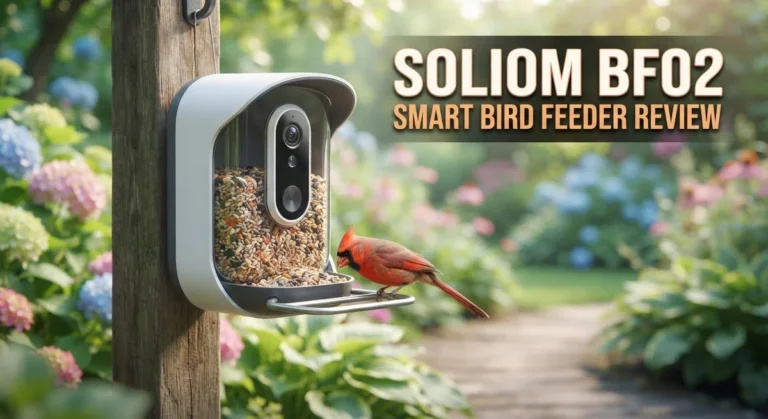
3. SOLIOM Smart Bird Feeder with Camera

Last update on 2026-08-28 / Affiliate links / Images from Amazon Product Advertising API Some of the links on this website are affiliate links, which means that at no additional cost to you, I earn a commission if you click through and make a purchase. I only recommend products and services that I believe will add value to my readers. Thank you for your support!
Camera and Video Quality in Real Use
The 4K video from the WingHome is genuinely impressive for a bird feeder camera.
Colors are accurate and vibrant. Blue jay feathers appear in rich, saturated blues. Cardinal reds look natural, not oversaturated. The 32MP still photos capture fine details like the barring on a downy woodpecker’s tail feathers and the tiny seeds in a finch’s beak.
Low-light performance is decent but not outstanding. At dawn and dusk, footage remains usable but loses some sharpness. Night vision switches to infrared black-and-white mode, which is functional but not color-accurate. If full-color night vision matters to you, look at the isYoung model instead.
The 0.4-second trigger speed means the camera activates almost instantly after a bird lands. I noticed very few missed captures during testing. Fast-moving species like chickadees and wrens were recorded consistently.
AI Bird Identification Performance
WingHome claims its AI identifies over 10,000 bird species. In practice, results are mixed.
The AI correctly identified common backyard species like cardinals, blue jays, mourning doves, house finches, and American robins roughly 85 to 90 percent of the time. It logs each sighting with a timestamp and species name inside the Hibird App, which builds a running list of visitors over days and weeks.
Where it struggles is with visually similar species. It confused a house finch with a purple finch twice during testing. It also occasionally misidentified a white-throated sparrow as a different sparrow subspecies. These errors are common across every smart bird feeder camera on the market right now.
One limitation worth noting: the AI requires an active WiFi connection to process identifications. If your WiFi drops, the camera still records, but species tagging pauses until connectivity returns.
Battery Life and Power Considerations
The 10,000mAh battery is one of WingHome’s strongest and weakest features simultaneously.
On the strong side, it lasts about 10 to 14 days with moderate bird traffic and standard notification settings. That is respectable for a feeder camera running 4K video. Reducing the video resolution extends battery life further.
On the weak side, there is no solar panel included. Competitors like the Harymor (triple solar panels), the isYoung (dual 5W solar panels), and the Kiwibit Beako (integrated solar roof) all ship with solar charging built in. With the WingHome, you must physically remove the unit, plug it into USB, charge it for several hours, and remount it. During winter or high-traffic seasons, that cycle becomes tedious.
WingHome does sell a separate solar panel accessory through their store. But the added cost and extra purchase step is a drawback compared to all-in-one solar competitors.
Hibird App Experience
The Hibird App is your control center for the WingHome feeder.
It supports live streaming in real-time, instant push notifications when a bird arrives, one-tap photo and video saving, and social sharing. The interface is clean and simple. You can adjust PIR sensitivity, set recording schedules, toggle two-way audio, and browse your AI-generated species log.
The app paired quickly over 5GHz WiFi during my setup. Live stream latency was low, roughly one to two seconds of delay. Video playback from saved clips was smooth with no buffering issues.
One annoyance: the app occasionally sends duplicate notifications for a single bird visit. A cardinal landing, hopping, and repositioning can trigger two or three alerts within thirty seconds. Adjusting the PIR sensitivity to “low” helps reduce this, but does not eliminate it entirely.
Weatherproofing and Durability
The IP66 rating means the WingHome can withstand heavy rain, dust storms, and prolonged sun exposure.
I left the unit outdoors through two weeks of mixed spring weather, including thunderstorms and direct afternoon sun. The housing showed zero moisture intrusion. The camera lens remained clear. The seed tray drained properly and did not accumulate standing water.
The PVC construction feels rigid and impact-resistant. Squirrels visited the feeder repeatedly and chewed on the edges without causing any visible damage. The mounting bracket held firm on a standard 4×4 post through high winds.
WingHome’s trail camera heritage shows here. This unit feels overbuilt for a bird feeder, which is a good thing. Long-term durability appears strong based on initial testing and consumer feedback echoing similar observations.
Who Should NOT Buy This Feeder
The WingHome is a solid product, but it is not for everyone.
Skip this feeder if you want zero-maintenance solar charging. The lack of an included solar panel means recurring recharging duties. If you want a truly set-and-forget setup, the Birdfy Feeder 2 Duo, the Harymor, or the isYoung with their solar systems are better fits.
Skip it if you need offline storage. The WingHome requires WiFi for full functionality, including AI identification and cloud-based footage access. There is no microSD card slot for local backup. If your feeder location has weak or no WiFi signal, the Technaxx TX-165 (fully offline with microSD) is a smarter choice.
Skip it if photo quality matters more than video. While 32MP sounds impressive, the still image quality is strong but not dramatically better than 2K competitors at half the price. The real value here is in the 4K video capture.
Pricing and Value Assessment
The WingHome Bird Feeder with Camera retails at $169.00 on Amazon.
That places it in the mid-range of the smart bird feeder market. The Bird Buddy starts around $199. The Birdfy Feeder 2 Duo costs significantly more. Budget options like the Harymor come in under $100 with solar panels included.
For $169, you get 4K video, 32MP photos, dual-band WiFi, AI identification of 10,000+ species, IP66 weatherproofing, and a 10,000mAh battery. That is a competitive feature set at this price point. The missing solar panel is the main value gap.
If WingHome bundled a solar panel at this price, the value proposition would be excellent. As it stands, factoring in a separate solar accessory purchase brings the true cost closer to $200, which narrows the gap with premium competitors.
Final Verdict on the WingHome Bird Feeder with Camera
The WingHome Bird Feeder with Camera delivers where it matters most: image quality and capture speed.
The 4K video and 32MP stills outperform most competitors at this price. The 0.4-second trigger speed catches birds that other feeders miss. The IP66 build quality inspires confidence for year-round outdoor deployment. And the AI species identification, while imperfect, adds genuine educational value for casual birders and serious enthusiasts alike.
The drawbacks are real but manageable. No included solar panel means manual recharging every one to two weeks. No microSD slot limits offline functionality. And the AI misidentifies lookalike species occasionally.
If you prioritize video sharpness, fast capture, and rugged construction over solar convenience and local storage, the WingHome is a strong buy at $169. It fills a clear gap between budget feeders with mediocre cameras and premium systems that cost twice as much.
Last update on 2026-07-11 / Affiliate links / Images from Amazon Product Advertising API Some of the links on this website are affiliate links, which means that at no additional cost to you, I earn a commission if you click through and make a purchase. I only recommend products and services that I believe will add value to my readers. Thank you for your support!
Frequently Asked Questions
Does the WingHome Bird Feeder with Camera require a subscription?
No. The AI bird identification and cloud features are included at no extra monthly cost. There are no hidden subscription fees for species recognition, alerts, or video access through the Hibird App.
Can I use the WingHome Bird Feeder without WiFi?
The camera will still record video clips based on motion detection. However, you will lose real-time alerts, live streaming, AI species identification, and app-based playback. WiFi is strongly recommended for the full experience.
How do I charge the WingHome Bird Feeder battery?
You remove the unit from its mount and charge it via the included USB cable. A full charge takes approximately four to five hours. WingHome sells an optional solar panel separately to reduce recharging frequency.
Is the WingHome Bird Feeder squirrel-proof?
The feeder is not marketed as squirrel-proof. The PVC housing resists chewing damage well, but squirrels can access the seed tray. Pairing it with a squirrel baffle on the mounting pole is recommended to deter persistent visitors.
What birds does the AI identify?
The AI database covers over 10,000 species worldwide. It performs best with common North American backyard birds. Accuracy drops with rare species, juveniles, and birds in non-breeding plumage. You can manually correct misidentifications inside the Hibird App to help improve future accuracy.
How far does the WiFi need to reach?
The feeder connects directly to your home WiFi router. Effective range depends on your router’s signal strength. Most users report reliable connections up to 50 to 80 feet from the router. A WiFi extender may be needed for feeders placed at the far edges of large yards.

Hello, I’m Emily Price, the founder of Birds Affection. As a passionate bird enthusiast and spiritual seeker, I’ve always been fascinated by the symbolic meanings and mystical connections between birds and our lives. On this website, I share my knowledge and insights on the spiritual significance of various bird species, exploring their roles as messengers, guides, and teachers. Through my writing, I aim to inspire and educate others on the profound wisdom and beauty that birds bring to our world. Join me on this journey as we delve into the enchanting realm of bird symbolism and discover the hidden meanings behind these magnificent creatures.