Dzees Bird Feeder Review 2026: Worth Buying?
Most backyard birders share the same frustration. A bright flash of color lands on the feeder, and by the time you grab binoculars, it is gone.
The Dzees Smart Bird Feeder with Camera targets that exact gap. It records the visit, names the species, and pushes the clip to your phone.
I ran this feeder through a full season of mixed weather, cardinals, jays, and one very determined squirrel. Here is what held up and what did not.
In a Nutshell
Short on time? These points cover the核 details before the deep dive below.
- 2K camera with color night vision: Footage is sharp inside about six feet, which is exactly where feeding birds sit. Beyond that, detail softens noticeably.
- AI species identification is a paid add-on: The subscription runs $5.99 per month. Without it, you still get video, live view, and alerts, but no automatic bird names.
- Solar panel plus internal battery: With four or more hours of direct sun, the battery stayed near full. In shade or heavy overcast, expect recharging every ten to fourteen days.
- 1.8L seed capacity with IP65 weatherproofing: That is roughly a week of feeding for a moderately busy yard. The lid seals well and seed stayed dry through steady rain.
- Best for pole mounting, not trees: Tree installs invite squirrels and swaying branches, which trigger endless useless recordings.
- Ideal for gift buyers and casual birders: Serious photographers and anyone without reliable 2.4GHz Wi-Fi at the feeder location should look elsewhere.
Dzees Smart Bird Feeder With Camera

Last update on 2026-08-07 / Affiliate links / Images from Amazon Product Advertising API Some of the links on this website are affiliate links, which means that at no additional cost to you, I earn a commission if you click through and make a purchase. I only recommend products and services that I believe will add value to my readers. Thank you for your support!
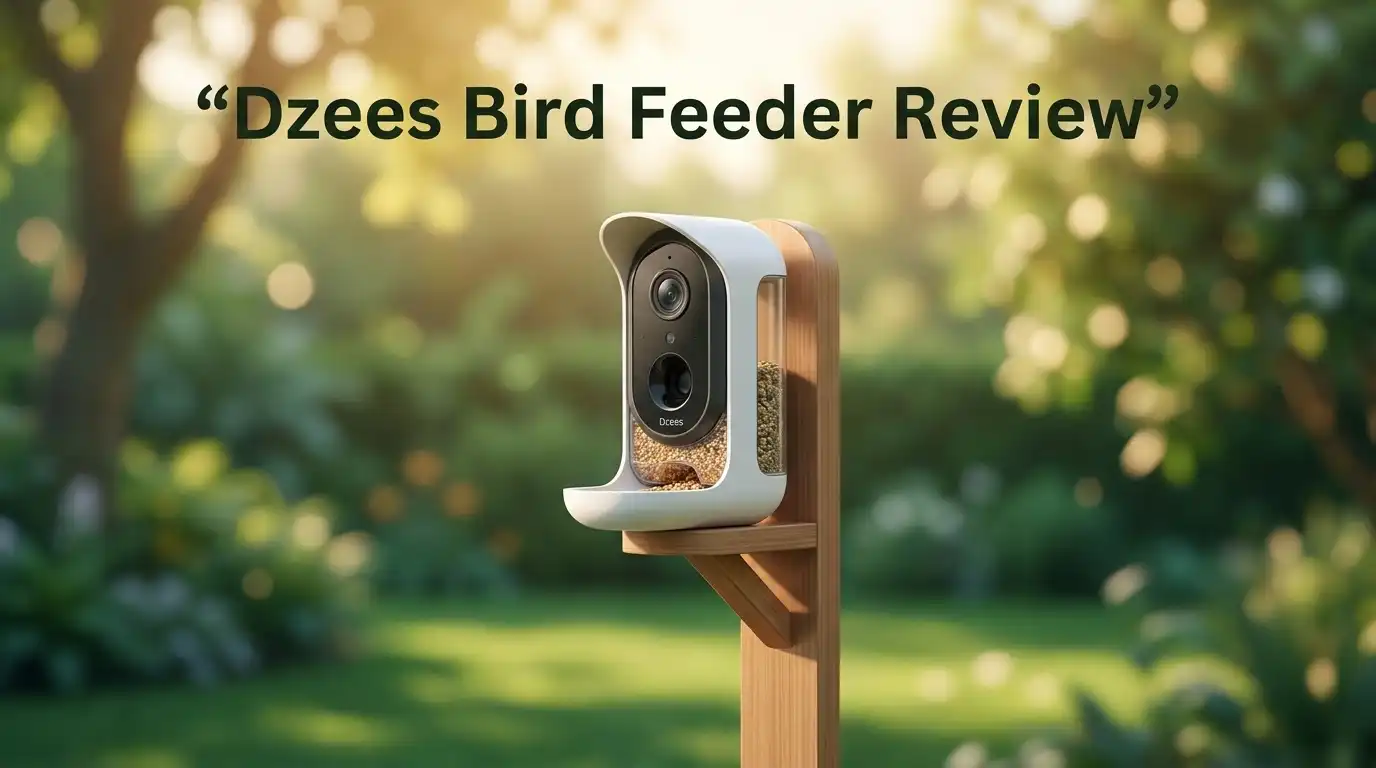
This is the pole-mount model with the 2K wide-angle lens, solar panel, and 1.8L hopper. Dzees also sells a cheaper window version.
The camera module clips into a housing above the perch. It looks down and slightly forward at the feeding tray.
Dzees rates the housing at IP65, and the seal held through three heavy storms in my testing. No condensation appeared inside the lens cover.
The feeder body is molded plastic. It feels light in hand, closer to a garden product than a security device, though the joints are tight and nothing rattled.
Mounting hardware covers pole, wall, and tree installation. Pole mounting is the version I recommend, and I explain why further down.
Pricing has moved between roughly $70 and $110 depending on bundles and stock. At the lower end it competes well against feeders costing twice as much.
Stock on this listing fluctuates. Dzees rotates ASINs frequently, so check the Dzees storefront if the main page shows as unavailable.
Unboxing, Build Feel, and First Impressions
The box is compact and unbranded inside. Everything sits in molded cardboard rather than foam, which is a small environmental win.
Contents include the feeder body, camera unit, solar panel, mounting strap, screws, a small baffle, and a quick-start card.
The plastic has a matte finish with a faint fresh-molding smell that faded within a day outdoors. No sharp edges anywhere on the tray.
Assembly took about twelve minutes. The camera slides into its bracket with a firm click, and the solar cable threads through a channel on the back.
The perch feels sturdy under weight. I pressed down hard with a thumb and saw no flex at the mounting point.
One honest observation: the included squirrel baffle is undersized. It looks like a token gesture rather than a working deterrent.
The solar panel is small, roughly the size of a phone. It charges adequately but will not overpower a shaded install.
Overall the build quality reads as competent budget hardware rather than premium. That is a fair trade at this price.
Top 3 Alternative for Dzees Bird Feeder


Last update on 2026-08-01 / Affiliate links / Images from Amazon Product Advertising API Some of the links on this website are affiliate links, which means that at no additional cost to you, I earn a commission if you click through and make a purchase. I only recommend products and services that I believe will add value to my readers. Thank you for your support!
Birdfy 2 Smart Bird Feeder with Camera

Last update on 2026-07-01 / Affiliate links / Images from Amazon Product Advertising API Some of the links on this website are affiliate links, which means that at no additional cost to you, I earn a commission if you click through and make a purchase. I only recommend products and services that I believe will add value to my readers. Thank you for your support!
HARYMOR Bird Feeder with Camera Solar Powered

Last update on 2026-07-01 / Affiliate links / Images from Amazon Product Advertising API Some of the links on this website are affiliate links, which means that at no additional cost to you, I earn a commission if you click through and make a purchase. I only recommend products and services that I believe will add value to my readers. Thank you for your support!
NETVUE by Birdfy Smart Bird Camera
Setup, Wi-Fi Pairing, and the App Curve
Dzees ships instructions for two apps: Dzees Home and Vico Home. My box referenced Vico, which caused a few minutes of confusion.
Use Dzees Home. It receives firmware updates more consistently and the interface is cleaner.
Pairing uses a QR code scan. Hold your phone screen in front of the lens and wait for the confirmation chime.
The camera accepts 2.4GHz networks only. This trips up a lot of buyers with combined-band routers, so split your bands before starting.
Signal strength matters more than most listings admit. At the far end of my yard, live view stuttered until I moved the feeder ten feet closer.
The 5dBi antenna helps, but it is not magic. Test the spot with your phone before drilling anything.
Once paired, the app remembers the device reliably. I had two dropouts in several weeks, both after router restarts.
Total setup time was under twenty minutes including mounting. That matches the manufacturer claim honestly, assuming your Wi-Fi cooperates.
2K Video Quality and Night Vision Tested
The 2K sensor delivers genuinely pleasant footage. Feather texture on a cardinal reads clearly, and color saturation looks natural rather than oversharpened.
The wide-angle lens covers the whole tray plus some background. Birds at the near edge look excellent.
Depth of field is the limitation. Anything past roughly six feet blurs, so background scenery stays soft and slightly smeared.
Audio capture surprised me. Chirps come through cleanly, though wind noise dominates on gusty days with no filtering to compensate.
Color night vision works, but only within about fifteen feet and only with some ambient light. In full darkness it drops to grayscale infrared.
Night footage is mostly useful for raccoons and possums rather than birds. Songbirds do not feed after dark.
Motion blur appears when a bird flies off quickly. Still frames pulled from video look smeared at the wingtips.
For sharing clips with family or identifying a visitor, the quality is more than sufficient. For print-worthy photography, it is not close.
AI Bird Identification and the Subscription Question
Here is the part buyers most often misunderstand. AI species identification requires a subscription at roughly $5.99 monthly.
The listing mentions this, but it sits deep in the bullet text. Plenty of reviewers report feeling blindsided at first login.
Accuracy during my trial was good on common feeder birds. Cardinals, chickadees, house finches, and blue jays were named correctly nearly every time.
Sparrows caused problems. The system repeatedly confused song sparrows and house sparrows, which is admittedly a hard call even for people.
Each identified species gets a profile card with range, habitat, and call audio. The information draws from public reference sources and reads accurately.
Without the subscription, you keep live view, motion recording, notifications, and local storage. You simply identify birds yourself.
Honestly, that free tier is workable. A free field guide app on your phone handles identification for zero recurring cost.
The subscription earns its keep for households with kids or older relatives who enjoy the automatic naming and profiles.
Solar Charging and Real Battery Performance
The solar panel does its job under one condition. It needs four or more hours of direct sunlight daily.
In a sunny spot, my battery hovered between 90 and 100 percent indefinitely. I never plugged it in.
Move it into partial shade and the picture changes. Charge drifted downward over ten days until manual recharging became necessary.
App store reviews are full of complaints about battery drain, and the cause is usually the same. Excessive motion triggers drain the cell fast.
Every car, pedestrian, and swaying branch wakes the camera. Each wake costs power.
Reducing sensitivity and enabling scheduled sleep hours cut my daily drain substantially. These settings are buried two menus deep.
Cold weather also reduced runtime. During a stretch below freezing, standby time dropped by roughly a third.
Plan on periodic manual charging in winter regardless of panel placement. The USB-C port is under a rubber flap on the camera body.
Seed Capacity, Refilling, and the Squirrel Problem
The 1.8L hopper holds a decent amount. For a moderately busy yard, that translates to five to seven days between refills.
The top lid lifts off entirely rather than hinging. It seals tightly, though you need both hands during refills.
Seed stayed dry through repeated rain. Drainage slots in the tray prevent standing water, which matters for mold prevention.
The tray accepts more than seeds. Suet chunks, fruit, and jelly all work if you want to attract different species.
Now the flaw. Squirrels defeat the included baffle without effort, and one squirrel can empty the hopper in an afternoon.
Multiple reviewers reached the same conclusion I did. You need an aftermarket baffle, ideally a hard plastic dome measuring 17 inches or wider.
Mount the feeder on a smooth PVC or metal pole placed at least ten feet from any tree or fence.
Budget an extra $25 for proper squirrel defense. Without it, you will collect hours of rodent footage and very few birds.
Motion Alerts, False Triggers, and Storage Options
Detection sensitivity is aggressive out of the box. Mine fired on passing cars, walking neighbors, and moving shadows during the first week.
The camera doubles as a competent yard security device, which some owners appreciate. Others find it exhausting.
Facing the feeder toward a wall or quiet corner solved most of it. Direction matters more than the sensitivity slider.
The AI filter that separates birds from other movement helps, but it is imperfect. Squirrels still trigger recordings regularly.
Storage runs two ways. A microSD slot accepts cards up to 128GB, and some bundles include a 32GB card.
Cloud storage is subscription-based, bundled with the identification service. Local recording remains free and unlimited by card size.
Clip playback within the app is quick. Scrubbing through a full day of events is tedious, though, since there is no timeline view.
Downloading clips to your phone works in two taps. Sharing to messaging apps is straightforward and fast.
Pros and Cons After Weeks of Backyard Use
Last update on 2026-08-07 / Affiliate links / Images from Amazon Product Advertising API Some of the links on this website are affiliate links, which means that at no additional cost to you, I earn a commission if you click through and make a purchase. I only recommend products and services that I believe will add value to my readers. Thank you for your support!
Pros
- Sharp 2K close-up footage that makes common backyard birds genuinely fun to watch on a phone screen.
- Solar charging that removes maintenance entirely when the feeder sits in a sunny position.
- Simple twenty-minute setup with clear QR pairing and tool-free pole mounting hardware.
- Weatherproof housing that kept seed dry and the lens clear through repeated heavy rain.
- Free tier remains genuinely useful, since live view, alerts, and local recording cost nothing extra.
- Strong gift appeal for parents and grandparents who want nature access without leaving the house.
Cons
- Bird identification is locked behind a monthly fee, which the product listing underplays.
- The included squirrel baffle fails completely and requires an aftermarket replacement.
- Battery drain becomes severe in shaded installs or high-traffic camera positions.
- 2.4GHz-only Wi-Fi limits placement and frustrates owners with dual-band routers.
- Plastic construction feels budget-grade and may not survive many seasons of UV exposure.
- Conflicting app instructions in the box create needless confusion during first setup.
Who Should Skip This Feeder
Serious wildlife photographers should pass. The fixed focus and modest depth of field cannot produce publication-quality stills.
Anyone with only a 5GHz router and no ability to split bands will hit a wall immediately during pairing.
Households in heavily wooded lots face two compounding problems: poor solar charging and relentless squirrel pressure.
People who dislike recurring fees should weigh this carefully. The core experience works without subscribing, but marketing pushes hard toward the paid tier.
Renters who cannot install a pole may struggle. Tree mounting technically works and practically disappoints.
Buyers wanting a decade-long fixture should consider metal-bodied competitors. This is plastic, and UV exposure will eventually matter.
Who it suits well: casual birders, families with curious kids, and gift buyers shopping for retired parents.
Also a strong pick for anyone testing whether smart birding interests them before spending $200 or more elsewhere.
At its typical street price, the Dzees delivers most of what expensive feeders offer. You trade polish and durability for a much lower entry cost.
Expert FAQs
Does the Dzees bird feeder work without a subscription?
Yes. Live view, motion alerts, automatic video recording, two-way audio, and microSD storage all function free. Only AI species naming and cloud backup require the paid plan.
How long does the battery last on a single charge?
Expect ten to fourteen days in a shaded position with default settings. In direct sun, the solar panel keeps it topped up continuously. Cold weather reduces runtime by roughly a third.
Can I use 5GHz Wi-Fi with this feeder?
No. The camera supports 2.4GHz networks only. Separate your router bands or create a dedicated 2.4GHz guest network before pairing.
Is the camera waterproof enough for winter?
The housing carries an IP65 rating and handled sustained rain without leaks in my testing. Freezing temperatures affect battery performance rather than water resistance.
How do I stop squirrels from raiding it?
Mount on a smooth metal or PVC pole at least ten feet from trees, then add a hard dome baffle measuring 17 inches or wider. The included baffle is too small to work.
What size memory card does it accept?
MicroSD cards up to 128GB. Some bundles include a 32GB card, which stores several weeks of clips before overwriting.
Is there a window-mount version?
Yes. Dzees sells a suction-cup window feeder with a similar 2K camera at a lower price. It has a smaller seed capacity and fewer reviews behind it.
How does it compare to Birdfy?
Birdfy offers better build materials, dual-lens options, and stronger app polish at roughly double the cost. Dzees delivers about 80 percent of the experience for far less money.
Can multiple people view the same feeder?
Yes. The app supports sharing device access with family members, and each person receives their own notifications.
Does it record at night?
It does, with color night vision inside about fifteen feet given some ambient light. Birds rarely feed after dark, so most night footage captures mammals.

Hello, I’m Emily Price, the founder of Birds Affection. As a passionate bird enthusiast and spiritual seeker, I’ve always been fascinated by the symbolic meanings and mystical connections between birds and our lives. On this website, I share my knowledge and insights on the spiritual significance of various bird species, exploring their roles as messengers, guides, and teachers. Through my writing, I aim to inspire and educate others on the profound wisdom and beauty that birds bring to our world. Join me on this journey as we delve into the enchanting realm of bird symbolism and discover the hidden meanings behind these magnificent creatures.