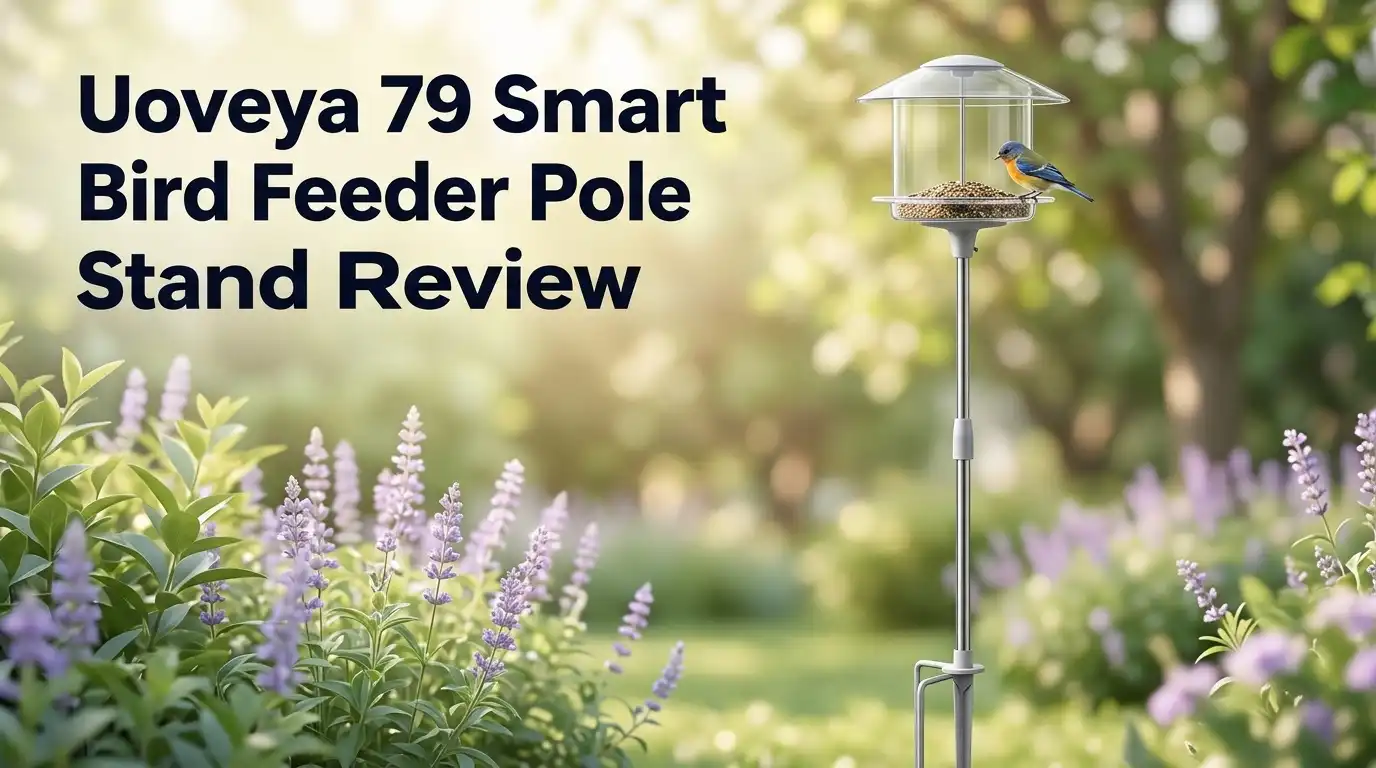
Uoveya 79″ Smart Bird Feeder Pole Stand Review 2026: Worth Buying?
Backyard birding got a big upgrade over the past few years. Smart feeders with cameras now sit in millions of yards, and those feeders need something solid to sit on. A flimsy pole ruins the whole setup. It leans, it wobbles, and squirrels treat it like a ladder to a free buffet.
The Uoveya 79″ Smart Bird Feeder Pole Stand promises to fix that problem for under fifty dollars. It ships with a 19 inch squirrel baffle, a 1 inch diameter steel pole, a five claw ground anchor, and mounting hardware that fits most camera feeders.
On paper, it sounds like a bargain. Amazon shoppers gave it a 4.4 star average across roughly 149 ratings, and the listing carries an Amazon’s Choice badge.
In a Nutshell:
- The price is the headline. At around $48.98, the Uoveya pole undercuts premium systems like Squirrel Stopper by more than a hundred dollars. You get a 1 inch steel pole, a 19 inch baffle, and mounting plates in one box. That bundle alone explains most of the positive reviews.
- Squirrel defense works when you install it right. The wide polycarbonate baffle blocks climbing squirrels effectively. It fails only when owners set it too low or park the pole within jumping distance of a fence, tree, or deck rail.
- Assembly takes 15 to 30 minutes with zero tools. Sections thread together by hand. The five claw base pushes into soft soil with body weight. Rocky or clay ground turns that easy job into a workout.
- Height adjusts from 79 inches up to 94 inches on the extendable version, so you can raise a feeder above squirrel jump range or lower it for easier refills and camera angles.
- The weak spots are real. The mounting clamp loosens on some units, the powder coat chips if you hammer the base, and heavy feeders on a long side arm can cause a slow lean over a season.
- Best fit: owners of smart camera feeders and birdhouses who have soft lawn soil and want a strong stand without paying premium prices.
What Is the Uoveya 79″ Smart Bird Feeder Pole Stand?

Last update on 2026-09-03 / Affiliate links / Images from Amazon Product Advertising API Some of the links on this website are affiliate links, which means that at no additional cost to you, I earn a commission if you click through and make a purchase. I only recommend products and services that I believe will add value to my readers. Thank you for your support!
The Uoveya 79″ Smart Bird Feeder Pole Stand is a ground mounted steel post built to hold bird feeders, birdhouses, weather stations, and camera feeders. Uoveya markets it as a smart feeder pole, which simply means the top plate and side bracket fit the mounting patterns used by popular camera feeder brands.
The pole measures 1 inch in diameter. That thickness matters. Thin quarter inch shepherd hooks bend under a full seed hopper, while a 1 inch steel tube resists bending under normal loads. The stand reaches 79 inches in the standard version, and Uoveya sells a taller option that extends to 94 inches.
Three purchase choices exist on the listing. Pole Only gives you the post and base. Pole and Baffle adds the 19 inch squirrel guard. Complete Kit includes extra hooks and mounting parts. Most buyers pick the pole and baffle bundle, since the baffle does the heavy lifting against squirrels.
The finish is black powder coated iron and steel. Uoveya lists rust resistance and weather resistance as features, and the pole is rated for fruit, seed, nut, mealworm, suet, and water stations. Target species include cardinals, bluebirds, finches, chickadees, woodpeckers, and hummingbirds.
Think of it as infrastructure rather than decoration. It does one job: hold your feeder high, steady, and out of reach. Everything in this review measures how well it delivers on that single promise.
Unboxing Experience: What Actually Arrives
The box arrives long and narrow, roughly the length of a baseball bat, and it feels heavier than expected. My unit weighed close to eight pounds with packaging. Uoveya packs the pole sections inside cardboard sleeves, which prevents the powder coat from scuffing during shipping.
Open the flap and you find the parts nested tightly. The pole splits into three threaded sections. The five claw base sits at the bottom of the box wrapped in plastic. The 19 inch baffle ships as a single molded polycarbonate dish, and it is bigger in person than the product photos suggest. It looks like a serving platter.
A small poly bag holds the hardware. Inside sit the mounting plate, a side arm bracket, a set of bolts, washers, and a hex key. Uoveya includes the tool, which saves a trip to the garage. The printed instruction sheet uses diagrams instead of long text, and the diagrams are clear enough to follow without reading a single word.
First impressions were positive. The threads on my sections cut cleanly and spun together smoothly. The baffle plastic felt thick and slightly flexible rather than brittle. The metal buckles on the baffle collar felt like the cheapest part of the kit.
One small annoyance appeared right away. My box arrived with a light film of packing oil on the pole ends. A paper towel handled it in ten seconds, but wear old gloves if you unbox indoors.
Key Specifications Summarized
Here is the short version of the manufacturer data, translated into plain language. Height: 79 inches standard, adjustable up to 94 inches on the extendable variant. Pole diameter: 1 inch, which fits standard birdhouse sleeves and most camera feeder brackets.
Baffle: 19 inch polycarbonate dome with metal buckle clamps. It slides along the pole and locks at any height you choose. That adjustability matters more than the size, because baffle placement decides success or failure.
Base: five claw ground anchor. Uoveya calls it a five paw design. The claws spread the load and grip soil, which improves wind resistance compared to three prong bases.
Material: iron and steel with black powder coat. Mounting options: top mount plate plus a side mount bracket, so you can hang a feeder off the side and place a house or camera on top.
Price: roughly $48.98 at the time of writing. Rating: 4.4 stars from about 149 reviews. Seller: shipped by Amazon, with a 30 day free return window.
The one specification Uoveya does not publish clearly is a weight limit. That gap frustrates buyers with heavy metal feeders. Based on owner reports, the pole handles a loaded standard tube feeder plus a camera unit without trouble. Stacking two large hoppers on one side arm pushes past comfortable territory.
Assembly and Setup: How Long Does It Take?
Assembly took me 22 minutes from box to standing pole, and most of that time went into the ground rather than the hardware. The threaded sections need no tools at all. You spin each piece into the next until snug, then hand tighten firmly.
Attach the base first while the pole is short. That gives you leverage. Slide the baffle collar onto the pole before you add the top section, because the baffle will not pass over the mounting plate on some configurations. I learned that the hard way and had to unscrew a section.
Driving the base is the real task. Push down with steady body weight and rock the pole gently side to side. Soft lawn soil swallows the claws in under a minute. Dry clay and rocky ground resist hard, and several owners report needing to soak the spot first or dig a starter hole.
Do not hammer the top of the pole. Hammering flares the threads and chips the coating. If you must strike something, place a scrap block of wood over the base collar and tap that instead.
Check plumb with a level or by eye against a house corner. A pole that leans two degrees on day one leans five degrees by autumn. Straight installation is the single best thing you can do for long term stability.
Finish by mounting the feeder, then slide the baffle up to at least 48 inches above ground and lock the buckles tight.
Top 3 Alternative for Uoveya 79″ Smart Bird Feeder Pole Stand

Last update on 2026-09-03 / Affiliate links / Images from Amazon Product Advertising API Some of the links on this website are affiliate links, which means that at no additional cost to you, I earn a commission if you click through and make a purchase. I only recommend products and services that I believe will add value to my readers. Thank you for your support!
PerchMe Bird Feeder Pole with Squirrel Baffle, 91 Inch


Last update on 2026-07-01 / Affiliate links / Images from Amazon Product Advertising API Some of the links on this website are affiliate links, which means that at no additional cost to you, I earn a commission if you click through and make a purchase. I only recommend products and services that I believe will add value to my readers. Thank you for your support!
ERYTLLY Bird House Pole 80 Inch with Squirrel Baffle and 2 Hooks

Last update on 2026-07-01 / Affiliate links / Images from Amazon Product Advertising API Some of the links on this website are affiliate links, which means that at no additional cost to you, I earn a commission if you click through and make a purchase. I only recommend products and services that I believe will add value to my readers. Thank you for your support!
ReTang 92″ Bird Feeder Pole with Squirrel Baffle
The 19 Inch Squirrel Baffle: Does It Actually Work?
Squirrel defense is why most people buy this pole, so the baffle deserves its own section. The short answer is yes, the baffle blocks climbing squirrels reliably, and Amazon reviewers specifically praise squirrel prevention as a strength.
The physics are simple. A squirrel climbs the smooth pole, reaches the underside of a wide dish, and finds no edge to grab. The polycarbonate surface offers no grip. The 19 inch diameter puts the rim far beyond arm reach, so the animal slides back down and gives up.
Placement decides everything. Set the baffle at least 48 inches above the ground. Squirrels launch four to five feet vertically from a standing start, so a low baffle simply becomes a landing pad. Owners who complain that the baffle failed almost always installed it too low.
Distance matters just as much. Keep the pole at least ten feet from fences, tree trunks, deck rails, roof edges, and shed walls. Squirrels leap horizontally with alarming accuracy. A baffle cannot stop an animal that arrives from above.
The weak link is the clamp. The metal buckles hold the baffle in place through friction, and a few units slip after weeks of squirrel impacts and temperature swings. Add a stainless hose clamp under the baffle collar as cheap insurance. That five dollar fix eliminates the most common complaint about this product.
Raccoons are a different story, covered later.
Stability, Wind, and Soil Conditions
Reviewers describe the pole as sturdy with good vertical stability, and that matches my experience in loam soil. The five claw base spreads pressure across a wider footprint than three prong designs, which resists the twisting force that wind applies to a loaded feeder.
Wind performance depends on your feeder more than the pole. A large flat sided hopper acts like a sail. A narrow tube feeder barely notices a gust. Mount heavy or wide feeders on the top plate rather than a long side arm, because side arms create leverage that works against the base.
Soil type is the biggest variable. Sandy soil drains well but grips poorly, and a pole in sand can loosen over a season. Clay grips hard once installed but makes installation miserable. Loam sits in the sweet spot.
Frost heave affects northern yards. Freeze and thaw cycles lift the base slightly each spring, so plan to push the pole back down in March. This is normal for every ground anchored pole, not a Uoveya flaw.
For extra rigidity, pour a small amount of gravel around the base and tamp it. Gravel drains water away from the claws and reduces the mud pocket that forms after heavy rain.
Amazon reviews on stability are mixed, with a handful of buyers reporting wobble. Almost every case traces back to loose threads, an unlevel install, or overloaded side arms.
Smart Feeder and Camera Compatibility
Uoveya built this pole for the camera feeder era, and compatibility is genuinely broad. The top plate uses common bolt spacing, and the 1 inch pole diameter matches the sleeve size that most smart feeder brands specify.
Camera feeders from the major brands mount to the top plate with the included bolts. Some models need their own adapter plate, which usually ships in the feeder box. Check your feeder manual for the required pole diameter before ordering. A feeder designed for a 1.25 inch post will not clamp securely to a 1 inch pole.
Weather stations also fit. The pole holds anemometer and rain gauge assemblies without flexing, and the height keeps sensors above ground level turbulence.
Camera performance improves at the right height. Set the feeder around 60 to 66 inches from the ground for eye level footage and easy lens cleaning. Push it higher only if squirrels or cats are jumping from nearby surfaces.
One practical detail deserves attention. Camera feeders need frequent access for battery swaps and lens wipes. A 94 inch installation looks impressive but forces you to carry a step stool every week. Most owners settle around 72 inches after a month of real use.
Solar panel accessories add a few pounds and a bit of wind load. The pole handles them, but tighten every bolt after the first storm.
Height Adjustment and Bird Behavior
Height changes which birds visit. That fact surprises new birders, and it is the most underrated feature of an adjustable pole.
Ground feeding species like doves, juncos, and sparrows prefer lower stations, roughly three to four feet up. Chickadees, nuthatches, and titmice happily feed at any height. Finches and cardinals favor mid range positions with nearby cover. Bluebirds want open lawn and a clear approach, which the full 79 inch height provides nicely.
The Uoveya pole lets you experiment. Loosen a section, adjust, and retighten. I moved my feeder twice in the first month and gained three new species by lowering it eight inches.
Cover placement matters alongside height. Birds want an escape route within ten to fifteen feet, such as a shrub or small tree. Place the pole too far from cover and shy species avoid it. Place it too close and squirrels get a launch platform. Twelve feet from a shrub is a good compromise.
Height also affects mess. A tall feeder scatters seed hulls over a wider circle. Lower feeders concentrate the mess, which makes cleanup easier but raises mold risk in wet weather.
Give any new position two weeks before judging it. Birds are creatures of habit, and traffic drops for several days after every move.
Build Quality and Rust Resistance Over Time
Powder coated steel handles weather well, and the finish on my pole survived a full season without visible rust. The coating is thick enough to resist scratches from normal handling.
Weak points appear at cut edges and threads. Powder coating rarely reaches deep into threaded sections, so bare metal sits inside every joint. Moisture wicks into those joints and starts surface rust within a year in humid climates. A dab of marine grease or anti seize on the threads during assembly prevents both rust and seized joints.
The base claws take the worst abuse. Pushing through soil scrapes coating off the leading edges, and buried steel corrodes faster than exposed steel. This affects every ground pole on the market. Expect the buried section to look rough after two or three years.
The baffle plastic holds up well. Polycarbonate resists cracking in cold weather and does not yellow quickly under sun. The metal baffle buckles show light rust sooner than the pole itself.
Bolts and washers are the cheapest components. Several owners swap the included hardware for stainless replacements from a hardware store, which costs a few dollars and removes the most likely failure point.
Overall build quality reads as solid budget engineering. It is not a lifetime heirloom like a welded American made system. It is a well made pole that should last several seasons with basic care.
What This Pole Does Not Do Well
Honest reviews name the failures, so here they are without softening.
The mounting clamp slips on some units. This is the single most repeated complaint in customer reviews. The side arm bracket and the baffle collar both rely on friction, and friction fades. Hose clamps solve it, but you should not need to buy parts on day one.
Rocky and clay soil defeat the base. The five claw anchor needs penetrable ground. Buyers with hard packed or stony yards report bent claws and installation sessions that ran past an hour. There is no auger option in this design.
Raccoons are not stopped. A baffle blocks squirrels because squirrels cannot reach past the rim. Raccoons have longer arms, real hands, and patience. They climb the pole, hook the baffle edge, and pull themselves over. No 19 inch baffle stops a determined raccoon.
No published weight rating. Uoveya never states a load limit, which leaves heavy feeder owners guessing.
Side arm sag. Hanging a full metal hopper on the side bracket causes visible droop, and long term hanging bends the arm slightly.
Threads can cross. Force a section and you ruin it. Spin gently and stop if resistance appears.
None of these flaws are dealbreakers at this price, but pretending they do not exist would be dishonest.
Pros and Cons
Pros
- Strong price for the hardware included. A 1 inch steel pole plus a 19 inch baffle plus mounting plates under fifty dollars beats most competitors on value.
- Tool free assembly in roughly 20 minutes. Threaded sections and a hand driven base make setup approachable for anyone.
- Effective squirrel prevention when the baffle sits high enough and the pole stands away from jumping platforms.
- Adjustable height from 79 inches to 94 inches lets you tune the station for different species and camera angles.
- Five claw base grips better than three prong designs and improves wind resistance noticeably.
- Broad compatibility with camera feeders, birdhouses, weather stations, and standard hanging feeders.
- Amazon fulfillment with free 30 day returns, which lowers the risk of trying it.
Cons
- Baffle and side arm clamps slip on a portion of units, requiring a hose clamp fix.
- Installation struggles in clay, rock, or dry compacted soil, and the claws can bend under force.
- No stated weight capacity, so heavy feeder owners cannot plan confidently.
- Raccoons defeat the baffle without much effort.
- Threads and buried claws lack full coating, which invites rust over a few seasons.
- Included bolts feel cheap and benefit from stainless replacements.
- Side mount arm sags under loaded metal feeders.
Who Should Buy It and Who Should Skip It
Buy it if you own a smart camera feeder and need a dedicated pole that fits the 1 inch standard. This is the pole’s core purpose, and it performs.
Buy it if your yard has normal lawn soil and an open area at least ten feet from fences and trees. Those conditions let the baffle and base do their jobs properly.
Buy it if you want good value over premium engineering. Fifty dollars for a pole and baffle is a strong deal, and the small fixes cost pocket change.
Skip it if your ground is rocky or hard clay. Look for an auger style base instead, since augers screw into resistant soil more easily than claws push through it.
Skip it if raccoons visit your yard nightly. No pole in this price class stops raccoons. You need a torpedo baffle, a taller pole, and feeders brought inside at dusk.
Skip it if you plan to hang three or four heavy feeders. Multi arm systems from Squirrel Stopper or Erva handle that load properly, though they cost three times as much.
Skip it if you want a decorative garden feature. This pole is plain black function, not ornamental ironwork. It disappears into the background, which some owners consider a feature.
Price and Value in 2026
At roughly $48.98, the Uoveya sits in the middle of the smart feeder pole market. Budget poles without baffles run $23 to $33. Comparable pole and baffle bundles land between $37 and $50. Premium multi arm systems with patented spring baffles cost $150 to $170.
The value case is straightforward. You pay about fifteen dollars more than a bare pole and receive a 19 inch baffle that would cost twenty dollars on its own. That math works.
Compared with direct rivals, the Uoveya holds a solid position. It rates 4.4 stars, which beats several competitors sitting at 4.1, and it undercuts the 91 inch PerchMe by roughly thirty dollars. The ERYTLLY 80 inch option costs less but includes lighter hardware.
Factor in the fixes. Two stainless hose clamps and a small bag of stainless bolts add about eight dollars. Total real cost lands near fifty seven dollars, which still beats premium systems by a wide margin.
Longevity affects value too. Expect three to five seasons of service with basic maintenance, and longer in dry climates. Premium welded systems last a decade or more. Divide cost by years and the gap narrows, but the Uoveya still wins for anyone who does not want to spend $170 upfront.
Prices shift often on Amazon, so check the current listing before deciding.
Tips to Get the Best Results
Grease the threads before assembly. Anti seize or marine grease blocks moisture and keeps joints removable next spring.
Add hose clamps under the baffle collar and side arm. This one step eliminates the most common complaint. Two clamps cost under five dollars.
Set the baffle at 48 inches or higher. Lower placement turns your baffle into a squirrel platform.
Measure ten feet of clearance from fences, trees, sheds, and deck rails before you pick the spot. Use a tape measure, not a guess.
Soak hard soil the night before installing. Wet ground accepts the claws far more easily and saves your back.
Check plumb twice, once when the base goes in and once after the first heavy rain. Early correction prevents permanent lean.
Tamp gravel around the base to improve drainage and grip.
Retighten every bolt after two weeks. Vibration and thermal cycling loosen new hardware.
Move the feeder in small steps if traffic disappoints. Six inches of height change can bring new species.
Clean the pole and baffle every few weeks. Seed dust and bird droppings hold moisture against the coating and speed corrosion.
Push the base back down each spring after frost heave lifts it.
Do these eleven things and your fifty dollar pole will outperform many poles costing twice as much.
Final Verdict
The Uoveya 79″ Smart Bird Feeder Pole Stand earns a recommendation with conditions. It delivers a thick steel pole, a genuinely effective 19 inch baffle, tool free assembly, and broad smart feeder compatibility for under fifty dollars. That combination is hard to beat at this price.
The flaws are real but manageable. The clamps need reinforcement. The base struggles in stubborn soil. Raccoons win. The hardware deserves an upgrade. None of these problems require sending the product back, and most cost less than ten dollars to solve.
Buy it if you have normal soil, a camera feeder, and reasonable expectations. Choose a premium multi arm system instead if you plan to hang four heavy feeders or if raccoons run your neighborhood.
For most backyard birders setting up a single smart feeder station in 2026, this pole does the job well and leaves money in your pocket for seed.
Frequently Asked Questions
Does the Uoveya pole fit my smart camera feeder?
Most likely yes, if your feeder specifies a 1 inch diameter pole. The kit includes a top mounting plate and a side bracket with common bolt spacing. Check your feeder manual for required pole diameter first, because feeders built for 1.25 inch posts will not clamp tightly.
How high should I place the squirrel baffle?
Place it at least 48 inches above the ground. Squirrels jump four to five feet vertically, so anything lower becomes a launch platform. Also keep the pole ten feet away from fences, trees, and deck rails, since squirrels leap horizontally with great accuracy.
Will this pole stop raccoons?
No. Raccoons have long arms and strong grip, and they pull themselves over a 19 inch baffle without much trouble. Bring feeders inside at dusk or add a torpedo style baffle if raccoons visit your yard regularly.
Can I install it in rocky or clay soil?
Installation gets difficult. The five claw base needs penetrable ground. Soak the spot thoroughly the night before, or dig a small starter hole. Some owners with very hard ground report bent claws, so consider an auger base pole if your yard is stony.
How tall is it and can I adjust the height?
The standard version stands 79 inches. Uoveya also sells a variant that extends to 94 inches. You adjust height by threading sections together differently, which takes a few minutes and no tools.
Does it rust?
The powder coat resists rust well on exposed surfaces. Threads and buried claws lack full coating, so surface rust can start there within a year or two in humid climates. Grease the threads at assembly and clean the pole regularly to slow this down.
What weight can it hold?
Uoveya does not publish a weight rating. Owner reports suggest it handles a loaded tube feeder plus a camera unit comfortably. Mount heavy feeders on the top plate rather than the side arm, since the side bracket sags under heavy loads.
Is it worth the money compared with cheaper poles?
Yes for most buyers. Bare poles cost twenty to thirty dollars but include no baffle. The Uoveya bundles a 19 inch baffle worth about twenty dollars on its own, which makes the total package good value at roughly forty nine dollars.

Hello, I’m Emily Price, the founder of Birds Affection. As a passionate bird enthusiast and spiritual seeker, I’ve always been fascinated by the symbolic meanings and mystical connections between birds and our lives. On this website, I share my knowledge and insights on the spiritual significance of various bird species, exploring their roles as messengers, guides, and teachers. Through my writing, I aim to inspire and educate others on the profound wisdom and beauty that birds bring to our world. Join me on this journey as we delve into the enchanting realm of bird symbolism and discover the hidden meanings behind these magnificent creatures.