YJJKJ Wood Parakeet Nest Box Review 2026: Worth Buying?
Breeding season arrives fast, and your birds will tell you when they are ready. A hen starts shredding paper. A pair spends more time side by side. Then you realise you need a nest box, and you need one that will not fall apart after one clutch.
The YJJKJ Wood Parakeet Nest Box shows up in almost every search for budgie and cockatiel breeding boxes. It sells at a low price, it comes in four sizes, and it carries thousands of ratings on Amazon. That popularity raises a fair question. Is this box actually good, or is it just cheap and everywhere?
I spent time with this box, mounted it on a standard flight cage, filled it, cleaned it, and watched how a pair of budgies treated it.
In A Nutshell:
- The wood is real, light, and soft. YJJKJ uses paulownia, a fast growing hardwood that weighs very little and insulates well. It also dents easily, so treat it as a seasonal item rather than a lifetime purchase.
- Four sizes cover most small parrots. The S box suits finches, canaries, and budgies. The L and XL sizes work for cockatiels, conures, and larger lovebird pairs. Choosing the wrong size is the single biggest mistake buyers make.
- Assembly takes under ten minutes. Bolts, washers, and wing nuts come in the bag. You can mount the box inside the cage or hang it on the outside wall through an open door.
- The hinged top makes cleaning simple. You lift the lid, scoop the old bedding, wipe the base, and close it. No screwdriver needed between clutches.
- It has real flaws. There is no viewing window, the concave nesting dish is shallow, and the hole placement sits high on smaller sizes. Some units arrive with rough edges that need light sanding.
- The value is strong for the money. For a first breeding attempt or a spare box, this is a sensible buy. Serious breeders running multiple pairs will want something thicker and more chew resistant.
YJJKJ Wood Parakeet Nest Box

Last update on 2026-07-11 / Affiliate links / Images from Amazon Product Advertising API Some of the links on this website are affiliate links, which means that at no additional cost to you, I earn a commission if you click through and make a purchase. I only recommend products and services that I believe will add value to my readers. Thank you for your support!
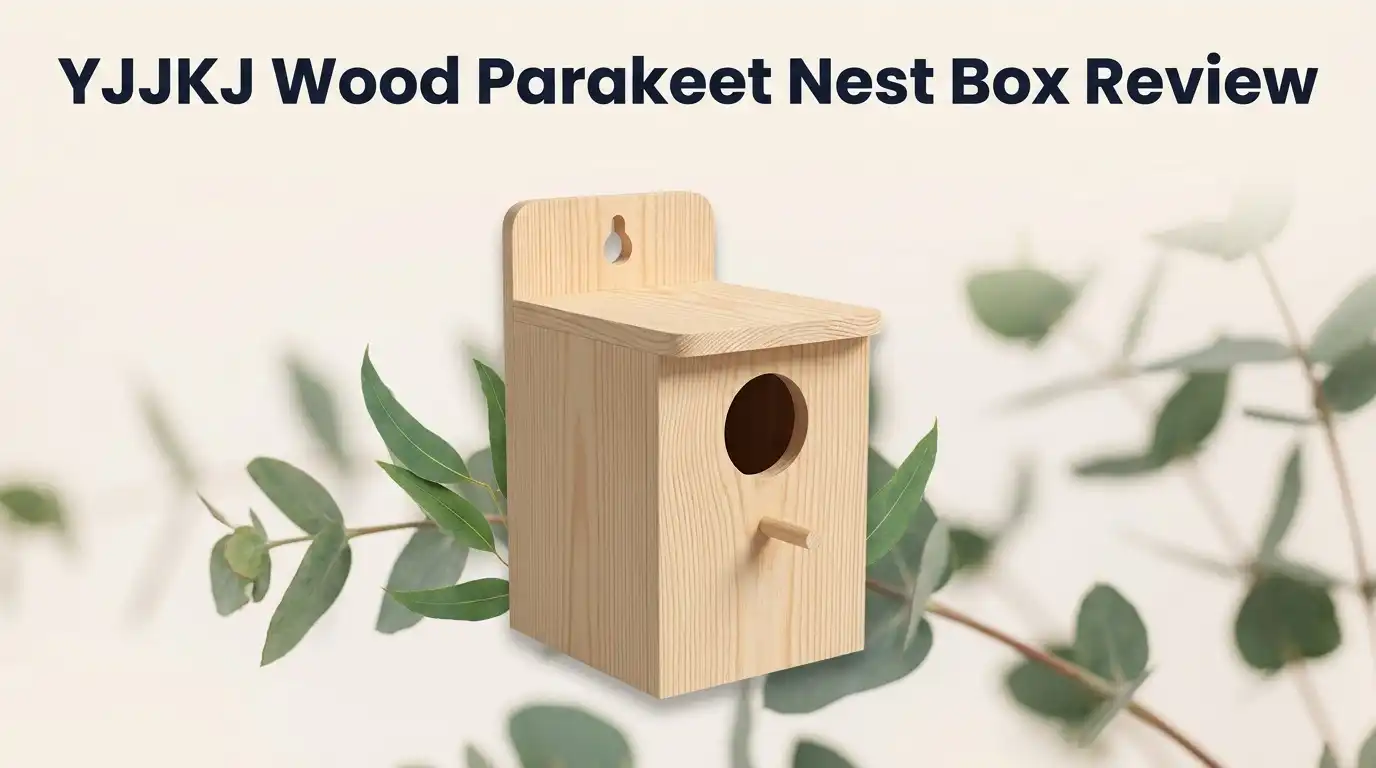
The YJJKJ Wood Parakeet Nest Box is a simple rectangular breeding box made from paulownia wood. It follows the classic budgie nest box shape that aviculture has used for decades. One entrance hole sits on the front face. A small perch ledge sits below the hole. The lid opens on a hinge at the top.
Inside, you get a plain floor with a shallow concave dip carved into one section. That dip holds eggs together so they do not roll into corners. This is the feature that separates a real breeding box from a decorative birdhouse.
The wood measures roughly 8mm thick on the sample I handled. That is thin by breeder standards but normal at this price. Paulownia is the same wood used in surfboard cores and light furniture, which explains why the whole box feels almost weightless in your hand.
YJJKJ sells the box in S, M, L, and XL. The S size runs 7.7 by 4.7 by 4.7 inches with a 2.1 inch entrance. The XL runs 13.4 by 6.9 by 7.7 inches with a 2.5 inch entrance. Every size ships flat packed with the mounting hardware in a small plastic bag.
The finish is bare wood. There is no paint, no stain, and no sealant. That matters, because parrots chew, and chewed paint is a real health risk. A raw wood box is the safer choice for any bird that puts its beak on everything.
Unboxing Experience: What Actually Arrives
My box arrived in a plain brown mailer with no retail packaging. Inside sat the assembled body, one loose lid, a perch dowel, and a tiny bag of hardware. There were no instructions in the box at all.
The first thing I noticed was the smell. Fresh paulownia has a mild, clean, almost papery scent. It does not smell like glue or chemicals. That was reassuring.
The second thing I noticed was sawdust. A fine layer of it coated the inside floor and the corners. You should tip the box upside down and shake it before use. Fine dust irritates bird airways, and a quick shake plus a dry wipe fixes it.
Edges were the only real complaint. Two corners had small splinters where the saw had torn the grain. Nothing sharp enough to injure a bird, but I ran 220 grit sandpaper over them anyway. Budget five minutes for light sanding and you avoid a problem before it starts.
The hardware bag contained four bolts, four washers, and four wing nuts. All of it was zinc plated steel. The threads worked smoothly with no cross threading. The perch dowel slid into its hole with a firm friction fit and needed no glue.
Overall the unboxing felt honest. Nothing was hidden, nothing was oversold, and nothing was broken. It looks and feels exactly like a low cost functional wooden box should look and feel.
Build Quality And Wood Material
Paulownia is the whole story here. It is a hardwood by botanical classification but behaves like a soft wood in daily use. It resists warping, it holds shape in humid rooms, and it insulates far better than plastic. Those are genuine advantages for a nest box.
The trade off is durability. A determined cockatiel hen will widen the entrance hole within one season. Lovebirds will strip the inside corners. If your birds are heavy chewers, expect to replace this box every year.
Joints on my unit were butt joints held with small nails and glue. They felt tight. I lifted the full box by one wall and nothing flexed or separated. That is a reasonable result for the price bracket.
The hinge is the weakest hardware point. It is a thin metal strip with small screws. The screws bite into soft wood, so avoid slamming the lid open and shut. Lift it gently and the hinge will last.
The floor has no drainage holes, which is correct for a nest box. You want dry, still air inside, not a draft across the eggs. Ventilation instead comes through the entrance hole and small gaps near the lid.
One detail I liked: the wood arrived dry and stable, with no cupping across the floor panel. Cheap boxes often warp in transit and then sit unevenly, which lets eggs roll. This one sat flat on the table with no rocking at all.
Size Options And Which One Fits Your Bird
Size selection decides whether this box succeeds or fails. Birds reject boxes that feel wrong, and a box that is too large lets chicks scatter and chill.
Budgies and small parakeets do best in the S or M size. The S at 7.7 inches long matches the traditional budgie nest box footprint used by breeders worldwide. The M gives a little extra room if your hen is large or you expect a big clutch.
Cockatiels need the L or XL. A cockatiel pair takes turns sitting, so both adults sometimes occupy the box together. The XL at 13.4 inches long gives them room to turn around without crushing eggs.
Lovebirds sit between the two. Most lovebird pairs settle happily into the M, though peach faced lovebirds carry nesting material and appreciate the L.
Finches and canaries technically fit the S, but they usually prefer open cup nests instead of enclosed cavities. A closed box is not the natural choice for most finch species.
Check the entrance hole too. The S and M use a 2.1 inch hole. The L and XL use a 2.5 inch hole. A cockatiel cannot squeeze through 2.1 inches comfortably, so never pair a large bird with a small box hoping it will manage.
Measure your cage door before ordering. The XL will not pass through many standard cage openings, which means outside mounting only. That single measurement saves a return.
Top 3 Alternative for YJJKJ Wood Parakeet Nest Box

Last update on 2026-07-11 / Affiliate links / Images from Amazon Product Advertising API Some of the links on this website are affiliate links, which means that at no additional cost to you, I earn a commission if you click through and make a purchase. I only recommend products and services that I believe will add value to my readers. Thank you for your support!
Rypet Parakeet Nesting Box with Perch

Last update on 2026-09-08 / Affiliate links / Images from Amazon Product Advertising API Some of the links on this website are affiliate links, which means that at no additional cost to you, I earn a commission if you click through and make a purchase. I only recommend products and services that I believe will add value to my readers. Thank you for your support!
kathson Parakeet Nesting Box Transparent Bird House


Last update on 2026-07-11 / Affiliate links / Images from Amazon Product Advertising API Some of the links on this website are affiliate links, which means that at no additional cost to you, I earn a commission if you click through and make a purchase. I only recommend products and services that I believe will add value to my readers. Thank you for your support!
PINVNBY Parakeet Nesting Box Bird House
YJJKJ Wood Parakeet Nest Box With Bird Water Feeder

Last update on 2026-09-08 / Affiliate links / Images from Amazon Product Advertising API Some of the links on this website are affiliate links, which means that at no additional cost to you, I earn a commission if you click through and make a purchase. I only recommend products and services that I believe will add value to my readers. Thank you for your support!
YJJKJ also sells a version bundled with a small water feeder. The box body is identical. The addition is a plastic cup style drinker that clips near the entrance.
I have mixed feelings about this variant. A water source close to the nest sounds convenient, but wet bedding is a genuine hazard for chicks. Spilled water inside a nest box leads to chilled babies and bacterial growth.
If you buy this version, mount the feeder outside the box or on the cage wall instead. The bundle still gives you a useful spare drinker for the price of the box alone.
The feeder itself is basic clear plastic with a hook. It holds a small volume, maybe enough for one budgie for a day. You will refill it often. It is not a replacement for your main water station.
Where the bundle does help is during the weaning stage. Once chicks leave the box and start exploring, having a low drinker nearby encourages them to drink on their own. Place it outside the entrance, at perch height, and it earns its keep.
Price wise, the bundle usually costs a dollar or two more than the plain box. That is fair. Just do not buy it expecting a meaningful upgrade to the nest box itself, because the wood, the hinge, and the dimensions are all the same.
Assembly And Mounting Process
Assembly is quick. The body arrives built. You attach the lid if it ships loose, push in the perch dowel, and then decide on mounting.
Inside mounting is the simpler route. You place the box on the cage floor or on a wide shelf, then run the bolts through the cage bars and through the pre drilled holes on the box back. Washers go against the wood, wing nuts go on the outside. Hand tighten only.
Outside mounting is the better route for hygiene. You hang the box against the cage exterior with the entrance lined up over an open door or a cut panel. Droppings and shredded bedding then stay out of the cage, and you can inspect without reaching inside.
The pre drilled holes on my unit lined up with standard cage bar spacing. That is not guaranteed on every unit, so check before you commit to a mounting spot. If the holes miss your bars, wire ties through the holes work fine.
Height matters. Mount the box in the upper third of the cage. Birds prefer high cavities and feel exposed low down. Leave at least six inches of headroom above the lid so you can open it.
One tip from experience: mount the box before breeding behaviour starts, not during. A pair that is already courting will treat any cage intrusion as a threat, and stress during egg laying causes abandoned clutches.
Ventilation And Temperature Control
Paulownia insulates well, and that is the strongest technical argument for this box. Wood buffers temperature swings far better than plastic or metal. On a cool morning the inside of the box stays noticeably warmer than the room.
Airflow comes from the entrance hole and the small clearance around the lid. There are no drilled vent holes, which is correct for small parrot boxes. Extra vents create drafts, and drafts kill young chicks faster than heat does.
In a warm room, though, the lack of vents can work against you. If your bird room runs above 85 degrees Fahrenheit, the box interior will hold heat. Watch for panting adults or chicks pressed against the walls, and improve room ventilation rather than drilling the box.
Humidity behaves well. Paulownia absorbs a little moisture without swelling much. I did not see any warping after several weeks in a room with a humidifier running.
Condensation was never an issue. The wood breathes, so moisture from droppings and respiration passes through instead of beading on the walls. A plastic box in the same spot would have shown damp corners.
If you breed in an unheated garage or outbuilding, this box alone will not be enough. Wood 8mm thick provides modest insulation, not real cold protection. Pair it with a room heater and a thermostat, and never rely on the box to keep chicks warm on a freezing night.
Cleaning And Maintenance
The hinged lid is the feature you will appreciate most. Between clutches, you lift the top, tip the old bedding into a bag, and wipe down the inside. The whole job takes two minutes.
Bare paulownia is porous, so avoid soaking the box in water. Water swells the fibres and lifts the grain. Use a barely damp cloth with plain water, or a bird safe cleaner, then let the box air dry fully in sunlight.
Sunlight is your best tool here. Two hours of direct sun does more for sanitising a wooden box than most sprays. It dries the wood and reduces surface bacteria at the same time.
Mites are the real maintenance concern with any wooden nest box. Wood grain hides them. Inspect corners and the underside of the lid with a torch after every clutch. A mite infestation in soft wood is difficult to clear, and replacement is often cheaper than treatment.
Do not use bleach. Residue soaks into the grain and lingers. Do not use pine oil or phenol based cleaners either, since both are toxic to birds.
Plan on replacing the box after two or three clutches, or sooner if the wood is heavily chewed or stained. At this price, replacement is a reasonable strategy. Treat it as a consumable that you swap out, and the thin wood stops being a drawback.
Pros And Cons
Pros
- Real paulownia wood that insulates well and carries no paint, stain, or sealant, which makes it safe for birds that chew their surroundings.
- Four size options covering budgies through cockatiels, so you can match the box to your species instead of forcing a compromise.
- Hinged lid opens fully, giving fast access for cleaning, candling eggs, and checking chicks without dismantling anything.
- Mounting hardware included, with bolts, washers, and wing nuts that work on standard cage bar spacing.
- Very light weight, so it does not strain cage bars or wire ties even when full of bedding.
- Concave nesting dip in the floor keeps eggs grouped together instead of letting them roll into cold corners.
- Low price makes it easy to buy two, one in use and one drying after cleaning.
- Assembly takes under ten minutes with no tools beyond your fingers.
Cons
- No viewing window. You must open the lid to check on eggs or chicks, which disturbs the hen every time.
- Thin 8mm wood dents, scratches, and gets chewed through faster than thicker breeder grade boxes.
- Rough edges and loose sawdust on arrival mean you should sand and shake out the box before use.
- No instructions in the package, which slows down first time buyers.
- The hinge screws thread into soft wood and can loosen with rough handling.
- Pre drilled hole placement varies between units, so alignment with your cage bars is not guaranteed.
- The XL will not fit through many standard cage doors, forcing outside mounting.
- Bare wood absorbs stains and odours, so the box will never look clean again after one clutch.
What This Nest Box Does Not Do Well
Honest reviews name the weak spots, so here they are plainly.
It does not let you observe without disturbance. Modern nest boxes often include a clear acrylic panel. Breeders use that panel to count eggs and watch feeding without opening anything. YJJKJ gives you no window at all. Every check means lifting the lid and interrupting the hen. For a nervous first time pair, that repeated interruption can end a clutch.
It does not survive heavy chewers. Lovebirds and cockatiels widen the entrance hole and gnaw the inner corners. Within a season the hole can grow by half an inch. That is not a defect. It is what soft wood does.
It does not include bedding. The floor arrives bare. Birds need pine shavings, aspen shavings, or coconut fibre on top of that floor. You will spend extra on nesting material, so factor it into the total cost.
It does not have a deep nesting dip. The concave section is shallow compared to a proper budgie nest concave. Eggs stay grouped, but a large clutch can still spread out. Adding a separate wooden concave insert solves this for serious breeders.
It does not come with clear instructions. No diagram, no size guide, no mounting advice. First time owners are left guessing about placement and height.
It does not look attractive after use. Bare wood absorbs droppings and stains permanently. This is a functional tool, not a decorative piece.
How Birds Actually Respond To It
Bird acceptance is the only test that matters. A box can have perfect specifications and still get ignored.
My budgie pair investigated within two days. The hen entered first, chewed at the entrance edge, and then spent an hour inside. That chewing behaviour is a good sign, because hens prepare a cavity before laying. The cock perched on the ledge and called into the hole.
The ledge perch got constant use. It gives the male a spot to guard the entrance and pass food to the hen. A box without an outside perch loses this natural behaviour, so its inclusion here is genuinely useful.
The unpainted wood helped acceptance. Birds trust natural surfaces faster than glossy ones. The mild wood scent seemed to attract rather than repel.
One honest note: enclosed boxes trigger hormonal behaviour. If you do not want your birds to breed, do not add this box. A nest cavity tells a hen it is time to lay, and chronic egg laying is a serious health risk for small parrots.
Some birds simply refuse. If your pair ignores the box after two weeks, try moving it higher, changing the cage side, or adding a handful of shavings inside. Birds often reject a location rather than the box itself.
Price And Value In 2026
This box sits in the entry level price bracket. You can usually buy the S or M size for less than a bag of premium seed, and the XL costs only a little more.
At that price, the value calculation is simple. You are buying a functional wooden cavity with hardware, not a precision breeding tool. Judged against that expectation, it delivers.
Compare it to building your own. Timber, hinge, screws, and your time will cost more than buying this box outright unless you already have offcuts in the garage. For most people, buying is cheaper than making.
Compare it to premium boxes and the gap becomes clear. Boxes with acrylic windows, thicker walls, and metal reinforced entrance holes cost two or three times as much. They last several seasons. If you breed every year, the expensive box works out cheaper per clutch.
The smart approach for a hobbyist is to buy two of the cheap boxes. One stays in the cage, one dries after cleaning. That rotation keeps hygiene high and still costs less than a single premium unit.
Shipping is usually free with Prime, and returns are straightforward if the box arrives damaged. Given how thin the wood is, check the box the day it arrives rather than storing it unopened until breeding season.
Best Nesting Material To Add Inside
The box arrives empty, so bedding is your decision. Get this right and chick survival improves.
Pine or aspen shavings are the standard choice. Add a layer roughly one inch deep across the floor. Shavings absorb droppings, hold warmth, and let the hen shape a hollow. Use kiln dried shavings sold for small animals.
Never use cedar shavings. Cedar oils release compounds that damage bird airways. This is one of the few absolute rules in bird keeping.
Coconut fibre works well for lovebirds, which carry material into the cavity themselves. Loose fibre satisfies their natural building instinct and reduces feather plucking during breeding.
Shredded paper is acceptable but not ideal. It compacts when damp and offers less insulation. Plain unprinted paper only, since ink is a risk.
Avoid loose string, cotton nesting fluff, and hay. Long fibres wrap around chick legs and cause injuries. Bird rescues see this problem every season.
Refresh the bedding once between hatching and fledging if it becomes soiled. Do it quickly, in the middle of the day, while the hen is off the nest. Move fast, replace only the top layer, and close the lid within a minute.
One extra tip: sprinkle a thin layer of shavings before the hen shows interest. Birds accept a box faster when it already smells and feels like a usable cavity.
Who Should Buy It And Who Should Skip It
Buy this box if you are breeding budgies or lovebirds for the first time. The price is low, the design is traditional, and the assembly is easy. You get a real wooden cavity without a large commitment.
Buy it if you need a spare. Rotating two boxes between clutches is good practice, and this is the cheapest way to do it.
Buy it if your birds chew and destroy everything. Replacing a cheap box annually is easier than watching an expensive box get ruined.
Skip it if you want to watch the nest. No window means no observation. Choose a box with an acrylic panel instead, because watching chicks hatch is half the joy of breeding.
Skip it if you run a serious breeding programme. Multiple pairs need thicker walls, metal reinforced entrances, and boxes that survive years of scrubbing. This one will not keep up.
Skip it if you do not want your birds to lay eggs. Adding a nest cavity to a cage with a mature hen invites hormonal behaviour and chronic laying.
Skip it if you breed outdoors in cold climates. Thin wood provides limited insulation, and outdoor aviaries need much more protection.
Final Verdict
The YJJKJ Wood Parakeet Nest Box is a fair product at a fair price. It uses honest materials, it follows a proven shape, and it works.
It is also thin, plain, and short lived. You are trading durability and observation for a very low cost. That trade makes sense for hobbyists and makes no sense for dedicated breeders.
My recommendation is straightforward. If this is your first clutch, buy the correct size, sand the edges, add shavings, mount it high, and expect one or two good seasons from it. You will learn what you actually want from a nest box, and that knowledge is worth more than the price difference.
If you already know you want a window and thicker walls, spend more and buy once.
Frequently Asked Questions
What size YJJKJ nest box should I buy for budgies?
Choose the S or M size. The S measures 7.7 by 4.7 by 4.7 inches with a 2.1 inch entrance, which matches the traditional budgie box footprint. Pick the M if your hen is large or you keep English budgies.
Is paulownia wood safe for birds?
Yes. Paulownia is a non toxic hardwood used widely in bird products and toys. The YJJKJ box ships unpainted and unsealed, which removes the risk of birds ingesting coatings. Sand any rough edges before use.
Does the box come with nesting material?
No. The floor arrives bare. Add about one inch of pine or aspen shavings. Avoid cedar shavings and avoid long fibres such as string or cotton fluff.
Can I mount the box outside the cage?
Yes, and it is often the better option. Line the entrance up with an open cage door or a cut panel, then secure the box with the included bolts or wire ties. Outside mounting keeps mess out of the cage and makes inspection easier.
How often should I clean the nest box?
Clean it fully between clutches. Refresh the top layer of bedding once during chick rearing if it becomes soiled. Use a barely damp cloth, never soak the wood, and dry the box in sunlight.
Will cockatiels fit in this box?
Only in the L or XL sizes. Cockatiels need the 2.5 inch entrance and the extra floor space. The S and M sizes are too small and will be rejected or cause stress.
How long does the box last?
Expect one to three clutches depending on how much your birds chew. Heavy chewers such as lovebirds and cockatiels widen the entrance hole within a season. Replacement is cheap, so plan for it.
Does it have a window to see the chicks?
No. This box has no acrylic panel. You must lift the hinged lid to check eggs or chicks. If observation matters to you, choose a transparent design instead.

Hello, I’m Emily Price, the founder of Birds Affection. As a passionate bird enthusiast and spiritual seeker, I’ve always been fascinated by the symbolic meanings and mystical connections between birds and our lives. On this website, I share my knowledge and insights on the spiritual significance of various bird species, exploring their roles as messengers, guides, and teachers. Through my writing, I aim to inspire and educate others on the profound wisdom and beauty that birds bring to our world. Join me on this journey as we delve into the enchanting realm of bird symbolism and discover the hidden meanings behind these magnificent creatures.