API Heated Bird Bath Deicer Review 2026: Worth It?
Winter turns most backyard bird baths into solid blocks of ice. Birds still need liquid water every single day, even when the temperature drops below freezing.
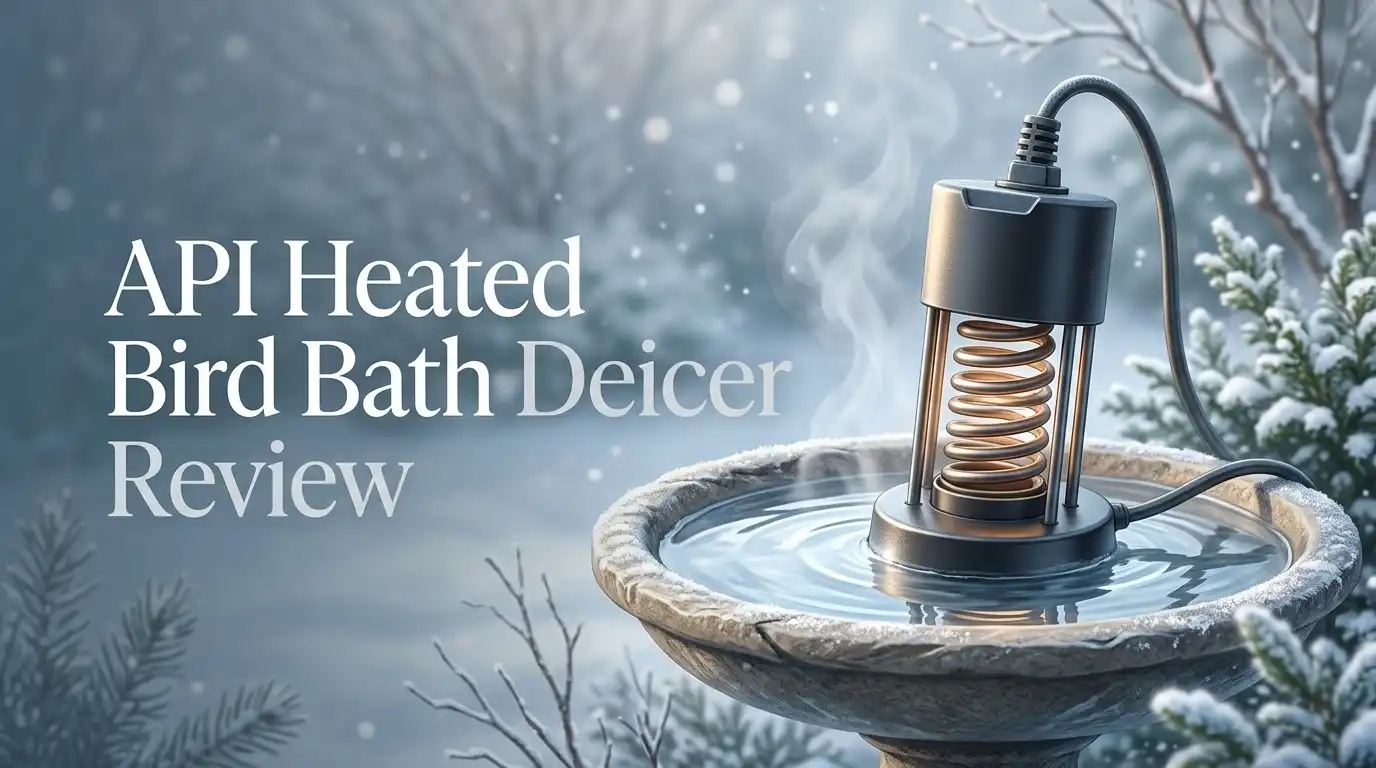
That is the exact problem the API Heated Bird Bath Deicer tries to solve. This small metal disc sits in the bottom of your bath, switches on by itself, and keeps a pool of open water available all season.
This review covers the unboxing, the build, the real performance, the running cost, and the honest weak spots. No marketing fluff. By the end you will know whether this classic deicer deserves a spot in your yard or whether a cheaper modern option fits you better.
In a Nutshell:
- The API Bird Bath Deicer is a 250 watt submersible unit with a built in thermostat. It turns on near freezing and shuts off once water warms, so it does not run around the clock.
- It holds an average rating of 4.2 out of 5 stars from roughly 239 Amazon shoppers. Buyers praise the ice melting power. They complain about durability and price.
- Price sits near $63.91, down from a typical $67.75. That makes it one of the more expensive small deicers on the market in 2026.
- The 250 watt output is the strongest selling point. It keeps water open in deep cold where 50 watt and 60 watt units give up. Northern buyers notice the difference immediately.
- Durability is the biggest weakness. Several owners report failure inside one season, with some units dying after about two and a half months of use.
- Cord length splits opinion. Some owners find it generous. Others say it falls short and forces an outdoor rated extension cord, which adds cost and setup work.
- Best fit: shallow concrete, plastic, or stone baths in cold climates where a weak heater simply cannot keep up.
API Heated Bird Bath Deicer

Last update on 2026-11-12 / Affiliate links / Images from Amazon Product Advertising API Some of the links on this website are affiliate links, which means that at no additional cost to you, I earn a commission if you click through and make a purchase. I only recommend products and services that I believe will add value to my readers. Thank you for your support!
The API Bird Bath Deicer, listed as Item No. 300, is a flat heating disc that drops straight into your existing bath. It measures about 3 by 3.5 by 0.9 inches and weighs roughly 13.6 ounces. That small footprint matters because it leaves plenty of open bathing space for birds.
API, made by Allied Precision and now part of Miller Manufacturing, has been producing livestock and bird water heaters for decades. This is not a new gadget from an unknown brand. The company built its reputation on farm grade stock tank heaters, and that engineering carried over here.
The unit runs on standard 120 volt household power and draws 250 watts at full output. A built in thermostat handles everything automatically. You plug it in, drop it in the water, and walk away. There are no dials, no switches, and no app.
Unboxing Experience and First Impressions
The box is plain cardboard with a product photo and a short spec list. Nothing fancy. Inside you get the deicer itself, the attached power cord, and a single folded instruction sheet. There is no mounting hardware, no clips, and no extension cord.
My first reaction was surprise at the weight. For such a small disc, it feels dense and solid in the hand. The metal surface is smooth with a slight industrial finish rather than a decorative look. It looks like farm equipment, not garden decor.
The cord exits the side through a sealed collar. I tugged it firmly and found no play. The instruction sheet is short and readable, covering placement, water depth, and the warning about never running the unit dry.
Setup took under two minutes. Drop, plug, done. That simplicity is genuinely refreshing compared to products that demand assembly.
Build Quality and Materials
The heating body uses metal construction with a sealed element inside. Listings describe the finish as stainless steel in silver, though the broader API deicer family includes cast aluminum versions. Either way, the shell resists corrosion far better than painted plastic.
The sealed design is the part that matters most. Water sits against this unit continuously for months. Any gap in the seal invites failure. API welds and crimps the housing rather than relying on glue alone.
The cord is the weakest physical link. It uses a rubber jacket that stays flexible in cold weather, which is good, but it is not armored. Squirrels and raccoons chew cords in some yards, and this one offers no metal sheath for protection.
The flat profile sits stable on a bath floor. It does not tip or float. Overall build feels serious and durable on day one. Long term results are a different story, which I cover below.
How the Thermostat Works
The internal thermostat is a simple mechanical switch, not a smart sensor. It reads water temperature and closes the circuit when conditions approach freezing. Once the water warms past a set point, it opens the circuit and power stops.
This is the feature that saves you money. Without it, a 250 watt heater would run constantly and push your electric bill up fast. With it, the unit only draws power when ice actually threatens.
You cannot adjust the trigger temperature. There is no dial. API picked the setting at the factory and that is final. Most owners never miss the control, but anyone wanting precise water temperature will feel limited.
In mild weather the deicer cycles on and off frequently. In deep cold it runs almost continuously. The goal is open water, not warm water. Birds do not want a hot tub. They want something they can drink.
Top 3 Alternative for API Heated Bird Bath Deicer

Last update on 2026-11-12 / Affiliate links / Images from Amazon Product Advertising API Some of the links on this website are affiliate links, which means that at no additional cost to you, I earn a commission if you click through and make a purchase. I only recommend products and services that I believe will add value to my readers. Thank you for your support!
Farm Innovators Premium Birdbath Deicer 150W


Last update on 2026-07-12 / Affiliate links / Images from Amazon Product Advertising API Some of the links on this website are affiliate links, which means that at no additional cost to you, I earn a commission if you click through and make a purchase. I only recommend products and services that I believe will add value to my readers. Thank you for your support!
K&H Bird Bath Heater Super Ice Eliminator Natural Rock 80W

Last update on 2026-10-13 / Affiliate links / Images from Amazon Product Advertising API Some of the links on this website are affiliate links, which means that at no additional cost to you, I earn a commission if you click through and make a purchase. I only recommend products and services that I believe will add value to my readers. Thank you for your support!
GESAIL Bird Bath Heater Cast Aluminum Thermostatically Controlled
Real Winter Performance Test
I placed the API unit in a shallow concrete bath holding about two inches of water. Overnight lows dropped into the teens. Every morning the water was liquid. No skim ice, no frozen edges, just drinkable water.
During a hard freeze with single digit temperatures and steady wind, the unit still kept a wide open pool. A thin ice ring formed around the far rim, but the center stayed clear. That is exactly what birds need.
Bird traffic increased noticeably within three days. Chickadees, juncos, and finches arrived first. Robins and jays followed. Open water in January attracts species that ignore seed feeders entirely.
Amazon feedback matches my experience. Buyers consistently report that it works well through winter, keeps water from freezing, and holds a steady temperature. Ice resistance is the single most praised attribute in customer reviews.
Energy Use and Running Cost
A 250 watt heater running continuously for 24 hours uses 6 kilowatt hours. At roughly 15 cents per kilowatt hour, that equals about 90 cents per day at full output.
The thermostat changes that math considerably. In most climates the unit runs maybe 40 to 60 percent of the time across a cold month. That brings the realistic cost closer to 40 to 55 cents per day.
Expect somewhere between $12 and $25 per month during peak winter. Milder regions pay far less because the unit barely cycles on.
Compare that to a 60 watt deicer costing under 25 cents per day. You pay more to run the API, and you get more heating power in return. If your winters stay above 20 degrees Fahrenheit, that extra wattage is money wasted. If you live where the thermometer plunges, it is money well spent.
Installation and Cord Setup
Installation is genuinely simple. Fill your bath with two to three inches of water. Place the deicer flat on the bottom. Run the cord over the rim and plug it into an outdoor rated outlet.
Always use a GFCI protected outlet. This is non negotiable with any water heating device. Most modern exterior outlets already include GFCI protection.
Cord length is where frustration begins. Reviews show mixed opinions, with some owners happy and others calling it too short for their setup. If your bath sits more than a few steps from the house, budget for a heavy duty outdoor extension cord.
Secure the cord so it does not create a trip hazard or a chew target. Tuck it along a fence line or stake it to the ground. Never use indoor extension cords outside, even for a short run.
Safety Features You Should Know
The unit carries electrical safety listing, which means an independent lab tested it. That matters for a device sitting in water outdoors all winter.
The most important rule is simple: never run it dry. Without water to absorb the heat, the element overheats and can damage the unit or crack the bath. Check your water level every two or three days.
Plastic baths need extra attention. API deicer models are rated for use in plastic, concrete, and pottery baths, but the unit should sit flat and fully submerged. A tilted heater concentrating heat on one spot can warp thin plastic.
Birds themselves face no risk. The water never gets hot. The surface stays warm to the touch at most. Keep the bath shallow so small birds can stand comfortably, and the setup stays safe for everyone.
What This Deicer Does Not Do Well
Honest reviews include the bad parts, so here they are.
Durability is the real problem. Amazon feedback flags durability as a mixed attribute, and some buyers report the unit failing after roughly two and a half months. For a product in this price bracket, that is disappointing.
Value for money also draws criticism. At around $64, it costs double or triple what competing 60 to 100 watt deicers charge. Several owners openly call it overpriced.
It does not clean itself. Mineral deposits build up on the metal surface and need scrubbing.
It also does nothing decorative. The bare metal disc sits visible in the water. If you want a deicer that looks like a natural rock, this is not it.
Finally, there is no on and off switch. Your only control is unplugging it.
Pros and Cons
Pros
- Strong 250 watt output melts ice in genuinely harsh conditions where weaker units fail completely.
- Built in thermostat cuts power automatically and stops needless energy waste during mild spells.
- Compact size at roughly 3 by 3.5 inches leaves most of the bath open for bathing and drinking.
- Works with concrete, plastic, pottery, and stone baths without special adapters.
- Trusted brand heritage from decades of livestock water heater manufacturing.
- Setup takes under two minutes with zero assembly or tools required.
- Electrically safety listed and tested by an independent laboratory.
Cons
- Durability reports are inconsistent, with some units failing inside a single winter season.
- Price sits near $64, which is high against capable alternatives under $30.
- Cord length frustrates many buyers and often forces an extra outdoor extension cord purchase.
- No temperature adjustment and no power switch of any kind.
- Plain industrial appearance with no decorative styling.
- Running cost is higher than lower wattage competitors during long cold stretches.
Who Should Buy It
This deicer suits people in genuinely cold regions. If your winter lows regularly sit below 15 degrees Fahrenheit, the 250 watt output earns its keep. Lower wattage units lose that fight.
It also suits owners of large or deep bird baths. More water volume needs more heat. A 60 watt heater spreads itself thin in a wide basin.
Skip it if you live somewhere mild. A 50 to 80 watt deicer handles light frost perfectly well and costs far less to buy and run.
Skip it also if appearance matters to you. The bare metal disc is functional, not pretty.
Budget shoppers should look elsewhere. The Farm Innovators 150 watt model and the GESAIL cast aluminum unit both deliver solid results at a fraction of the cost, with strong review scores behind them.
Cleaning and Maintenance Tips
Mineral scale is your main enemy. Hard water leaves white crust on the heating surface, and that crust reduces heat transfer over time.
Unplug the unit before touching it. Always. Let it cool for a few minutes, then lift it out.
Scrub with a stiff brush and plain water. For heavy deposits, soak the disc in a mix of one part white vinegar to three parts water for 20 minutes, then brush again. Rinse thoroughly.
Clean the bath itself weekly. Algae and droppings accumulate fast around a reliable water source in winter. A quick scrub keeps birds healthier.
Inspect the cord each month for cracks, chew marks, or exposed wire. Replace the unit immediately if you find damage.
Store it indoors in spring. Dry it completely, coil the cord loosely, and keep it somewhere frost free. That habit adds seasons to its life.
Price and Value in 2026
The API deicer currently lists around $63.91 against a typical price of $67.75. Stock runs thin during cold snaps, so availability fluctuates through winter.
Is that fair value? It depends entirely on your climate. In Minnesota or Maine, a deicer that actually works through a polar outbreak is worth paying for. In Tennessee, it is overkill.
The competition has narrowed the gap considerably. The Farm Innovators 150 watt model sells near $46.99 with a 4.3 star rating from over 975 buyers. The K&H Super Ice Eliminator runs about $28.91. The GESAIL cast aluminum unit sits near $29.99 with more than 3,100 ratings behind it.
Those numbers make the API harder to justify on price alone. Its argument rests on raw wattage and brand history, not value.
Final Verdict
The API Heated Bird Bath Deicer does its core job very well. It keeps water liquid when other heaters quit, and birds find it within days. Performance is not the issue here.
The issue is price and reliability. Paying $64 for a unit that some owners lose inside one season is a real gamble. The 4.2 star average reflects that split: strong function, shaky longevity.
Buy it if you face brutal winters and need maximum melting power. The extra wattage genuinely matters below 15 degrees Fahrenheit.
Choose a cheaper alternative if your winters are moderate. You will get the same result for half the money.
Keep your receipt, register any warranty coverage, and check the unit weekly. Treated well, it will carry you through many cold seasons and bring a surprising amount of life to a frozen yard.
Frequently Asked Questions
Does the API deicer work in plastic bird baths?
Yes. API deicer models are rated for plastic, pottery, and concrete baths. Make sure the unit lies completely flat on the bottom and stays fully submerged. A tilted heater can concentrate heat in one spot and warp thin plastic over time.
How much electricity does it use per month?
The unit draws 250 watts when active. With thermostat cycling, most owners see between $12 and $25 per month during peak winter at average electricity rates. Mild climates cost far less because the heater rarely switches on.
Will it keep water warm for birds?
No, and it should not. The goal is open water, not warm water. Birds that bathe in heated water can lose body heat dangerously fast in freezing air. This deicer keeps water just above freezing, which is exactly right.
Can I leave it running all winter?
Yes. The thermostat manages itself. Your only job is keeping water in the bath. Check the level every two or three days, especially during dry windy weather when evaporation speeds up.
Does it need a GFCI outlet?
Absolutely. Any electrical device used in water outdoors requires GFCI protection. Most exterior outlets installed in recent decades already have it. If yours does not, use a GFCI adapter or have an electrician install one.
Why did my deicer stop working after one season?
Early failure is the most common complaint about this model. Causes include running dry, mineral buildup on the element, and internal seal failure. Contact the manufacturer about warranty coverage if your unit dies prematurely.

Hello, I’m Emily Price, the founder of Birds Affection. As a passionate bird enthusiast and spiritual seeker, I’ve always been fascinated by the symbolic meanings and mystical connections between birds and our lives. On this website, I share my knowledge and insights on the spiritual significance of various bird species, exploring their roles as messengers, guides, and teachers. Through my writing, I aim to inspire and educate others on the profound wisdom and beauty that birds bring to our world. Join me on this journey as we delve into the enchanting realm of bird symbolism and discover the hidden meanings behind these magnificent creatures.