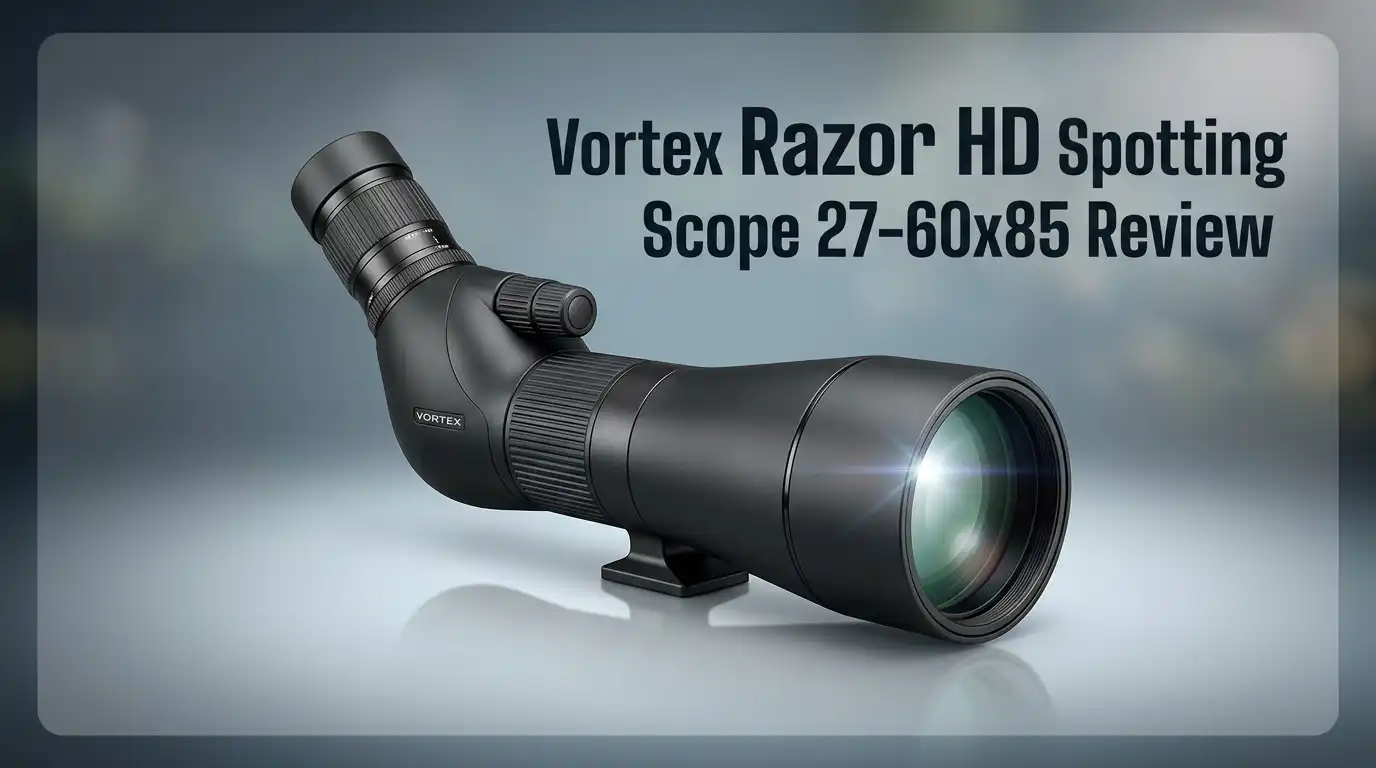
Vortex Razor HD Spotting Scope 27 60×85 Review 2026: Still Worth It?
Glass quality decides whether you spot a buck at 1,200 yards or walk past it. The Vortex Razor HD 27 60×85 sits near the top of the Vortex spotting scope line, just under true alpha European glass, and it has held that spot for years.
Hunters pack it into high country. Precision rifle shooters park it behind the firing line. Birders mount it on a fluid head and watch shorebirds for hours.
So the real question in 2026 is simple. Does this scope still earn its price when cheaper rivals keep improving? I spent time behind this spotter at the range, on a ridge, and in my backyard at last light. Here is the honest breakdown, including the parts Vortex would rather you skipped.
In a Nutshell:
- Optical quality ranks near the top of the sub alpha class. The HD glass with APO correction and XR Plus coatings delivers bright, sharp images with low chromatic aberration. Correction peaks near 44x. At 27x and 60x, color fringing rises slightly but stays controlled.
- The wide field eyepiece is the big upgrade over the Viper HD. Apparent field of view runs roughly 60 degrees at low power and climbs near 78 degrees at high power. Linear field measures 117 feet to 68 feet at 1,000 yards.
- It weighs 65.6 ounces and measures 15.5 inches in the angled body. That makes it noticeably more compact than the Viper HD 85mm, which matters on a backpack hunt.
- The helical focus collar is smooth but single speed. Fine focusing at 60x takes patience compared with dual speed systems from Athlon and Leupold.
- Eyepieces are locked to the Razor HD 85mm mount. You cannot use Viper eyepieces, other brands, or 1.25 inch astronomy eyepieces. Extra Razor eyepieces cost $400 to $500.
- The warranty is unlimited, unconditional, and lifetime. That coverage alone moves the value needle for many buyers.
Vortex Razor HD Spotting Scope 27 60×85 Overview

Last update on 2026-07-25 / Affiliate links / Images from Amazon Product Advertising API Some of the links on this website are affiliate links, which means that at no additional cost to you, I earn a commission if you click through and make a purchase. I only recommend products and services that I believe will add value to my readers. Thank you for your support!
The Razor HD 27 60×85 carries the model code RS 85A in angled form and RS 85S in straight form. Vortex lists MSRP at $2,399.99, though street pricing often lands lower.
The optical system uses high density, extra low dispersion glass elements in an apochromatic layout. Light travels through a Porro prism path, then a 45 degree prism redirects it in the angled version.
Vortex coats every air to glass surface with XR Plus anti reflective layers and adds dielectric prism coatings. Exterior lenses get ArmorTek, a hard coating that resists oil, dirt, and scratches.
The housing is argon purged and O ring sealed, so it stays fogproof and waterproof. The base specification sheet reads like a serious field instrument, and the glass backs it up.
Unboxing Experience and First Impressions
The box arrives plain and sturdy. Inside, the scope sits in a fitted soft case rather than loose foam, which already feels like a step above budget spotters. You get an ocular lens cover, an objective lens cover, a neoprene stay on cover, and a lens cloth. No tripod. No phone adapter. Vortex assumes you already own a decent head.
Lifting it out, the first thing you notice is density. This thing feels poured, not assembled. The rubber armor grips your palm with a slightly rough texture.
The sunshade slides out with even resistance and reveals a metal chassis underneath. The zoom collar turns with firm, consistent tension and zero gritty spots. First impressions are strong, and nothing about the presentation feels padded with filler accessories.
Build Quality, Armor and Tripod Mounting
The armor wraps the body without loose seams or soft spots. Every mechanism feels deliberate. The tripod collar rotates smoothly and offers a click stop every 45 degrees, which helps when you switch from upright glassing to a low prone position. A locking lever holds your chosen angle.
The best practical update is Arca Swiss compatibility built into the foot. You mount it straight to an Arca head with no extra plate. That removes a common failure point, since cheap plates loosen and wobble under 60x magnification.
The interior is blackened, matte, and clean, divided by baffles. One small criticism from bench testing: the tube interior lacks ribbing, and ribbing would knock down stray reflections a little better in harsh backlight.
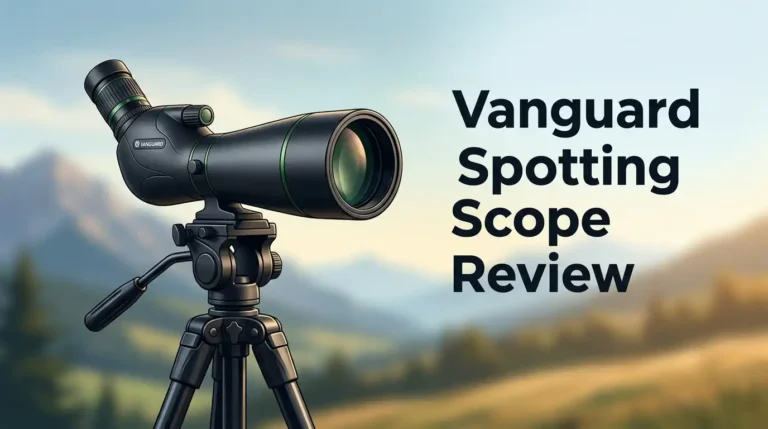
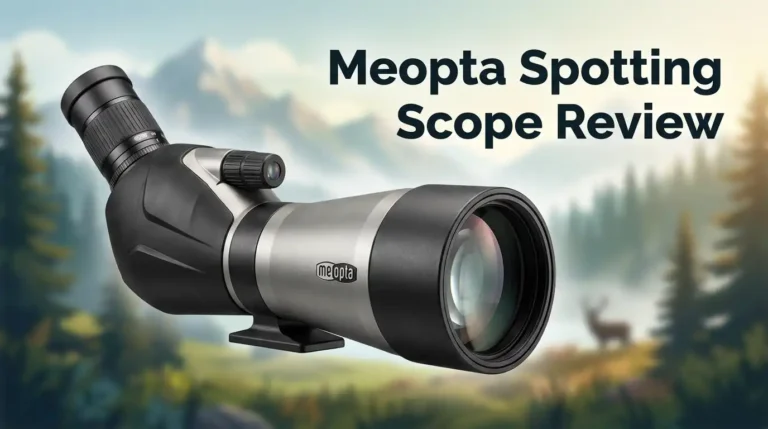
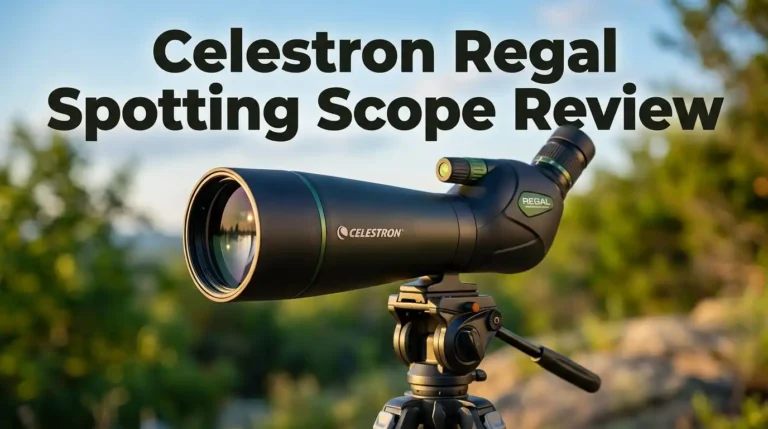
Top 3 Alternative for Vortex Razor HD Spotting Scope 27 60×85

Last update on 2026-07-25 / Affiliate links / Images from Amazon Product Advertising API Some of the links on this website are affiliate links, which means that at no additional cost to you, I earn a commission if you click through and make a purchase. I only recommend products and services that I believe will add value to my readers. Thank you for your support!
Athlon Optics Cronus G2 UHD 20 60×86 Spotting Scope

Last update on 2026-10-01 / Affiliate links / Images from Amazon Product Advertising API Some of the links on this website are affiliate links, which means that at no additional cost to you, I earn a commission if you click through and make a purchase. I only recommend products and services that I believe will add value to my readers. Thank you for your support!
Leupold SX 4 Pro Guide HD 20 60x85mm Spotting Scope

Last update on 2026-09-13 / Affiliate links / Images from Amazon Product Advertising API Some of the links on this website are affiliate links, which means that at no additional cost to you, I earn a commission if you click through and make a purchase. I only recommend products and services that I believe will add value to my readers. Thank you for your support!
Vortex Optics Viper HD Spotting Scope 20 60×85 Angled
Daylight Optical Performance
In bright conditions, the Razor HD produces crisp, high contrast images with good color fidelity. Resolution holds across most of the field. Edge sharpness behaves in an interesting way.
At 27x, the outer 10 to 15 percent of the field softens slightly. At 44x and 60x, softening shrinks to roughly the last 5 percent. That is strong performance for a zoom eyepiece pushing a wide apparent field.
Chromatic aberration stays low in the center, best near 44x, with a small rise at both ends of the zoom range. On high contrast targets like dark antlers against snow, you can find a faint fringe at the field edge. Some testers note a slight magenta color bias. Side by side against premium fixed focal eyepieces, the Razor loses only a hair of bite at maximum power.
Low Light and Dusk Performance
An 85mm objective gathers serious light, and the exit pupil at 27x measures about 3.1mm. That combination keeps images usable deep into legal shooting light.
The XR Plus coatings matter here. Reflections inside the tube appear less intense than on the Viper HD, which translates to better contrast when the sun sits low and glare creeps in.
Brightness loss toward the field edge is minimal. Testing scored it best at 27x, with slightly weaker numbers at higher magnifications, which is normal.
Star testing showed near point like images with low astigmatism, strongest at 27x and softening as you zoom. Coma appears around 75 to 85 percent of the field radius. Dusk performance is a genuine strength, not marketing copy.
Magnification Range and Field of View
Vortex traded zoom range for field width here, and that choice defines the scope. You get 27x to 60x instead of the Viper’s 20x to 60x. Angular field runs 2.2 degrees down to 1.3 degrees. Linear field covers 117 feet at low power and 68 feet at high power per 1,000 yards.
The payoff is immersion. Looking through this eyepiece feels open rather than like peering down a straw. The cost is the missing low end. Starting at 27x removes some of the ultra bright, ultra wide scanning view that 17x to 20x gives you when you sweep a basin.
If your workflow is wide scanning first and detail second, you will feel that loss. Many hunters solve it by scanning with binoculars, then switching to the spotter.
Helical Focus System in Practice
The focus ring is a wide, ribbed collar sitting between the objective and the prism housing. It turns smoothly with good damping and no backlash. Travel from 16.4 feet of close focus to infinity covers roughly 450 degrees of rotation, which is less throw than the Viper despite a wider focus range.
The snag free design deserves credit. Nothing protrudes, so the scope slides into a pack sleeve without catching. The weakness is the single speed ratio.
At 60x on a thermal day, nailing exact focus takes small, careful nudges, and gripping a large collar introduces more tube vibration than a small external knob would. Dual speed focus systems on the Athlon Cronus G2 and Leupold SX 4 handle this part better.
Eyepiece Options and the Locked Mount
Here is the most frustrating part of owning a Razor HD 85mm. The eyepiece mount is proprietary to this series. You cannot fit Viper eyepieces, Endurance eyepieces, third party eyepieces, or 1.25 inch astronomy eyepieces. Even the Razor HD 65mm uses a different interface for some accessories.
Vortex sells two extra eyepieces. The Razor HD Long Eye Relief unit gives 22x, a 2.5 degree field, and a generous 31mm of eye relief, which eyeglass wearers love.
The Razor HD Reticle eyepiece matches those figures and adds a ranging grid for shooters. Both cost roughly $400 to $500. An 85mm apochromatic objective of this grade could easily handle 80x to 100x, but Vortex gives you no path there. That ceiling bothers anyone who wants occasional lunar or planetary viewing.
Hunting Use in the Field
For western hunting, the numbers work in your favor. At 65.6 ounces and 15.5 inches, this spotter rides in a pack better than most 85mm competitors. The angled body lets you glass from a seated position without craning your neck, and the click stop collar helps when you tilt it for an uphill slope.
Judging antler mass, tine length, and body condition at a mile becomes realistic in good light. The wide field speeds up relocating an animal that moves behind cover.
Armor and sealing shrug off rain, snow, and dust. The scope still needs a serious tripod. Mount it on a light aluminum travel tripod and you will blame the optics for shake that the legs actually caused.
Long Range Shooting and Impact Calls
Behind a rifle, this spotter earns its keep. Testers have called shots and estimated MOA corrections from 100 yards out to a mile with it. Bullet trace is visible in the right atmospheric conditions, and vapor trails show up clearly when mirage stays moderate.
The Razor HD Reticle eyepiece turns the scope into a spotting tool with measurable holds, which helps in competition and in training new shooters. Impact splash on steel reads well at 44x, and most spotters settle around that power rather than maxing out. Mirage, not glass, limits your usable magnification on hot ranges. Expect to run 35x to 45x most of the day and treat 60x as a bonus for calm mornings.
Birding and Digiscoping Results
Birders get a lot to like. The 16.4 foot close focus is far better than the Viper HD, which stops around 36 feet, so feeder birds and nearby warblers come into range. Color rendering stays pleasant, though fixed focal eyepieces on competing scopes render slightly more neutral tones.
Eye relief measures 16.7mm to 17.0mm, which works for most eyeglass wearers, and the twist up eyecup offers four stops. The wide field makes tracking flying birds practical.
For digiscoping, the scope performs well with a phone adapter, but Vortex does not include one, and no dedicated camera adapter ships in the box. Plan an extra purchase if photography sits high on your list.
What the Razor HD Does Not Do Well
Honest reviews list the misses, so here they are. The zoom starts at 27x, which limits wide, bright scanning. The single speed helical focus slows precise adjustment at high power. Eyepiece lock in kills upgrade paths and third party options. No high power eyepiece exists, so astronomy use stays capped near 60x.
Chromatic aberration is low but not absent, and it rises at both ends of the zoom range. The tube interior lacks ribbing. Nothing beyond basic covers and a cloth ships in the box. Price remains high enough that Athlon and Leupold alternatives undercut it heavily. It is also not a true alpha scope. Kowa, Swarovski, and Meopta still pull ahead in edge resolution and color neutrality at maximum power.
Pros and Cons of the Vortex Razor HD Spotting Scope 27 60×85
Last update on 2026-07-25 / Affiliate links / Images from Amazon Product Advertising API Some of the links on this website are affiliate links, which means that at no additional cost to you, I earn a commission if you click through and make a purchase. I only recommend products and services that I believe will add value to my readers. Thank you for your support!
Pros
- Bright, sharp HD glass with apochromatic correction and XR Plus coatings that perform strongly in low light.
- Wide apparent field of view near 78 degrees at high power, which feels open and aids target tracking.
- Compact 15.5 inch, 65.6 ounce angled body that packs easier than most 85mm rivals.
- Close focus of 16.4 feet suits birding and backyard observation.
- Arca Swiss compatible foot mounts directly with no extra plate.
- Unlimited, unconditional, transferable lifetime warranty from a responsive support team.
- Excellent mechanical feel with smooth zoom, click stop collar, and snag free focus.
Cons
- Zoom starts at 27x, so you lose wide low power scanning.
- Single speed focus collar makes fine focus at 60x slower than dual speed designs.
- Proprietary eyepiece mount blocks all third party and other Vortex eyepieces.
- Optional eyepieces cost $400 to $500 each.
- No high power eyepiece option for astronomy.
- Minimal accessories included and no tripod or phone adapter.
- Priced well above strong value competitors.
Razor HD vs Viper HD: Which One Fits You
The Viper HD 20 60×85 costs considerably less and keeps the 20x low end. Its optical correction to the field edge is excellent, but it achieves that with a narrower eyepiece field, so the view feels tighter. The Viper also runs longer and heavier, and its close focus sits far out at roughly 36 feet.
The Razor HD gives you better glass, a much wider field, a smaller body, and far closer focus. You pay several hundred dollars more for those gains.
Choose the Viper if budget rules and you scan wide country at low power. Choose the Razor if image quality, field width, and pack size matter most. Both share the same lifetime warranty, so service is not a deciding factor.
Price, Warranty and Final Verdict
MSRP sits at $2,399.99, with Amazon third party listings often showing around $1,650 and sales dropping further. At that street price, the Razor HD 27 60×85 competes well.
The Athlon Cronus G2 20 60×86 delivers similar brightness with dual speed focus for less money. The Leupold SX 4 Pro Guide HD Gen 2 lands under $1,000 and remains the value pick.
The Razor wins on build refinement, field width, pack size, and warranty support. I recommend it for serious western hunters, precision rifle shooters, and birders who want sub alpha glass without alpha pricing. Skip it if you need low power scanning, high power astronomy, or eyepiece flexibility. For everyone else, it stays one of the smartest spotting scope buys in 2026.
Frequently Asked Questions
Is the Vortex Razor HD 27 60×85 worth the money in 2026?
Yes, if you buy at street price rather than MSRP. The glass, build, field width, and lifetime warranty justify the cost for hunters and shooters who use a spotter often. Casual users save real money with the Leupold SX 4 or Athlon Cronus G2.
Should I choose the angled or straight model?
Angled suits seated glassing, shared viewing, and uphill angles, and it measures 15.5 inches. Straight suits truck window mounts, flat terrain, and fast target acquisition, and it measures 16.2 inches. Both weigh 65.6 ounces. Most hunters pick angled. Most range shooters pick straight.
Can I use other eyepieces on this scope?
No. The Razor HD 85mm mount accepts only Razor HD eyepieces made for it. Third party eyepieces, 1.25 inch astronomy eyepieces, and eyepieces from other Vortex lines do not fit. Your only options are the supplied zoom, the Long Eye Relief eyepiece, and the Reticle eyepiece.
What tripod does this spotting scope need?
Use a carbon fiber or heavy aluminum tripod with a fluid or ball head rated above 10 pounds. The Arca Swiss foot mounts directly to compatible heads. Light travel tripods introduce vibration at 60x and ruin otherwise excellent image quality.
Does it work for astronomy?
It handles lunar viewing, bright planets, and wide star fields well. Star images stay close to point like at 27x. The 60x ceiling prevents detailed planetary work, and no higher power eyepiece exists for this mount, so dedicated astronomers should look at a telescope instead.
How good is the Vortex warranty?
Vortex offers an unlimited, unconditional, lifetime warranty with no receipt required and full transferability. Damage from accidents gets covered. That policy is a major part of why many buyers choose Vortex over competitors with similar optical performance.

Hello, I’m Emily Price, the founder of Birds Affection. As a passionate bird enthusiast and spiritual seeker, I’ve always been fascinated by the symbolic meanings and mystical connections between birds and our lives. On this website, I share my knowledge and insights on the spiritual significance of various bird species, exploring their roles as messengers, guides, and teachers. Through my writing, I aim to inspire and educate others on the profound wisdom and beauty that birds bring to our world. Join me on this journey as we delve into the enchanting realm of bird symbolism and discover the hidden meanings behind these magnificent creatures.