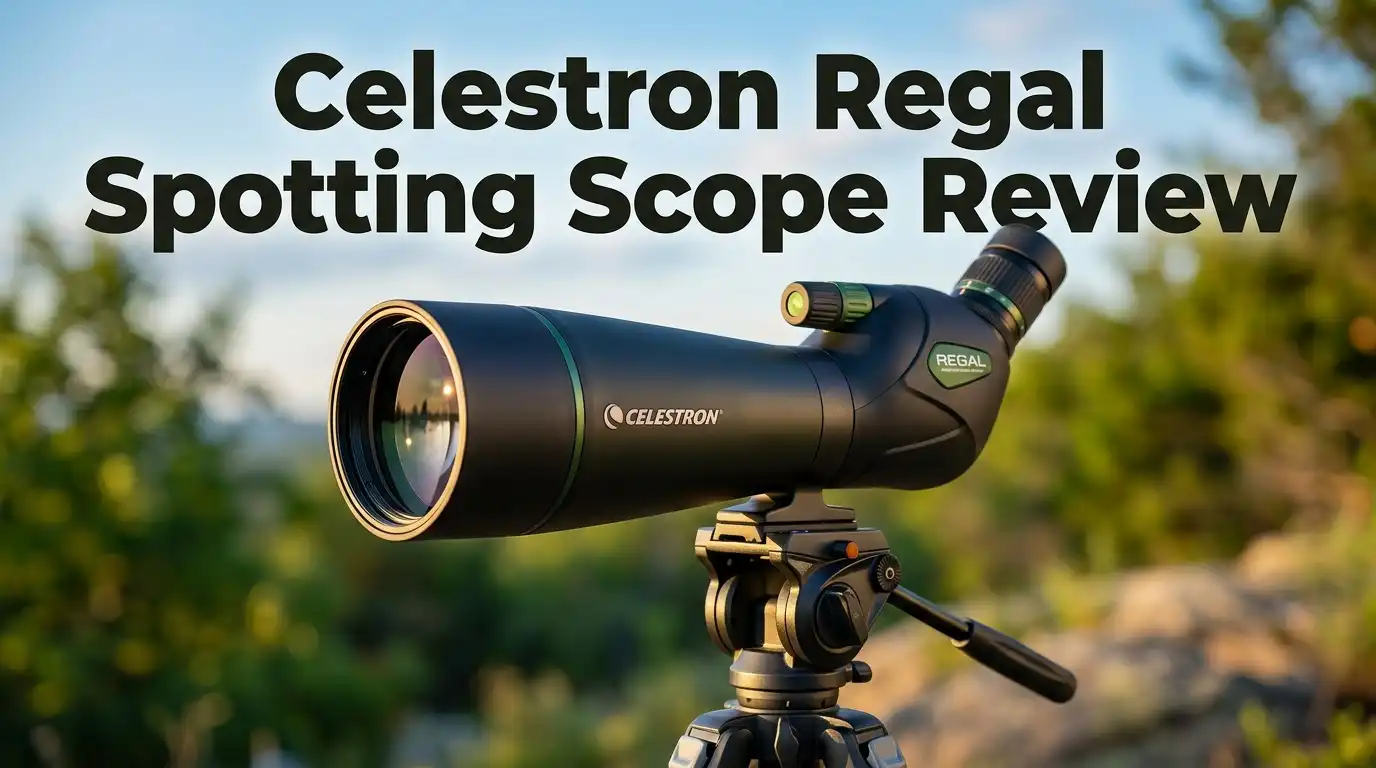
Celestron Regal Spotting Scope Review 2026: Worth Buying?
You want a spotting scope that shows real feather detail at 600 yards. You also want to keep your savings account intact.
The Celestron Regal M2 series sits right in that middle ground, and it has stayed popular for more than a decade. Birders use it. Long range shooters use it. Backyard astronomers sneak it onto a tripod at night.
But popular does not always mean perfect. The Regal M2 has real strengths and a few frustrating quirks that owners talk about often. This review covers both sides.
In a Nutshell:
- ED glass at a fair price. The Regal M2 line uses Extra Low Dispersion objective lenses with Celestron’s XLT fully multicoated optics. Color fringing stays low. Contrast holds up well. You get performance that used to cost twice as much.
- Three sizes cover three buyers. The 65ED weighs about 4.5 pounds and travels easily. The 80ED hits the sweet spot at 66.6 ounces with the eyepiece attached. The 100ED gathers the most light at 85.3 ounces and asks for a serious tripod.
- Magnesium alloy body saves real weight. Celestron cut over 14 percent of the mass compared to the older Regal F ED series. The scope still feels solid in cold weather and wet weather.
- Dual focus works fast. A coarse knob gets you close. A fine knob locks in the detail. Celestron claims two times faster focusing than the previous generation, and field use backs that up.
- The 1.25 inch eyepiece mount is a genuine bonus. You can drop in astronomy eyepieces for sharper fixed power views. The catch is that swapping them takes effort, which we cover honestly below.
- It is not a Swarovski. Edge sharpness softens past 50x. The zoom eyepiece narrows at high power. Some owners feel the 100ED does not deliver the light gain its aperture promises.
Celestron Regal M2 65ED Spotting Scope Review


Last update on 2026-09-17 / Affiliate links / Images from Amazon Product Advertising API Some of the links on this website are affiliate links, which means that at no additional cost to you, I earn a commission if you click through and make a purchase. I only recommend products and services that I believe will add value to my readers. Thank you for your support!
The 65ED is the travel member of the family. It measures roughly 13 inches long and weighs about 4.5 pounds with the eyepiece attached. You can carry it on a hike without hating your decision by mile three.
The 16x to 48x zoom eyepiece gives you a usable range for birding. Views stay bright through most of that range because the exit pupil holds reasonable size. Small aperture always costs you light, and you will notice it at dusk.
Sharpness is the headline here. Owners on birding forums describe the 65ED as surprisingly crisp for its class, with clean color and minimal purple fringing on high contrast edges like a white egret against dark water.
The close focus sits around 16 feet. That helps butterfly watchers and anyone scanning a feeder in the yard.
The tradeoff is simple. You trade light gathering for portability. If your birding happens at first light or last light, step up in size.
Celestron Regal M2 80ED Spotting Scope Review

Last update on 2026-09-17 / Affiliate links / Images from Amazon Product Advertising API Some of the links on this website are affiliate links, which means that at no additional cost to you, I earn a commission if you click through and make a purchase. I only recommend products and services that I believe will add value to my readers. Thank you for your support!
The 80ED is the model most buyers should look at first. It balances aperture, weight, and price better than its siblings.
Specifications tell a clear story. The objective measures 80mm. Focal length is 480mm. The included eyepiece runs 20x to 60x. Weight lands at 55.5 ounces bare and 66.6 ounces with the eyepiece mounted. Close focus is 21.3 feet at 20x.
Field of view spans 110 feet at 1000 yards at the low end and 52 feet at the top end. That wide low power view makes finding your target far easier than the numbers suggest.
Eye relief measures 20mm at 20x. Eyeglass wearers get a full view with the twist up eyecup down.
Real world impressions are consistently positive. Reviewers call the optical clarity excellent and praise the outdoorsy carry case. The scope accepts any 1.25 inch eyepiece, which opens up serious upgrade paths.
At street prices near the mid 600 dollar range, the 80ED remains one of the strongest value picks in ED spotting scopes.
Unboxing the Celestron Regal M2
The box arrives plain and sturdy. Celestron does not spend money on theatrical packaging, and that is fine.
Inside, the scope sits inside its padded green nylon case. The case is the view through type, so you can mount the scope and glass through it without stripping the cover off. Rain days make you grateful for this detail.
You lift the scope out and the first thing you notice is density. The magnesium alloy body feels cool and tight. The rubber armor grips your palm. Nothing rattles.
The accessory tray holds the zoom eyepiece in its own sleeve, an objective lens cap, an eyepiece cover, an eyepiece mount cap, a lens cloth, a T adapter ring for camera work, and the manual. The 100ED also includes a balance rail.
Mounting the eyepiece takes about thirty seconds. You seat it, then turn the locking collar. Then you slide out the sunshade and spot the engraved sighting line on top.
Setup to first view takes under five minutes.
Top 3 Alternative for Celestron Regal M2 Spotting Scope

Last update on 2026-09-13 / Affiliate links / Images from Amazon Product Advertising API Some of the links on this website are affiliate links, which means that at no additional cost to you, I earn a commission if you click through and make a purchase. I only recommend products and services that I believe will add value to my readers. Thank you for your support!
Vortex Optics Diamondback HD Spotting Scope 20 to 60×85

Last update on 2026-09-17 / Affiliate links / Images from Amazon Product Advertising API Some of the links on this website are affiliate links, which means that at no additional cost to you, I earn a commission if you click through and make a purchase. I only recommend products and services that I believe will add value to my readers. Thank you for your support!
Athlon Optics Argos HD 20 to 60×85 Spotting Scope

Last update on 2026-07-01 / Affiliate links / Images from Amazon Product Advertising API Some of the links on this website are affiliate links, which means that at no additional cost to you, I earn a commission if you click through and make a purchase. I only recommend products and services that I believe will add value to my readers. Thank you for your support!
Celestron Ultima 20 to 60×80 Angled Spotting Scope
Optical Performance in Daylight
Daylight is where the Regal M2 earns its reputation. Point it at a distant ridge on a clear morning and the image snaps into place with strong contrast and neutral color.
The ED objective does its job. Chromatic aberration stays controlled on tough targets like a dark branch against bright sky. You see a faint trace of color at the highest zoom settings, but it never smears fine detail.
Resolution stays excellent from the low end through about 40x. Past 45x, atmospheric shimmer usually limits you more than the glass does.
Edge performance is the honest weak point. The center of the field looks tack sharp. The outer 20 percent softens slightly, especially at maximum zoom. Premium European scopes hold their edges better, and they charge three times more for that privilege.
Long range shooters report reading bullet holes at 200 yards under good light with the 80ED. Birders report clear plumage detail on waterfowl at 400 yards.
That is strong performance for this price bracket.
Low Light and Astronomy Performance
Twilight separates good scopes from average ones. The Regal M2 does reasonably well, with caveats.
The 80ED posts a twilight factor between 40 and 69.3. The 100ED pushes that to 46.9 through 81.9. Bigger aperture helps, but only if you keep magnification low. Drop to 20x or 22x at dusk and the image stays usable far longer.
Astronomy fans find real value here. The 100ED reaches a limiting stellar magnitude near 12.5 under ideal skies. Users report clean views of Jupiter’s moons, Saturn’s rings, and lunar craters. One owner described the 100ED as sharp, lightweight, and genuinely fun for quick planet sessions.
Now the honest part. One detailed forum comparison found the 100ED delivered only a slight brightness gain over an 80mm Pentax scope at matched magnifications. The reviewer suspected the scope does not use its full 100mm aperture.
Treat the 100ED as a strong 90mm class performer rather than a true light cannon.
Build Quality and Weather Sealing
Celestron built the Regal M2 to survive field abuse. The magnesium alloy housing resists dents better than plastic and weighs less than aluminum.
The body is fully waterproof and nitrogen purged. Internal fogging does not happen when you move from a cold truck into humid air. Rain, snow, and river spray cause no drama.
Rubber armor covers the main tube. The texture grips well with gloves on. Owners in cold climates report the focus knobs still turn smoothly at freezing temperatures.
The rotating tripod collar includes detents. You loosen the ring, rotate the body, and click it into a comfortable eyepiece angle. This matters when you glass from a prone position or share the scope with someone taller.
The sliding sunshade extends smoothly and blocks stray light. The etched sighting line on top helps you aim before you look through the eyepiece.
Celestron backs the series with a limited lifetime warranty. Users describe the mechanics as perfectly usable rather than luxurious, which is a fair summary.
The Dual Focus System in Real Use
The dual focus mechanism is a highlight. Two separate knobs sit on top of the body.
The coarse knob moves focus quickly. You use it to jump from a nearby fence post to a distant treeline in one motion. The fine knob makes tiny adjustments for critical sharpness at high zoom.
This design beats single knob scopes for speed and precision. Celestron says focusing happens two times faster than the previous Regal generation, and field testing supports the claim.
The knobs have different textures, so your fingers learn them without looking. Tension feels even through the whole travel. No sticky spots. No backlash worth mentioning.
One small complaint appears in owner reports. The fine focus can feel slightly loose after years of heavy use. Nothing breaks, but the crispness fades a little.
Bird photographers appreciate the system most. A warbler moves three feet closer and you track focus instantly. That single feature saves shots you would otherwise lose.
Eyepiece Options and the 1.25 Inch Mount
The Regal M2 accepts standard 1.25 inch astronomy eyepieces. This is a rare feature at this price, and it changes what the scope can do.
Swap in a quality fixed power eyepiece and image quality improves noticeably. A good 24mm wide field eyepiece gives you a bigger, sharper view than the zoom at similar magnification. Astronomy users gain the most from this flexibility.
Celestron also sells a 27x long eye relief eyepiece made for the 80mm Regal M2, which suits eyeglass wearers well.
Here is the honest drawback. The eyepiece holder uses an internal O ring that pushes the eyepiece back out. You must press down firmly while turning the locking collar several times. One owner described bracing the eyepiece with his chin while holding the body and turning the collar.
If you seat the eyepiece poorly, the scope will not reach focus.
Frequent swappers will find this annoying. Set it once and forget it, and the issue disappears.
Digiscoping and Camera Work
The Regal M2 ships with a T adapter ring in the box. That saves you money right away.
Attach a T ring for your camera brand, thread it to the adapter, and your DSLR or mirrorless body becomes a long telephoto lens. The 80ED gives you 480mm of focal length. The 100ED gives you 540mm.
Image quality through this setup is decent, not spectacular. The scope was built for eyes first and sensors second. You get sharp centers and softer corners on a full frame body. Crop sensor cameras look better because they use only the sweet spot.
Smartphone digiscoping works well with a third party bracket. The 20mm eye relief gives your phone lens room to align.
Two practical warnings apply. First, you need a heavy tripod because any vibration ruins the shot. Second, autofocus does not work, so you focus manually every time.
Casual wildlife documentation works fine. Professional bird photography still needs a dedicated telephoto lens.
Weight, Tripod Needs and Field Portability
Weight deserves real discussion because it shapes your experience.
The 65ED weighs about 4.5 pounds ready to use. You can hike with it on a light carbon tripod. The 80ED reaches 66.6 ounces, roughly 4.2 pounds, with the eyepiece attached. The 100ED climbs to 85.3 ounces, which is over 5.3 pounds.
Your tripod must be stronger than you expect. A flimsy photo tripod will shake at 60x and ruin every view. Budget at least 200 dollars for a proper video head and legs.
The 100ED includes a balance rail so you can shift the center of gravity. Use it. Without it, the long body tips forward on most heads.
Length matters too. The 80ED stretches to 19.1 inches with the eyepiece on. The 100ED reaches 21.9 inches. Neither fits inside a small daypack.
Backcountry hunters who count ounces should choose the 65ED. Truck based glassing favors the 100ED.
What the Celestron Regal M2 Does Not Do Well
Honest reviews list problems. Here are the real ones.
Edge sharpness drops at high zoom. The outer field softens past 50x. Alpha class scopes from Swarovski, Zeiss, and Kowa hold their edges far better.
The 100ED underperforms its aperture. Multiple experienced users report brightness gains smaller than a 20mm aperture jump should deliver. If you buy the 100ED purely for low light, temper your expectations.
Eyepiece swapping is a chore. The O ring design fights you every time.
The zoom eyepiece narrows uncomfortably at maximum power. The field of view shrinks to 47 feet at 1000 yards on the 100ED, which makes tracking moving animals harder.
Mechanical polish trails the optics. Focus knobs and collars feel functional rather than refined. One owner summed it up by calling the mechanics not fantastic but perfectly usable.
Availability fluctuates. The 65ED in particular goes out of stock often, and prices swing between 570 and 700 dollars.
Pros and Cons
Pros
- ED glass delivers excellent color accuracy and low chromatic aberration for the price bracket.
- Magnesium alloy body cuts weight by more than 14 percent over the older series.
- Dual focus knobs make target acquisition fast and precise.
- Fully waterproof and nitrogen purged construction handles rain, snow, and humidity.
- Standard 1.25 inch eyepiece mount lets you upgrade views with astronomy eyepieces.
- T adapter ring comes included, so camera work costs you less.
- Rotating tripod collar with detents adapts to any viewing position.
- Limited lifetime warranty from an established brand.
- Padded view through carry case protects the scope and lets you glass while it stays covered.
Cons
- Edge sharpness softens past 50x magnification.
- The 100ED may not use its full aperture, so low light gains disappoint some users.
- Eyepiece holder design makes swapping eyepieces slow and awkward.
- The 100ED weighs over 5 pounds and demands a heavy tripod.
- Field of view narrows sharply at top magnification.
- Mechanical feel trails premium European competitors.
- Stock availability and pricing fluctuate across retailers.
Who Should Buy the Celestron Regal M2
This scope fits specific people very well.
Serious birders on a budget get the most value. You want ED glass and real resolution without spending 2500 dollars. The 80ED answers that need directly.
Long range shooters find the Regal useful for spotting impacts at 200 to 600 yards. Users on shooting forums describe it as very clear at long distances and easy to pack.
Casual astronomers gain an unusual benefit. The 1.25 inch eyepiece mount means your spotting scope doubles as a small refractor for the Moon and planets.
Nature photographers who document rather than publish will like the included T adapter.
Skip this scope if you glass in near darkness for hours, if you swap eyepieces constantly, or if you demand edge to edge perfection. Those buyers should save for a Kowa or Swarovski.
Backpackers who count every ounce should pick the 65ED and accept the light penalty.
Price and Value in 2026
Celestron lists the 80ED at 879.95 dollars and the 100ED at 1049.95 dollars on its own site. Street prices run lower.
The 65ED has appeared near 570 dollars at Amazon, with a list price around 629 dollars. The 80ED often sits in the 600s. The 100ED usually lands between 800 and 950 dollars.
Value depends on what you compare it against. Against the Vortex Diamondback HD 20 to 60×85, the Regal offers comparable glass with the eyepiece swap advantage. Against the Athlon Argos HD, the Regal costs more but delivers cleaner color correction.
Against alpha scopes costing 2000 dollars and up, the Regal gives you roughly 80 percent of the performance for about 35 percent of the money.
The limited lifetime warranty protects your purchase long term.
Watch for price drops. This series has been in production for years, and retailers discount it regularly.
Final Verdict
The Celestron Regal M2 remains a smart buy in 2026. It is not the best spotting scope made, and it never claimed to be.
What it does is give ordinary buyers access to genuine ED performance, weatherproof construction, and flexible eyepiece options at a price that does not require a second mortgage.
Buy the 80ED if you want the best balance. Buy the 65ED if you hike. Buy the 100ED only if you glass mostly from a vehicle and you understand its light gathering limits.
Pair it with a strong tripod. That single accessory affects your experience more than any spec on the box.
Rating: 4.3 out of 5.
Frequently Asked Questions
Is the Celestron Regal M2 waterproof?
Yes. Every Regal M2 model is fully waterproof and nitrogen purged. The nitrogen fill prevents internal fogging when temperatures change quickly. You can glass through rain and snow without worry. Dry the external lenses with the included cloth afterward.
Can I use the Regal M2 for astronomy?
Yes, and it works better than most spotting scopes. The 1.25 inch eyepiece mount accepts standard astronomy eyepieces. The 100ED reaches a limiting stellar magnitude near 12.5 under ideal skies. Users report clear views of lunar craters, Saturn’s rings, and Jupiter’s moons. Never point it at the Sun.
Which Regal M2 size should I choose?
Choose the 65ED for hiking and travel. Choose the 80ED for balanced all around use, which suits most buyers. Choose the 100ED for maximum aperture from a vehicle or fixed position. The 80ED offers the best mix of weight, brightness, and price.
Does the Regal M2 come with a tripod?
No. The package includes the scope, zoom eyepiece, lens caps, carry case, T adapter ring, lens cloth, and manual. You must buy a tripod separately. Choose a sturdy model with a fluid video head, because vibration ruins high magnification views.
How does the Regal M2 compare to the Celestron Ultima?
The Regal M2 uses ED glass and a magnesium body. The Ultima uses standard glass and costs far less. The Regal shows better color correction and sharper detail at high zoom. The Ultima suits casual users. The Regal suits people who glass often and care about image quality.
Can I attach a camera to the Regal M2?
Yes. A T adapter ring comes in the box. Add a T ring matched to your camera brand and you get a 480mm lens on the 80ED or 540mm on the 100ED. Focus manually and use a heavy tripod. Smartphone adapters also work well.

Hello, I’m Emily Price, the founder of Birds Affection. As a passionate bird enthusiast and spiritual seeker, I’ve always been fascinated by the symbolic meanings and mystical connections between birds and our lives. On this website, I share my knowledge and insights on the spiritual significance of various bird species, exploring their roles as messengers, guides, and teachers. Through my writing, I aim to inspire and educate others on the profound wisdom and beauty that birds bring to our world. Join me on this journey as we delve into the enchanting realm of bird symbolism and discover the hidden meanings behind these magnificent creatures.