Tasco World Class Spotting Scope Review 2026: Worth Buying?
Spotting scopes used to cost a small fortune. Today you can grab one for less than the price of a decent pair of boots. The Tasco World Class sits right at that entry level, and it keeps showing up in shopping carts every hunting season. The question is simple. Does cheap glass still deliver a usable image, or are you better off saving up?
I spent time with this scope at the range, on a ridge at first light, and pointed at the moon from my driveway. What follows is an honest account.
I will tell you where the Tasco surprised me and where it plainly let me down. If you want marketing copy, you will not find it here. If you want to know whether this scope earns a spot in your truck, keep reading.
In A Nutshell:
- The price is the main selling point. The Tasco World Class usually lands around the $100 to $160 mark depending on the model and objective size. That is entry level money for a 60mm or 80mm scope, and no other brand really undercuts it.
- Daylight performance is acceptable, not impressive. At 20x to 30x magnification the image stays fairly sharp and bright. Push the zoom past 40x and the picture softens, dims, and loses contrast quickly.
- The included tripod is the weakest part of the package. It wobbles, it lacks height, and it fights you during fine adjustments. Budget another $40 for a real tripod and treat the bundled one as a spare.
- Build quality feels light and plasticky. The housing is waterproof and fogproof on paper, but it does not feel like a lifetime tool. Several owners report the eyepiece fogging in high humidity or freezing conditions.
- Best uses are casual. Backyard birding, plinking sessions at 50 to 100 yards, moon watching, and general scouting all work fine. Serious long range target scoring and trophy judging at 600 yards will frustrate you.
- Who should buy it: first time buyers, occasional users, and anyone who wants magnification without commitment. Everyone else should stretch the budget.
Tasco World Class 20 To 60x60mm Spotting Scope

Last update on 2026-09-30 / Affiliate links / Images from Amazon Product Advertising API Some of the links on this website are affiliate links, which means that at no additional cost to you, I earn a commission if you click through and make a purchase. I only recommend products and services that I believe will add value to my readers. Thank you for your support!
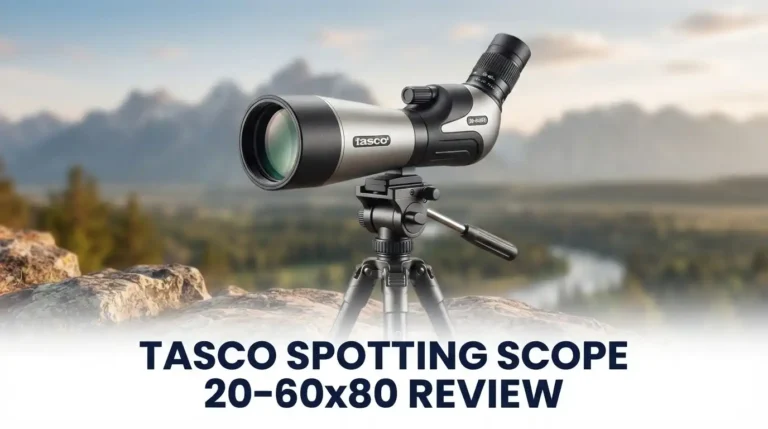
The Tasco World Class is the brand’s long running nature and hunting scope line. The most common version pairs a 60mm objective lens with a 20x to 60x zoom eyepiece set at a 45 degree angle. An 80mm variant also exists for shoppers who want more light gathering. Both ship with a compact tabletop tripod, lens covers, a soft carry bag, and a hard case on most retail packages.
Tasco lists fully multicoated optics, a retractable sunshade, a rubber armored body, and waterproof plus fogproof sealing.
The 60mm model weighs roughly 1.8 pounds and measures about 13 inches long with the shade retracted. Those numbers matter. This is a genuinely portable scope, and that portability becomes one of its real strengths once you get past the optical limits.
Unboxing Experience And First Impressions
The box is plain cardboard with a product photo on the front. Inside, the scope sits in a molded hard case with a zippered lid. That case impressed me more than I expected at this price. It holds the scope, the tripod, and the caps without rattling around.
Lifting the scope out, the first thing you notice is how light it feels. Light in a good way for packing, light in a worrying way for durability. The rubber armor has a slightly slick finish rather than a grippy texture. The eyepiece and objective covers are simple friction fit rubber. They stay on, but they are the first thing most owners lose.
The tiny tripod comes folded in a separate pocket. Unfolding it takes two seconds and sets expectations immediately. It is small, thin legged, and clearly an afterthought.
Build Quality And Materials
Let me be direct. The Tasco World Class does not feel premium. The body shell is lightweight polymer under a thin rubber coat. Press firmly on the barrel and you can feel a little flex. The focus knob and zoom ring both turn smoothly enough, but they have a hollow, plasticky sound.
The tripod mounting foot uses a standard quarter inch thread, which is genuinely useful. You can swap the scope onto any camera tripod without an adapter.
Sealing is the part I cannot fully verify. Tasco claims waterproof and fogproof construction, and the scope survived a steady drizzle with no internal moisture. However, multiple long term owners report eyepiece fogging in humid heat and frost forming in freezing weather. That points to a rubber eyecup trapping breath and body heat rather than a seal failure, but the practical result is the same annoyance.
Optical Performance In Bright Daylight
This is where your money goes, so here is the honest breakdown. On a clear sunny afternoon at 20x, the image looks respectable. Colors stay natural, the center of the field is reasonably sharp, and you can identify a robin across a large field without strain.
Zoom to 30x and things hold together. Zoom to 40x and the picture starts to soften noticeably. By the time you reach 60x, the view turns dim, hazy, and low in contrast. I stopped using the top end of the zoom range almost entirely.
Chromatic aberration shows up as purple or green fringing along dark edges against bright sky. It is obvious on power lines and bare branches. The usable field of view also feels narrow, which makes finding your target slower than it should be. Treat this as a 20x to 35x scope with a 60x bonus you will rarely want.
Top 3 Alternative For Tasco World Class Spotting Scope


Last update on 2026-10-13 / Affiliate links / Images from Amazon Product Advertising API Some of the links on this website are affiliate links, which means that at no additional cost to you, I earn a commission if you click through and make a purchase. I only recommend products and services that I believe will add value to my readers. Thank you for your support!
Celestron Ultima 20-60×80 Angled Spotting Scope

Last update on 2026-09-13 / Affiliate links / Images from Amazon Product Advertising API Some of the links on this website are affiliate links, which means that at no additional cost to you, I earn a commission if you click through and make a purchase. I only recommend products and services that I believe will add value to my readers. Thank you for your support!
Bushnell Trophy Xtreme 20-60×65 Waterproof Spotting Scope

Last update on 2026-09-13 / Affiliate links / Images from Amazon Product Advertising API Some of the links on this website are affiliate links, which means that at no additional cost to you, I earn a commission if you click through and make a purchase. I only recommend products and services that I believe will add value to my readers. Thank you for your support!
Gosky Updated 20-60×80 Spotting Scope with Tripod and Phone Adapter
Low Light Performance At Dawn And Dusk
Hunters care about the first and last thirty minutes of legal light. The Tasco struggles here, and I want to be clear about why.
A 60mm objective at 60x magnification produces a one millimeter exit pupil. Your eye cannot work with that in dim conditions. Even at 20x, the three millimeter exit pupil sits below what a human pupil opens to at dusk. Add budget glass coatings, and light transmission drops further.
In practice, the image went muddy roughly twenty minutes before sunset. Detail collapsed into gray shapes. I could tell a deer was standing there. I could not count points. The 80mm version does better and is worth the small upcharge if low light use matters to you. For serious dawn and dusk work, this scope is not the right tool.
The Included Tripod Is The Weak Link
I will say this plainly. The bundled tripod is the single biggest complaint from owners, and I agree with every word of it.
The legs are thin aluminum. The pan head has limited travel, so aiming at anything above or below your eye level becomes an exercise in patience. It stands only tall enough for bench or tailgate use. Any breeze introduces visible shake, and at 40x a tiny shake becomes a huge blur.
There is worse news. Because the eyecup requires you to press your face close, your own head movement transmits straight into the image on this flimsy mount. The fix is cheap and easy. Buy a mid weight photo tripod with a fluid pan head. The scope becomes a genuinely different product once it sits on something stable.
Focus And Zoom Controls
The focus wheel sits on top of the barrel near the eyepiece. It turns with moderate resistance and takes about one and a half rotations to run from near to infinity. That ratio works fine for slow scanning, though fast refocusing between distances feels sluggish.
Precision is the issue. The sweet spot is narrow, and the knob has a small amount of play. You often overshoot and have to creep back. With gloves on, this gets fiddly.
The zoom ring sits on the eyepiece collar and rotates smoothly with clear power markings. It stays where you put it, which I appreciated. One quirk worth knowing. Changing magnification shifts the focus slightly, so you need a small focus correction after every zoom change. Better scopes hold focus through the zoom range.
Eye Relief And Eyepiece Comfort
Eye relief measures roughly 18 to 20mm depending on the model, and on paper that sounds fine. Reality is less comfortable. The rubber eyecup is shallow and firm, and the exit pupil position feels fussy. Move your head slightly off axis and the image blacks out around the edges.
Eyeglass wearers will notice this most. You can fold the cup down, but the sight picture still narrows. I found myself pressing my brow against the rubber to hold position, which is exactly what causes the fogging problem I mentioned earlier.
Long viewing sessions become tiring. After fifteen or twenty minutes of scanning, my eye felt strained. Comfort is a real cost here, and it is the kind of thing spec sheets never mention.
Range Use: Spotting Bullet Holes At 100 Yards
This is the job most buyers have in mind, so here are real results. At 50 yards, the Tasco shows .22 caliber holes in paper clearly at 20x to 30x. No complaints at all. Owners consistently confirm this, and it alone saves a lot of walking.
At 100 yards the picture changes. In flat, even light on a white target, I could make out .30 caliber holes at around 40x. In harsh midday sun with mirage, or on a dark colored target, I lost them completely. Smaller calibers at 100 yards were hit or miss.
Beyond 100 yards, forget it. Bullet hole spotting past that distance sits outside this scope’s ability. If you shoot precision groups at 200 yards or more, you need better glass or a target camera.
Birding And Wildlife Watching
Casual birding is where the Tasco earns its keep. Set it up on a deck overlooking a feeder or a pond, dial it to 25x, and you get a genuinely enjoyable view. Feather patterns on a cardinal, the eye ring on a warbler, ducks across open water. All clearly identifiable.
The 45 degree angled eyepiece helps more than I expected. It lets you view comfortably from a seated position and reduces neck strain during long sessions.
The limits show with distant shorebirds and raptors. Fine plumage detail needed for tricky identification just is not there. Serious birders chasing rare species will outgrow this scope in one season. For a beginner learning the hobby, it is a reasonable starting point that costs a fraction of dedicated birding glass.
Astronomy And Moon Viewing
Here is a pleasant surprise. The Tasco performs better on the moon than it does on almost anything else. Lunar craters at 40x look crisp and detailed because the moon is so bright that mediocre light transmission stops mattering.
You also get an upright, correctly oriented image, unlike a traditional astronomical telescope that flips the view. Panning feels natural. Jupiter shows as a small disc with a couple of moons visible as points. Saturn’s rings appear as a faint oval shape if seeing conditions cooperate.
Deep sky objects are off the table. A 60mm objective with budget coatings simply cannot gather enough light for nebulae or galaxies. Think bright targets only. On a solid tripod, this becomes a fun casual stargazing tool that doubles as a daytime scope.
Digiscoping With A Smartphone
Plenty of buyers want to shoot photos through the eyepiece. The Tasco World Class does not include a phone adapter, which is a notable omission in 2026 when competitors bundle one for the same money.
You can buy a universal clamp adapter separately for around $20. Alignment takes patience because the eyepiece diameter and short eye relief make centering the phone camera tricky. Once aligned, results are strictly casual. Photos come out soft with visible vignetting and color fringing on bright edges.
Video is worse because any tripod vibration turns into obvious shake. Digiscoping works, barely, for a record shot. If photography is a real goal for you, pick a scope that ships with a proper adapter and holds focus better through the zoom range.
Pros And Cons
Pros
- Very low price for a 60mm or 80mm spotting scope with 20x to 60x zoom
- Complete package including hard case, soft bag, lens covers, and a starter tripod
- Light and compact at under two pounds, easy to pack or leave in a vehicle
- Standard quarter inch tripod thread accepts any camera tripod
- Solid performance at 20x to 30x in good light
- Excellent for moon viewing and bright planet spotting
- Angled eyepiece reduces neck strain during long sessions
- Retractable sunshade helps with glare and light rain
Cons
- Image quality falls apart above 40x magnification, with dim, hazy views at 60x
- Poor low light performance at dawn and dusk
- Included tripod is flimsy and lacks height and smooth adjustment
- Noticeable chromatic aberration on high contrast edges
- Short, shallow eyecup causes eye strain and blackout
- Eyepiece fogging reported in high humidity and freezing weather
- Lightweight plastic body does not inspire long term confidence
- Focus shifts when you change magnification
- No phone adapter included
- Narrow field of view slows target acquisition
What This Scope Does Not Do Well
I want to spell this out because too many reviews skip it. The Tasco World Class fails at four specific jobs.
It fails at long range target scoring. Spotting holes past 100 yards is unreliable. It fails at trophy judging in dim light. You will see an animal but not the detail that matters. It fails at critical bird identification, because the resolution needed for fine plumage marks is absent. It fails as a high magnification scope, despite 60x printed on the box. That top end is essentially decoration.
The tripod also fails as a tripod. Plan on replacing it. And the eyecup design makes extended viewing genuinely uncomfortable.
None of this makes the scope worthless. It makes it a limited tool. Buy it knowing exactly what it cannot do, and you will not feel cheated.
Final Verdict: Who Should Buy It In 2026
The Tasco World Class is an honest entry level scope at an honest entry level price. It gives you magnification, portability, and a complete kit for roughly $100 to $160. At that number, expectations should stay modest.
Buy it if you are new to spotting scopes and want to test the hobby cheaply. Buy it for backyard birding, casual scouting, range sessions inside 100 yards, or moon watching with the family. Buy it as a knockaround scope you will not cry over.
Skip it if you hunt in low light, shoot past 100 yards, chase rare birds, or plan to digiscope seriously. In those cases, spending two or three times more on a Celestron Ultima, Bushnell Trophy Xtreme, or Vortex Diamondback HD returns real, visible improvement. Cheap glass has a ceiling, and this scope hits it fast.
FAQs
Is the Tasco World Class spotting scope waterproof?
Yes. Tasco lists the World Class line as waterproof and fogproof with nitrogen sealing and O ring construction. It handled light rain without internal moisture during my testing. That said, several owners report the eyepiece surface fogging or frosting in extreme humidity and cold. That is usually condensation on the outer lens from your face, not a seal failure, but it still interrupts viewing.
Can you see bullet holes at 100 yards with this scope?
Sometimes. Larger calibers on light colored paper in even lighting show up around 40x magnification. Small calibers, dark targets, or heavy mirage will hide them. At 50 yards it works reliably, even for .22 holes. Past 100 yards, plan on walking to the target or using a target camera instead.
Should I replace the included tripod?
Yes, and it is the best upgrade you can make. A mid weight photo tripod with a fluid pan head costs around $40 to $80 and transforms the shooting experience. The scope uses a standard quarter inch mounting thread, so almost any camera tripod fits without an adapter.
Is the 60mm or 80mm version better?
The 80mm model gathers noticeably more light, which helps most at dawn, dusk, and at higher magnification. It also weighs more and costs a little extra. If you mainly use the scope in bright daylight and value portability, the 60mm is fine. For low light use, choose 80mm.
How does Tasco compare to Celestron or Bushnell?
Tasco sits below both on optical quality and build. The Celestron Ultima and Bushnell Trophy Xtreme cost roughly two to three times more and deliver brighter, sharper images with better high magnification performance and stronger warranties. Tasco competes purely on price, and for a first scope that trade can still make sense.
Can I use this scope for astronomy?
Yes, for bright targets. The moon looks genuinely good at 40x, and you can spot Jupiter’s moons and a hint of Saturn’s rings on a steady night. Deep sky objects like galaxies and nebulae need far more aperture and better coatings than this scope offers.

Hello, I’m Emily Price, the founder of Birds Affection. As a passionate bird enthusiast and spiritual seeker, I’ve always been fascinated by the symbolic meanings and mystical connections between birds and our lives. On this website, I share my knowledge and insights on the spiritual significance of various bird species, exploring their roles as messengers, guides, and teachers. Through my writing, I aim to inspire and educate others on the profound wisdom and beauty that birds bring to our world. Join me on this journey as we delve into the enchanting realm of bird symbolism and discover the hidden meanings behind these magnificent creatures.