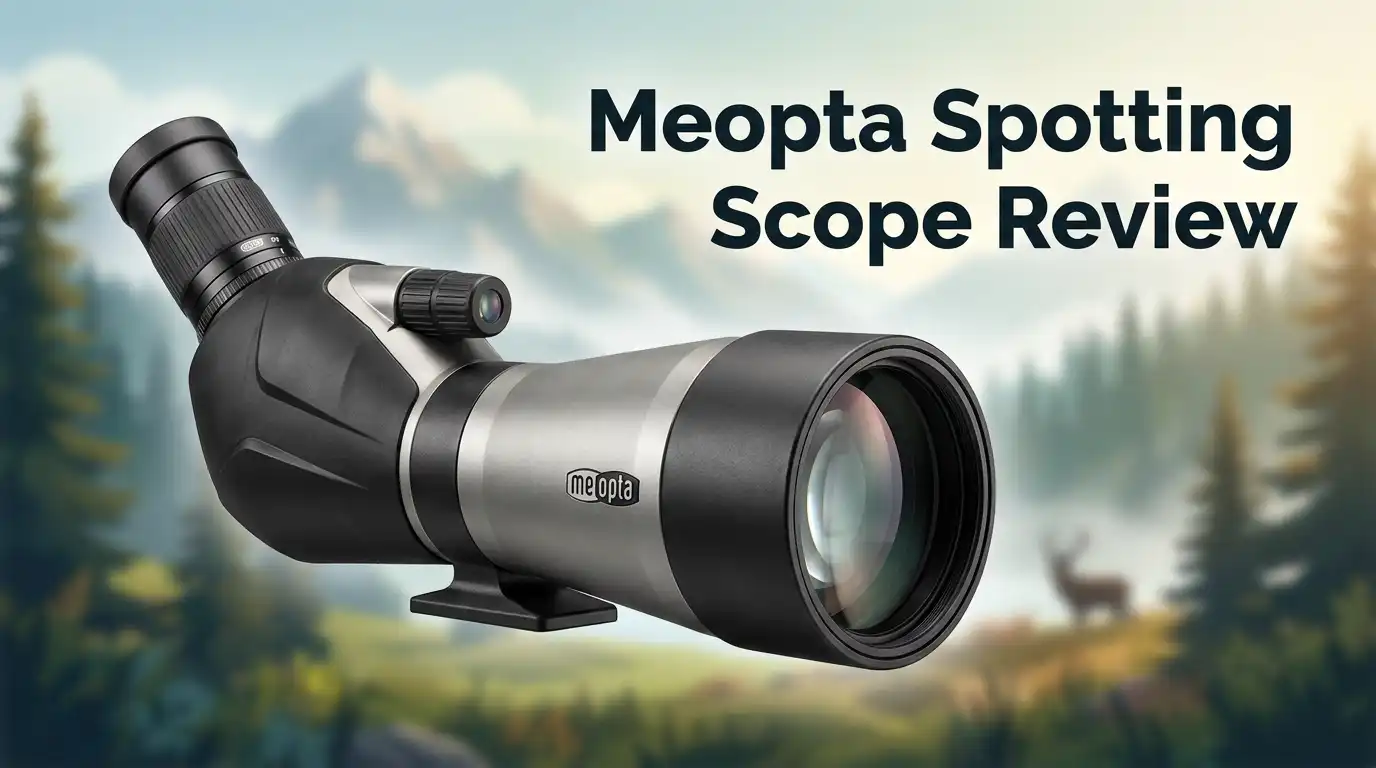
Meopta Spotting Scope Review 2026: Worth It?
You have a $2,000 budget and a hard question in front of you. Do you stretch for Swarovski, or does a Czech brand most of your hunting buddies cannot pronounce get you 95% of the way there?
That gap between “good glass” and “great glass” only shows up at 60x, at dusk, on a bedded buck two miles out. Anything less than honest resolution costs you the animal or the score.
I spent months with the Meopta MeoStar S2 82 HD, glassing shale slides, mudflats, and gull-covered jetties. This review covers what the fluoride objective actually delivers, where the focus wheel annoys, and who should buy something else.
In a Nutshell
- Optical class: The 82mm HD fluoride objective competes directly with Zeiss and Swarovski at 60x. Center resolution is free of color fringing, and only a whisper appears at the very edge in high-contrast light.
- Best for: Western hunters, long-range shooters, and serious birders who glass for hours and judge antlers, feather patterns, or bullet holes at distance.
- Build: A nitrogen-purged magnesium alloy chassis wrapped in green rubber armor. The integrated foot clicks into most tripod heads without a separate plate, which saves real weight and fumbling.
- The catch: The eyepiece sells separately. Budget another $500 to $700 for either the 30-60x wide angle or the 20-70x super zoom, or your box arrives feeling incomplete.
- Weight reality: Roughly 4 pounds with an eyepiece attached and 16.5 inches long. That is a truck scope or a short-pack scope, not a backcountry ultralight.
- Value verdict: Around $2,000 to $2,400 complete against $3,000 to $4,000 for the Austrian and German alpha scopes. The savings are real and the optical penalty is small.
Meopta MeoStar S2 82 HD Spotting Scope

Last update on 2026-07-25 / Affiliate links / Images from Amazon Product Advertising API Some of the links on this website are affiliate links, which means that at no additional cost to you, I earn a commission if you click through and make a purchase. I only recommend products and services that I believe will add value to my readers. Thank you for your support!
Meopta has built optics in Přerov, Czech Republic since 1933, two years before Swarovski Optik existed. That history matters because the company grinds its own glass rather than sourcing it.
The S2 82 HD sits at the top of the Meopta line. It uses an apochromatic fluoride objective, MeoBright ion-assisted coatings, and MeoShield hydrophobic protection on exterior surfaces.
You choose the body first: straight or angled. Then you choose the eyepiece, which mounts through a locking bayonet with a push-button release.
That modular setup annoys buyers who expect a complete package. It rewards anyone who later wants a different magnification range without replacing the whole instrument.
Meopta claims class-leading light transmission. In practice, the scope sits within a hair of scopes costing twice as much, and it beats several of them on contrast.
Unboxing and First Impressions
The box is plain cardboard with foam inserts. No leather, no theater, no branded unboxing experience. Meopta spent the money on glass instead.
Inside you get the body, objective and eyepiece caps, a cleaning cloth, and paperwork. The stay-on case sells separately, which stings at this price.
Lift the body out and the density registers immediately. It feels solid rather than heavy, with weight distributed evenly along the barrel.
The armor is a matte forest green rubber with a light texture. It grips well in wet hands and stays quiet against a rifle stock or tripod leg.
Turn the helical focus collar once and you understand the price. It moves like a well-damped camera lens with zero grit and no backlash.
The eyepiece bayonet locks with an audible click. There is no wobble, no play, and no sense that the connection is a weak point.
First impression: this is a working tool built by people who use them, not a display piece.
Build Quality and Handling in the Field
The magnesium alloy chassis shrugs off treatment that would dent aluminum. Meopta scopes have survived tumbles down avalanche chutes without losing collimation.
Focus speed is fast. The full range travels in about a quarter turn, which takes adjustment if you came from a slow fine-focus European scope.
That speed becomes an advantage within a week. You land on sharp focus quicker than you would with a two-stage system.
The integrated tripod foot is the sleeper feature. It seats directly into Manfrotto-style heads with no adapter plate, removing a failure point and a few ounces.
The rotating collar loosens with a firm twist and lets you angle the eyepiece for prone shooting or standing glassing. It holds position without creep.
The twist-up eyecup offers generous eye relief. Eyeglass wearers get the full field, and eyelashes never touch the ocular glass.
The integrated sunshade pulls forward smoothly and stays put. Glare control improves noticeably with it extended.
Top 3 Alternative for Meopta MeoStar S2 82 HD

Last update on 2026-07-25 / Affiliate links / Images from Amazon Product Advertising API Some of the links on this website are affiliate links, which means that at no additional cost to you, I earn a commission if you click through and make a purchase. I only recommend products and services that I believe will add value to my readers. Thank you for your support!
Vortex Razor HD 27-60×85 Angled Spotting Scope

Last update on 2026-07-25 / Affiliate links / Images from Amazon Product Advertising API Some of the links on this website are affiliate links, which means that at no additional cost to you, I earn a commission if you click through and make a purchase. I only recommend products and services that I believe will add value to my readers. Thank you for your support!
Athlon Optics Cronus G2 20-60×86 Spotting Scope

Last update on 2026-07-25 / Affiliate links / Images from Amazon Product Advertising API Some of the links on this website are affiliate links, which means that at no additional cost to you, I earn a commission if you click through and make a purchase. I only recommend products and services that I believe will add value to my readers. Thank you for your support!
Maven CS.1 15-45x65mm Spotting Scope
Optical Performance at High Magnification
Resolution is where the money went. At 60x the S2 82 pulls detail that mid-tier 85mm scopes simply cannot render.
I compared it directly against a Zeiss Diascope 85 T FL. At matched 60x magnification, the Meopta showed slightly more detail.
The Zeiss regained the lead only by climbing to 75x, a power the 30-60x eyepiece cannot reach.
Chromatic aberration control is excellent. The center of the field is clean, and only high-contrast edges show a faint trace.
Depth of field runs deep, deeper than the Zeiss. That means faster focus acquisition and better resistance to mirage on hot afternoons.
Distortion behaves oddly. There is mild barrel distortion at low power that flattens out and turns to a touch of pincushion at maximum zoom.
The practical effect is slight rolling-ball motion when you pan at 30x. Static viewing shows no visible distortion at all.
Feather detail on a backlit immature gull at 60x, over 100 yards out, was sharp enough to call the age.
Low Light and Color Rendition
Low light is where premium glass earns its keep. The S2 82 stays usable well past legal shooting light.
Against the Zeiss, the German scope held the thinnest edge in the final minutes of dusk. The difference is real but small enough that most users would miss it in a blind test.
Contrast is where Meopta separates from the pack. Colors come through saturated, and subtle tonal shifts between brush and hide are easy to read.
That contrast advantage matters more than raw brightness for judging antler mass against a timbered background.
Color bias is neutral. Older Meostar binoculars ran slightly warm and yellow, and the HD generation corrects that.
Stray light control is good rather than perfect. Glassing at a hard angle to low sun produced a glare artifact on one occasion.
I could not reproduce it afterward. Extending the sunshade eliminates the problem in nearly every situation.
Choosing Between the Two Eyepieces
This decision changes the scope more than the body choice does. Meopta offers a 30-60x wide angle and a 20-70x super zoom.
The 30-60x WA delivers a noticeably wider field than traditional 20-60x eyepieces from Swarovski and Zeiss at every matched power. It suits hunters who scan large basins.
The 20-70x trades some field width for a lower starting magnification and 70x on top. Target shooters checking holes at distance prefer it.
My recommendation for hunters is the 30-60x WA. Starting at 30x is not a handicap once you glass with binoculars first and confirm with the spotter.
Birders often want the 20x low end for finding subjects in dense cover. Choose the 20-70x if you bird more than you hunt.
Both eyepieces use the same bayonet, so you can own both and swap in seconds.
Neither is cheap. Factor the eyepiece into your budget from the start rather than treating it as an accessory.
Digiscoping and Phone Photos
Meopta sells MeoPix adapters that seat over the eyepiece and align a phone camera with the exit pupil.
The fit is firm and the alignment is precise. There is no vignetting and no need to refocus the scope after mounting.
Image quality surprises people. A mule deer doe at nearly two and a half miles came through as a recognizable, shareable photo.
The adapter also turns your phone into a shared viewing screen, which helps when you are glassing with a partner or teaching someone.
Twist the eyecup all the way down first, and remove any phone case. Skip either step and the fit fights you.
A camera app with a two-second timer removes shake and improves results dramatically.
The newer universal adapter fits most modern phones. Older model-specific versions are worth avoiding unless you own that exact handset.
Digiscoping will never match a proper camera and lens. For documenting sightings and scouting evidence, it does the job well.
Who Should Skip This Scope
Be honest about your use case before spending this much.
Backcountry hunters counting ounces should look elsewhere. Four pounds and 16.5 inches is a serious commitment on a multi-day pack trip.
Casual users who glass a few times a year will not perceive the difference between this and a $600 scope. Buy the cheaper option and spend the savings on a better tripod.
Anyone who wants a complete package out of one box will find the separate eyepiece purchase frustrating.
Shooters who need magnification above 70x for tiny-caliber hole spotting should consider a dedicated target scope.
Buyers who need extensive local dealer support may prefer a brand with wider retail presence, since Meopta service runs through a smaller network.
If your budget is genuinely capped at $2,000 total including eyepiece and tripod, a Vortex Razor HD leaves room for the rest of the kit.
The Flaws Nobody Advertises
Every scope has compromises. Here are the ones I noticed and the ones owners report consistently.
The focus wheel can arrive stiff. More than one reviewer has flagged this, and it appears to be sample variation rather than a design fault.
The rolling-ball effect at 30x while panning bothers some viewers. It disappears above 40x and during static observation.
The eyepiece cost is the biggest real complaint. A complete setup pushes past $2,400, which narrows the gap to the alpha brands.
Low-light performance sits a fraction behind Zeiss and Swarovski. The difference appears only in the last few minutes of usable light.
Maximum magnification tops out at 70x. Some competitors reach 75x for the same money.
The stay-on case and adapters all cost extra, which adds up quickly.
Availability is inconsistent. Meopta stock on major retail platforms comes and goes, and some models list intermittently.
Price and Value in 2026
Last update on 2026-07-25 / Affiliate links / Images from Amazon Product Advertising API Some of the links on this website are affiliate links, which means that at no additional cost to you, I earn a commission if you click through and make a purchase. I only recommend products and services that I believe will add value to my readers. Thank you for your support!
The body alone typically runs around $1,500 to $1,800, with complete packages landing near $2,000 to $2,400 depending on eyepiece choice.
Against a Swarovski ATX at $3,500 or a Zeiss Harpia at $4,000, the savings buy you a first-rate tripod, a head, and a rangefinder.
Against a Vortex Razor HD at roughly $1,700, the Meopta costs more but delivers measurably better contrast and edge sharpness.
Meopta backs the scope with a transferable lifetime warranty on optics and workmanship, serviced through Meopta USA.
Resale holds well. Used S2 bodies move quickly in optics classifieds, which limits your downside if you decide to change direction.
Verdict: yes, it is worth it, provided you glass often enough to use the resolution and you accept the eyepiece as part of the purchase price.
Occasional users are paying for capability they will not exercise. Serious ones will not regret it.
Frequently Asked Questions
Is Meopta as good as Swarovski or Zeiss?
Close enough that the difference rarely matters. Meopta trails slightly in the final minutes of low light and in maximum magnification. It leads in contrast, depth of field, and field of view at matched powers. Most users blind-testing the two would struggle to name a clear winner during daylight hours.
Does the Meopta S2 come with an eyepiece?
No. The body and eyepiece sell as separate items. Confirm your order includes both before checkout, because several buyers have opened a box expecting a complete scope and found only the body.
Straight or angled body, which should I buy?
Choose angled if you glass from a tripod for long sessions, share the scope, or view from seated positions. Choose straight if you glass from a truck window, a prone position, or need to acquire targets fast without repositioning your head.
Can I use a Meopta spotting scope for target shooting?
Yes. The 20-70x eyepiece resolves bullet holes well at 200 to 300 yards in decent conditions. Mirage limits every scope beyond that point, and the Meopta’s deep depth of field handles heat waves better than most.
How heavy is it for backpack hunting?
Around four pounds with an eyepiece. That is manageable for day trips and truck-based hunts. For multi-day backcountry work, a 65mm compact like the Maven CS.1 saves nearly two pounds.
What tripod does it need?
Something rated well above four pounds with a fluid head. The integrated foot fits Manfrotto-style heads directly. A weak tripod will waste every dollar you spent on the glass, because vibration destroys resolution faster than poor optics do.
Is the warranty transferable?
Yes. Meopta’s lifetime coverage on optics and workmanship transfers to subsequent owners, which supports resale value on the used market. Coverage runs through Meopta USA rather than international service centers.

Hello, I’m Emily Price, the founder of Birds Affection. As a passionate bird enthusiast and spiritual seeker, I’ve always been fascinated by the symbolic meanings and mystical connections between birds and our lives. On this website, I share my knowledge and insights on the spiritual significance of various bird species, exploring their roles as messengers, guides, and teachers. Through my writing, I aim to inspire and educate others on the profound wisdom and beauty that birds bring to our world. Join me on this journey as we delve into the enchanting realm of bird symbolism and discover the hidden meanings behind these magnificent creatures.