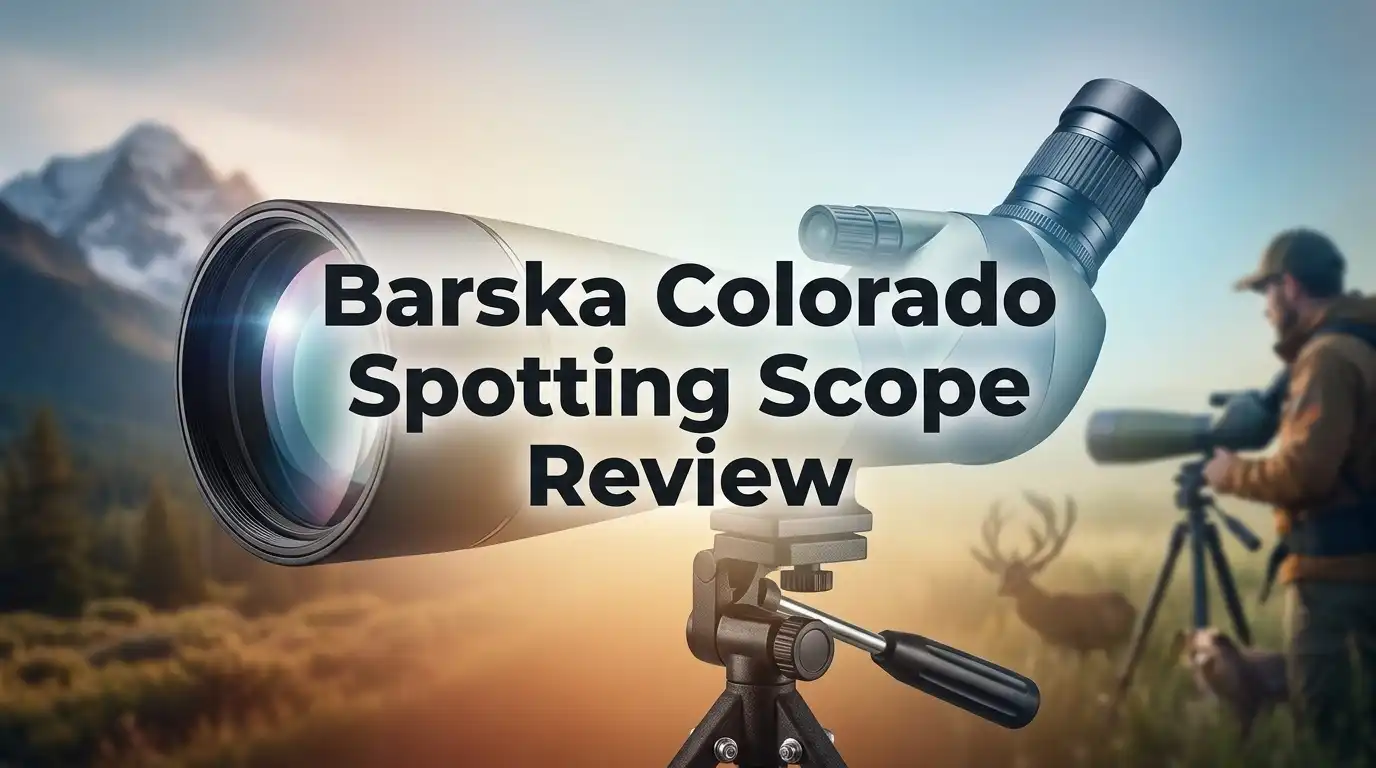
Barska Colorado Spotting Scope Review 2026: Still Worth It?
Spotting scopes confuse a lot of first time buyers. The numbers look impressive, the prices swing wildly, and the marketing photos never match what your eye actually sees.
The Barska Colorado sits right in the middle of that confusion. It costs less than a decent pair of binoculars, promises 60x magnification, and ships with a tripod and a case. That combination sounds too good to be true, and in some ways it is.
I spent weeks with this scope at a public rifle range, on a back porch feeder, and at a marsh boardwalk at sunrise. This review covers what the glass actually delivers, where the build feels cheap, and who walks away happy.
In a Nutshell:
- Best for close and medium range work. The Barska Colorado shines between 20x and 35x. Paper targets at 100 yards, backyard birds, and boat traffic all look clear and bright at those settings.
- The top end of the zoom is mostly marketing. At 55x and 60x the image gets dim, soft, and shaky. Most owners park the zoom ring below 40x and leave it there.
- The included tripod is the weakest part of the package. It works on a stable bench. It wobbles in wind and it will not survive rough handling. Budget for a replacement.
- Waterproof versions exist, and you want one. Barska sells both sealed and unsealed Colorado models. The sealed version resists fog and rain and costs only slightly more.
- Value is the real selling point. For the price of a tank of gas plus lunch, you get usable optics, a case, and a tripod. Nothing else at this price includes so much.
- Serious birders and long range shooters should spend more. The glass lacks ED elements, so color fringing shows on bright edges. An 80mm scope changes the experience completely.
Barska Colorado 20x to 60×60 Angled Spotting Scope


Last update on 2026-09-17 / Affiliate links / Images from Amazon Product Advertising API Some of the links on this website are affiliate links, which means that at no additional cost to you, I earn a commission if you click through and make a purchase. I only recommend products and services that I believe will add value to my readers. Thank you for your support!
The angled model is the one I recommend to most buyers. The eyepiece sits at a 45 degree angle, which sounds like a small detail and turns out to be a big one.
You look down into the scope instead of craning your neck forward. At a shooting bench, that means you can check your group without lifting your cheek far off the stock. At a bird blind, it means you can share the view with a shorter person without touching the tripod legs.
The core specs are simple. You get a 60mm objective lens, a BK7 Porro prism, fully coated optics, and a zoom range from 20x to 60x. Eye relief runs roughly 18mm at the low end and shrinks as you zoom in. Field of view measures about 91 feet at 1000 yards at 20x, dropping near 30 feet at full zoom. Weight sits around 2.6 pounds on the sealed version.
That field of view number matters more than magnification. Wide views help you find your target fast.
Unboxing Experience
The box arrives smaller than you expect. Mine was a plain cardboard sleeve with a printed product photo, and the scope sat inside a molded foam tray. No fancy magnetic flaps, no tissue paper, no premium presentation. That is fine. The money went into the glass instead of the packaging.
Inside you find four things: the scope body, a soft nylon carry case with a shoulder strap, a small pan head tripod, and a folded instruction sheet. The lens caps are already attached, and the objective cap is a flip down design that stays tethered to the body. I like that detail. Loose caps get lost in tall grass within one season.
First impressions of the body are good. The rubber armor feels grippy and slightly tacky, not slick. The zoom dial has deep grooves you can find with gloves on. The tripod, by contrast, feels light in the hand the moment you lift it. You know instantly which part of this kit will fail first.
Setup took under three minutes.
Build Quality and Weather Sealing
The scope body earns real praise. Rubber armor wraps the entire tube, and it absorbs knocks that would dent a bare metal housing. I bumped mine against a truck tailgate and a concrete bench. No damage, no shift in alignment. The tripod mounting foot is metal, not plastic, which matters because that is the part carrying all the weight.
Weather sealing depends on which version you buy, and this trips people up. Barska lists both waterproof and non waterproof Colorado models under similar names. The sealed models are nitrogen purged and resist internal fogging. The unsealed ones are lighter and cheaper and will fog on a cold morning when you breathe near the eyepiece.
Always check the listing for the words waterproof and fogproof before you click buy. The price gap is small. The performance gap on a damp October morning is not.
I left the sealed model out during a two hour drizzle at the range. Water beaded on the armor. No moisture reached the inside. That is exactly what I wanted to see.
Top 3 Alternative for Barska Colorado Spotting Scope

Last update on 2026-09-13 / Affiliate links / Images from Amazon Product Advertising API Some of the links on this website are affiliate links, which means that at no additional cost to you, I earn a commission if you click through and make a purchase. I only recommend products and services that I believe will add value to my readers. Thank you for your support!
Gosky 20x to 60×80 Spotting Scope

Last update on 2026-07-01 / Affiliate links / Images from Amazon Product Advertising API Some of the links on this website are affiliate links, which means that at no additional cost to you, I earn a commission if you click through and make a purchase. I only recommend products and services that I believe will add value to my readers. Thank you for your support!
Celestron Ultima 80 Angled Spotting Scope

Last update on 2026-07-01 / Affiliate links / Images from Amazon Product Advertising API Some of the links on this website are affiliate links, which means that at no additional cost to you, I earn a commission if you click through and make a purchase. I only recommend products and services that I believe will add value to my readers. Thank you for your support!
Emarth 20x to 60×60 Angled Spotting Scope
Optical Performance in Real Daylight
Here is where honesty matters. In bright daylight at 20x to 30x, the Barska Colorado surprised me. Paper targets at 100 yards showed .22 caliber holes clearly. Center fire holes were obvious at a glance. Bird plumage on a cardinal 60 feet away looked sharp with accurate color.
Push the zoom to 40x and the image softens slightly but stays usable. Push it to 60x and everything changes. Brightness drops hard because the exit pupil shrinks to about 1mm. The image goes hazy, contrast fades, and any breeze turns the view into a wobbling mess. This is physics, not a defect. Every 60mm scope with a 60x eyepiece struggles the same way.
Color fringing shows at high contrast edges, like a dark branch against white sky. Fully coated glass without ED elements always does this. You notice it when you look for it and forget it when you are actually spotting something.
Edge sharpness drops off in the outer twenty percent of the view. Center sharpness holds well.
Low Light and Dawn Testing
Dawn and dusk expose budget optics fast. I tested this scope at a marsh thirty minutes before sunrise. At 20x, the 60mm objective gathered enough light to identify duck silhouettes and pick out white wing patches. That is a fair result for the price.
At 40x and above during that same window, the image went dark and muddy. Details vanished. I could see shapes moving and nothing more. The usable low light range on this scope is 20x to 25x, full stop.
Compare that to an 80mm scope like the Celestron Ultima. The bigger objective pulls in roughly seventy percent more light, and it stays usable at 30x in the same conditions. If you hunt at legal light or bird at sunrise regularly, the extra glass is worth the money.
For midday range sessions, none of this matters. Bright sun makes the Colorado look far more expensive than it is. Match the tool to your hours.
Barska Colorado 20x to 60×60 Straight Spotting Scope

Last update on 2026-09-13 / Affiliate links / Images from Amazon Product Advertising API Some of the links on this website are affiliate links, which means that at no additional cost to you, I earn a commission if you click through and make a purchase. I only recommend products and services that I believe will add value to my readers. Thank you for your support!
The straight body version exists for a reason, and it is not just preference. If you spot from a car window, a hunting blind window, or a prone position behind a rifle, a straight eyepiece lines up naturally with your eye. You point the scope like a rifle and look through it.
The optics are identical to the angled model. Same 60mm objective, same BK7 Porro prism, same 20x to 60x zoom, same fully coated glass. The only real differences are ergonomics and a slightly lower weight on some variants, around 1.5 to 2.5 pounds depending on the exact model.
Straight scopes also handle rain better in one small way. The eyepiece faces sideways instead of up, so water does not pool on the glass during a shower.
The downside is neck strain. Tracking a bird high in a tree with a straight scope means bending your body into odd shapes. Angled bodies win for sky watching. Straight bodies win for flat ground and vehicles. Pick based on where you sit.
Zoom Ring and Focus Feel
Mechanical feel tells you a lot about a scope. The Barska Colorado focus knob sits on top of the body, and it turns with light, even resistance. No grinding, no dead spots. Getting from close focus to infinity takes about one and a half turns, which is quick enough to catch a moving animal.
Close focus lands near 23 to 26 feet depending on the model. That is too far for butterfly watching but fine for a feeder across the yard.
The zoom ring is the eyepiece collar itself. You grip the grooved rubber and rotate. Mine moved smoothly, but I have read multiple owner reports of the rubber zoom grip loosening or spinning on the eyepiece after months of use. That seems to be a real quality control weak point.
A drop of rubber cement fixes a loose grip ring if it happens to you. Annoying, not fatal. The zoom mechanism underneath keeps working either way.
The Included Tripod Problem
Let me be blunt. The bundled tripod is a tabletop unit with thin legs and a simple pan head. On a solid concrete shooting bench it holds the scope steady and does its job. Anywhere else it struggles.
Set it on soft ground and the legs sink. Set it on a picnic table and vibration from someone leaning on that table shows in the view. Use it in wind above ten miles per hour and the image shakes at any magnification over 30x. Owners of other Barska Colorado models report the plastic parts cracking or failing within a season of regular use.
Here is the practical fix. The scope has a standard quarter inch tripod thread. Any full size photo tripod works, and a cheap one costs less than thirty dollars. A fifty dollar tripod under this scope improves the image more than a hundred dollar upgrade in glass would.
Treat the included tripod as a free bonus, not a real accessory.
What the Barska Colorado Does Not Do Well
Authentic reviews list failures. Here are the real ones.
It does not deliver usable images at 60x. The top third of the zoom range exists on the box more than in the field. It does not resolve bullet holes at 300 yards, even at full zoom, even in perfect light. Testers consistently top out around 200 yards for center fire holes and less for rimfire.
It does not control chromatic aberration. Purple and green fringing appears on bright edges because there is no ED glass here.
It does not come with a usable phone adapter, and the eyepiece shape makes universal adapters fiddly. It does not have interchangeable eyepieces, so you are locked into the supplied zoom forever.
It does not feel premium. Focus and zoom work, but they lack the buttery damping of a Vortex or Celestron unit. Quality control varies between individual units, which explains the split in owner reviews between delighted and disappointed.
Digiscoping With a Phone
Phone photography through a spotting scope is genuinely fun, and this scope makes it harder than it should be. The eyecup is small and the eye relief tightens as you zoom, so getting your phone camera aligned with the exit pupil takes patience.
Results at 20x are decent. You get a round vignette with a clear center, good enough for documenting a bird sighting or sharing a target group in a group chat. Crank past 35x and phone images turn soft and dark, because the camera sensor amplifies every flaw the eyepiece already has.
A clamp style universal adapter helps enormously. Expect to spend a few minutes on alignment each time you mount the phone. Do not buy this scope primarily for digiscoping. Scopes with wider eyepieces and longer eye relief handle phones far better.
For casual snapshots, it works. For anything you would print or publish, it does not.
Pros and Cons
Pros
- Excellent price for a complete kit with scope, case, and tripod included
- Sharp, bright images from 20x to 35x in good daylight conditions
- Rubber armor body survives real field abuse without cosmetic or optical damage
- Waterproof and fogproof models available with nitrogen purging
- Angled and straight body options let you match the scope to your shooting or viewing position
- Flip down tethered objective cap will not get lost in grass
- Smooth top mounted focus knob with fast travel from close focus to infinity
- Light enough at roughly 2.5 pounds to carry on a short hike
Cons
- The 60x setting is effectively unusable because of dim, soft images
- Included tabletop tripod is flimsy and likely to fail within a season
- Visible color fringing on high contrast edges due to non ED glass
- Eye relief shrinks at high zoom, which frustrates eyeglass wearers
- Rubber zoom grip ring can loosen over time on some units
- Close focus of roughly 23 feet limits nearby nature viewing
- Quality control varies between individual units
- Poor performance at dawn and dusk above 25x magnification
Price and Value in 2026
Spotting scope prices have climbed across the board, and the Barska Colorado still sits near the bottom of the market. That position defines the whole conversation. You are not comparing this scope to a Swarovski. You are comparing it to buying nothing at all.
At this price, the competition is a handful of similar 60mm bundles from Gosky, Emarth, and a rotating cast of online brands. Those scopes use comparable glass and comparable prisms. Barska has one real advantage: the company has been around for decades and honors a warranty. That counts when a zoom ring slips.
Step up to an 80mm scope and you roughly double or triple the spend. The image improvement is large and obvious, especially in low light. The question is whether your use case justifies it.
My honest math looks like this. If you shoot paper at 100 yards a few times a month, buy the Colorado and a real tripod. If you bird seriously, save longer and buy 80mm glass.
Who Should Buy It
This scope fits a specific person well. You shoot at a range with fixed targets at 100 yards or less. You want to stop walking downrange every five shots. You do not want to spend real money on optics yet. The Barska Colorado solves that problem completely.
It also fits the casual backyard nature watcher. Feeders, nesting boxes, squirrels raiding the garden, a distant hawk on a phone pole. At 20x to 30x, the view is genuinely enjoyable, and the low price means you will not panic if a kid knocks it over.
It fits beginners who are still learning whether they like spotting at all. Buying cheap first and upgrading later is a smart path in optics.
It does not fit competitive long range shooters, birders chasing rare species, or anyone photographing wildlife. Those users need bigger objectives, better glass, and better eyepieces. Buying this scope for those jobs leads to frustration and a resale listing within two months.
Frequently Asked Questions
Is the Barska Colorado waterproof?
Some versions are and some are not. Barska sells sealed waterproof and fogproof Colorado models alongside standard ones. Check the product listing carefully for the words waterproof and fogproof before ordering, because the model names look nearly identical.
Can you see bullet holes at 200 yards with this scope?
Center fire holes in white paper are usually visible at 200 yards in bright light at 40x. Rimfire holes are much harder and generally need 100 yards or less. Light conditions and target paper color change the answer a lot.
Does the Barska Colorado work for astronomy?
It works for the moon and for bright planets as small discs. Craters along the lunar terminator look good at 30x. Deep sky objects need a real telescope with far more aperture.
Should I buy the angled or straight version?
Choose angled if you watch birds in trees, share the scope with others, or spot from a shooting bench. Choose straight if you use a vehicle window, a blind, or spot from prone positions.
Do I need to replace the included tripod?
Most owners eventually do. The bundled tabletop tripod is stable enough on a solid bench, but it struggles on soft ground and in wind. Any standard photo tripod with a quarter inch screw fits and improves the image noticeably.
How long does a Barska Colorado last?
The scope body holds up well for years with normal care. The tripod and the rubber zoom grip are the parts most likely to need attention. Store the scope in the included case and keep the lens caps on between outings.

Hello, I’m Emily Price, the founder of Birds Affection. As a passionate bird enthusiast and spiritual seeker, I’ve always been fascinated by the symbolic meanings and mystical connections between birds and our lives. On this website, I share my knowledge and insights on the spiritual significance of various bird species, exploring their roles as messengers, guides, and teachers. Through my writing, I aim to inspire and educate others on the profound wisdom and beauty that birds bring to our world. Join me on this journey as we delve into the enchanting realm of bird symbolism and discover the hidden meanings behind these magnificent creatures.