Pentax PF-65ED II Spotting Scope Review 2026: Worth Buying?
The Pentax PF-65ED II has quietly outlived dozens of flashier spotting scopes. It launched years ago, yet birders and target shooters still hunt for it in 2026. That says something. Most midsize scopes chase features. This one chases image quality and then stops.
You might wonder why a Japanese made 65mm scope keeps beating newer rivals in side by side tests. The answer sits in two places: the ED objective lens and the eyepiece mount. Pentax built this scope as a platform, not a sealed package. You choose the glass that touches your eye.
This review covers real handling, the unboxing moment, optical strengths, and the places where this scope falls short. Because it does fall short in a few spots, and you deserve to hear about them before you spend money.
In a Nutshell:
- Optics beat the price tag. The 65mm ED objective delivers sharp, neutral color with very little purple fringing. In group tests against other 65mm ED scopes, the Pentax repeatedly scored at or near the top for resolution at 30x.
- Eyepieces are sold separately on some listings. This is the single biggest buying trap. The body only version costs far less because it ships without any eyepiece. Always check the listing twice.
- It accepts 1.25 inch telescope eyepieces. That means Pentax XF and XW oculars, plus many astronomy eyepieces. Very few spotting scopes offer this freedom in 2026.
- Weight is a real advantage. The body weighs roughly 37.7 ounces, which is light for a 65mm ED scope. Backpack hunters and hiking birders notice the difference by mile three.
- It is not a modern feature machine. You get single focus, no reticle eyepiece option, no built in phone adapter, and no ARCA compatible foot. Older design, older conveniences.
- Best for image quality purists. If you value a clean view over gadgets, this scope earns its keep. If you want quick phone digiscoping and dual focus, look elsewhere.
Pentax PF-65ED II Spotting Scope Overview

Last update on 2026-09-20 / Affiliate links / Images from Amazon Product Advertising API Some of the links on this website are affiliate links, which means that at no additional cost to you, I earn a commission if you click through and make a purchase. I only recommend products and services that I believe will add value to my readers. Thank you for your support!
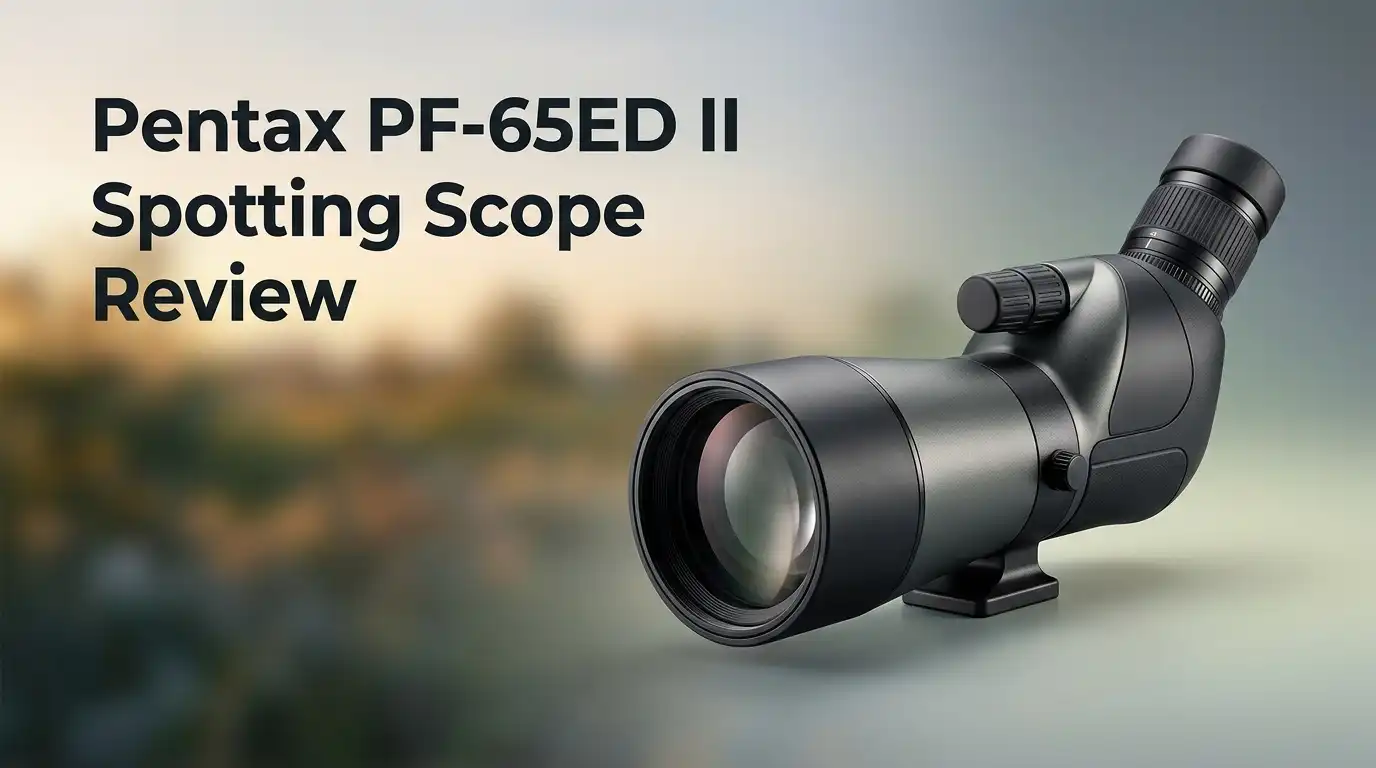
The PF-65ED II is a porro prism spotting scope with a 65mm ED objective lens and a 390mm focal length. That gives an aperture ratio near f/6.0, which is fast for this class. Pentax offers two body styles. The PF-65ED II is the straight version. The PF-65EDA II is the angled version with a 45 degree eyepiece and a click stop rotating tripod collar.
Both bodies measure about 10.6 inches long and weigh 37.7 ounces without an eyepiece. The housing uses a magnesium alloy shell wrapped in shock absorbing rubber armor. Nitrogen filling handles fog. The scope is made in Japan, which still means something in the optics world.
The focusing range starts at roughly 16.4 feet and runs to infinity. With the XF 20x to 60x zoom eyepiece, field of view measures 111 to 51 feet at 1000 yards.
Unboxing Experience and First Impressions
The box arrives smaller than most people expect. Pentax packs the scope in a plain retail carton with molded foam, a soft carrying case, and a pair of lens caps. There is no theatrical presentation. No magnetic flaps. No printed thank you card. Pentax spent the money on glass instead.
Lifting the scope out is the moment most buyers remember. It feels dense but genuinely light in the hands. The rubber armor has a matte grip that does not squeak. The focus ring sits on top of the barrel and turns with a smooth, slightly stiff resistance right out of the box.
The carrying case deserves praise. You can keep it fitted to the straight model while observing, which protects the body in wet weather. Pulling the retractable sunshade forward gives a satisfying click. First light through the scope, even on a dull afternoon, looks noticeably crisp.
Build Quality and Weatherproofing
Pentax rates the body to JIS Class 6 waterproof standards. That means it resists jets of water from any direction. The scope is nitrogen purged, so internal fogging during rapid temperature swings stays away. A dust shielding glass element sits inside the eyepiece receptacle, so the body stays sealed even when no eyepiece is mounted. That detail matters more than it sounds.
This scope is not submersible. Pentax states this clearly. Do not drop it in a creek and expect survival.
The rubber armor absorbs knocks well. Field users report scopes surviving years of truck beds, tripod tumbles, and salt spray. The collet type eyepiece receptacle grips oculars firmly without wobble. After a decade of field reports, build complaints remain rare. The one weak point is the plastic eyepiece cap, which loosens over time and gets lost easily.
Top 3 Alternative for Pentax PF-65ED II

Last update on 2026-09-13 / Affiliate links / Images from Amazon Product Advertising API Some of the links on this website are affiliate links, which means that at no additional cost to you, I earn a commission if you click through and make a purchase. I only recommend products and services that I believe will add value to my readers. Thank you for your support!
Vortex Diamondback HD Spotting Scope 16-48×65 Angled


Last update on 2026-09-17 / Affiliate links / Images from Amazon Product Advertising API Some of the links on this website are affiliate links, which means that at no additional cost to you, I earn a commission if you click through and make a purchase. I only recommend products and services that I believe will add value to my readers. Thank you for your support!
Celestron Regal M2 65ED Spotting Scope

Last update on 2026-09-17 / Affiliate links / Images from Amazon Product Advertising API Some of the links on this website are affiliate links, which means that at no additional cost to you, I earn a commission if you click through and make a purchase. I only recommend products and services that I believe will add value to my readers. Thank you for your support!
Athlon Optics Argos HD 20-60×85 Spotting Scope
Optical Performance and Image Quality
This is where the Pentax earns its reputation. The 65mm objective uses ED glass in a five element, three group design. Chromatic aberration stays low even on high contrast targets like a dark branch against a bright sky. Color rendering looks neutral rather than warm or cool, which helps birders judge plumage accurately.
In a published comparison of four 65mm ED spotting scopes, the Pentax posted the leading resolution score at 30x and the highest subjective image quality score in the group. Center sharpness is excellent. Edge sharpness softens slightly at maximum zoom, which is normal for this class.
Contrast holds up well in harsh midday light thanks to the extendable sunshade. Push past 45x and image brightness drops, as physics demands from a 65mm aperture. Below 40x, the view stays bright, clean, and easy on the eyes.
The Interchangeable Eyepiece System Explained
The eyepiece mount is the feature that separates this scope from almost every rival. The receptacle accepts any 1.25 inch collet mount eyepiece. That opens the door to the full Pentax XF and XW lineups plus a large chunk of the astronomy eyepiece market.
Pentax offers the XF 8.5 at 46x, the XF12 at 32.5x, and the XF zoom at 20x to 60x. The XW series adds the XW7 at 55.5x, XW10 at 39x, XW14 at 28x, and XW20 at 19.5x, all with 20mm eye relief and a 70 degree apparent field. The XW20 at 19.5x is a favorite for wide, bright scanning.
Fixed eyepieces give visibly better edge performance than the zoom. You pay more, but the reward is real.
Magnification, Field of View and Eye Relief
With the XF zoom eyepiece, magnification runs 20x to 60x. Field of view measures 111 feet at 1000 yards on the low end and drops to 51 feet at the top. Exit pupil shrinks from 3.2mm down to 1.1mm. Eye relief ranges from 15mm at low power to 11mm at high power.
That eye relief is tight. Eyeglass wearers will struggle at 60x with the zoom eyepiece. This is a genuine drawback and worth knowing before purchase.
The XW eyepieces solve the problem completely. Every XW model offers 20mm of eye relief with a 70 degree apparent field. Swap in an XW14 at 28x and you get a wide, comfortable view that glasses wearers can actually use. The eyepiece choice changes the entire personality of this scope.
Focusing Feel and Close Focus
Pentax placed the focus ring on top of the barrel. Either hand reaches it without repositioning your grip. The ring turns smoothly with even resistance, and it holds position once set. Cold weather stiffens it slightly, which most users accept.
This is a single speed focus system. There is no separate fine focus knob. Premium scopes from Swarovski and Kowa offer dual focus, and at 60x you notice the absence. Landing exact focus on a distant bullet hole takes patience.
That said, the ring travel is well judged. Full travel from close focus to infinity takes roughly two thirds of a turn. Pentax tuned one control properly instead of adding two sloppy ones. Close focus sits near 16.4 feet, which is fine for butterflies and shorebirds but not the best in class.
Straight or Angled: Which Version Suits You
The PF-65ED II is the straight barrel model. The PF-65EDA II angles the eyepiece 45 degrees upward. Both share identical optics, dimensions, and weight.
Choose the straight model for target shooting from a bench, for scanning from a car window, and for quick target acquisition. Pointing a straight scope feels intuitive because you aim it like a rifle. The sight line molded into the lens hood helps.
Choose the angled model for birding, for tripod sharing between people of different heights, and for watching anything above the horizon. The angled body adds a click stop rotating tripod collar, so you can twist the eyepiece to any comfortable angle without moving the barrel.
Angled also lets you run a shorter, lighter tripod, which saves weight overall. Most birders pick angled. Most shooters pick straight.
Low Light Performance and Digiscoping
A 65mm aperture gathers less light than an 80mm. At dawn and dusk, the Pentax holds detail better than cheaper 65mm scopes, but it cannot match an 80mm ED scope in the final ten minutes of shooting light. Drop to 20x or 25x and the image brightens considerably.
Digiscoping works well. The sharp, flat field pairs nicely with a camera, and Pentax designed the scope with high magnification photography in mind. There is no built in phone adapter, though. You buy a third party clamp adapter separately.
Alignment takes patience because the collet mount eyepieces have no dedicated adapter thread on most models. Once set up, image quality through the ED glass rewards the effort. Video at 20x to 30x looks clean and stable on a solid tripod.
Tripod Pairing and Field Setup
The tripod foot uses a standard quarter inch thread. There is no ARCA Swiss dovetail machined into the foot, which is a modern convenience this older design lacks. You will need a plate.
Because the scope weighs only 37.7 ounces with the body alone, you can run a lighter tripod than an 80mm scope demands. A carbon travel tripod rated for eight pounds handles it comfortably. A fluid head beats a ball head every time for scope work.
Total packed weight with an eyepiece, plate, and compact tripod lands near six pounds. That is manageable for a full day hike. This portability is a genuine reason people still choose this scope in 2026. Set the legs wide, hang your pack from the center column, and the view steadies immediately.
What the Pentax PF-65ED II Does Not Do Well
Honesty time. This scope has real weaknesses.
The eyepiece confusion is the worst of them. Two listings exist for nearly the same product, and one ships without any eyepiece. Buyers get burned regularly.
Eye relief with the XF zoom is short. Glasses wearers at 60x will fight for a full field. Single focus slows precise focusing at high power. The tripod foot lacks ARCA compatibility. There is no reticle eyepiece option for ranging, which shooters miss.
Availability has thinned in 2026. Stock comes and goes, and prices swing. Pentax has not refreshed this line in years, so accessories can be hard to source. The included cap quality feels cheap next to the excellent glass. None of these flaws are fatal, but they are real.
Pros and Cons of the Pentax PF-65ED II

Last update on 2026-09-25 / Affiliate links / Images from Amazon Product Advertising API Some of the links on this website are affiliate links, which means that at no additional cost to you, I earn a commission if you click through and make a purchase. I only recommend products and services that I believe will add value to my readers. Thank you for your support!
Pros
- Excellent ED glass with leading resolution scores in its size class
- Accepts any 1.25 inch collet mount eyepiece, including Pentax XF, XW, and astronomy oculars
- Light at 37.7 ounces, so it travels easily
- JIS Class 6 waterproof with nitrogen filling and shock absorbing armor
- Made in Japan with consistent build quality
- Focus ring reachable with either hand
- Extendable sunshade with a molded sight line
- Carrying case can stay fitted during use on the straight model
Cons
- Body only and kit listings look almost identical, causing purchase mistakes
- Short eye relief with the XF zoom eyepiece at high power
- Single focus only, with no fine focus wheel
- No ARCA compatible tripod foot
- No reticle eyepiece available for range estimation
- Best eyepieces cost extra and push the total price up
- Stock availability has become inconsistent
Price and Value in 2026
Body only pricing sits near the 500 dollar mark from specialist dealers. Kits bundled with the XF 20x to 60x zoom eyepiece typically land between 750 and 850 dollars depending on stock. Prices move around because supply is limited.
Compare that to a Vortex Diamondback HD 16-48×65 near 400 dollars or a Celestron Regal M2 65ED near 570 dollars. The Pentax costs more. It also out resolves both of them.
Step up to a Kowa TSN 554 or a Swarovski ATC and you pay double or triple. The Pentax sits in a sweet spot where optical quality outruns the price. If you already own quality 1.25 inch eyepieces from astronomy gear, the body only purchase becomes an outstanding value.
Who Should Buy It and Who Should Skip It
Buy this scope if you care about image quality above everything else. Birders who study plumage detail will love the neutral color. Astronomy hobbyists who already own XW eyepieces get a daytime scope for the cost of a body. Backpack hunters who count ounces get ED glass at a reasonable weight.
Skip it if you want a turnkey package. Shooters who need a reticle for calling shots should look at Vortex or Athlon. Anyone who wears glasses and refuses to buy a separate eyepiece will find the zoom frustrating.
Buyers on a strict budget under 400 dollars should look at the Diamondback HD instead. And if you glass in deep twilight regularly, an 80mm or 85mm scope serves you better than any 65mm design.
Final Verdict
The Pentax PF-65ED II remains a genuinely excellent spotting scope in 2026. The ED objective delivers sharpness and color fidelity that embarrass scopes costing more. The interchangeable eyepiece system gives you a platform you can grow into over years rather than a fixed package you outgrow.
The flaws are honest ones. Single focus, short zoom eye relief, no ARCA foot, and a confusing product listing. None of them touch the actual image quality.
Rating: 4.5 out of 5. Buy the kit if you want simplicity. Buy the body only if you already own good 1.25 inch eyepieces. Either way, pair it with a fluid head tripod and give the view five full minutes before you judge it. It grows on you.
Frequently Asked Questions
Does the Pentax PF-65ED II come with an eyepiece?
It depends entirely on the listing. Pentax sells a body only version and a kit version bundled with the XF 20x to 60x zoom eyepiece. The body only version costs several hundred dollars less. Read the product title and description carefully before ordering.
What is the difference between the PF-65ED II and PF-65EDA II?
The letter A indicates the angled model. Both share identical optics, size, and weight. The angled version adds a 45 degree eyepiece position and a click stop rotating tripod collar. The straight version lets you keep the carrying case fitted while observing.
Can I use astronomy eyepieces on this scope?
Yes. The scope takes standard 1.25 inch collet mount eyepieces. Pentax XW oculars work beautifully and give 20mm eye relief. Many third party astronomy eyepieces also fit, though results vary with eye relief and field curvature.
Is the Pentax PF-65ED II good for target shooting?
It works well out to moderate distances in good light. The straight model suits bench shooting. However, there is no reticle eyepiece for holdover reference, and the single focus makes precise focusing on bullet holes slower than a dual focus scope.
Is it waterproof?
Yes, to JIS Class 6 standards, with nitrogen filling to prevent internal fogging. It handles rain and spray without issue. Pentax states clearly that the scope is not designed for underwater use, so do not submerge it.
Where is the Pentax PF-65ED II made?
Japan. Pentax manufactures both the PF-65 and PF-80 series scopes there, and the consistent build quality reflects that.

Hello, I’m Emily Price, the founder of Birds Affection. As a passionate bird enthusiast and spiritual seeker, I’ve always been fascinated by the symbolic meanings and mystical connections between birds and our lives. On this website, I share my knowledge and insights on the spiritual significance of various bird species, exploring their roles as messengers, guides, and teachers. Through my writing, I aim to inspire and educate others on the profound wisdom and beauty that birds bring to our world. Join me on this journey as we delve into the enchanting realm of bird symbolism and discover the hidden meanings behind these magnificent creatures.