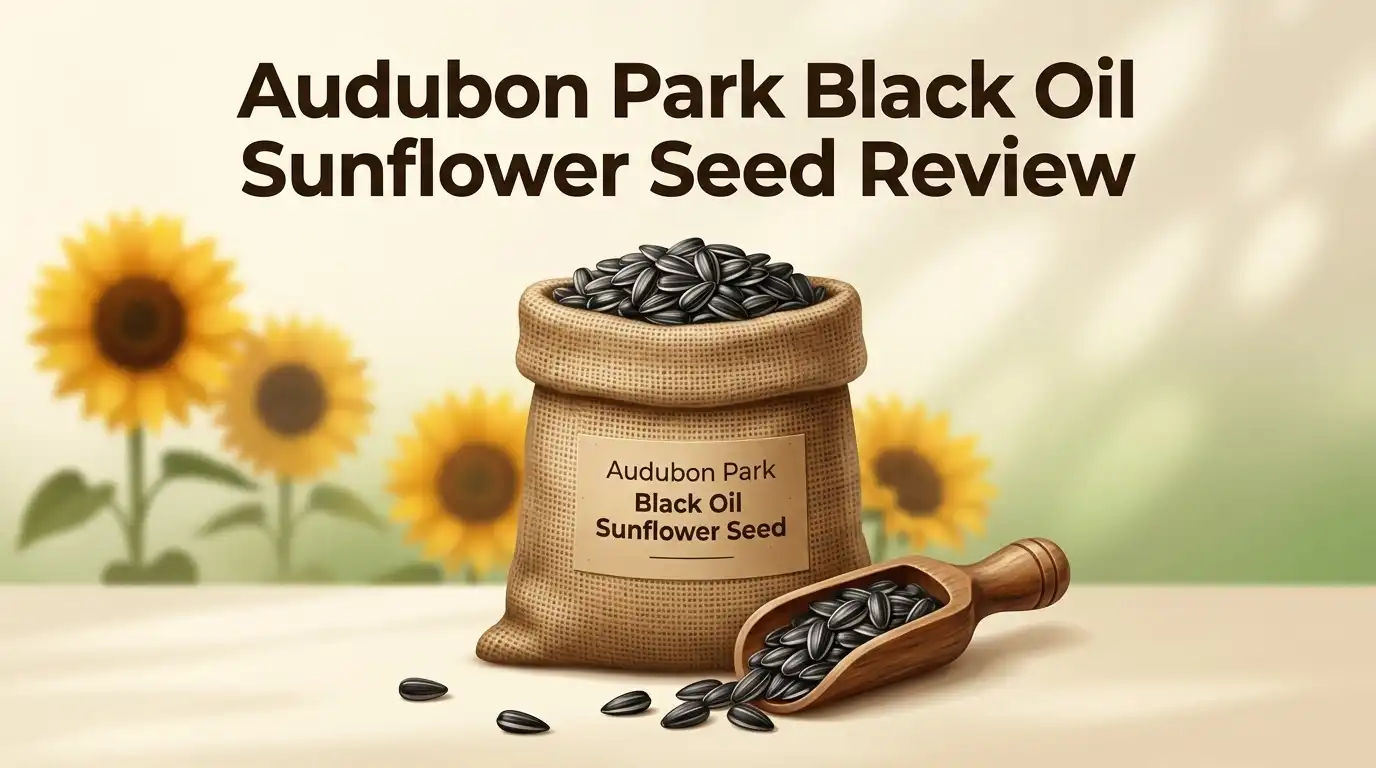
Audubon Park Black Oil Sunflower Seed Review 2026: Worth Buying?
Backyard bird feeding looks simple until you stand in the seed aisle. Dozens of bags promise the same thing. Most of them disappoint. Black oil sunflower seed is the one food that almost every feeder bird eats, so the brand you pick matters more than you think.
Audubon Park sells one of the most common black oil sunflower bags in America. You find it at Costco, Walmart, Lowe’s, Chewy, and Amazon.
It is cheap, it is everywhere, and bird lovers argue about it constantly. Some people swear the birds empty the feeder in two days. Others complain about dust, sticks, and sprouting weeds under the feeder.
In a Nutshell:
- Audubon Park Black Oil Sunflower Seed is 100% black oil sunflower with no filler. You get no milo, no cracked corn, and no red millet. Every seed in the bag is food that birds actually want, which is rare at this price point.
- The bird traffic is excellent. Cardinals, chickadees, titmice, nuthatches, finches, grosbeaks, and woodpeckers all feed on it. Thin shells make it easy for small beaks to crack the seed open.
- Value is the main selling point. The large bags often land near one dollar per pound or less, which beats most premium brands by a wide margin.
- Quality control is inconsistent. Some bags are clean and plump. Other bags contain dust, small stems, and a handful of empty hulls. This is the single biggest complaint from long term buyers.
- Squirrels love it as much as birds do. This seed will not keep rodents away, so you need a baffle or a weight activated feeder.
- Shell litter is heavy. Black oil sunflower drops a thick layer of hulls under the feeder, and those hulls can kill grass over time.
Audubon Park Black Oil Sunflower Seed

Last update on 2026-11-12 / Affiliate links / Images from Amazon Product Advertising API Some of the links on this website are affiliate links, which means that at no additional cost to you, I earn a commission if you click through and make a purchase. I only recommend products and services that I believe will add value to my readers. Thank you for your support!
Audubon Park is a bird food brand produced by Global Harvest Foods, a family owned company based in Washington state. The seed is grown in the United States and packed domestically. The black oil sunflower line comes in 5 pound, 7 pound, 20 pound, and 40 pound bags, so you can match the size to your feeder setup.
The product itself is simple. One ingredient. Nothing added. No dye, no pellets, no vitamin coating. The brand positions it as the best single seed for attracting the widest range of backyard birds, and that claim holds up well in practice.
The appeal is honesty. Cheap mixed seed hides filler grain that birds kick to the ground. This bag gives you only the seed birds eat first, which means less waste and faster feeder turnover.
Unboxing Experience and First Impressions
My 20 pound bag arrived in a plain cardboard overbox with no padding. The seed bag inside is thick woven polypropylene with a glossy printed wrap showing a cardinal on a branch. The stitching across the top holds firm, though it does not pull open cleanly. I cut it with scissors instead.
The first thing you notice is weight distribution. The bag slumps rather than holding shape, so carrying it needs two hands. There is no resealable zipper and no handle, which feels like a miss on a 20 pound product.
Opening the bag releases a mild nutty smell. No sour odor, no mustiness, no sign of moisture damage. The seeds look glossy black with faint grey stripes. A light puff of seed dust rose when I poured the first scoop, so open it outdoors if you have allergies.
Seed Quality and Cleanliness
Quality is where this product earns both praise and criticism. My first bag was clean. The kernels felt plump when squeezed, and the shell to meat ratio looked good. I sorted a cup by hand and found only four empty hulls.
My second bag told a different story. It carried more dust at the bottom, a few short stem pieces, and roughly a dozen shriveled seeds per cup. That inconsistency between batches is the brand’s weakness.
Compared with triple cleaned premium brands, Audubon Park feels like it gets one or two cleaning passes instead of three. You are trading a little purity for a much lower price. Most birds do not care. Tube feeder owners will care, because dust and stems clog small ports faster.
Which Birds Actually Show Up
Black oil sunflower is the closest thing to a universal bird food, and this bag proves it. Within 48 hours of filling my hopper feeder, I had black capped chickadees working in and out one seed at a time.
By the end of week one the regular crowd included northern cardinals, tufted titmice, white breasted nuthatches, house finches, American goldfinches, and downy woodpeckers. Blue jays arrived next and cleared seed in large mouthfuls.
Ground feeding birds like mourning doves, juncos, and white throated sparrows picked up the spillage underneath. The thin shell is the key reason the variety is so wide. Small birds that struggle with striped sunflower crack black oil seed easily. Larger birds simply swallow it whole and move on.
Top 3 Alternative for Audubon Park Black Oil Sunflower Seed


Last update on 2026-11-12 / Affiliate links / Images from Amazon Product Advertising API Some of the links on this website are affiliate links, which means that at no additional cost to you, I earn a commission if you click through and make a purchase. I only recommend products and services that I believe will add value to my readers. Thank you for your support!
Wagner’s 76027 Black Oil Sunflower Wild Bird Food, 25 Pound Bag

Last update on 2026-11-12 / Affiliate links / Images from Amazon Product Advertising API Some of the links on this website are affiliate links, which means that at no additional cost to you, I earn a commission if you click through and make a purchase. I only recommend products and services that I believe will add value to my readers. Thank you for your support!
Kaytee Wild Bird Black Oil Sunflower Food, 20 Pounds

Last update on 2026-11-12 / Affiliate links / Images from Amazon Product Advertising API Some of the links on this website are affiliate links, which means that at no additional cost to you, I earn a commission if you click through and make a purchase. I only recommend products and services that I believe will add value to my readers. Thank you for your support!
Pennington Select Black Oil Sunflower Seed, 40 Pounds
Feeder Compatibility and Flow
This seed works in nearly every feeder style. I tested it in a wooden hopper, a wire mesh tube, and a flat platform tray. All three handled it without jamming.
Hopper feeders are the best match. The seed flows smoothly and refills itself as birds feed. Platform trays also work well because doves and cardinals prefer an open landing spot.
Tube feeders need a little more attention. The occasional stem fragment can wedge in a feeding port, and seed dust builds up at the base over a few weeks. Clean your tube feeder monthly if you use this brand.
Avoid thistle feeders and any feeder with tiny nyjer ports. Black oil sunflower is far too large to pass through those openings. A standard sunflower port of roughly half an inch handles it perfectly.
Nutrition and Energy Value
Black oil sunflower seed holds a high oil content, which is exactly what wild birds need. Typical guaranteed analysis for this seed type sits near 15% crude protein and above 25% crude fat, with the fat level doing most of the heavy lifting.
That fat converts directly into body heat. Winter birds burn enormous calories overnight just to survive, and a few sunflower kernels at dusk can make the difference.
The kernel inside is also larger relative to the shell than striped sunflower. Birds get more food per trip and spend less time exposed to predators at the feeder.
Spring and summer feeding matters too. Parent birds carry sunflower kernels back to nestlings, and the protein supports feather growth. You can offer this seed in every season without worry.
Price and Value per Pound
Price is the strongest argument for this bag. Store pricing moves around, but the 20 pound bag frequently sits in the ten to fifteen dollar range at retail, and the 40 pound bag often drops below one dollar per pound.
Premium triple cleaned brands regularly cost 40% to 70% more for the same weight. If you fill feeders daily, that gap adds up to real money across a winter.
Amazon pricing runs higher than warehouse club pricing because shipping heavy seed is expensive. Buy the small bag online to test it, then buy the large bag locally. That is the smartest way to use this product.
The value equation only fails if your bag arrives dusty. A dusty bag wastes maybe 5% of the weight, which still leaves you ahead on cost.
Pros and Cons
Every bird food has tradeoffs. Here is the honest split after months of feeding.
Pros
- Pure 100% black oil sunflower seed with zero filler grain, so almost nothing gets wasted on the ground by picky birds.
- Attracts the widest range of songbirds, including cardinals, chickadees, finches, nuthatches, titmice, and woodpeckers.
- Thin shells let small beaked birds crack seeds easily, which speeds up feeder traffic.
- Excellent price per pound, especially in the 20 pound and 40 pound sizes.
- Grown and packed in the USA by a family owned company.
- Works in hopper, tube, and platform feeders without special equipment.
Cons
- Batch quality varies. Some bags contain noticeable dust, stems, and empty hulls.
- No resealable closure or carry handle on the bag.
- Shell litter piles up fast and can damage lawn grass underneath.
- Squirrels, chipmunks, and raccoons love it just as much as birds do.
- Spilled seed sprouts into unwanted sunflower plants in spring.
- Dust can trigger sneezing in sensitive people during pouring.
What This Seed Does Not Do Well
Honest reviews name the failures, so here they are. This seed will not solve your squirrel problem. Black oil sunflower is squirrel candy. Without a baffle or a weight activated feeder, you will feed rodents instead of birds.
It also does nothing for mess control. Shells accumulate in a thick ring under the feeder. Those hulls contain a mild growth inhibitor that can thin your grass over a season. Sweep or rake the area every few weeks.
The seed will not attract every bird either. Bluebirds, orioles, warblers, and hummingbirds mostly ignore sunflower. You need mealworms, jelly, oranges, or nectar for those species.
Finally, the packaging offers no pest protection. Pantry moths and mice can chew straight through the woven bag if you leave it on a garage floor.
Storage Tips That Prevent Waste
Bird seed spoils faster than people expect. Heat, humidity, and air turn the oil rancid, and birds refuse rancid seed.
Transfer the contents into a metal trash can with a tight lid as soon as the bag arrives. Metal beats plastic because mice chew through plastic bins. A galvanized 20 gallon can holds a full 40 pound bag with room to spare.
Keep the container in a cool, dry, shaded spot. A garage corner away from the water heater works well. Avoid sheds that bake in summer sun.
Buy only what you can use in about three months. Freezing a small portion for 48 hours before storage kills moth eggs. Scoop with a dedicated cup rather than your hands, and never pour old seed on top of fresh seed.
How It Compares to Kaytee and Wagner’s
Kaytee markets its black oil sunflower as triple cleaned, and the difference shows. Kaytee bags arrive noticeably cleaner with fewer fragments, but you pay more per pound for that polish.
Wagner’s sits in the middle. The seed is consistently plump, the bags are sturdy, and the 25 pound size prices competitively. Many feeder owners consider Wagner’s the best balance of cleanliness and cost.
Pennington Select targets bulk buyers with 40 pound bags at warehouse pricing. Quality reports vary just as much as Audubon Park, so the two trade places depending on the batch.
Audubon Park wins on availability and price. If a clean bag matters more than saving three dollars, choose Kaytee. If you fill four feeders every day, Audubon Park stretches your budget furthest.
Who Should Buy This Seed
This bag suits high volume feeders. If you run several stations and refill constantly, the low cost per pound is hard to beat.
It also suits beginners. You cannot really go wrong with pure black oil sunflower as a first seed, because it attracts more species than any mix you could buy.
Shoppers with warehouse club memberships get the best deal of all, since Costco pricing on the large bag undercuts almost every competitor.
Skip it if you own a finicky tube feeder with narrow ports, or if you live somewhere humid where dusty seed clumps quickly. Also skip it if you hate yard cleanup, because the hull pile is real and it grows fast.
Final Verdict
Last update on 2026-11-12 / Affiliate links / Images from Amazon Product Advertising API Some of the links on this website are affiliate links, which means that at no additional cost to you, I earn a commission if you click through and make a purchase. I only recommend products and services that I believe will add value to my readers. Thank you for your support!
Audubon Park Black Oil Sunflower Seed earns a solid recommendation with one honest caveat. The seed does its job. Birds arrive fast, feeders empty quickly, and the price stays friendly even when you feed through a long winter.
The caveat is consistency. One bag can be beautifully clean and the next can carry dust and stems. That lottery keeps it out of the top tier.
For most backyard feeders, that tradeoff is acceptable. You are paying less and still giving birds the single best seed available. Pair it with a squirrel baffle and a monthly feeder cleaning, and the weak points mostly disappear.
Rating: 4 out of 5. Great value, good bird response, average cleanliness.
Frequently Asked Questions
Is Audubon Park bird seed good quality?
Yes, for the price. The black oil sunflower bag contains pure sunflower with no filler grain, which already puts it ahead of cheap mixes. Cleanliness varies between batches, so expect some dust and the occasional stem.
Where is Audubon Park bird seed made?
Audubon Park products come from Global Harvest Foods, a family owned company in Washington state. The sunflower seed is grown in the United States and packed domestically.
Will black oil sunflower seed attract squirrels?
Absolutely. Squirrels, chipmunks, and raccoons all raid sunflower feeders. Use a pole baffle, a dome, or a weight activated feeder to keep them off.
Can I feed black oil sunflower seed year round?
Yes. The high fat content helps birds survive winter, and the protein supports nesting birds in spring and summer. Just keep the seed dry and fresh.
Does the seed sprout under the feeder?
Spilled seed does sprout in spring. Rake the hull pile regularly, or place a seed catching tray beneath the feeder to limit growth.
What feeders work best with this seed?
Hopper feeders and platform trays work best. Tube feeders with standard sunflower ports also work, though you should clean them monthly to clear dust buildup.
How long does a 20 pound bag last?
That depends on your bird traffic. A single hopper feeder in a busy yard usually empties around three to four pounds per week, so one bag covers roughly five to six weeks.

Hello, I’m Emily Price, the founder of Birds Affection. As a passionate bird enthusiast and spiritual seeker, I’ve always been fascinated by the symbolic meanings and mystical connections between birds and our lives. On this website, I share my knowledge and insights on the spiritual significance of various bird species, exploring their roles as messengers, guides, and teachers. Through my writing, I aim to inspire and educate others on the profound wisdom and beauty that birds bring to our world. Join me on this journey as we delve into the enchanting realm of bird symbolism and discover the hidden meanings behind these magnificent creatures.