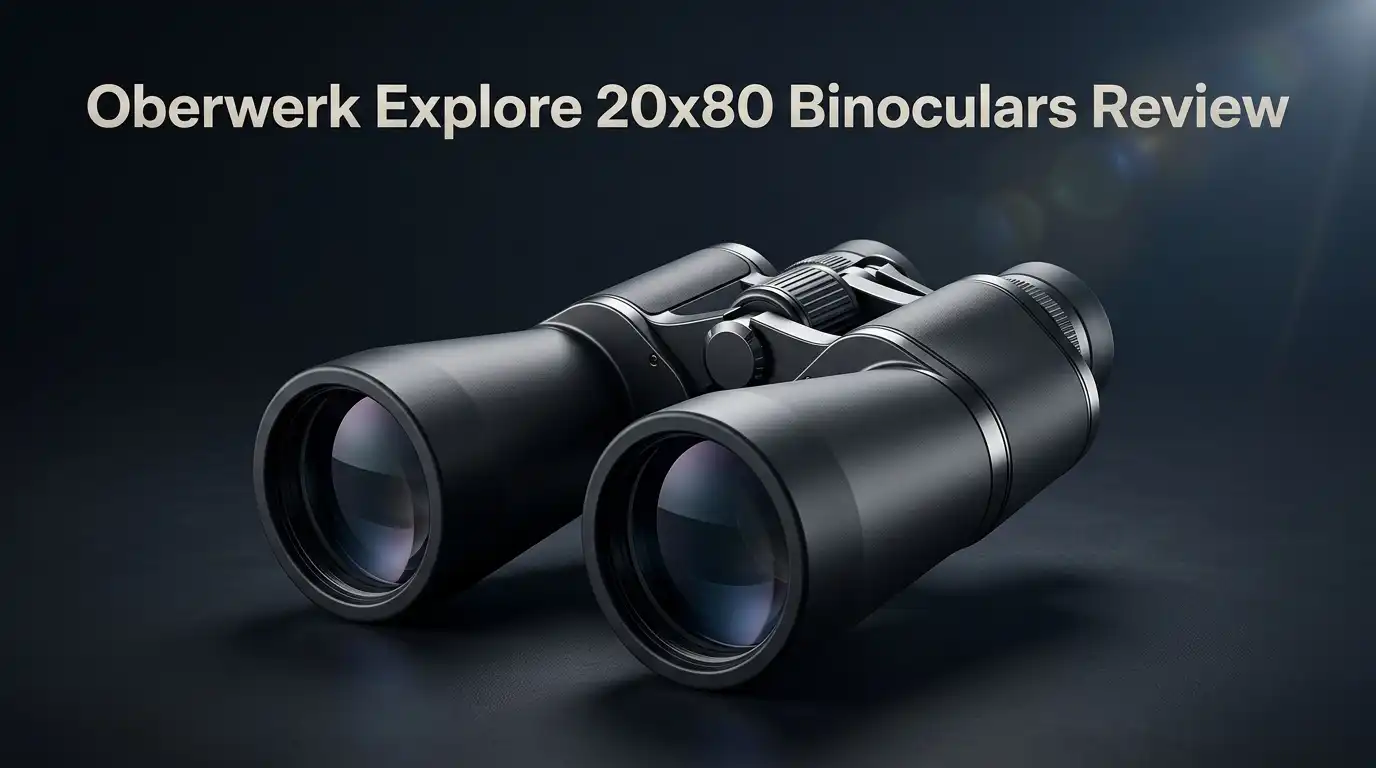
Oberwerk Explore 20×80 Binoculars Review 2026: Worth It?
Big binoculars make big promises. The Oberwerk Explore 20×80 is one of those pairs that looks serious the moment you lift the box. Two 80mm objective lenses stare back at you. The aluminum body feels dense in your hands. And the price sits in that tempting middle zone where beginners start asking whether they should skip the telescope entirely.
So here is the honest question. Does this pair actually deliver the night sky, or does it just look impressive on a shelf? I spent time with these under suburban skies, under a darker rural sky, and in daylight across open fields. The results surprised me in good ways and frustrated me in a few predictable ways.
This review covers the unboxing, the glass, the weight problem, the tripod requirement, and the things Oberwerk does not advertise. No fluff. Just what you need before you spend your money in 2026.
In A Nutshell:
- Light gathering is the main attraction. The 80mm objectives pull in far more light than a 10×50 pair. Star clusters look brighter. Faint deep sky objects become visible instead of imaginary. This is the single biggest reason to buy.
- You must use a tripod. At 4.7 pounds and 20x magnification, handheld viewing is shaky and tiring. The built in mounting rail helps, but a sturdy tripod is a required purchase, not an optional extra.
- Eye relief is generous at 18mm. Eyeglass wearers can see the full 3.25 degree field of view with twist up eyecups. Many competing 20×80 models fail badly here.
- Build quality punches above the price. Aluminum body, BAK4 prisms, fully broadband multicoated optics, nitrogen filled and waterproof construction. It feels like a tool, not a toy.
- The limits are real. Minimum focus sits at 25 meters, so close range birding is impossible. The 4.0mm exit pupil is small for older eyes in dark conditions. Edge sharpness softens noticeably.
- Best value at around $270. For the money, few 20×80 binoculars match this combination of coatings, waterproofing, and comfort.
Oberwerk Explore 20×80 Binoculars

Last update on 2026-10-25 / Affiliate links / Images from Amazon Product Advertising API Some of the links on this website are affiliate links, which means that at no additional cost to you, I earn a commission if you click through and make a purchase. I only recommend products and services that I believe will add value to my readers. Thank you for your support!
The Explore 20×80 sits at the top of Oberwerk’s entry level Explore Series. Oberwerk is a small Ohio based company that has built a loyal following among astronomy hobbyists for decades. They specialize in big binoculars, and that focus shows in the details.
The specifications read well. You get 20x magnification, 80mm objective lenses, a 3.25 degree field of view, 18mm of eye relief, and a 4.0mm exit pupil. The body is aluminum. The prisms are BAK4. The optics are fully broadband multicoated with roughly 96 percent light transmission efficiency.
It weighs 4.7 pounds and measures 13 inches long. The interpupillary distance range runs from 62mm to 74mm, which covers most adult faces but excludes narrow set eyes. That detail matters more than people expect.
The Unboxing Experience
The box arrives heavier than you predict. Mine shipped in a plain shipping carton with the product box nested inside. No glossy marketing imagery. Oberwerk clearly spends money on glass rather than packaging.
Inside sits a lightweight hard case with a zipper closure. The case is functional rather than luxurious. It protects the binocular during transport and storage, though it will not survive being dropped from a roof.
Lifting the binocular out is the moment the purchase feels real. These are genuinely large. The objective barrels are wide enough that your fingers wrap around them rather than grip them. The aluminum feels cool and solid.
You also get an ocular rain guard and captive objective covers that stay attached to the barrels. Those captive caps are a small touch that prevents the classic problem of losing lens covers in dark grass.
Build Quality And Design
The aluminum housing gives the Explore 20×80 a reassuring density. There is no creaking, no flex, and no hollow plastic sound when you tap the barrels. The rubber armor provides grip without feeling sticky.
The center focus wheel turns smoothly with moderate resistance. It is large enough to operate with gloves in cold weather, which matters during winter astronomy sessions. The right eyepiece has a diopter adjustment for balancing differences between your eyes.
Waterproof and nitrogen filled construction means dew and humidity will not fog the internal surfaces. For astronomy, where dew forms constantly on cool nights, this is a meaningful advantage over cheaper sealed models.
The integrated mounting rail runs along the bottom. It allows fore and aft adjustment so you can balance the binocular properly on a tripod head. No flimsy screw in L adapter required.
Optical Performance Under The Stars
This is where the Explore 20×80 earns its reputation. Point it at the Pleiades and the cluster fills a meaningful portion of the field with bright, clean stars. The Double Cluster in Perseus resolves beautifully.
The Orion Nebula shows real structure, including visible nebulosity around the trapezium region. The Andromeda Galaxy appears as a clear elongated glow with a bright core, far more convincing than through a 10×50 pair.
Lunar views are excellent. Crater walls along the terminator show sharp shadow detail. The Moon is bright enough to need a steady mount and patient eyes.
Star color comes through well thanks to the coatings. Contrast holds up under suburban light pollution better than expected. Jupiter shows its four Galilean moons easily, though the planet itself stays a small bright disc at 20x.
Top 3 Alternative For Oberwerk Explore 20×80


Last update on 2026-10-25 / Affiliate links / Images from Amazon Product Advertising API Some of the links on this website are affiliate links, which means that at no additional cost to you, I earn a commission if you click through and make a purchase. I only recommend products and services that I believe will add value to my readers. Thank you for your support!
Celestron SkyMaster 20×80 Binoculars

Last update on 2026-10-25 / Affiliate links / Images from Amazon Product Advertising API Some of the links on this website are affiliate links, which means that at no additional cost to you, I earn a commission if you click through and make a purchase. I only recommend products and services that I believe will add value to my readers. Thank you for your support!
Celestron SkyMaster Pro ED 20×80 Astronomy Binoculars

Last update on 2026-10-25 / Affiliate links / Images from Amazon Product Advertising API Some of the links on this website are affiliate links, which means that at no additional cost to you, I earn a commission if you click through and make a purchase. I only recommend products and services that I believe will add value to my readers. Thank you for your support!
Orion 20×80 Astronomy Binoculars
Daytime And Terrestrial Viewing
Astronomy is the headline use, but plenty of buyers want daytime performance too. The Explore 20×80 works well for long distance observation across valleys, lakes, coastlines, and open country.
Image brightness in daylight is excellent. The 4.0mm exit pupil is more than adequate when your pupils contract in sunlight. Colors look neutral with only mild warmth.
The 25 meter minimum focus distance is the deal breaker for close work. You cannot watch a bird in your garden. You cannot study a flower or an insect. Anything closer than about 80 feet stays blurry no matter how you turn the wheel.
For ship spotting, mountain scanning, or watching wildlife across a large field, these perform well. For backyard birding, buy a 10×42 instead.
Eye Relief And Comfort For Eyeglass Wearers
Many large binoculars treat eyeglass wearers as an afterthought. Oberwerk did not. The 18mm of eye relief is generous for a 20x instrument and makes a genuine difference.
With glasses on and the twist up eyecups retracted, I could see the full 3.25 degree field without black edge cutoff. That is uncommon in this price bracket. Competing models often force you to choose between glasses and full field visibility.
The twist up eyecups click into position firmly. They do not collapse under eye pressure during long sessions.
Non glasses users extend the eyecups fully and get comfortable spacing. Blackouts are minimal once you learn the correct head position. Finding that sweet spot takes a few minutes of practice on your first night out.
Why A Tripod Is Not Optional
Let me be blunt. Trying to hold these steady by hand is a bad experience. At 20x magnification, every heartbeat and muscle tremor turns stars into shaky streaks.
Your arms will fatigue within two minutes. Your neck will ache if you try to view objects near the zenith. The image will never settle enough to reveal faint detail.
Budget for a proper tripod before you buy. A lightweight camera tripod will wobble. You need something rated for at least 10 pounds with a stable head. Oberwerk sells matching 3000 and 5000 Series tripods, and taller users benefit from the 5000 Series for overhead viewing.
A parallelogram mount is the premium solution for astronomy. It costs more than the binoculars, but it transforms the experience completely.
Pros And Cons
Here is the balanced breakdown after real use.
Pros
- Outstanding light gathering from 80mm objectives reveals deep sky objects that smaller binoculars miss entirely
- 18mm eye relief delivers full field viewing for eyeglass wearers, which is rare at this price
- Waterproof and nitrogen filled construction handles dew, humidity, and unexpected weather without internal fogging
- Integrated mounting rail with fore and aft adjustment makes tripod balancing simple and secure
- Solid aluminum body with BAK4 prisms and fully broadband multicoated optics at roughly 96 percent transmission
- Strong value at around $270 compared to similarly specified competitors
- Hard case and captive lens covers included rather than sold separately
Cons
- 4.7 pound weight makes handheld use impractical for more than brief moments
- 25 meter minimum focus eliminates close range birding and nature study
- 4.0mm exit pupil is small for observers over 50 whose pupils dilate less
- Edge softness becomes visible in the outer 20 percent of the field
- Narrow 62mm to 74mm IPD range excludes users with close set eyes
- No ED glass, so bright objects show some color fringing
What The Explore 20×80 Does Not Do Well
Honest reviews name the weak spots, so here they are without softening.
Edge performance disappoints. Stars in the outer portion of the field show noticeable distortion and softening. Center sharpness is good, but you will keep recentering objects to see them properly.
Chromatic aberration is present. These use achromatic objectives, not ED glass. Around the Moon’s limb and bright planets, you will see a violet or yellow fringe. It is not severe, but purists will notice immediately.
Collimation sensitivity is a risk. Large porro prism binoculars can drift out of alignment if dropped or handled roughly. Treat the case as mandatory storage.
The field of view feels tight. At 3.25 degrees, wide sweeping views of the Milky Way are limited. A 15×70 covers more sky and costs less.
Oberwerk Explore 20×80 Versus Celestron SkyMaster 20×80
The Celestron SkyMaster 20×80 is the most common comparison and usually costs less. So which one deserves your money?
The SkyMaster offers similar aperture and magnification at a lower price point. It is widely available and has sold in huge numbers. However, quality control varies between units, and collimation complaints appear regularly in owner reports.
The Oberwerk wins on consistency. Build tolerances feel tighter. The waterproof nitrogen filled sealing is more reliable. The 18mm eye relief beats the SkyMaster for glasses wearers.
The Oberwerk also benefits from direct customer support from a small company that answers the phone. If something goes wrong, you talk to a person who knows binoculars rather than a call center script.
Who Should Buy These Binoculars
The Explore 20×80 suits a specific kind of buyer. Identifying yourself here saves disappointment later.
Buy these if you are a beginner or intermediate astronomy hobbyist who wants more reach than a 10×50 without the setup time of a telescope. They excel at star clusters, large nebulae, lunar detail, and comet hunting.
Buy these if you already own a sturdy tripod or are willing to purchase one. The binocular alone is only half the system.
Buy these if you wear glasses and have been frustrated by cramped eye relief on other large binoculars.
Skip these if you want handheld portability, close focus birding, or planetary detail. A small telescope serves planetary observers far better at this budget.
Price And Value In 2026

Last update on 2026-10-25 / Affiliate links / Images from Amazon Product Advertising API Some of the links on this website are affiliate links, which means that at no additional cost to you, I earn a commission if you click through and make a purchase. I only recommend products and services that I believe will add value to my readers. Thank you for your support!
At roughly $270, the Explore 20×80 sits in a competitive but thin segment. Cheaper 20×80 models exist, and most cut corners on coatings, sealing, or eye relief.
The value argument is strong. You get waterproof nitrogen filled construction, fully multicoated optics, BAK4 prisms, an integrated mount rail, and a hard case. Many competitors charge extra for the case alone.
Bundles that include a tripod or monopod often cost less than buying both separately. If you do not already own a stable mount, a bundle is usually the smarter purchase.
Compared with the Oberwerk 20×80 Deluxe III at around $440, the Explore saves money while keeping the same aperture. The Deluxe adds triplet objectives and better correction, but the Explore covers the fundamentals well.
Care, Maintenance And Long Term Use
These binoculars reward basic care. Store them in the hard case between sessions and keep them away from extreme heat.
After a dewy night, leave the caps off indoors for an hour so moisture evaporates from the exterior surfaces. The nitrogen filling protects the inside, but external dew can still mark coatings if left to dry unevenly.
Clean lenses sparingly. Use a blower first, then a microfiber cloth with a dedicated lens solution. Avoid household glass cleaners, which strip coatings.
Check collimation occasionally by viewing a distant star. If you see a doubled image that your eyes cannot merge, the binocular needs service. Oberwerk handles repairs directly, which is a quiet advantage over imported brands with no service network.
Final Verdict
The Oberwerk Explore 20×80 delivers exactly what it promises. Big aperture, bright views, solid construction, and comfortable eye relief at a fair price.
It is not perfect. Edge sharpness softens, chromatic aberration appears on bright targets, and the weight demands a tripod. The 25 meter minimum focus rules out close range nature watching entirely.
But for astronomy, this pair is a genuine pleasure. Mounted properly on a stable tripod under a dark sky, it opens up clusters, nebulae, and lunar detail that smaller binoculars simply cannot show.
If you understand the tripod requirement and accept the daytime limitations, this is one of the best value large binoculars available in 2026. Beginners stepping up from 10×50 will feel the difference on their very first night.
Frequently Asked Questions
Do I really need a tripod for the Oberwerk Explore 20×80?
Yes. At 4.7 pounds and 20x magnification, handheld views shake badly and your arms tire within minutes. A tripod rated for at least 10 pounds is essential for any useful observing.
Can I see planets clearly with these binoculars?
You will see Jupiter’s four largest moons, Saturn as an oval shape, and Venus phases. Surface detail on planets requires a telescope. Planets remain small bright points at 20x.
Are these suitable for birdwatching?
Only for distant subjects beyond 80 feet. The 25 meter minimum focus distance makes garden and woodland birding impossible. Choose a 10×42 or 8×42 for general birding.
Do they work well for people who wear glasses?
Yes. The 18mm eye relief with twist up eyecups lets eyeglass wearers see the full 3.25 degree field without edge cutoff. This is one of the model’s strongest features.
How do they compare to a beginner telescope?
Binoculars offer wider fields, instant setup, and two eyed comfort. A telescope offers higher magnification and planetary detail. Many observers eventually own both and use them for different targets.
Are the Explore 20×80 waterproof?
Yes. The housing is sealed and nitrogen filled, which prevents internal fogging and protects against rain and heavy dew during night sessions.

Hello, I’m Emily Price, the founder of Birds Affection. As a passionate bird enthusiast and spiritual seeker, I’ve always been fascinated by the symbolic meanings and mystical connections between birds and our lives. On this website, I share my knowledge and insights on the spiritual significance of various bird species, exploring their roles as messengers, guides, and teachers. Through my writing, I aim to inspire and educate others on the profound wisdom and beauty that birds bring to our world. Join me on this journey as we delve into the enchanting realm of bird symbolism and discover the hidden meanings behind these magnificent creatures.