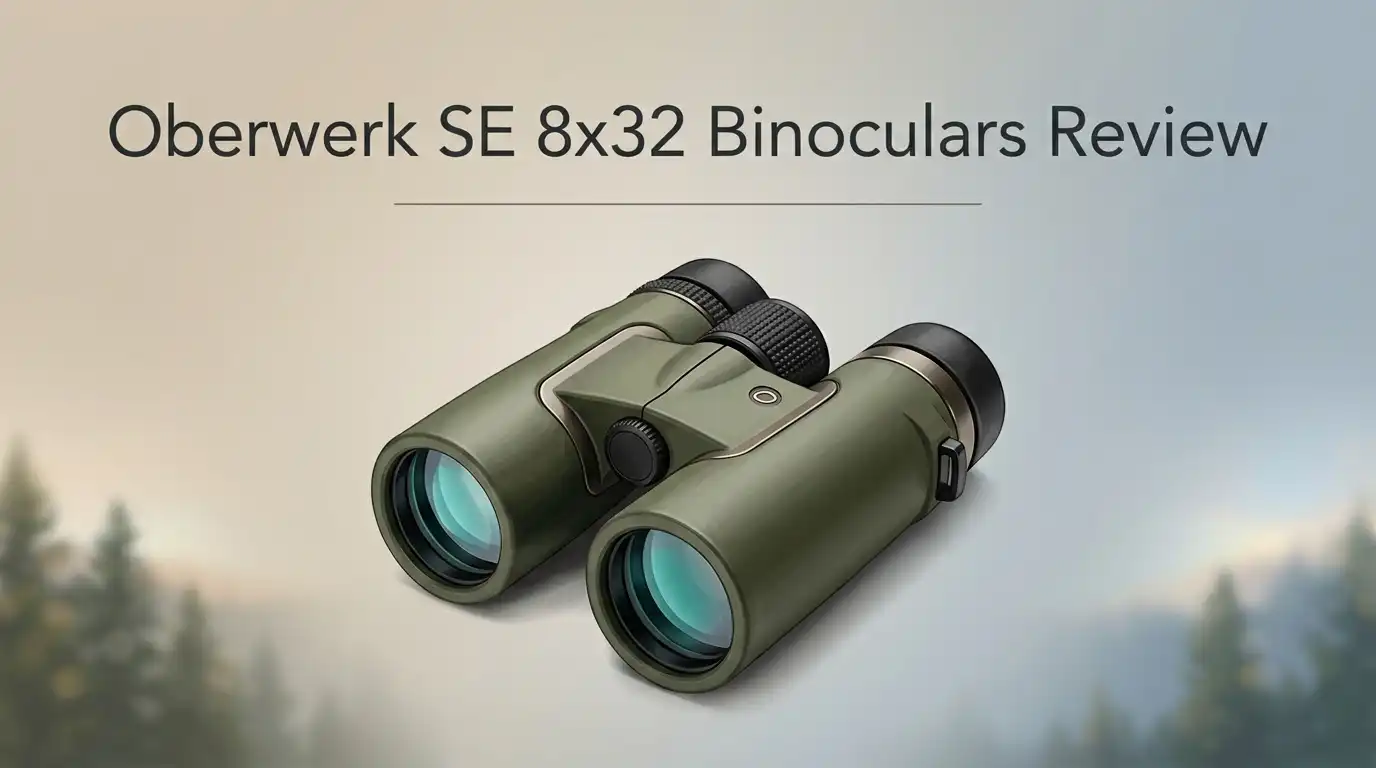
Oberwerk SE 8×32 Binoculars Review 2026: Worth Buying?
Porro prism binoculars were supposed to be dead. Nobody told Oberwerk.
The Oberwerk SE 8×32 sits in a strange spot. It costs $279.95. It uses an old school porro design. It weighs more than most pocket friendly roof prism rivals. Yet reviewers keep calling it one of the sharpest 32mm binoculars under $300.
I spent weeks with this pair. I used it for backyard birding, dawn hikes, stadium seats, and late night star fields. This review covers what the SE 8×32 does brilliantly, and the four or five things that genuinely annoyed me. No marketing fluff. Just honest field notes.
In a Nutshell:
- Optical quality punches far above $280. The FK61 ED glass controls color fringing extremely well. On axis sharpness rivals binoculars costing two or three times more. Several veteran reviewers compared the center image favorably to alpha brand glass.
- The 8.2 degree field of view is the headline feature. That gives you roughly 144 meters of view at 1000 meters. Very few 8×32 binoculars offer this much sky. Independent testing measured closer to 7.8 degrees, which is still generous.
- It is heavy for its class. At 1.75 pounds, the SE 8×32 outweighs many 8×42 roof prism models. The porro body is also wider, so it will not slip into a jacket pocket.
- Build quality is good but not flawless. The magnesium alloy chassis feels solid. The eyecups and paint finish feel cheaper than the glass deserves. Some owners report inconsistent hinge tension.
- Warranty coverage is modest. Oberwerk offers a two year limited warranty. Competitors like Vortex and Athlon offer lifetime coverage, which matters at this price.
- Best suited to patient observers. Birders, astronomy fans, and anyone who values image quality over portability will love it. Hikers counting grams should look elsewhere.
Oberwerk SE 8×32 Binoculars

Last update on 2026-10-25 / Affiliate links / Images from Amazon Product Advertising API Some of the links on this website are affiliate links, which means that at no additional cost to you, I earn a commission if you click through and make a purchase. I only recommend products and services that I believe will add value to my readers. Thank you for your support!
Oberwerk is a family run optics company based in Dayton, Ohio. The company built its reputation on giant astronomy binoculars. The SE line is its attempt at something smaller and more wearable.
The SE name is a deliberate nod. Oberwerk openly modeled this series on a beloved Japanese porro line that was discontinued years ago. The company kept the ergonomic shape and then upgraded the glass.
Every pair ships from the Dayton facility after inspection. The optics are manufactured in China, which some buyers care about. Oberwerk does not hide this. The company instead focuses on quality control at the final stage, and that approach shows in most units.
The 8×32 is the smallest member of the SE family. Its siblings are the 10×42 at $309.95 and the 12×50 at $349.95.
Unboxing Experience: What You Actually Get
The box is plain. No glossy sleeve, no cinematic reveal. Oberwerk spends money on glass instead of cardboard, and that becomes obvious quickly.
Inside sits a padded soft case with a zip closure. The case is thicker than expected and genuinely protective. It feels like something you would use rather than discard.
Lift the binocular out and the first impression is weight. The SE 8×32 feels dense in a reassuring way. The grey finish has a light texture that grips without feeling tacky.
The package includes objective caps, a rainguard, and a padded neck strap. The strap is adequate but plain. Many owners swap it for a wider aftermarket strap within a week.
There is no harness and no tripod adapter included. The SE accepts a standard 1/4 20 adapter, sold separately.
Build Quality and Body Design
The chassis uses magnesium alloy rather than polycarbonate. That is unusual at this price and it explains part of the weight.
Oberwerk nitrogen purges the body and seals it against water. The unit is fully waterproof and resists internal fogging. I used mine in steady drizzle with zero issues.
The hinge arms connecting the eyepieces are notably stiff. This is deliberate. Weak hinges shift your interpupillary setting every time you grab the binocular, and cheap porros suffer badly from this.
Here is the honest caveat. Hinge tension is the most commonly reported inconsistency. A few buyers received units with hinges that drifted too easily. Oberwerk replaces these without argument, but the variation exists.
The paint finish also shows occasional small imperfections under bright light. Cosmetic only, but worth knowing.
Optical Performance in Daylight
This is where the SE 8×32 earns its reputation.
The FK61 extra low dispersion objectives do real work. Chromatic aberration is close to invisible in normal viewing. Look at a dark branch against a bright overcast sky and you will struggle to find purple fringing.
Center sharpness is excellent. Fine detail on bird plumage resolves cleanly. Bark texture, feather edges, and license plate numbers all snap into focus with satisfying precision.
Contrast is the second strength. The internal blackening around the eyepieces is unusually good, and glare is well suppressed. Images look clean rather than washed out.
Color rendition is neutral. Whites appear white rather than warm or yellow. Birders who care about accurate plumage color will appreciate this.
Brightness is strong for a 32mm instrument thanks to the broadband multicoatings.
Top 3 Alternative for Oberwerk SE 8×32 Binoculars


Last update on 2026-10-25 / Affiliate links / Images from Amazon Product Advertising API Some of the links on this website are affiliate links, which means that at no additional cost to you, I earn a commission if you click through and make a purchase. I only recommend products and services that I believe will add value to my readers. Thank you for your support!
Nikon Monarch M7 8×30 Binoculars

Last update on 2026-10-25 / Affiliate links / Images from Amazon Product Advertising API Some of the links on this website are affiliate links, which means that at no additional cost to you, I earn a commission if you click through and make a purchase. I only recommend products and services that I believe will add value to my readers. Thank you for your support!
Celestron TrailSeeker ED 8×32 Binoculars

Last update on 2026-10-25 / Affiliate links / Images from Amazon Product Advertising API Some of the links on this website are affiliate links, which means that at no additional cost to you, I earn a commission if you click through and make a purchase. I only recommend products and services that I believe will add value to my readers. Thank you for your support!
ZEISS Terra ED 8×32 Binoculars
Field of View and Edge Performance
Oberwerk advertises 8.2 degrees. That figure is the main selling point against the competition.
For context, most 8×32 roof prism binoculars in this price band deliver around 7.5 degrees. The extra width genuinely helps when you track a warbler through branches.
An independent European test measured the real field at approximately 7.8 degrees. That is narrower than claimed but still wider than nearly every direct competitor.
Edge sharpness is the compromise. The outer fifteen percent of the field softens noticeably. Stars become small comet shapes at the very edge, and landscape detail loses crispness.
This bothers some observers and not others. Your eye naturally centers on your subject. If you scan the field edge to edge deliberately, you will notice the falloff.
Field curvature is present but gentle enough to refocus away.
Eye Relief, Eyecups and Eyeglass Users
Oberwerk lists 18mm of eye relief. Measured usable relief from the eyecup rim is closer to 15mm.
That is enough for most eyeglass wearers. I used mine with thin framed glasses and saw the full field with the eyecups fully down.
People with thicker lenses or deeply set frames may lose a sliver of the outer field. Test this before committing if you wear strong prescriptions.
The eyecups themselves are the weakest part of the binocular. They twist up through intermediate stops, but the mechanism feels light and plasticky. One owner described them as cheap feeling, and I understand the complaint.
They work. They hold position. They simply do not match the quality of the glass behind them. This is the single biggest disconnect in the design.
Focusing Speed and Close Focus
The center focus wheel is large and easy to find with gloves on.
Travel from the 10 foot close focus point to infinity takes roughly one and a half turns. That is slow by modern standards. Fast roof prism binoculars manage the same range in under one turn.
Slow focus has a benefit. It gives you fine control for precise work, especially at distance. It has a cost too. You will occasionally miss a fast moving bird while cranking the wheel.
The wheel on my sample started stiff straight out of the box. It loosened into a smooth action after about two weeks of regular use.
Close focus of three meters is fine for garden birding. Butterfly and dragonfly watchers will find it limiting. Many competitors focus to two meters or closer.
The diopter adjustment sits on the right eyepiece and does not lock.
Low Light and Astronomy Performance
The 4mm exit pupil sets realistic expectations here. This is a 32mm binocular, not a light bucket.
Within those limits, the SE 8×32 performs very well. Twilight views stay bright and contrasty for longer than the aperture suggests, thanks to the coatings and the clean internal baffling.
Astronomy is where this pair surprises people. The wide field frames large open clusters beautifully. The Pleiades, the Hyades, and the Beehive all sit comfortably within view.
Handheld, you can reach roughly magnitude 8.2 under suburban skies. Mount it on a tripod and that improves past magnitude 9.
Star points stay tight across the central field. Edge coma is visible but not distracting. The SE accepts standard tripod adapters, which makes extended sessions genuinely comfortable.
Weight, Size and Handling
Let us be direct about the weight. At 1.75 pounds, this is a chunky 8×32.
Several popular 8×42 roof prism binoculars weigh less. A Nikon Monarch M7 8×30 comes in meaningfully lighter and slimmer.
The porro layout also makes the body wide. Measured roughly 5 inches long, 6.5 inches across, and 2.5 inches tall, it does not disappear into a day pack side pocket.
So why tolerate it? Porro prisms deliver better depth perception. The widely spaced objectives create a genuine three dimensional effect that roof prism binoculars cannot match.
The ergonomics also help. Your hands fall naturally into the classic porro shape, and the balance sits forward in a stable way. Longer glassing sessions feel steadier than the weight implies.
Birding Performance in the Field
I tested the SE 8×32 across woodland edges, open wetland, and a suburban feeder station.
The wide field shines in dense cover. Finding a moving target among branches is noticeably easier than with a narrower 7.5 degree instrument.
Color accuracy helps with identification. Subtle differences between similar species read clearly, especially in flat overcast light.
The depth effect is the real pleasure. Birds separate from the background in a way that flat roof prism images do not reproduce. Once you experience it, narrow field roof prisms feel slightly lifeless.
The slow focus wheel is the recurring frustration. Fast flyovers and restless flocks demand quicker adjustment than this binocular offers.
For patient, seated observation, it is superb. For fast walking surveys, it lags.
What the Oberwerk SE 8×32 Does Not Do Well
Honest reviews name the flaws. Here they are plainly.
It is not a travel binocular. The weight and bulk work against anyone counting ounces on a long trail.
Edge sharpness falls off. If you demand a flat field across the entire view, this is not your instrument.
The eyecups and strap feel budget grade. The glass deserves better accessories than it receives.
Quality control varies. Loose hinges and cosmetic paint flaws appear in owner reports often enough to mention. Inspect your unit immediately and use the return window if something feels wrong.
Close focus of ten feet rules out insect watching.
The two year warranty is short for this category. Vortex and Athlon offer lifetime coverage on cheaper models, and that comparison stings.
Finally, the diopter does not lock and can drift.
Pros and Cons
Pros
- Outstanding center sharpness that genuinely competes with binoculars priced two or three times higher.
- FK61 ED glass controls color fringing almost completely, delivering clean and neutral images.
- The 8.2 degree advertised field of view is among the widest available in the 8×32 class.
- Porro prism design produces a rich three dimensional depth effect that roof prisms cannot replicate.
- Magnesium alloy chassis with full waterproofing and nitrogen purging feels built to last.
- Excellent internal blackening keeps glare and veiling flare under control.
- Accepts standard 1/4 20 tripod adapters for comfortable astronomy sessions.
- Inspected in Dayton, Ohio with direct phone support from real optics people.
Cons
- Heavy at 1.75 pounds, outweighing many full size 8×42 roof prism alternatives.
- Eyecups feel cheap and let down an otherwise premium feeling product.
- Edge sharpness softens noticeably in the outer portion of the field.
- Slow focus wheel needs about one and a half turns from close focus to infinity.
- Three meter close focus is too far for butterflies and insects.
- Only a two year limited warranty, shorter than key rivals.
- Reported inconsistency in hinge tension between individual units.
- Bulky porro body limits packability for travel and hiking.
Oberwerk SE 8×32 Price and Value in 2026
Last update on 2026-10-25 / Affiliate links / Images from Amazon Product Advertising API Some of the links on this website are affiliate links, which means that at no additional cost to you, I earn a commission if you click through and make a purchase. I only recommend products and services that I believe will add value to my readers. Thank you for your support!
At $279.95, the SE 8×32 occupies an interesting price gap.
Below it sit capable budget options around $150 to $200. Above it sit the Nikon Monarch M7 8×30 and Celestron TrailSeeker ED, both strong performers in the $340 to $520 range.
The value argument is straightforward. You get optical performance that competes with the $500 tier for roughly half the money. The savings come from the porro construction and the simpler accessories.
Oberwerk sells direct and through retailers. Prices have stayed stable rather than dropping, which suggests healthy demand.
The two year warranty is the main value weakness. Factor that into your decision if long term coverage matters to you.
Who Should Buy the Oberwerk SE 8×32
Buy this binocular if image quality ranks above portability in your priorities.
Backyard birders will love it. The wide field, neutral color, and depth effect make feeder watching genuinely enjoyable.
Casual astronomy fans get excellent value. Wide star fields, clean contrast, and tripod compatibility cover most beginner needs.
Anyone upgrading from a $100 binocular will experience a dramatic jump. The difference is immediately obvious, not subtle.
Skip it if you hike long distances, if you need a pocket sized pair for travel, or if you watch insects at close range.
Also skip it if lifetime warranty coverage is non negotiable for you.
Eyeglass wearers with strong prescriptions should test first because the usable eye relief sits near the practical limit.
Final Verdict
The Oberwerk SE 8×32 is a specialist tool pretending to be a generalist.
Its glass is genuinely excellent. The sharpness, color control, and contrast deliver more than the price suggests, and the wide field makes observation a pleasure rather than a chore.
Its body is where compromise lives. The weight, the eyecups, the slow focuser, and the short warranty all pull against the optics.
My recommendation is conditional. If you observe from a chair, a deck, a hide, or a slow walking pace, buy it without hesitation. You will not find better glass near $280.
If your binocular needs to travel light and focus fast, spend more on a Monarch M7 or save money on a lighter roof prism model.
Exceptional optics, average packaging. That summary fits perfectly.
Frequently Asked Questions
Is the Oberwerk SE 8×32 good for birding?
Yes, with one caveat. The wide field, accurate color, and strong contrast make identification easy and enjoyable. The slow focus wheel makes tracking fast moving birds harder than with quicker focusing roof prism models.
Where is the Oberwerk SE 8×32 manufactured?
The optics are manufactured in China. Oberwerk, a family run company based in Dayton, Ohio, handles final inspection and distribution. The company states that it checks every pair before shipping.
Does the Oberwerk SE 8×32 work for people who wear glasses?
Usually yes. Usable eye relief measures around 15mm from the eyecup rim. Most eyeglass wearers see the full field with eyecups retracted. People with thick lenses may lose a small amount of the outer field.
Can I use the SE 8×32 for astronomy?
Absolutely. The wide field frames open star clusters beautifully. Handheld limiting magnitude reaches roughly 8.2 under suburban skies, improving past magnitude 9 on a tripod. The binocular accepts standard 1/4 20 tripod adapters.
How heavy is the Oberwerk SE 8×32?
It weighs 1.75 pounds, or approximately 793 grams. That is heavier than most 8×32 roof prism binoculars and heavier than several 8×42 models. The weight comes from the magnesium alloy chassis and porro prism layout.
What warranty does Oberwerk offer?
Oberwerk provides a two year limited warranty on the SE series. This is shorter than the lifetime warranties offered by brands such as Vortex and Athlon, which is worth considering at this price point.
Is the SE 8×32 waterproof?
Yes. The body is sealed and nitrogen purged, making it fully waterproof and resistant to internal fogging. It handles rain and humidity without problems.
What is the closest focusing distance?
Approximately three meters, or ten feet. This works well for garden birds and feeder watching. It is too far for butterflies, dragonflies, and other close range subjects.

Hello, I’m Emily Price, the founder of Birds Affection. As a passionate bird enthusiast and spiritual seeker, I’ve always been fascinated by the symbolic meanings and mystical connections between birds and our lives. On this website, I share my knowledge and insights on the spiritual significance of various bird species, exploring their roles as messengers, guides, and teachers. Through my writing, I aim to inspire and educate others on the profound wisdom and beauty that birds bring to our world. Join me on this journey as we delve into the enchanting realm of bird symbolism and discover the hidden meanings behind these magnificent creatures.