Oberwerk Explore 15×70 Binoculars Review 2026: Worth Buying?
Big binoculars change how the night sky looks. The Oberwerk Explore 15×70 sits at a price point that tempts almost every beginner stargazer, yet it carries a brand name that serious observers respect.
That combination raises an obvious question. Does this pair deliver real optical quality, or does it simply ride on reputation?
I spent weeks testing this binocular under suburban skies, at a dark rural site, and during long daylight sessions across open fields. I looked at star clusters, nebulae, the Moon, distant ridgelines, and birds on power lines. I also pushed it in ways that exposed its weak points, because a review that only lists strengths helps nobody.
Key Takeaways:
- Strong value for the money. The Explore 15×70 lists around $189.95 direct from Oberwerk. For that price you get fully broadband multicoated optics, BAK4 prisms, waterproof and nitrogen filled construction, and an aluminum body. Cheaper 15×70 models exist, but few match this build.
- Astronomy is where it shines. The 70mm objectives pull in far more light than a 50mm pair. Open clusters resolve into pinpoints. The Andromeda Galaxy shows real shape. Deep sky scanning becomes genuinely fun instead of frustrating.
- Eyeglass wearers get treated well. With 18mm of eye relief and twist up eyecups, you can see the entire 4.3 degree field while wearing spectacles. Many competitors fail this test badly.
- A tripod is not optional. At 3.25 pounds and 15x magnification, handheld views shake. The included heavy duty L adapter helps, but you must supply a sturdy tripod to see what this glass can actually do.
- It has real limitations. The 20 meter minimum focus rules out close range nature viewing. Some chromatic aberration appears on the Moon and bright planets. The field is not flat edge to edge.
- Best fit: beginner and intermediate astronomers, marine watchers, and anyone who wants a wide sky sweeper without spending telescope money.
Oberwerk Explore 15×70 Binoculars Overview

Last update on 2026-07-11 / Affiliate links / Images from Amazon Product Advertising API Some of the links on this website are affiliate links, which means that at no additional cost to you, I earn a commission if you click through and make a purchase. I only recommend products and services that I believe will add value to my readers. Thank you for your support!
The Explore series sits as Oberwerk’s entry tier, but entry tier here does not mean cheap feeling. Oberwerk is a small Ohio company founded by Kevin Busarow, and the brand built its name on large aperture astronomy binoculars. The 15×70 Explore launched as a replacement for the older LW line, and owners consistently describe it as a clear upgrade.
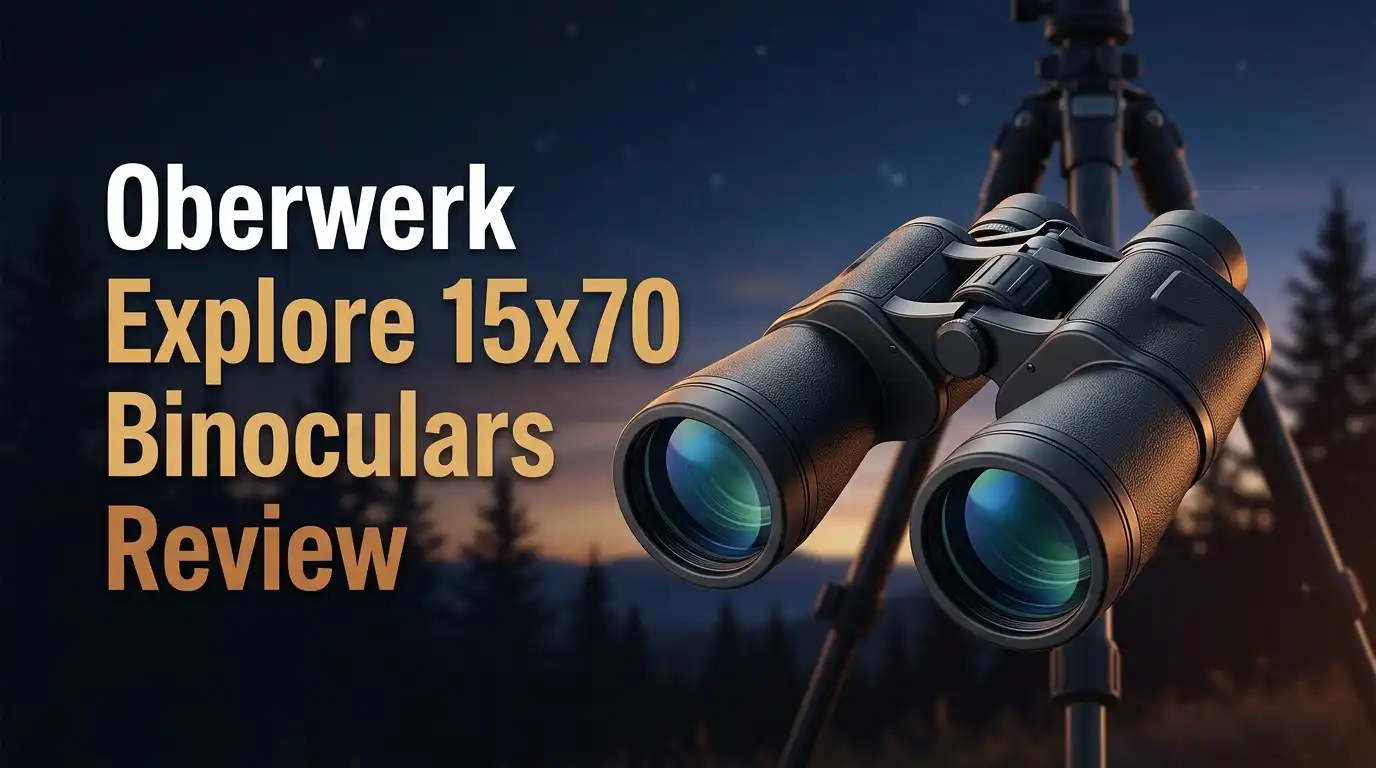
The core specification sheet reads well. You get 15x magnification, 70mm objective lenses, a 4.6mm exit pupil, an IPD range of 62mm to 74mm, and dimensions of roughly 10.5 inches long by 8 inches wide. Edge to edge light transmission sits near 96 percent thanks to the broadband coatings.
This is a porro prism design, which matters. Porro prisms deliver better depth perception and higher light throughput per dollar than roof prisms at this size. For sky scanning, that tradeoff makes sense.
The Unboxing Experience
The box arrives smaller than you expect for a 70mm binocular. Inside sits a lightweight hard case with a zip closure, which already feels like an upgrade over the floppy nylon bags that ship with budget pairs.
Lift the lid and the binocular sits nested in foam. The first impression is weight distribution. At 3.25 pounds the Explore feels dense in the hands but not punishing. The rubber armor has a slightly textured grip that holds well even with cold fingers.
Accessories include a neck strap, a one piece ocular rainguard, captive objective covers that stay tethered to the barrels, and the Oberwerk Heavy Duty L Adapter. That adapter normally costs extra with competing brands. Finding it in the box is a genuinely pleasant surprise.
Setup takes under two minutes. Twist the eyecups, set your interpupillary distance, adjust the right diopter, and you are observing.
Build Quality and Construction
The aluminum chassis gives the Explore a solid, cold feel that plastic bodied rivals cannot match. Flex is essentially absent. Grip the barrels and twist, and nothing creaks.
Waterproofing is real, not marketing language. The housing is sealed and purged with nitrogen, which prevents internal fogging during temperature swings. That matters more than people assume. A binocular that fogs the moment you step from a warm house into a cold yard wastes your observing window.
The rubber armor covers the full body and absorbs minor knocks. The focus bridge feels stiff and well machined. The tripod socket sits in a reinforced housing rather than a thin plastic insert.
One honest note: the hinge tension on my sample started slightly tight and loosened after about two weeks of regular use. That is normal, but first time buyers sometimes mistake it for a defect.
Top 3 Alternatives for Oberwerk Explore 15×70


Last update on 2026-10-25 / Affiliate links / Images from Amazon Product Advertising API Some of the links on this website are affiliate links, which means that at no additional cost to you, I earn a commission if you click through and make a purchase. I only recommend products and services that I believe will add value to my readers. Thank you for your support!
Celestron SkyMaster 15×70 Astronomy Binoculars

Last update on 2026-10-25 / Affiliate links / Images from Amazon Product Advertising API Some of the links on this website are affiliate links, which means that at no additional cost to you, I earn a commission if you click through and make a purchase. I only recommend products and services that I believe will add value to my readers. Thank you for your support!
Celestron SkyMaster Pro 15×70 Binoculars

Last update on 2026-10-25 / Affiliate links / Images from Amazon Product Advertising API Some of the links on this website are affiliate links, which means that at no additional cost to you, I earn a commission if you click through and make a purchase. I only recommend products and services that I believe will add value to my readers. Thank you for your support!
Celestron SkyMaster Pro ED 15×70 Binoculars
Optical Performance During Daylight
Daylight testing tells you things the night sky hides. Contrast, color accuracy, and edge sharpness all become obvious when there is plenty of light.
Center sharpness on the Explore is excellent. Reading distant signage, counting fence posts on a far ridge, and picking out plumage detail on a hawk all worked without strain. Color rendition stays neutral with a very slight warm bias that most people will never notice.
The 4.3 degree field translates to roughly 77 meters at 1000 meters. That is a respectable width for 15x magnification, though noticeably tighter than a 10×50 pair.
Edge performance is where honesty matters. The outer 15 to 20 percent of the field softens. Stars become small commas and terrestrial detail loses bite. This is typical for the price class, but do not expect flat field performance here.
Night Sky and Deep Sky Performance
This is the Explore’s home territory, and it performs.
Point it at the Double Cluster in Perseus and you get two glittering knots of resolved stars inside a single field. The Pleiades fit comfortably with room around them. M13 in Hercules appears as a distinctly grainy ball rather than a fuzzy dot. The Orion Nebula shows clear wing structure on a dark night.
The 70mm aperture gathers roughly twice the light of a 50mm pair. That difference is not subtle. Faint objects that barely register in smaller binoculars become obvious targets.
Star points stay tight across the central field with minimal flaring. Background sky appears genuinely dark, which signals good internal baffling and quality coatings. Light scatter around bright stars stays controlled.
Eye Relief and Comfort for Glasses Wearers
Many large binoculars fail eyeglass wearers. The Explore does not.
18mm of eye relief is generous at this magnification. With the twist up eyecups fully retracted, I saw the complete 4.3 degree field while wearing standard prescription glasses. No blackout rings, no hunting for the sweet spot.
The eyecups click firmly into three positions. They hold their setting rather than drifting during a session, which is a small detail that becomes important after an hour of observing.
The IPD range of 62mm to 74mm is the one caveat. That lower limit is wider than average. Users with narrow eye spacing, including many children and some adults, may struggle to merge the two images. Measure your IPD before buying if you suspect this applies to you.
Focusing System and Handling
The center focus wheel is large, textured, and smooth. Travel from near focus to infinity takes roughly one and a quarter turns, which balances speed against precision nicely.
Focus action on my unit had zero backlash. You turn, the image responds, and it stays put. The right eyepiece diopter adjusts with a separate ring that holds its position firmly.
Handling is where realism enters. Fifteen power amplifies every tremor. Handheld views look like a slightly seasick version of what the optics can actually resolve. You will see maybe 60 percent of the available detail.
Bracing against a wall, a car roof, or a fence post helps enormously. A reclining chair with a monopod works even better. Treat handheld use as casual scanning, not serious observing.
Tripod Mounting and Stability
The included heavy duty L adapter is a genuine asset. It threads into the front tripod socket and provides a standard quarter inch mounting point.
Pair the Explore with a sturdy photo tripod and the transformation is dramatic. Stars snap into pinpoints. Faint nebulosity emerges. Detail you never suspected was there suddenly appears.
Oberwerk recommends its own 3000 Series tripod as an affordable platform, with the taller 5000 Series for users above six feet. Any solid tripod rated for at least 8 pounds works, though.
One practical frustration deserves mention. Looking straight up through a tripod mounted binocular forces an awkward neck angle. A parallelogram mount or a zero gravity reclining chair solves this. Budget for that comfort accessory if you plan long sessions.
What the Oberwerk Explore 15×70 Does Not Do Well
Authentic reviews name the flaws. Here are this binocular’s real weaknesses.
Close focus is poor. The 20 meter minimum focus distance makes backyard birding, butterfly watching, and museum use impossible. This is a long distance instrument only.
Chromatic aberration is visible. Scan the Moon’s limb or look at Jupiter and you will see a purple or yellow fringe. It is not severe, and it disappears on deep sky targets, but ED glass models handle this better.
Edge softness is noticeable. The outer field loses sharpness and stars distort. Critical observers who demand flat fields should look at the Ultra series instead.
Handheld use disappoints. Without support, the shake robs you of resolution.
The case is lightweight, not armored. It protects against dust and bumps, not against being dropped or crushed in checked luggage.
Pros and Cons
Pros
- Excellent light gathering from the 70mm objectives brings deep sky objects within easy reach.
- 18mm eye relief delivers the full field for eyeglass wearers, a rare feature at this price.
- Waterproof and nitrogen filled construction prevents internal fogging and handles damp nights.
- Aluminum body with rubber armor feels far more durable than plastic bodied rivals.
- Heavy duty L adapter included, saving you a separate purchase.
- Strong value at roughly $189.95 compared to similar quality alternatives.
- Responsive direct support from a small company that answers the phone.
Cons
- 20 meter minimum focus eliminates all close range viewing.
- Visible chromatic aberration on the Moon and bright planets.
- Soft outer field affecting the last fifth of the view.
- 3.25 pounds is too heavy for comfortable extended handheld use.
- 62mm minimum IPD may not suit narrow set eyes or younger users.
- No ED glass at this tier, which limits color correction.
Oberwerk Explore 15×70 vs Celestron SkyMaster 15×70
The SkyMaster 15×70 is the default budget choice, often selling under $100. It gathers the same amount of light on paper, so why pay more?
Quality control is the honest answer. SkyMaster units arrive with inconsistent collimation often enough that experienced observers treat it as a lottery. Some samples are excellent. Others show doubled images that cause eyestrain.
The Explore arrives collimated and stays that way because the aluminum chassis resists flexing. Build materials, coatings, and the sealed waterproof body all sit a tier above.
The SkyMaster still makes sense if your budget is firm and you accept the risk. If you want a binocular that works correctly out of the box and lasts a decade, the Explore justifies its extra cost.
Oberwerk Explore 15×70 Price and Value in 2026
Last update on 2026-07-11 / Affiliate links / Images from Amazon Product Advertising API Some of the links on this website are affiliate links, which means that at no additional cost to you, I earn a commission if you click through and make a purchase. I only recommend products and services that I believe will add value to my readers. Thank you for your support!
At roughly $189.95, the Explore 15×70 occupies a smart middle ground. It costs about twice what a bargain 15×70 costs and roughly a third of what the Oberwerk 15×70 ED Ultra costs at $689.95.
Think of it this way. Below $100 you gamble on quality control. Above $500 you pay for ED glass and flat field correction that most casual observers never fully use. The Explore sits where performance per dollar peaks.
Resale value holds up well because Oberwerk has a loyal following. Warranty support comes directly from the company, and collimation claims must be filed within 30 days of purchase, so inspect your unit promptly.
For a first serious astronomy binocular, the value proposition here is genuinely hard to beat.
Who Should Buy the Oberwerk Explore 15×70
This binocular suits specific people very well.
Beginner astronomers gain a wide field instrument that shows dozens of Messier objects without the setup time a telescope demands. You step outside, point, and observe.
Telescope owners benefit too. A 15×70 serves as a finder for locating targets before switching to higher magnification.
Marine and coastal watchers appreciate the waterproof sealing and long distance clarity, though the magnification requires bracing on a moving boat.
Wildlife observers working across open terrain, such as prairies, lakes, or mountain ridges, will find the reach useful.
Skip it if you watch birds at close range, need a lightweight travel pair, have narrow IPD, or demand perfectly flat fields. Match the tool to the task and this binocular rewards you.
Final Verdict
The Oberwerk Explore 15×70 earns a confident recommendation with clear boundaries.
It delivers bright, contrasty, well corrected views across the central field. The build quality feels like a product designed by people who actually use binoculars. The eye relief generosity, the included L adapter, and the sealed construction all signal thoughtful design rather than specification padding.
It is not a perfect instrument. The edges soften, the Moon shows color fringing, close focus does not exist, and you need a tripod to unlock the performance you paid for.
Judged against its price and its purpose, though, those compromises feel fair. This is the binocular I would hand to someone asking where to start with astronomy. It shows them enough wonder to keep them hooked, and it holds up long enough to stay useful.
Frequently Asked Questions
Do I need a tripod for the Oberwerk Explore 15×70?
For serious observing, yes. At 15x magnification and 3.25 pounds, handheld shake reduces visible detail significantly. You can scan casually by hand or brace against a wall for short periods, but a tripod reveals substantially more. The included heavy duty L adapter makes mounting simple on any standard photo tripod rated for at least 8 pounds.
Is the Oberwerk Explore 15×70 good for beginners?
Yes. It requires no alignment, no collimation of a telescope, and no complex setup. You point and look. The wide 4.3 degree field makes finding objects far easier than through a telescope eyepiece, which helps new observers learn the sky layout quickly.
Can eyeglass wearers use these binoculars comfortably?
Absolutely. The 18mm eye relief with twist up eyecups allows full field viewing with spectacles on. This is one of the Explore’s strongest practical advantages over competing 15×70 models.
What can I actually see with 15×70 binoculars?
Expect craters and maria on the Moon, the four Galilean moons of Jupiter, dozens of open clusters, bright globular clusters showing granulation, the Andromeda Galaxy with its core and halo, the Orion Nebula with visible structure, and comets when they appear.
How does it compare to the Oberwerk 15×70 Deluxe?
The Deluxe costs around $349.95 and weighs 4.2 pounds. It offers a slightly different build but less eye relief at 15mm. The Explore actually wins on eye relief and weight while costing considerably less. The Deluxe appeals to buyers wanting the heavier traditional Oberwerk chassis.
Are these waterproof enough for boating?
Yes. The sealed nitrogen filled housing handles rain, spray, and humidity without internal fogging. Just remember that 15x magnification on a moving boat produces a very unstable image, so a 7×50 or 10×50 suits marine use better.

Hello, I’m Emily Price, the founder of Birds Affection. As a passionate bird enthusiast and spiritual seeker, I’ve always been fascinated by the symbolic meanings and mystical connections between birds and our lives. On this website, I share my knowledge and insights on the spiritual significance of various bird species, exploring their roles as messengers, guides, and teachers. Through my writing, I aim to inspire and educate others on the profound wisdom and beauty that birds bring to our world. Join me on this journey as we delve into the enchanting realm of bird symbolism and discover the hidden meanings behind these magnificent creatures.