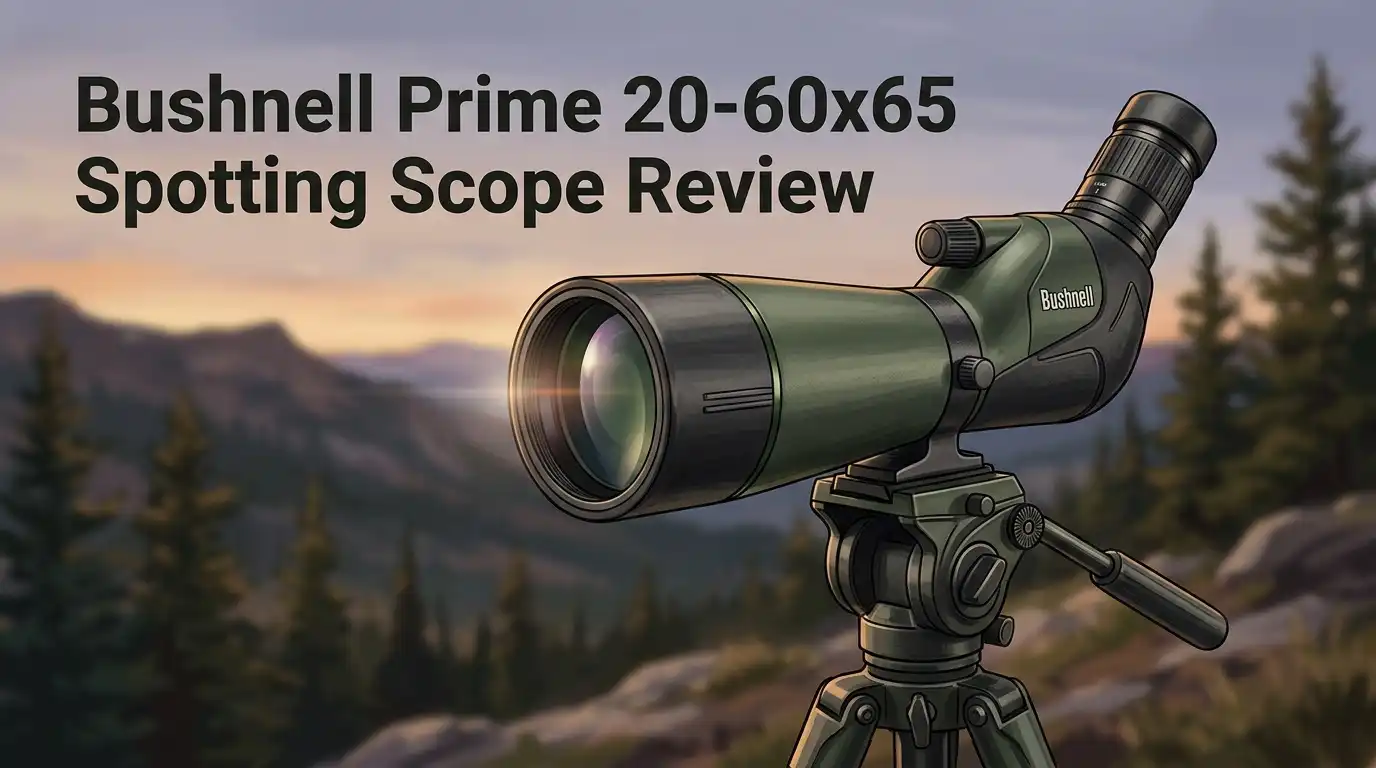
Bushnell Prime 20-60×65 Spotting Scope Review 2026: Still Worth It?
Spotting scopes used to cost a small fortune. That has changed. The Bushnell Prime 20-60×65 sits in the sweet spot where price and performance meet, and it keeps showing up in buyer guides year after year. Shooters use it to call shots at the range. Birders use it to pull feather detail out of a distant marsh. Hunters throw it in a pack and glass hillsides at first light.
But a low price always carries a trade off somewhere. So where does this scope give ground? I looked at the manufacturer specs, field reports from shooters and birders, and long term owner feedback to answer that question honestly.
This review covers the unboxing, the glass, the weak points nobody advertises, and three solid alternatives if the Prime misses your needs. Read on before you spend your money.
In a Nutshell:
- Price to performance is the main story. The Bushnell Prime 20-60×65 lists around $299 direct from Bushnell, and street prices often drop lower. You get a 65mm objective, a 20x to 60x zoom, and a full accessory kit for the money.
- The bundle punches above its weight. Many packages ship with a hard case, a soft case, and a small tripod. Reviewers consistently call the hard case genuinely good, with locking latches and foam padding.
- Weather sealing is real. The scope carries an IPX7 rating and argon purged optics. It survives three feet of water for thirty minutes and resists internal fogging in cold or humid air.
- Image quality fades at the top of the zoom. Detail looks crisp from 20x to about 45x. Push past 50x and the view softens, especially in poor light. Owners report this over and over.
- This is not an ED glass scope. Bushnell lists ED Prime glass as “No” for this model. Expect some color fringing on high contrast edges.
- Best fit: target shooters inside 600 yards, casual birders, and first time scope buyers. Poor fit: serious digiscopers and anyone glassing in deep shade.
Bushnell Prime 20-60×65 Spotting Scope

Last update on 2026-09-22 / Affiliate links / Images from Amazon Product Advertising API Some of the links on this website are affiliate links, which means that at no additional cost to you, I earn a commission if you click through and make a purchase. I only recommend products and services that I believe will add value to my readers. Thank you for your support!
The Prime line sits at the entry point of Bushnell’s optics ladder, below Nitro, Forge, and Elite Tactical. That position tells you a lot. Bushnell built this scope to be the standard, not the showpiece.
The core specs are simple. You get a 65mm objective lens, a 20x to 60x zoom eyepiece, a porro prism design with BaK-4 prism glass, and fully multi coated lenses. The body weighs 38.1 ounces, or about 1080 grams. Total length runs roughly 370mm with the sunshade retracted.
Field of view measures about 150 feet at 1000 yards at 20x, narrowing to roughly 51 feet at 60x. Eye relief stays at a comfortable 18mm across the range. Exit pupil shrinks from 3.3mm down to 1.2mm, which explains a lot about the low light behavior later in this review.
Bushnell sells both a 45 degree angled version and a straight version. The angled model suits tripod use and shared viewing. The straight model suits prone shooters and truck window mounts.
Unboxing Experience: What Actually Shows Up
The shipping box arrives bigger than you expect. That is a good sign, because the extras fill the space.
Open the outer carton and you find a hard case first. This case surprises most buyers. It uses real locking latches, an O ring seal, and cut foam that cradles the scope. Reviewers who handle expensive optics regularly have called it excellent for the price bracket. Plenty of scopes costing three times more ship in a thin nylon sleeve.
Inside the hard case sits a soft carry case. It is not premium, and the stitching feels basic, but it works for a walk to the ridge line.
Tucked in the soft case you find a compact tripod. It stands roughly a foot tall at full extension. It includes a small pan head with a handle and a lock. This tripod is a bonus, not a solution. Use it on a bench, a tailgate, or the ground while prone.
You also get attached lens covers. The front cover flips down and stays tethered. The rear cover is a rubber cap held with a buckle strap. Both resist loss in the field.
Build Quality and Handling in the Field
Lift the scope out and it feels honest. The rubber armor wraps the full barrel and gives a grippy, slightly tacky surface. Nothing rattles. Nothing flexes.
The weight sits at a fair balance point. At just over two pounds, you can hold it steady against a fence post for short looks. Longer sessions need a tripod, as they do with any 60x optic.
The zoom ring runs stiff out of the box. Several reviewers noted this. Stiffness is a mixed blessing. You will not bump the magnification by accident while pulling the scope from a bag, but fast zoom changes require a deliberate twist. The ring loosens slightly after a few months of use.
The focus wheel sits forward of the zoom ring. Your finger lands on it naturally while your eye stays at the eyepiece. That placement matters more than it sounds. You can chase a moving bird and refocus without losing the subject.
The twist up eyecup works smoothly. Leave it down for glasses. Twist it up for bare eye viewing.
Top 3 Alternative for Bushnell Prime 20-60×65 Spotting Scope

Last update on 2026-09-17 / Affiliate links / Images from Amazon Product Advertising API Some of the links on this website are affiliate links, which means that at no additional cost to you, I earn a commission if you click through and make a purchase. I only recommend products and services that I believe will add value to my readers. Thank you for your support!
Bushnell Nitro 20-60×65 Spotting Scope


Last update on 2026-09-13 / Affiliate links / Images from Amazon Product Advertising API Some of the links on this website are affiliate links, which means that at no additional cost to you, I earn a commission if you click through and make a purchase. I only recommend products and services that I believe will add value to my readers. Thank you for your support!
Celestron Ultima 18-55×65 Angled Spotting Scope

Last update on 2026-09-13 / Affiliate links / Images from Amazon Product Advertising API Some of the links on this website are affiliate links, which means that at no additional cost to you, I earn a commission if you click through and make a purchase. I only recommend products and services that I believe will add value to my readers. Thank you for your support!
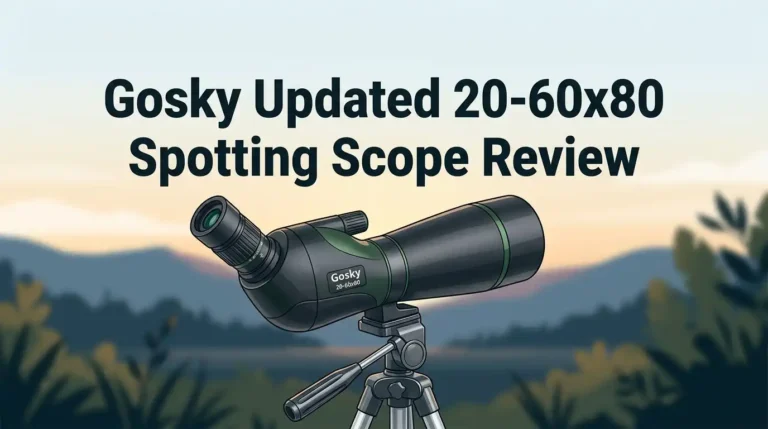
Gosky 20-60×80 Spotting Scope with Tripod and Phone Adapter
Optical Performance in Good Light
Bright daylight is where this scope shines. Set it at 20x to 30x on a sunny morning and the view looks clean, bright, and pleasantly wide.
Contrast holds up well through the lower half of the zoom range. Colors look natural without the yellow cast some budget scopes produce. The fully multi coated lenses do their job on glare and internal reflection.
Sharpness stays strong to about 40x. At 45x the image begins to soften a little. By 60x you see a clear drop in crispness and brightness. One verified owner described focus as sharp at 20x, 40x, and 50x, but noticeably less sharp at 60x. That matches what most field reports say.
Edge performance is average. The center 70 percent of the view looks good. The outer edge loses a bit of definition.
Against premium European glass, the difference is obvious. Testers comparing it to Leica and Zeiss scopes described the Bushnell view as slightly cloudy in dull conditions by comparison. That is expected at one tenth the price.
Low Light and Dawn to Dusk Use
This is the honest weak point of any 65mm scope, and the Prime is no exception.
Exit pupil drives low light performance. At 20x, the exit pupil measures 3.3mm, which is workable at dawn. At 60x, it drops to 1.2mm. Your eye simply cannot gather enough light through that small a cone in dim conditions.
Practical advice: dial down to 20x or 25x in the first and last thirty minutes of daylight. You will see more detail at low power than you will at high power. New users often do the opposite and get frustrated.
The lack of ED glass also shows here. Bushnell lists ED Prime glass as not included on this model, despite some third party listings suggesting otherwise. You will spot purple or green fringing on backlit branches, antler tips, and dark targets against bright paper.
Under a heavy forest canopy or on an overcast evening, an 80mm scope will simply outperform this one. That is physics, not a manufacturing fault. Buy accordingly if low light glassing is your main use.
Zoom, Focus and Eye Relief in Practice
The 20x to 60x range covers most needs. Start wide to find your subject, then zoom in to study it. That workflow becomes second nature within a day.
The 18mm eye relief deserves praise. Glasses wearers get a full field of view with the eyecup retracted. Many budget scopes force you to choose between your glasses and your view. This one does not.
Close focus sits at roughly 20 feet, or 6.1 meters. That number is only average. Butterfly watchers and anyone studying nearby feeders will find it limiting. Backyard birders often want closer.
The focus wheel turns smoothly with useful resistance. It is small, which makes fine adjustment easy but fast racking slow. Going from a close subject to infinity takes several turns.
One handling note: at 60x, every tiny vibration multiplies. Touching the focus wheel shakes the image. Let the scope settle for a second after each adjustment. A better tripod fixes most of this complaint.
Weatherproofing and Long Term Durability
Last update on 2026-09-22 / Affiliate links / Images from Amazon Product Advertising API Some of the links on this website are affiliate links, which means that at no additional cost to you, I earn a commission if you click through and make a purchase. I only recommend products and services that I believe will add value to my readers. Thank you for your support!
Bushnell sealed this scope properly, and that matters more than most buyers realize.
The IPX7 rating means the body survives immersion in three feet of water for up to thirty minutes. O ring seals block moisture at every joint. You can glass through a rainstorm without worry.
Argon purging fills the internal chambers with dry inert gas. Argon molecules are larger than nitrogen molecules, so they leak out more slowly over the years. The practical benefit is simple: the inside of your lenses will not fog when you move from a warm truck into cold air.
One reviewer tested the scope in light drizzle with no issues at all. Owner reports after multiple seasons show the same pattern. The rubber armor scuffs, the finish dulls, but the optics stay sealed.
The included hard case extends the life of the scope considerably. Store it there between trips. Cheap scopes usually die from transport damage, not from optical failure.
Range Use for Target Shooters
Target shooters make up a huge share of Prime owners, and the scope earns its place on the bench.
At 100 yards you can see .22 caliber holes in paper clearly, assuming decent light and a stable tripod. At 200 yards, .30 caliber holes remain visible on clean white targets. Beyond 300 yards, plan on using steel or spotting splash instead of holes.
One experienced reviewer, a former military sniper, called the Prime completely adequate for spotting out to 1000 yards. He tracked vapor trail at 450 meters with no trouble and recorded it on a phone.
The same tester ran it beside a $2600 Nightforce TS-82. Both scopes read fine print at 100 meters. The Bushnell ran out of resolving ability at 120 meters while the Nightforce kept going. That is a strong showing against glass costing six times more.
Mirage is your real enemy at the range, not the scope. Drop to 30x when heat waves roll and the image improves immediately.
Birding and Wildlife Watching
Birders judge scopes differently than shooters do. Color accuracy, edge sharpness, and low light reach matter more than raw magnification.
For casual birding, this scope works well. You can identify ducks across a pond, read leg bands at moderate range, and watch raptors on a distant snag. The wide 20x field makes tracking movement easy.
Serious birders will notice the limits. Color fringing on white birds against a bright sky is visible. Warblers in shaded foliage lose detail. The 20 foot close focus rules out nearby feeder study.
The angled eyepiece is the right choice for most birders. It lets short and tall people share a scope without adjusting the tripod. It also makes upward viewing into trees comfortable.
Try to pair the scope with a full height tripod rather than the included mini model. Standing comfort changes the entire experience. A relaxed posture keeps you at the eyepiece longer, and longer looks mean better identifications.
Digiscoping with a Smartphone
Phone photography through a scope is popular, and this one handles it with mixed results.
The eyepiece accepts most universal phone adapters. Alignment takes patience the first few times. Once the adapter is set, you can capture usable photos and video.
Results look best between 20x and 35x. At those settings you get a bright, full circle image with decent detail. Push past 40x and photos turn soft, dark, and heavily vignetted.
No phone adapter ships in the box. Budget an extra $25 to $40 for a decent clamp style mount. Cheap plastic adapters flex and ruin alignment.
Video shakes badly on the included mini tripod. A heavier tripod solves this instantly.
Set your phone exposure manually if it allows. Auto exposure hunts constantly through a scope and produces flickering video.
Compared to dedicated digiscoping setups, this is a casual tool. You will get shareable photos of a bird or a target group. You will not get magazine quality wildlife images.
What This Scope Does Not Do Well
Honest reviews list the failures. Here are the real ones.
The top of the zoom range disappoints. From 50x to 60x, the image softens and dims. Many owners simply stop using those settings. Treat this as a 20x to 45x scope with headroom you rarely touch.
Low light performance is limited. A 65mm objective cannot compete with 80mm glass at dawn or dusk. Hunters glassing in shadow will want more aperture.
No ED glass means visible chromatic aberration. Look at a dark branch against a bright sky and you will see color fringing.
The zoom ring is stiff. Quick magnification changes feel slow, especially with gloves.
Close focus at 20 feet is mediocre. Backyard and insect viewing suffers.
The included tripod is too short for standing use. It is a bonus accessory, not a real solution.
None of these flaws are surprising at this price. They only become deal breakers if your primary use sits in the categories above.
Pros and Cons of the Bushnell Prime 20-60×65
Pros
- Strong value for the price. You get sealed optics, a full accessory kit, and a lifetime warranty for around $300.
- Excellent bundled hard case with locking latches, O ring seal, and cut foam padding.
- IPX7 waterproofing and argon purging keep moisture and internal fog away in real weather.
- Comfortable 18mm eye relief with a twist up eyecup that works well for glasses wearers.
- Sharp, bright images from 20x to 45x in good daylight, with natural color rendering.
- Built in pull out sunshade that cannot be lost, unlike screw on accessories.
- Solid rubber armored build that handles field abuse without complaint.
Cons
- Image softens noticeably above 50x, which limits the usable top end of the zoom.
- No ED glass, so chromatic aberration appears on high contrast edges.
- Weak low light performance compared to 80mm scopes at dawn and dusk.
- Stiff zoom ring slows fast magnification changes.
- Close focus of 20 feet restricts nearby viewing.
- Included tripod is undersized for standing use and vibrates at high power.
- No phone adapter included for digiscoping.
Tripod Pairing Tips That Change Everything
The tripod matters as much as the scope. Most disappointment with budget spotting scopes traces back to shaky support, not bad glass.
The included mini tripod works on a shooting bench or on the ground. It fails for standing birding. Plan to buy a real tripod if you glass upright.
Look for three features. First, a load rating of at least eight pounds. Second, a fluid pan head, which makes tracking smooth. Third, a center column that reaches your standing eye height.
Aluminum tripods cost less and add welcome mass. Carbon fiber costs more and saves weight on long hikes. For a two pound scope, aluminum is usually the smarter buy.
The scope uses a standard 1/4 inch 20 mount, so it fits almost any tripod head. An Arca Swiss plate makes mounting faster.
One free tip: hang your pack from the tripod center hook. The added weight kills vibration at 60x and costs you nothing.
Price, Warranty and Value in 2026
Bushnell lists the Prime 20-60×65 at $299.95 direct, and sale pricing appears often. Earlier MSRP figures around $430 circulated when the line launched, so today’s pricing represents a real improvement.
At $300, the value equation looks strong. Comparable scopes in this bracket rarely include a hard case and a tripod. Those extras alone are worth $80 to $100.
The warranty adds confidence. Bushnell covers the Prime line with its Ironclad limited lifetime warranty. The company defines a product lifetime and repairs or replaces covered failures within it. Registration is quick and worth doing.
Resale value holds up reasonably well. Bushnell has broad name recognition, and used Prime scopes move quickly on secondary markets.
Value depends entirely on matching the scope to your use. For a range shooter inside 600 yards, this is excellent money spent. For a dedicated dawn hunter, spending another $150 on an 80mm scope makes more sense.
Who Should Buy It and Final Verdict
Buy this scope if you are a target shooter working inside 600 yards, a casual birder, a first time scope owner, or someone who needs a tough optic that shrugs off weather.
Skip it if you glass in low light regularly, chase high magnification detail past 50x, or plan to digiscope seriously. Those users should look at an 80mm scope or an ED glass model.
The Bushnell Prime 20-60×65 is a genuinely good entry level spotting scope in 2026. It gives you clean daylight images, real weather sealing, and a complete accessory package for around $300. The glass is not premium, and Bushnell never claimed it was.
The trade offs are predictable and the strengths are real. That combination is exactly what a budget optic should deliver.
Rating: 4.2 out of 5 for the price bracket.
Frequently Asked Questions
Is the Bushnell Prime 20-60×65 good for 1000 yard shooting?
Yes, with limits. One experienced tester called it adequate for spotting out to 1000 yards. You will see steel hits, vapor trail, and splash. You will not see bullet holes in paper at that distance. Few scopes at any price can do that.
Does this scope have ED glass?
No. Bushnell lists ED Prime glass as not included for this model. Some third party listings state otherwise, but the manufacturer spec sheet is clear. Expect mild color fringing on high contrast edges.
Should I buy the angled or straight version?
Choose angled for tripod birding, shared viewing, and looking upward into trees. Choose straight for prone shooting, car window mounts, and quick target acquisition. Most buyers are happier with the angled model.
Can I see bullet holes at 200 yards?
You can usually see .30 caliber holes at 200 yards on clean white paper in good light. Smaller .22 caliber holes become difficult past 100 yards. Mirage and light conditions affect this more than the scope does.
Is the included tripod good enough?
It works for bench shooting and prone use. It stands only about a foot tall, so it fails for standing birding. Consider it a useful bonus rather than your permanent support.
How does it compare to an 80mm spotting scope?
An 80mm scope gathers roughly 50 percent more light. That advantage shows clearly at dawn, dusk, and high magnification. The 65mm Prime is lighter, cheaper, and easier to pack. Pick based on when and where you glass.
Does it fog up in cold weather?
No. Argon purging keeps the internal chambers dry, so internal fogging is not an issue. External lens condensation can still occur, just as it does on any optic. Wipe it with a microfiber cloth.
What is the warranty?
Bushnell covers the Prime line under its Ironclad limited lifetime warranty. Register your scope after purchase to simplify any future claim.

Hello, I’m Emily Price, the founder of Birds Affection. As a passionate bird enthusiast and spiritual seeker, I’ve always been fascinated by the symbolic meanings and mystical connections between birds and our lives. On this website, I share my knowledge and insights on the spiritual significance of various bird species, exploring their roles as messengers, guides, and teachers. Through my writing, I aim to inspire and educate others on the profound wisdom and beauty that birds bring to our world. Join me on this journey as we delve into the enchanting realm of bird symbolism and discover the hidden meanings behind these magnificent creatures.