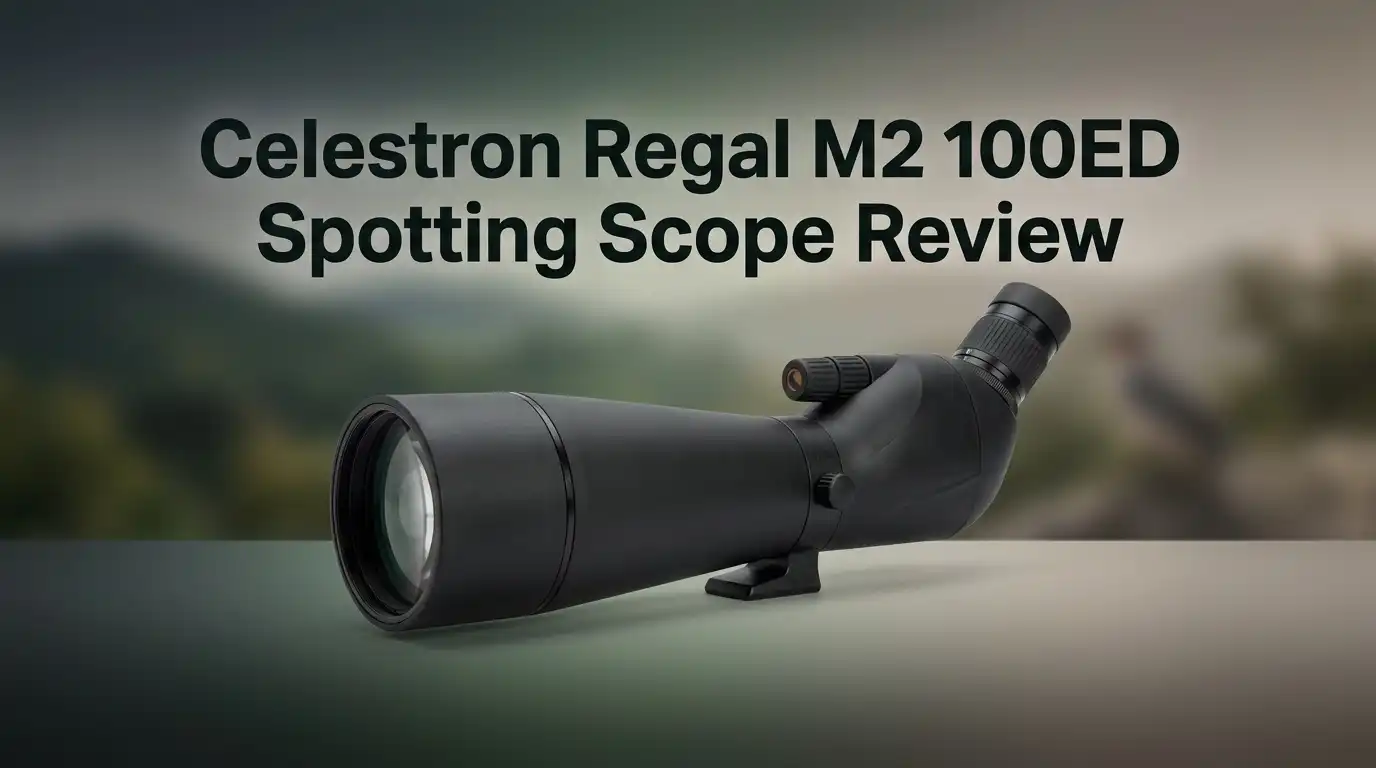
Celestron Regal M2 100ED Spotting Scope Review 2026: Still Worth It?
Big glass changes what you see. A 100mm objective pulls in light that smaller scopes simply cannot reach. The Celestron Regal M2 100ED has been sitting in that sweet spot for years now, and it still shows up on shortlists in 2026.
So the real question is simple. Does a scope designed over a decade ago still earn your money today? I spent time with this one in fields, on a lake shore, and in my backyard under stars.
This review covers the sharp images, the heavy weight, the annoying quirks, and the things Celestron does not put on the box. Read before you spend.
In a Nutshell:
- Optics punch above the price. The ED objective and XLT coatings deliver bright, high contrast images with very little color fringing. Feather detail at 400 yards is genuinely impressive, and the view stays usable deep into dusk.
- It is heavy and big. At roughly 85 ounces with the eyepiece attached and nearly 22 inches long, this is a vehicle scope or a short walk scope. Backpack hunters will hate carrying it.
- You must buy a serious tripod. A lightweight photo tripod turns this scope into a shaking mess. Budget an extra $200 to $400 for a stable head and legs.
- The 1.25 inch eyepiece mount is the hidden bonus. You can swap in astronomy eyepieces and use the scope as a small refractor telescope. Very few spotting scopes allow this.
- Reported aperture is optimistic. Field testers measured the true clear aperture closer to 90mm or 91mm rather than a full 100mm. The scope still performs well, but know this going in.
- Price around $950 to $1,050 makes it a value pick. It competes with scopes costing twice as much, though it will not match Swarovski or Kowa at the edges of the field.
Celestron Regal M2 100ED Spotting Scope


Last update on 2026-09-24 / Affiliate links / Images from Amazon Product Advertising API Some of the links on this website are affiliate links, which means that at no additional cost to you, I earn a commission if you click through and make a purchase. I only recommend products and services that I believe will add value to my readers. Thank you for your support!
The Regal M2 100ED is Celestron’s flagship spotter. It uses a 100mm Extra Low Dispersion objective lens, a magnesium alloy body, and a 540mm focal length. The included zoom eyepiece covers 22x to 67x magnification.
Celestron rates the angular field of view at 1.9 degrees wide open, which equals about 100 feet at 1,000 yards. Close focus sits near 26 feet. Eye relief measures 20mm at the lowest power, so eyeglass wearers get a comfortable view.
The body is fully waterproof and nitrogen purged. Celestron backs it with a limited lifetime warranty. The angled 45 degree design keeps your neck relaxed during long sessions, which matters more than most buyers expect.
The Unboxing Experience
The box arrives plain and sensible. Celestron does not chase luxury packaging here, and that is fine. Inside you find the scope cradled in foam, the zoom eyepiece in its own sleeve, and a green padded nylon case.
The first thing I noticed was weight. Lifting the scope out of the foam takes two hands. The magnesium body feels cool and solid, not hollow or cheap.
You also get a balance rail, lens caps, an eyepiece cover, a lens cloth, a T adapter ring for camera work, and a manual. The included soft case has a view through design, so you can leave the scope inside while observing.
Mounting the eyepiece takes about ten seconds. Drop it in, tighten the locking collar, and you are ready. No tools needed.
Build Quality and Body Design
The magnesium alloy shell drops the weight by roughly 14 percent compared with the older Regal F ED. It still weighs over five pounds. That tradeoff is real.
The rubber armor grips well in wet hands. Seams feel tight. I left the scope out in steady rain for an hour and found no moisture inside.
The rotating tripod collar includes detents, so the eyepiece clicks into set positions. This feature shines when you shoot photos or share the scope with other people.
A sliding sunshade pulls forward and includes a sighting line on top. The line helps you point the scope before you look through it. Small touch, big time saver when a bird lands and disappears.
One gripe. The eyepiece locking collar uses a smooth ring rather than a knurled one, and cold fingers slip on it.
Top 3 Alternative for Celestron Regal M2 100ED

Last update on 2026-09-17 / Affiliate links / Images from Amazon Product Advertising API Some of the links on this website are affiliate links, which means that at no additional cost to you, I earn a commission if you click through and make a purchase. I only recommend products and services that I believe will add value to my readers. Thank you for your support!
Celestron Regal M2 80ED Spotting Scope

Last update on 2026-07-25 / Affiliate links / Images from Amazon Product Advertising API Some of the links on this website are affiliate links, which means that at no additional cost to you, I earn a commission if you click through and make a purchase. I only recommend products and services that I believe will add value to my readers. Thank you for your support!
Athlon Optics Cronus G2 UHD 20x to 60×86 Spotting Scope

Last update on 2026-07-01 / Affiliate links / Images from Amazon Product Advertising API Some of the links on this website are affiliate links, which means that at no additional cost to you, I earn a commission if you click through and make a purchase. I only recommend products and services that I believe will add value to my readers. Thank you for your support!
Celestron Ultima 80 Angled Spotting Scope
Optical Performance in Daylight
Daylight is where this scope earns its reputation. Images look clean, bright, and neutral in color. The ED glass controls chromatic aberration very well through most of the zoom range.
I glassed ducks across a 600 yard marsh. At 30x I counted bill details and wing bars easily. Color edges on white birds against dark water stayed almost invisible, which is the main job of ED glass.
Center sharpness stays strong from 22x up to about 50x. Push past 55x and resolution softens noticeably. Heat shimmer usually ruins the view before the optics do.
Edge sharpness is the weak point. The outer 15 percent of the field goes soft, especially at low power. Premium European scopes hold their edges far better, and that difference is exactly what you pay extra for.
Low Light and Dusk Performance
This is the reason people choose a 100mm scope. Exit pupil measures 4.5mm at 22x, which feeds your eye plenty of light at twilight.
I compared it against an 80mm scope during the last 20 minutes of legal shooting light. The Regal M2 stayed usable for several extra minutes. Deer bodies kept their outlines when the smaller scope went muddy.
Keep the magnification low when light fades. At 22x or 30x the view stays bright. At 67x the exit pupil shrinks to 1.5mm and the image turns dim and grainy.
Hawk watchers and dusk hunters benefit most here. If you only observe in bright midday sun, a smaller scope saves you weight and money with almost no visible loss.
The Zoom Eyepiece and Magnification Range
The bundled zoom eyepiece uses a Kellner design. It works, and it represents decent value, but it is not the strongest part of the package.
Field of view at 22x feels tight compared with modern wide angle zooms. Finding small birds in thick brush takes patience. Experienced users often swap in a quality fixed astronomy eyepiece for a wider, crisper view.
The twist up eyecup moves smoothly and holds position. Eye relief is generous enough for glasses.
Zooming requires a firm grip and a deliberate turn. The zoom ring is stiff out of the box and loosens only slightly over months of use. Image shift during zoom is minor but present, so expect a small refocus after big magnification changes.
Dual Focus System
Celestron gave the M2 line two focus wheels. The coarse wheel gets you close fast. The fine wheel nails the final detail.
This setup works better than a single helical ring on a scope this long. I could go from a near shoreline to a distant treeline in about two turns.
Both wheels feel smooth with light resistance. Neither wheel has noticeable backlash. In cold weather the grease thickens and the fine wheel drags a little.
The fine focus knob is small. Gloved hands struggle with it. I ended up removing a glove every time I needed critical focus, which gets old fast in winter. A larger focus knob would be an easy improvement for a future version.
What This Scope Does Not Do Well
Honest reviews list the failures. Here are mine after extended use.
Portability is poor. Five pounds plus a heavy tripod means you leave it in the truck more often than you plan to.
Edge performance disappoints at low magnification. The usable sharp zone sits in the middle of the field, so you learn to center your subject.
Reported aperture is generous. Independent flashlight testing suggests the real clear aperture measures around 90mm to 91mm at infinity focus, not a full 100mm.
Build consistency varies. Some owners report loose focus wheels or collimation issues on arrival. Quality control is the most common complaint in long term owner feedback.
The included case protects the scope but offers no backpack straps. The eyepiece collar design also frustrates cold fingers.
Birding Performance
Birders will enjoy this scope at fixed locations. Shorelines, hawk watch platforms, wetland blinds, and feeder setups all suit it perfectly.
Resolution at 40x reveals leg color, eye rings, and wing covert patterns on distant shorebirds. The angled body makes scanning flocks comfortable for long stretches.
The 26 foot close focus limit hurts in woodland settings. Warblers at 20 feet stay blurry. Premium birding scopes often focus down to 8 or 10 feet.
Digiscoping works well for documentation shots. You can record a rare sighting clearly enough for identification.
Carry it to a pond and you will love it. Carry it up a ridge trail and you will question your choices before you reach the top.
Hunting and Long Range Shooting Use
Western hunters who glass from a truck or a stable ridge seat get real value here. The big objective finds bedded animals in shadowed timber.
For target shooting, the scope resolves bullet holes in paper. I read .30 caliber holes at 300 yards under good light at 50x. Mirage limits you far more than the glass does.
Backcountry hunters should look elsewhere. This scope is too heavy and too long for a serious pack trip. An 65mm or 80mm scope saves two pounds and a lot of space.
The green finish blends into brush better than black. The sunshade also cuts glare that could give away your position on an open hillside.
Astronomy Use
Here is the secret weapon. The standard 1.25 inch eyepiece mount turns this spotter into a small refractor.
Swap the zoom for a good 10mm eyepiece and you get crisp lunar craters. Saturn shows its rings. Jupiter shows cloud bands and all four Galilean moons.
Celestron rates limiting stellar magnitude at 12.5 under ideal skies. Double stars split cleanly thanks to the ED objective.
No other spotting scope in this price class offers this much astronomy flexibility. You can add filters, a diagonal, or a zoom astronomy eyepiece.
The 540mm focal length produces fast, wide views that work nicely for star clusters. Deep sky objects stay faint, since 90mm of aperture only gathers so much light.
Digiscoping and Photography
Celestron includes a T adapter ring, so attaching a camera requires only a T ring for your specific body. Setup takes a few minutes.
Results look good at low to medium magnification. Vignetting appears as you zoom past 45x, and sharpness drops with it.
Smartphone adapters work too, though you must buy one separately. A universal phone clamp over the eyepiece produces solid video of birds and wildlife.
Autofocus does not function in this setup. You focus with the scope wheels and trigger the shutter manually or remotely.
Expect usable documentation images rather than gallery prints. Serious wildlife photographers should buy a telephoto lens instead. Casual users who want to share a sighting online will be happy with what comes out.
Tripod Requirements
Do not skip this section. The tripod decides whether you love or hate this scope.
A flimsy aluminum photo tripod under a five pound scope at 67x produces constant vibration. You will blame the optics when the tripod is the problem.
Buy a fluid video head rated for at least 10 pounds. Carbon fiber legs with large diameter tubes work best.
Plan on spending $200 to $400 on support. Good options include heavy duty video tripods and dedicated spotting scope heads.
The included balance rail helps a lot. It lets you slide the scope forward or back so the load sits centered over the head. Once balanced, panning feels smooth and the scope holds its aim without drifting.
Pros and Cons
Pros
- Excellent ED optics deliver bright, high contrast images with minimal color fringing
- Large 100mm class objective provides strong low light and dusk performance
- Standard 1.25 inch eyepiece mount accepts astronomy eyepieces for real telescope use
- Dual focus system allows fast coarse adjustment plus precise fine tuning
- Magnesium alloy body stays lighter than comparable aluminum scopes
- Fully waterproof and nitrogen purged with a limited lifetime warranty
- Outstanding value against scopes costing two or three times more
- T adapter ring and padded case come included
Cons
- Heavy and bulky at over five pounds and nearly 22 inches long
- Soft image quality at the outer edges of the field
- True clear aperture measures closer to 90mm than the advertised 100mm
- Close focus limit of 26 feet restricts woodland birding
- Included zoom eyepiece offers a narrow field of view by modern standards
- Small fine focus knob is awkward with gloves
- Requires an expensive, heavy tripod to perform properly
- Reported quality control inconsistency between individual units
Price and Value in 2026
Celestron lists the Regal M2 100ED at $1,049.95. Street prices often land between $900 and $1,000 depending on promotions.
At that number the value equation works. You get ED glass, a 100mm class objective, waterproof construction, and telescope compatibility.
Compare it with alpha scopes from Swarovski or Kowa that start near $3,000. Those scopes beat the Regal on edge sharpness, field width, and close focus. They do not beat it by three times the amount.
The Athlon Cronus G2 is the toughest rival in the $1,000 to $1,500 range, with a wider field and better edges.
The Regal M2 wins on aperture and on eyepiece flexibility. Buyers who value raw light gathering and astronomy use still find no better deal.
Who Should Buy the Celestron Regal M2 100ED
Last update on 2026-09-24 / Affiliate links / Images from Amazon Product Advertising API Some of the links on this website are affiliate links, which means that at no additional cost to you, I earn a commission if you click through and make a purchase. I only recommend products and services that I believe will add value to my readers. Thank you for your support!
Buy this scope if you observe from fixed positions. Hawk watch sites, duck marshes, shooting ranges, lake shores, and backyard patios all fit.
Buy it if you want one optic for both wildlife and casual astronomy. The 1.25 inch eyepiece mount makes that dual role genuinely practical.
Buy it if dusk and dawn matter to your hobby. The large objective delivers real extra minutes of usable light.
Skip it if you hike far with your gear. Choose the 65ED or 80ED instead and save weight.
Skip it if you watch warblers in close woodland. The long close focus distance will frustrate you.
Skip it if you demand edge to edge perfection. Save longer and buy an alpha scope.
Final Verdict
The Celestron Regal M2 100ED remains a strong buy in 2026. The optics deliver bright, sharp, color accurate views that justify the price without hesitation.
It is not perfect. The weight is real, the edges go soft, the aperture claim is generous, and quality control varies between units.
Judge it for what it is. This is a stationary observation scope with serious light gathering and unusual versatility.
My rating sits at 4.3 out of 5. Pair it with a solid tripod, set it up at a good vantage point, and it will show you things you have never seen before. For birders, range shooters, and backyard astronomers who stay close to their vehicle, few scopes offer this much performance for the money.
Frequently Asked Questions
Is the Celestron Regal M2 100ED really a 100mm scope?
The objective lens glass measures 100mm. Independent flashlight testing shows the effective clear aperture at infinity focus measures closer to 90mm or 91mm. Performance still beats an 80mm scope noticeably, but the gap is smaller than the numbers suggest.
Can I use the Regal M2 100ED for astronomy?
Yes, and this is one of its best features. The standard 1.25 inch eyepiece mount accepts astronomy eyepieces, filters, and diagonals. You can see lunar craters, Saturn’s rings, Jupiter’s cloud bands, and bright star clusters clearly.
What tripod do I need for this scope?
You need a sturdy tripod with a fluid video head rated for at least 10 pounds. Carbon fiber legs with thick tubes work best. Budget $200 to $400. A cheap tripod will make the scope shake and ruin your view at high power.
How does the Regal M2 100ED compare with the 80ED model?
The 100ED gathers more light and performs better at dusk. The 80ED weighs less, costs less, and packs smaller. If you hike with your gear, choose the 80ED. If you observe from a fixed spot in low light, choose the 100ED.
Is the included zoom eyepiece good enough?
It works well and offers fair value. The field of view feels narrow compared with modern wide angle zooms, and edge sharpness is average. Many owners add a quality fixed eyepiece for critical viewing while keeping the zoom for general scanning.
Does the Regal M2 100ED work for digiscoping?
Yes. The included T adapter ring lets you attach a DSLR with the correct T ring. Smartphone adapters also work well. Expect good documentation images at low to medium magnification, with vignetting appearing above roughly 45x.

Hello, I’m Emily Price, the founder of Birds Affection. As a passionate bird enthusiast and spiritual seeker, I’ve always been fascinated by the symbolic meanings and mystical connections between birds and our lives. On this website, I share my knowledge and insights on the spiritual significance of various bird species, exploring their roles as messengers, guides, and teachers. Through my writing, I aim to inspire and educate others on the profound wisdom and beauty that birds bring to our world. Join me on this journey as we delve into the enchanting realm of bird symbolism and discover the hidden meanings behind these magnificent creatures.