Firefield 20-60×60 Spotting Scope Review 2026: Still Worth It?
Buying your first spotting scope feels like a gamble. You want to see bullet holes at 200 yards without spending half a paycheck. The Firefield 20-60x60SE keeps showing up in that search, usually under $120, usually with a tripod and case thrown in. That price makes people suspicious, and honestly, it should.
I spent several weeks with this scope at the range, in the backyard, and on two early morning walks looking for deer. Some of it impressed me. Some of it annoyed me. This review covers both, including the parts the product page skips.
You will learn what the glass really shows at 40x, why the included tripod frustrates almost every owner, and whether a $120 optic can honestly replace a $400 one. Short answer: sometimes yes, often no. Keep reading and you will know which camp you fall into before you spend a dollar.
In A Nutshell:
- The price is the main selling point. You get a 60mm objective, a 20x to 60x zoom, a tripod, a nylon case, and lens covers for roughly the cost of one decent tripod head. For a first scope, that package is hard to argue with.
- Image quality peaks between 20x and 35x. In that band the view looks bright, sharp, and honest. Colors stay natural. Push past 45x and the picture softens noticeably, especially in heat shimmer or low light.
- The included tripod is the weakest part of the kit. It wobbles, it sits low, and it turns a usable optic into a shaky one. Budget another $40 for a real tripod and the scope improves dramatically.
- Eye relief is tight. Glasses wearers will fight the eyecup. This is the most common complaint in owner reviews, and my experience matched it.
- It is weather resistant, not submarine grade. Firefield lists an IPX6 rating and fogproof construction. Light rain is fine. Full immersion is not.
- Best use case: paper and steel targets from 100 to 300 yards. Serious birders and long range hunters should spend more.
Firefield 20-60x60SE Spotting Scope Kit


Last update on 2026-09-24 / Affiliate links / Images from Amazon Product Advertising API Some of the links on this website are affiliate links, which means that at no additional cost to you, I earn a commission if you click through and make a purchase. I only recommend products and services that I believe will add value to my readers. Thank you for your support!
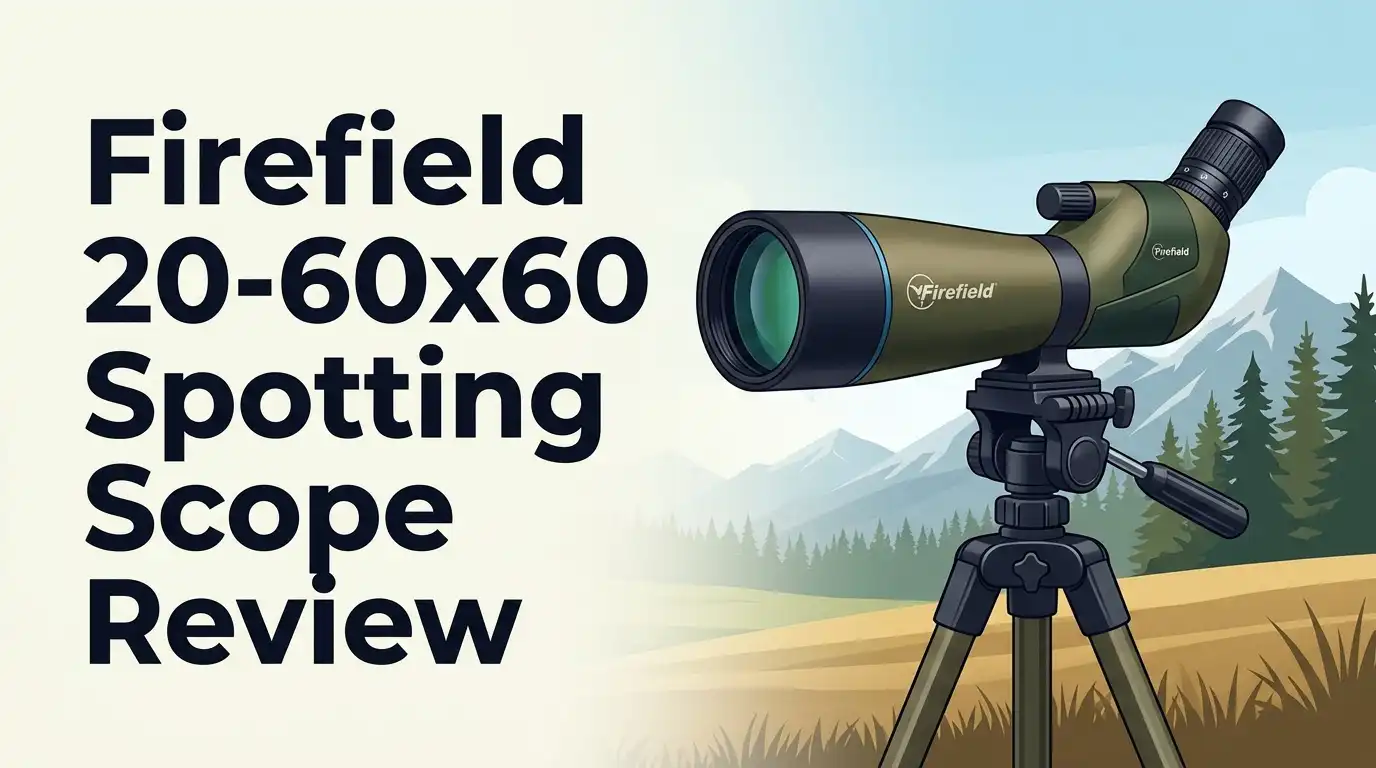
The Firefield 20-60x60SE sits at the entry level of the spotting scope market. Firefield builds it as a kit, which means the scope arrives with an adjustable tripod, a nylon carry case, and lens caps. The body uses a 60mm objective lens paired with BAK4 prisms and fully multicoated glass. Magnification runs from 20x to 60x through a rotating collar near the eyepiece.
The eyepiece sits at a 45 degree angle. That design choice matters more than people expect. Angled eyepieces let you sit low, shoot prone, and share the scope with a friend of a different height without resetting the tripod every time.
Firefield lists the weight at 22.5 ounces, which is light for a 60mm scope. Field of view measures 110 feet at 1,000 yards on the low end and drops to 57 feet at full zoom. Minimum focus distance is 15 feet. Those numbers describe a general purpose scope, not a specialist tool.
Unboxing Experience: What Actually Arrives
The box is plain. Brown cardboard, a printed sleeve, no fanfare. Inside, the scope sits in molded foam with the tripod tucked beside it in a plastic sleeve. The nylon case comes folded flat at the bottom.
My first reaction was surprise at how small the scope felt. Photos make it look chunky. In hand it is about the length of a forearm and light enough to hold one handed while you thread it onto the tripod.
The rubber armor feels grippy and slightly tacky, the kind of texture that stays put in cold weather. Lens caps are soft rubber and fit snugly. The eyepiece cap, however, popped off in the case twice during transport.
The tripod is where the mood shifts. It arrives in three telescoping aluminum sections that feel thin under thumb pressure. You will know within ten seconds that this part was built to a price. Assembly takes under a minute. Nothing needs tools.
Build Quality And Handling In The Field
The scope body holds up better than the price suggests. Rubber armor wraps the main tube and absorbs bumps from truck beds and tailgates. I knocked it against a concrete bench and found no damage beyond a scuff.
The focus knob sits on top of the barrel and turns with light resistance. It travels smoothly, though it lacks a fine focus wheel. That means small corrections require a delicate touch, and at 60x you will overshoot focus more than once.
The zoom collar rotates with slightly more friction than the focus knob. Some units break in after a few weeks. Mine stayed a little stiff, which honestly helped, since a loose zoom ring drifts during use.
Balance on the tripod mount is decent. The single 1/4 inch socket sits near the center of gravity, so the scope does not nose dive when you loosen the head. Handling feels solid for the money, and that counts for something.
Top 3 Alternative for Firefield 20-60×60 Spotting Scope

Last update on 2026-07-01 / Affiliate links / Images from Amazon Product Advertising API Some of the links on this website are affiliate links, which means that at no additional cost to you, I earn a commission if you click through and make a purchase. I only recommend products and services that I believe will add value to my readers. Thank you for your support!
Emarth 20-60x60AE Angled Spotting Scope

Last update on 2026-09-13 / Affiliate links / Images from Amazon Product Advertising API Some of the links on this website are affiliate links, which means that at no additional cost to you, I earn a commission if you click through and make a purchase. I only recommend products and services that I believe will add value to my readers. Thank you for your support!
Gosky 20-60×80 Spotting Scope with Phone Adapter

Last update on 2026-09-13 / Affiliate links / Images from Amazon Product Advertising API Some of the links on this website are affiliate links, which means that at no additional cost to you, I earn a commission if you click through and make a purchase. I only recommend products and services that I believe will add value to my readers. Thank you for your support!
Celestron Ultima 18-55×65 Angled Spotting Scope
Optical Performance From 20x To 35x
This is the range where the Firefield earns its keep. At 20x the image looks bright and clean across most of the frame. Edges soften a little, but the center stays crisp enough to read range flags and count fence posts at distance.
At 25x to 30x, I could pick out .30 caliber holes on white paper at 100 yards in good afternoon light. Smaller .223 holes showed up too, though they required a steady moment and a careful focus adjustment.
Color rendering is neutral. Grass looks like grass. I did notice mild purple fringing on high contrast edges, like a dark branch against bright sky. That is chromatic aberration, and it is normal for glass at this price.
Contrast holds up well in flat overcast light. The fully multicoated lenses are doing real work here. For the first two thirds of the zoom range, this scope punches above its price tag.
What Happens Above 40x Magnification
Here is the honest part. The image degrades as you climb past 40x, and by 55x to 60x it gets mushy.
Brightness drops first. The exit pupil shrinks to about 1.05mm at full zoom, which is tiny. Your eye receives far less light, so the view dims and colors flatten. In early morning or late evening, 60x becomes nearly useless.
Sharpness fades next. Fine detail smears into a soft haze. You can still tell that something is there, but you cannot resolve what it is. Heat shimmer makes this worse. On a warm range day past noon, anything above 45x turns into rippling soup.
My practical ceiling was around 40x on bright days and 30x in low light. Owners across forums report the same thing.
Treat the 60x marking as marketing, not as a working setting. That is true of most budget scopes, but it is worth stating plainly.
The Included Tripod: The Kit’s Weak Link
Every criticism of this scope traces back to the tripod at some point. The aluminum legs are thin. The head has no pan and tilt damping. A light breeze or a finger tap sets the whole view shaking for several seconds.
At 20x you can live with it. At 40x the vibration ruins the image. You will find yourself waiting for the picture to settle after every focus adjustment, which gets old fast.
Height is another issue. The tripod stands short, so bench use works but standing use does not. On a shooting bench it is workable if you brace the legs.
The fix is simple and cheap. A basic aluminum photo tripod with a fluid pan head costs $35 to $60 and transforms this scope. Vibration drops, focusing gets faster, and the effective magnification you can actually use climbs by about 10x. I consider the upgrade mandatory, not optional.
Eye Relief And Comfort For Glasses Wearers
Firefield lists eye relief at 17mm down to 13.5mm. On paper that sounds acceptable. In practice it feels shorter, and glasses wearers notice immediately.
With the rubber eyecup folded down, I could get a full field of view with prescription glasses, but only by pressing my lens against the rubber. That leaves smudges and gets uncomfortable within a few minutes.
With safety glasses at the range, the problem worsens. Thicker frames push your eye further back, and you end up with a dark ring around the edge of the view, called vignetting.
Contact lens users and people who shoot without glasses will have a much better time. For them, the eyecup folds up and positions the eye correctly with no fuss.
If you wear glasses full time, this is the single biggest reason to look at another scope. Several owners have flagged this over the years, and it remains the most consistent complaint.
Range Day Testing At 100 To 300 Yards
I set the scope up at a public range across three sessions. At 100 yards, spotting .308 and 9mm holes on white targets took no effort at 25x. The .223 holes needed 30x to 35x and decent light.
At 200 yards, .30 caliber holes remained visible at 35x under bright sun. Smaller calibers became guesswork. Steel targets were easy at any distance inside 300 yards because you watch for paint chips and movement rather than holes.
At 300 yards, the scope worked for steel and for large caliber holes on light backgrounds. Anything finer required conditions to cooperate.
Mirage was the limiting factor more often than glass quality. On cool mornings the scope performed noticeably better than on hot afternoons.
Bottom line: this is a competent 100 to 200 yard paper spotter and a solid steel spotter to 400 yards. It is not a precision rifle tool for small groups at distance.
Birding And Wildlife Watching Results
Birders have different needs than shooters. They want brightness at dawn, quick focus, and a wide field of view for finding moving subjects.
The Firefield handles static birding reasonably well. Feeder watching at 60 to 100 feet looked good at 20x to 25x, with enough detail to identify common species by plumage. The 15 foot minimum focus distance is helpful for close range viewing.
Tracking moving birds is harder. The narrow field of view combined with the shaky stock tripod makes it slow to find and follow a subject. By the time you center the bird, it has often moved.
Low light performance disappoints. The 60mm objective simply cannot compete with the 80mm scopes that serious birders prefer, and dawn or dusk sessions lose detail quickly.
For casual backyard birding, it works. For dedicated birding trips, an 80mm scope with better glass is the smarter purchase.
Weather Resistance And Real World Durability
Firefield rates the 20-60x60SE at IPX6 and describes it as fogproof. That rating covers strong water jets from any direction, which in practice means rain and splashes.
I used it through light drizzle with no internal fogging and no water intrusion. The rubber armor sheds water well and the focus knob kept working with wet hands.
What the scope does not claim is full waterproof submersion or nitrogen purging on every model variant. Firefield’s own spec sheet is ambiguous on nitrogen filling. Treat it as weather resistant and store it dry.
Operating temperature runs from 0 to 120 degrees Fahrenheit. Cold weather performance was fine down to freezing in my testing, though the zoom collar stiffened.
Durability over years is the open question. Budget optics often fail at the focus mechanism or the zoom seal. Mine held up across weeks of use, but I cannot speak to year five.
Phone Digiscoping And Camera Adapters
Firefield markets the scope as camera adaptable. The eyepiece accepts common universal phone adapters, which clamp around the eyecup and hold your phone lens over the exit pupil.
Digiscoping works, with caveats. At 20x to 25x you can capture watchable video of targets and wildlife. Alignment takes patience, and the adapter must be centered precisely or you get a black tunnel effect.
Photo quality is acceptable for documentation, not for publishing. Expect soft edges, some color fringing, and vignetting at higher zoom levels.
Note that a phone adapter is not included in the standard kit. You buy that separately, usually for $15 to $25. Several competing scopes at similar prices bundle one, which is a small but real value gap.
Video of steel target hits came out best. The motion and sound cues make up for the soft detail. Set expectations at casual sharing, not content production.
Pros And Cons
Pros
- Excellent price for a complete kit with tripod, case, and lens caps included
- Bright and sharp image from 20x to 35x, which covers most practical use
- Fully multicoated glass and BAK4 prisms deliver decent contrast for the money
- Light at 22.5 ounces, so packing it into a hunting spot is easy
- Angled 45 degree eyepiece suits bench shooting and prone positions
- Rubber armor survives normal field abuse and light rain
- Simple controls with no learning curve for first time owners
Cons
- Image softens badly above 45x and becomes nearly unusable at 60x
- Included tripod is flimsy, short, and vibrates at any real magnification
- Short eye relief frustrates anyone wearing glasses
- No fine focus wheel, so precise focusing at high zoom takes several attempts
- Weak low light performance compared to 80mm scopes
- No phone adapter included despite camera adaptable marketing
- Purple fringing appears on high contrast edges
What This Scope Does Not Do Well
Authentic reviews name the failures, so here they are grouped together.
It does not deliver usable 60x magnification. The number on the collar exists for the spec sheet. Real work happens below 40x.
It does not work well at dawn or dusk. A 60mm objective at high zoom starves your eye of light, and the view goes dim and gray.
It does not suit glasses wearers. The eye relief is too short, and no accessory fixes that.
It does not track moving targets easily. The narrow field of view and shaky stock tripod make fast acquisition slow and frustrating.
It does not replace a mid tier scope for precision shooting. If you need to see .22 caliber holes at 300 yards, this is the wrong tool and no amount of patience changes that.
It does not survive submersion. Weather resistant means rain, not rivers.
Knowing these limits before purchase is the difference between a happy owner and a disappointed one.
Who Should Buy It And Who Should Skip It
Buy it if you are new to spotting scopes and want to learn what you actually need. Buy it if you shoot at a bench inside 300 yards and want to stop walking downrange. Buy it as a truck scope, a loaner, or a backup you will not cry over.
Buy it if your budget caps at $120 and you need something today.
Skip it if you wear glasses full time. Skip it if you bird seriously or glass at first light. Skip it if you shoot small calibers at long distance and need to see individual holes.
Skip it if you already own a good tripod and would rather put the full budget into glass. In that case, spending $180 to $250 on a Celestron Ultima or an Athlon Talos buys noticeably better optics.
This scope is a starter tool and a range companion, not a lifetime optic. Match your expectations to that and you will be satisfied.
Price And Value In 2026
Firefield lists the 20-60x60SE kit around $119.97 on its own site, and street prices often drop lower during sales. Retail listings have hovered near $100 for years.
Value depends entirely on how you count the accessories. If you would have bought a tripod and case anyway, the bundle looks strong. If you already own a tripod, the math shifts and competitors offer better glass for similar money.
The budget spotting scope category has grown crowded. Gosky, Emarth, Urbancoast, and Creative XP all fight in the same price band, and several now include 80mm objectives and phone adapters.
Against that field, the Firefield competes on brand reliability and build feel rather than raw specs. It is a fair deal, not a steal.
My honest recommendation: buy it on sale, pair it with a $50 tripod, and treat the combined $150 as the real cost of a working setup.
Final Verdict
The Firefield 20-60x60SE does what a budget spotting scope should do. It gets you looking downrange without emptying your wallet, and it performs honestly across the lower two thirds of its zoom range.
The glass is better than the price suggests. The tripod is worse than it should be. The eye relief is a genuine problem for a real portion of buyers. Those three facts define the whole experience.
I would recommend it to a new shooter, a casual backyard observer, or anyone who wants a light scope for a hunting pack. I would steer a serious birder or a precision rifle shooter toward something with an 80mm objective and better coatings.
Rated as a beginner kit, it earns a solid score. Rated as a lifetime optic, it falls short. Know which one you are buying and this scope will treat you fine for years.
Frequently Asked Questions
Is the Firefield 20-60×60 waterproof?
It carries an IPX6 weatherproof rating and fogproof construction. That covers rain, splashes, and humidity. It is not rated for submersion, so do not drop it in a creek or leave it sitting in standing water.
Can you see bullet holes at 200 yards?
Yes, for .30 caliber and larger holes on light targets in good daylight at around 35x. Smaller calibers like .223 become difficult past 150 yards, and .22 holes are unreliable beyond 100 yards.
Does it come with a tripod?
Yes. The kit includes an adjustable tabletop tripod and a nylon carrying case. The tripod is functional but flimsy, and most owners upgrade it within the first few outings.
What is the best magnification setting to use?
Stay between 20x and 35x for the sharpest and brightest image. Use 40x only in good light with a stable tripod. The 50x to 60x range produces soft, dim images in most conditions.
Is it good for bird watching?
It works for casual backyard birding at moderate distances. Dedicated birders will find the low light performance and field of view limiting, and an 80mm scope serves them better.
Does it work with eyeglasses?
Not comfortably. Eye relief measures roughly 13.5mm to 17mm, which is short. Glasses wearers report vignetting and have to press their lenses against the eyecup to see the full field.
How does it compare to the Emarth 20-60×60?
Both sit at similar prices with similar specs. The Emarth is lighter and often includes a phone adapter. The Firefield feels slightly more solid in hand. Optical differences between them are small.
Can you attach a phone for photos?
Yes, with a universal phone adapter purchased separately. Results are acceptable for casual video at lower magnification, but image quality softens quickly as you zoom in.

Hello, I’m Emily Price, the founder of Birds Affection. As a passionate bird enthusiast and spiritual seeker, I’ve always been fascinated by the symbolic meanings and mystical connections between birds and our lives. On this website, I share my knowledge and insights on the spiritual significance of various bird species, exploring their roles as messengers, guides, and teachers. Through my writing, I aim to inspire and educate others on the profound wisdom and beauty that birds bring to our world. Join me on this journey as we delve into the enchanting realm of bird symbolism and discover the hidden meanings behind these magnificent creatures.