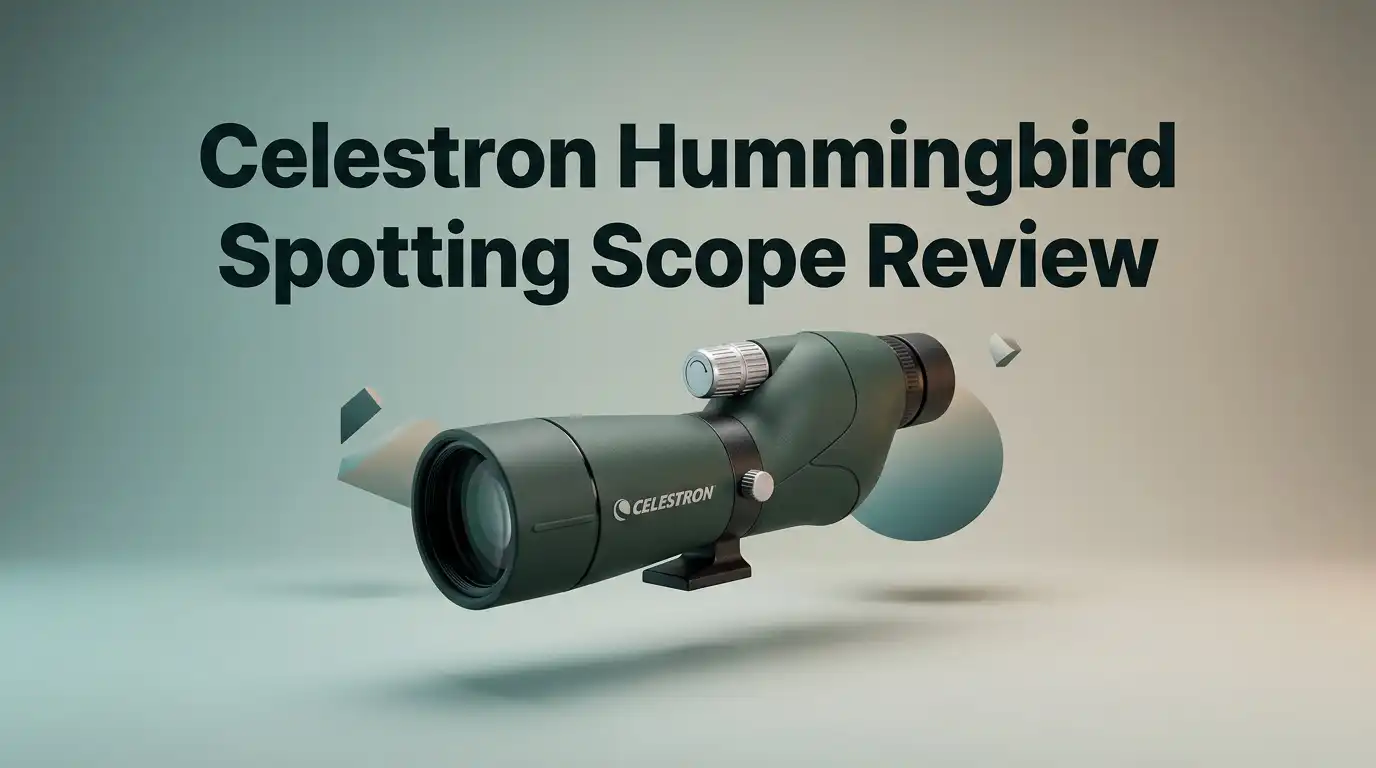
Celestron Hummingbird Spotting Scope Review 2026: Worth Buying?
Most birders know the pain. You pack a full size scope and tripod, walk two miles, and your shoulder files a complaint. Then you spot a distant shorebird and forget the ache for about nine seconds.
The Celestron Hummingbird tries to fix that problem by shrinking the whole idea of a spotting scope. It fits in your palm. It weighs less than many 10×42 binoculars. It still uses ED glass.
But small gear always hides a tradeoff somewhere. I spent time with this scope in bright sun, flat gray overcast, and fading dusk light. I looked at ducks, raptors, license plates, and the moon. Some results impressed me. Others annoyed me.
In a Nutshell:
- Size is the headline feature. The 56mm model weighs 20.8 oz and measures roughly 8.2 inches long. The 50mm model weighs 19 oz. A reviewer once compared the weight to eight granola bars, and that comparison holds up. You will actually carry this scope.
- The ED glass punches above the price. Color fringing stays well controlled. The center of the image looks crisp and clean. Edge sharpness softens a little, which is normal at this price point.
- Magnification tops out at 27x. That is the big compromise. Full size scopes reach 50x or 60x. The Hummingbird trades reach for image quality and portability. Seawatching is not its job.
- The focus wheel feels stiff. Many owners report this. It never slips, which is a plus, but it needs a steady tripod and a patient hand.
- The supplied case fits too tightly. You cannot leave the tripod plate attached and still zip the case shut. This is a genuine design flaw.
- Value remains strong in 2026. Street prices usually sit between $350 and $450 depending on model and stock. For travel birding, that is fair money.
Celestron Hummingbird ED Micro Spotting Scope


Last update on 2026-07-02 / Affiliate links / Images from Amazon Product Advertising API Some of the links on this website are affiliate links, which means that at no additional cost to you, I earn a commission if you click through and make a purchase. I only recommend products and services that I believe will add value to my readers. Thank you for your support!
The Hummingbird comes in two versions. The 50ED offers 7x to 22x magnification with a 50mm objective lens. The 56ED offers 9x to 27x magnification with a 56mm objective lens. Both use extra low dispersion glass, BaK4 prisms with phase coatings, and fully multicoated optics.
Celestron markets this as the first micro spotting scope. That claim holds. Nothing else in the category shrinks this far while keeping ED glass.
Both bodies are waterproof and nitrogen filled. Rubber armor wraps the barrel. The eyepiece sits at a 45 degree angle, which helps when you share views with shorter people or children.
Close focus lands at 9.8 feet on both models. That distance lets you watch butterflies, dragonflies, and feeder birds at close range. A full size scope rarely does that.
Unboxing the Hummingbird: First Impressions
Opening the box feels anticlimactic in a good way. There is no giant foam coffin. You get a small carton, a padded nylon case with belt and shoulder straps, the scope itself, two lens covers, and a short manual.
Lift the scope out and your brain stalls for a second. It looks like a toy. The weight says otherwise. The body feels dense and solid, with tight rubber armor and no creaks.
The orange accent ring looks sharp against the black armor. Build finish is clean. The zoom collar turns with light resistance.
Then you try to pack it back up. The case is cut so snugly that the tripod plate must come off every single time. That detail bothered me on day one and it still bothers me now.
Build Quality and Everyday Durability
The Hummingbird survives normal field abuse. The armor absorbs bumps against car doors, fence posts, and rocks. Nitrogen purging keeps internal fogging away during humid mornings.
I used it in light rain with no water intrusion. The seals do their job.
The focus wheel sits on the barrel and turns smoothly enough, but it carries noticeable stiffness out of the box. That stiffness loosens slightly after a few months of use. It never develops slop, which matters more than first impressions.
The zoom ring rotates independently near the eyepiece. Markings are printed clearly.
One small gripe: the eyepiece cover pops off easily inside a backpack. Expect to lose it eventually. The objective cover stays attached better.
Overall the hardware feels like a product built by people who use optics, not by a marketing team alone.
Top 3 Alternative for Celestron Hummingbird Spotting Scope

Last update on 2026-09-23 / Affiliate links / Images from Amazon Product Advertising API Some of the links on this website are affiliate links, which means that at no additional cost to you, I earn a commission if you click through and make a purchase. I only recommend products and services that I believe will add value to my readers. Thank you for your support!
Hawke Nature Trek 9 to 27×56 Compact Spotting Scope

Last update on 2026-09-17 / Affiliate links / Images from Amazon Product Advertising API Some of the links on this website are affiliate links, which means that at no additional cost to you, I earn a commission if you click through and make a purchase. I only recommend products and services that I believe will add value to my readers. Thank you for your support!
Celestron Regal M2 65ED Spotting Scope

Last update on 2026-10-03 / Affiliate links / Images from Amazon Product Advertising API Some of the links on this website are affiliate links, which means that at no additional cost to you, I earn a commission if you click through and make a purchase. I only recommend products and services that I believe will add value to my readers. Thank you for your support!
Hawke Nature Trek 13 to 39×56 Spotting Scope
Optical Performance in Daylight
Daylight is where this scope shines. Point it at a tree line at 150 yards and the detail arrives fast. Feather edges separate. Bark texture shows up. Colors look natural rather than oversaturated.
The ED glass controls chromatic aberration well. Look at a dark branch against bright sky and you see only a trace of purple fringing. Cheaper non ED compacts smear that boundary badly.
Center sharpness stays strong through most of the zoom range. The sweet spot covers a generous portion of the view.
Edge softness appears in the outer ring of the field. You notice it if you look for it, and ignore it if you do not.
One practical tip: back the zoom off slightly from maximum. At roughly 24x instead of 27x, the image tightens up noticeably.
Low Light and Dusk Performance
Here the physics catch up. A 56mm objective gathers a limited amount of light, and the exit pupil shrinks fast as you zoom.
At 9x, the exit pupil measures about 6.2mm, which is bright and comfortable. At 27x, it drops near 2mm. That is a dim view in fading light.
In practice, the Hummingbird handles dawn and dusk better than expected at low power. Duck silhouettes resolve into identifiable birds. Detail still comes through.
Push the zoom past 20x after sunset and the image goes murky. One reviewer described a subtle hazing effect at the edges in weak light, and that matches my experience.
This is not a low light specialist. Use the bottom half of the zoom range when the sun drops and you will stay happy.
Zoom Range: What 9x to 27x Really Means
Twenty seven power sounds modest next to a 60x full size scope. In the field it covers more situations than you expect.
At 9x, the Hummingbird works like a handheld binocular on a tripod. The field of view spans 216 feet at 1000 yards. That makes scanning easy.
At 27x, the field narrows to 98 feet. You can read leg color on small sandpipers, check bill shape on distant ducks, and pick out plumage detail on perched raptors.
What it cannot do is seawatching. Distant scoters on open water need real magnification, and this scope runs out of reach.
The honest framing is this: Celestron chose better glass with less reach instead of weaker glass with more reach. For most land birding, that choice works.
Focusing Experience and Close Focus
The focus mechanism uses a barrel mounted wheel. It travels a long way from close focus to infinity, which helps precision but slows you down when a bird moves.
The stiffness is real. On a lightweight tripod, turning the wheel nudges the whole rig. A sturdy head fixes most of this.
The payoff is stability. The focus never drifts once set, even in wind or during transport.
Close focus at 9.8 feet opens up uses beyond birding. Butterflies, dragonflies, and reptiles all become viable subjects. I spent an embarrassing amount of time watching a bumblebee.
Infinity focus arrives with a touch of overtravel, which is useful for eyeglass wearers and for anyone with a mild prescription difference.
Eye Relief and Eyeglass Comfort
Eye relief measures 15mm on both models. That number sits at the low end of comfortable for glasses wearers.
The twist up eyecup works smoothly and holds its position. With glasses on and the cup fully down, I could see most of the field but not quite all of it at low power.
Contact lens users get the full view with no complaints. Glasses wearers lose a small slice of the edges.
The 45 degree angled eyepiece earns real praise. It lowers the tripod height needed, saves your neck during long sessions, and makes sharing views much easier.
If you bird with kids, the angled design matters more than any spec sheet number. Children can reach the eyepiece without climbing on anything.
Tripod Setup and Stability Notes
The Hummingbird accepts a standard tripod plate and also mounts on monopods and window mounts. A quick release plate is not included.
Pair it with a lightweight carbon fiber tripod. The scope weighs so little that your tripod will dominate the total load.
Skip the monopod. The stiff focus wheel needs the counterforce of three legs, and a monopod wobbles under that pressure.
Wind performance surprised me. A small scope should shake badly in gusts, but the low profile body catches less wind than a long barrel. Image shake stayed comparable to full size scopes on the same head.
Set your tripod lower than usual. The angled eyepiece lets you sit on a stool and still see comfortably, which adds stability and saves energy.
Digiscoping and Phone Photography
Digiscoping works, with conditions. The eyepiece diameter suits most universal phone adapters, and the angled design makes positioning easy.
At 9x to 15x, phone images come out clean and bright. Posting worthy shots of perched birds are realistic.
Past 20x, vignetting creeps in and brightness drops. Autofocus hunting becomes a constant battle.
Celestron lists the scope as camera adaptable, and T adapters exist for the eyepiece. Results with a dedicated camera look better than phone results.
Set your expectations correctly. This is a documentation tool, not a wildlife photography system. You get record shots that prove what you saw, not gallery prints.
A solid tripod and a two second timer solve half the blur problems you will encounter.
What the Hummingbird Does Not Do Well
Honest reviews list failures. Here are the real ones.
Magnification ceiling. Twenty seven power limits long range work. Seawatchers and hunters glassing distant ridges will feel frustrated fast.
The case design. You cannot store the scope with the tripod plate attached. Removing the plate every session invites loss and wastes time.
Focus stiffness. It slows your reaction when a bird moves between branches.
Low light at high zoom. The small exit pupil at 27x produces a dim, soft view after sunset.
Edge softness. The outer field loses sharpness. Premium scopes hold detail further out.
No included quick release plate or tripod. Budget extra money for a proper support system.
None of these are deal breakers for travel birding. All of them matter if you expected a full size scope in miniature form.
Hummingbird 50ED vs 56ED: Which One Fits You
Celestron sells two Hummingbirds and the choice confuses people.
The 50ED uses a 50mm objective with 7x to 22x zoom. It weighs 19 oz and measures 7.4 inches long. The wider 7x setting gives a 263 foot field at 1000 yards, which makes scanning easier.
The 56ED uses a 56mm objective with 9x to 27x zoom. It weighs 20.8 oz and measures 8.2 inches. It gathers more light and reaches further.
Choose the 50ED if minimum size and widest view matter most. It genuinely replaces a binocular at the low setting.
Choose the 56ED if you want the extra reach and brightness. Most buyers should pick the 56ED. Two ounces is not a meaningful penalty, and the extra magnification gets used often.
Price and Value in 2026
The Hummingbird launched around $320 for the 50ED and $360 for the 56ED. In 2026, street prices usually land between $350 and $450 depending on model and stock levels.
Supply has tightened. The 50ED shows as out of stock on Celestron’s own site at times, so availability varies by retailer.
At this price, your alternatives are either bulkier compacts with weaker glass or premium travel scopes costing three to ten times more. The Swarovski ATX compact sits above $3,700.
Celestron backs the scope with a limited lifetime warranty, which adds real value.
Value verdict: strong for travel birders, backyard watchers, and anyone building a go light kit. Weak for people who need serious reach, since that money buys more magnification elsewhere.
Pros and Cons
Pros
- Truly pocketable size and a weight under 21 oz that you will actually carry every time
- ED glass that controls color fringing far better than typical budget compacts
- Waterproof and nitrogen filled body with durable rubber armor
- Close focus at 9.8 feet works for butterflies, dragonflies, and feeder birds
- Comfortable 45 degree angled eyepiece that suits shared viewing and kids
- Stable in wind thanks to the low profile body
- Limited lifetime warranty from an established optics brand
- Low power setting doubles as a binocular replacement
Cons
- Maximum 27x magnification limits long range and seawatching use
- Stiff focus wheel slows you down on moving subjects
- Supplied case will not close with a tripod plate attached
- Image dims noticeably at high zoom in low light
- Edge sharpness falls off in the outer field
- No tripod or quick release plate included
- Only 15mm eye relief, which is tight for glasses wearers
- Digiscoping results weaken past 20x
Final Verdict: Should You Buy It
The Celestron Hummingbird solves one problem extremely well. It removes the excuse for leaving your scope at home.
If your birding involves flights, long hikes, or travel with limited luggage space, this scope earns its place. The ED glass delivers real optical quality, not a gimmick. Views at 150 to 400 yards look genuinely good.
If you scan ocean horizons, judge trophy animals at a mile, or need 50x on demand, buy something bigger. No amount of clever engineering overcomes a 27x ceiling.
My honest take: this is the scope I grab when I am unsure whether I need a scope at all. That usefulness is worth more than a spec sheet suggests.
Rated for what it is, the Hummingbird is one of the smartest compact optics purchases available in 2026.
Frequently Asked Questions
Is the Celestron Hummingbird good for astronomy?
It works for casual sky viewing. The moon looks sharp and bright. Jupiter shows as a small disc with visible moons. Star clusters resolve nicely at low power. However, 27x is far too low for planetary detail, and the scope accepts only limited eyepiece swaps. Treat astronomy as a bonus, not a reason to buy.
Does the Hummingbird need a tripod?
Yes, for anything above about 12x. You can brace it against a car window or fence post for quick looks. For steady viewing, a lightweight carbon tripod with a smooth head transforms the experience. Skip monopods because the stiff focus wheel creates wobble.
How does it compare to the Hawke Nature Trek 9 to 27×56?
The two scopes share nearly identical specifications on paper. The Celestron uses ED glass, which gives it better color correction and slightly sharper images. The Hawke often costs less. Most users who compare both directly prefer the Celestron view, though the margin is not dramatic.
Can I use the Hummingbird with eyeglasses?
Mostly yes. The 15mm eye relief with a twist down eyecup lets glasses wearers see most of the field. You will lose a small portion of the outer edges at low magnification. Contact lens users get the complete view with no issue.
Is the Hummingbird waterproof enough for rain?
Yes. The body is sealed, waterproof rated, and nitrogen filled to prevent internal fogging. It handles rain, fog, humidity, and temperature swings without trouble. Dry the exterior before packing it into the padded case.

Hello, I’m Emily Price, the founder of Birds Affection. As a passionate bird enthusiast and spiritual seeker, I’ve always been fascinated by the symbolic meanings and mystical connections between birds and our lives. On this website, I share my knowledge and insights on the spiritual significance of various bird species, exploring their roles as messengers, guides, and teachers. Through my writing, I aim to inspire and educate others on the profound wisdom and beauty that birds bring to our world. Join me on this journey as we delve into the enchanting realm of bird symbolism and discover the hidden meanings behind these magnificent creatures.