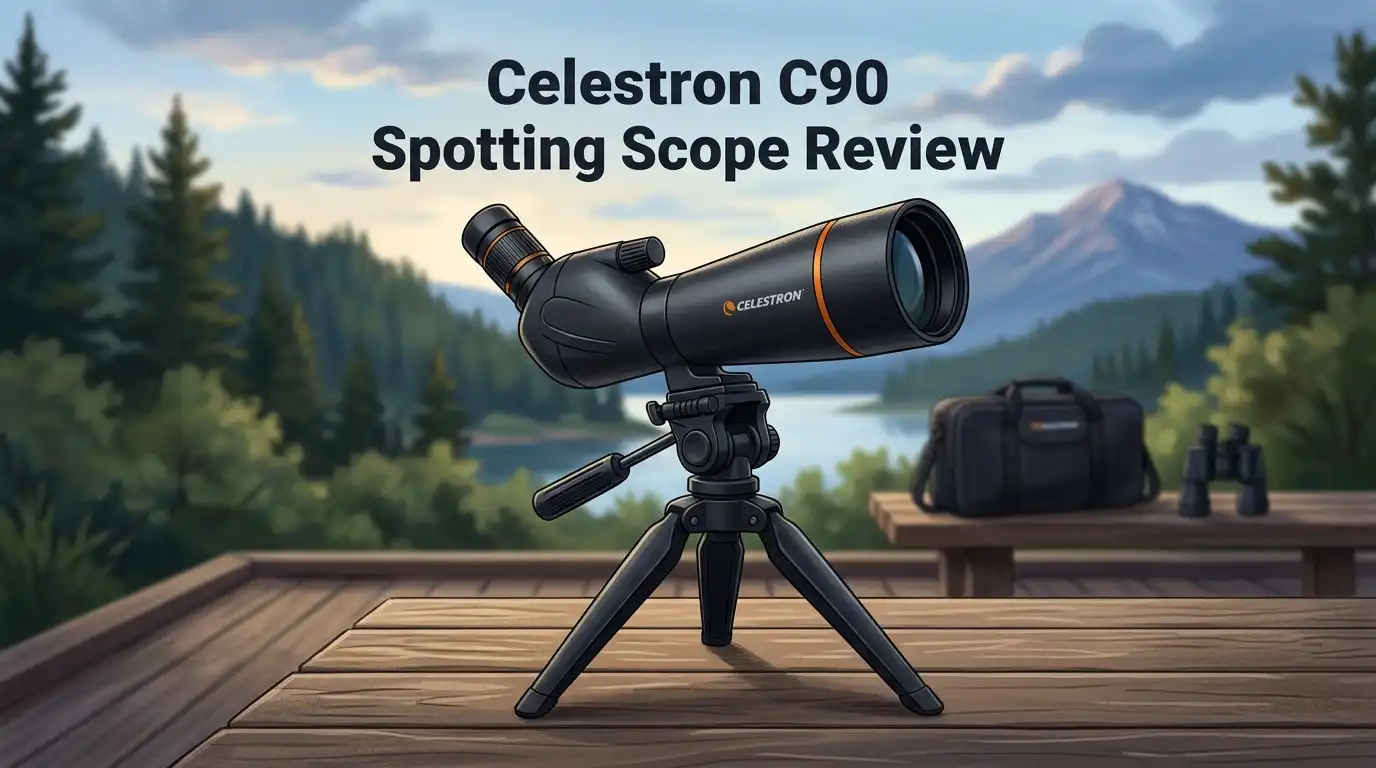
Celestron C90 Spotting Scope Review 2026: Still Worth It?
The Celestron C90 does not look like a normal spotting scope. It looks like a small telescope that wandered into the hunting aisle by mistake. That odd shape is exactly why people keep buying it, and also why some people send it back within a week.
I have spent time behind this little tube in daylight, at dusk, and under a dark sky. It gave me razor sharp views of a hawk on a fence post 300 yards away.
It also frustrated me with its narrow view and its shaky included tripod. This review covers both sides honestly, so you know what you are getting before you spend your money in 2026.
In A Nutshell:
- The optics punch far above the price. The C90 uses a Maksutov Cassegrain design with a 90mm objective and a 1250mm focal length. Images look sharp and high in contrast, especially in the middle of the field. For roughly $250, that optical quality is hard to beat.
- It is a high power specialist, not a wide view scanner. The included 32mm Plössl gives only 39x and a 1.3 degree field of view. You will find birds slowly. Once you find them, the detail is excellent.
- It doubles as a real telescope. The Vixen style dovetail bar lets you mount it on an astronomy mount. Swap in shorter eyepieces and you can push past 150x on the Moon and planets. No other spotting scope at this price does that.
- The accessories are the weak link. The bundled tripod wobbles, the 45 degree correct image diagonal is mediocre, and the baffle tube is shiny enough to cause glare.
- It is not waterproof. Celestron does not seal or nitrogen purge this scope. Rain, fog, and heavy humidity are genuine risks.
- Best for target shooters, lunar fans, and patient birders. Open country birders and anyone who needs fast zoom should look at an 80mm refractor style scope instead.
Celestron C90 Mak Spotting Scope

Last update on 2026-09-23 / Affiliate links / Images from Amazon Product Advertising API Some of the links on this website are affiliate links, which means that at no additional cost to you, I earn a commission if you click through and make a purchase. I only recommend products and services that I believe will add value to my readers. Thank you for your support!
The C90 Mak carries item number 52268 in the Celestron catalog. It packs a 90mm aperture and a 1250mm focal length into a tube only 16 inches long. That works out to f/13.9, which is a very slow focal ratio by telescope standards and a very long one by spotting scope standards.
The package includes a 32mm Plössl eyepiece, a 1.25 inch correct image 45 degree prism diagonal, an 8×21 erect image finder scope, a small tabletop tripod, and a soft backpack style case. Weight sits at roughly 5 pounds for the optical tube.
The headline feature is the folded light path. Light enters through a thick meniscus corrector lens, bounces off a spherical primary mirror, then reflects off an aluminized spot on the back of that corrector. You get the reach of a long lens inside a short, sealed body.
The Unboxing Experience
The box arrives smaller than most people expect. Inside sits the soft case, and inside that sits the scope wrapped in foam. My first reaction was simple surprise at the density. Five pounds in a 16 inch tube feels like holding a thermos filled with lead.
The black finish looks clean and slightly glossy. The rubber focus knob on the rear turns with a smooth, slightly stiff feel that loosens up after a few sessions. The dovetail bar on the bottom has a standard quarter inch threaded hole, so you can skip the included tripod and go straight to your own.
Assembly took me under three minutes. Slide the diagonal into the visual back, tighten the thumbscrew, drop in the 32mm eyepiece, clamp the finder scope on. No tools needed. The included case zips shut with the scope fully assembled, which is a thoughtful touch for anyone walking to a blind.
Build Quality And Design
The tube feels solid. There is no flex, no rattle, and no creaking when you clamp it down hard on a tripod head. The exterior paint resists scuffs well, and after a season of use mine shows only minor marks near the dovetail.
Focusing works by moving the primary mirror along an internal rod. This system is far better than the twist focus barrel used on the original orange C90 from the 1970s. Image shift during focus is small but present. At 150x and above you will notice the view nudge slightly as you turn the knob.
The visual back carries T threads, which opens the door to camera adapters. One real complaint sits inside the tube. The baffle tube has a shiny interior surface that scatters light. Flocking paper fixes it for a few dollars, but a scope at this price should not need owner modifications.
Optical Performance In Daylight
This is where the C90 earns its reputation. Point it at a license plate 200 yards out and the numbers snap into focus with genuine clarity. Contrast looks strong, edges look clean, and color stays neutral without the yellow cast that cheap glass often adds.
Chromatic aberration is almost absent, which makes sense for a mirror based design. Bright objects against a dark background can show a faint halo, a normal trait of Maksutov optics. You will notice it on a white bird against dark trees, though it never ruins the view.
Sharpness holds across most of the field with the stock eyepiece. Glare is the main daylight weakness. Shoot toward a low sun and the shiny baffle washes contrast down noticeably. A longer dew shield or lens hood helps a lot here, and flocking helps even more.
Top 3 Alternative For Celestron C90


Last update on 2026-07-01 / Affiliate links / Images from Amazon Product Advertising API Some of the links on this website are affiliate links, which means that at no additional cost to you, I earn a commission if you click through and make a purchase. I only recommend products and services that I believe will add value to my readers. Thank you for your support!
Celestron Ultima 20 to 60×80 Angled Spotting Scope

Last update on 2026-10-03 / Affiliate links / Images from Amazon Product Advertising API Some of the links on this website are affiliate links, which means that at no additional cost to you, I earn a commission if you click through and make a purchase. I only recommend products and services that I believe will add value to my readers. Thank you for your support!
Celestron TrailSeeker 16 to 48×65 Spotting Scope

Last update on 2026-10-03 / Affiliate links / Images from Amazon Product Advertising API Some of the links on this website are affiliate links, which means that at no additional cost to you, I earn a commission if you click through and make a purchase. I only recommend products and services that I believe will add value to my readers. Thank you for your support!
Gosky 20 to 60×80 HD Spotting Scope
Magnification And Eyepiece Options
The stock 32mm Plössl delivers 39x. That number sounds low next to a 20 to 60x zoom scope, and it is. The upside is a bright, comfortable image with very long eye relief. Eyeglass wearers see the full field with ease.
Some users find that eye relief too generous. Holding your head steady becomes a small balancing act because there is no eyecup to rest against. A simple rubber eyeguard solves it.
Swap eyepieces and the scope transforms. A 12mm gives about 104x. A 9mm gives roughly 139x. Good optics let the C90 reach 200x on a steady night, which is remarkable for a 90mm instrument. Avoid anything under 8mm because the exit pupil gets uncomfortably tiny. A simple kit of 25mm, 18mm, and 12mm eyepieces covers almost every real situation.
Close Focus Range For Target Shooting
Here is a feature that rarely gets attention. The C90 focuses as close as about 15 feet. Most long refractor style spotting scopes cannot come anywhere near that without extension tubes.
For target shooters this matters enormously. At 100 and 200 yards the C90 resolves bullet holes in paper clearly in good light, and .22 holes at 100 yards stay visible under decent conditions. At 300 yards you will want the higher magnification eyepieces and steady air.
Butterfly watchers and insect photographers benefit too. You can stand back and frame a dragonfly without scaring it off. The long focal length produces a pleasantly compressed, almost macro style view at close range.
The 45 degree diagonal makes bench use comfortable because you look down rather than crane your neck sideways.
Birding Performance In The Field
Birding is where opinions split sharply. The detail available at 39x and above is excellent. A warbler’s eye ring, the wing bars on a sparrow, the scale pattern on a hawk’s legs all show clearly.
Finding the bird is the problem. A 1.3 degree field is narrow, roughly 68 feet of view at 1000 yards. Birds that move fast are hard to track, and birds in dense brush take patience to locate. The included 8×21 finder scope helps more than you would expect, and it holds alignment well once set.
My honest summary is this. For a feeder, a pond, a nesting site, or a perched raptor, the C90 is a joy. For walking a trail and scanning quickly, an 80mm zoom scope will frustrate you far less.
Nighttime Astronomy Performance
This is the C90’s secret life. The Moon through this scope looks stunning. Craters show sharp rims, shadows show real depth, and the terminator rewards an hour of study.
Saturn shows its rings clearly along with Titan. Jupiter shows two cloud belts, the Great Red Spot on good nights, and all four Galilean moons. Mars gives a small disc with a polar cap at opposition. Double stars split cleanly thanks to the tight, well formed star images.
Deep sky work is limited. Ninety millimeters gathers modest light, and the 1250mm focal length produces a narrow field. Bright clusters like the Pleiades will not fit fully in view. Swap the 45 degree correct image diagonal for a 90 degree star diagonal before any serious night session. Your neck will thank you.
Digiscoping And Photography
The T threaded visual back accepts a camera T ring for about ten dollars. Attach a DSLR or mirrorless body and you have a 1250mm f/13.9 lens, which is a fun and cheap way to reach serious focal length.
Moon photos come out genuinely good. Planets work with a camera that shoots video for stacking. Deep sky astrophotography is off the table because f/13.9 demands exposures far too long for this mount class.
Smartphone digiscoping works with an adapter, though the long eye relief of the stock eyepiece makes alignment fiddly. Expect some trial and error. Bird photos through the C90 look sharp in the center but often show halos around bright feathers. Treat photography as a bonus feature rather than a core strength.
What The Celestron C90 Does Not Do Well
Honest reviews list failures, so here they are plainly.
The included tripod is nearly useless. It is short, light, and wobbles at any real magnification. Budget for a proper tripod immediately.
The scope is not waterproof and not nitrogen purged. Celestron is clear about this. Rain, river spray, and rapid temperature swings can let moisture reach the interior.
The 45 degree correct image diagonal is optically soft compared with the main optics. Upgrading it produces a visible improvement.
Thermal settling takes time. The thick corrector lens needs 20 to 30 minutes outdoors before high power views sharpen fully. Pull it out of a warm car and the first views will disappoint you.
Finally, there is no zoom. Changing power means changing eyepieces, which is slow in the field.
Pros And Cons
Pros
- Excellent optical sharpness and contrast for the price, with almost no color fringing thanks to the mirror based design.
- Very compact at 16 inches long, so it fits in a backpack easily and travels well.
- Close focus down to roughly 15 feet, which beats almost every refractor style spotting scope.
- Doubles as a capable astronomy telescope with a Vixen style dovetail and T threaded rear port.
- Accepts standard 1.25 inch eyepieces, so you can push magnification to 150x or more.
- Long eye relief with the stock eyepiece suits eyeglass wearers well.
Cons
- Narrow 1.3 degree field of view makes finding moving subjects slow.
- Not waterproof or fog proof, which limits bad weather use.
- Included tripod is too flimsy for serious observation.
- Shiny internal baffle tube causes glare and reduced contrast in bright light.
- Included 45 degree diagonal is the weakest optical part of the kit.
- No zoom eyepiece, so power changes require swapping glass.
- Five pound weight feels heavy for such a small tube.
Celestron C90 Versus Ultima 80
These two sit at nearly the same price, so the comparison matters. The Ultima 80 brings an 80mm refractor objective with a 20 to 60x zoom eyepiece. It is waterproof, longer at 19 inches, and slightly heavier in the straight version.
The Ultima wins on convenience. Zoom plus waterproofing plus a wider low power field makes it the better pure birding tool. You find subjects faster and you worry less about weather.
The C90 wins on raw image quality and reach. Its views at matched magnification look cleaner and sharper, and it keeps going well past 60x where the Ultima runs out of room. It also serves as a night sky instrument, which the Ultima does poorly.
Pick the Ultima for birding trips. Pick the C90 for the range, the backyard, and the Moon.
Price And Value In 2026
The C90 Mak typically sells around $250, with sales pulling it slightly lower. At that figure the optics represent strong value. You are buying a design that costs roughly one twentieth of what a comparable Questar Maksutov commands.
Plan on spending more, though. A usable tripod runs $80 to $150. A decent 90 degree star diagonal runs $40 to $70. Two extra eyepieces run $60 to $120. Realistic total investment lands near $400 to $500.
Judged on that complete figure, the C90 still holds up. Nothing else near this price gives you one instrument that genuinely works for shooting ranges, backyard birding, and planetary viewing. The compromises are real, but so is the value.
Who Should Buy The Celestron C90
Buy it if you shoot at a range and want to see holes at 100 to 300 yards without walking downrange. The close focus and high resolution serve that job perfectly.
Buy it if you watch birds from a fixed position such as a window, a hide, or a deck. Patience pays off with beautiful detail.
Buy it if you want one tool for day and night. This is the strongest argument for the C90. No normal spotting scope reaches 200x on Saturn.
Skip it if you hike and scan wide open terrain. Skip it if you hunt in rain or snow, because the lack of sealing is a real risk. Skip it if you want a zoom and nothing else to fuss with.
Final Verdict
The Celestron C90 Mak is a specialist that hides inside a spotting scope label. Its 90mm Maksutov optics deliver sharpness and contrast that embarrass similarly priced scopes. Its compact size, close focus, and eyepiece flexibility give it range that few rivals match.
The flaws are equally real. The field is narrow, the tripod is poor, the diagonal is soft, the glare needs fixing, and the body is not weather sealed. These are not dealbreakers, but they are not small either.
My recommendation is straightforward. If high magnification detail and dual use flexibility matter most to you, buy the C90 and budget for a tripod. If convenience, weather resistance, and quick wide scanning matter more, buy an 80mm zoom scope and enjoy an easier experience.
Frequently Asked Questions
Is the Celestron C90 waterproof?
No. Celestron does not list the C90 as waterproof or nitrogen purged. Light drizzle under cover is survivable, but sustained rain or submersion can let moisture inside. Use a rain cover and store the scope with the caps on in a dry place.
What magnification does the Celestron C90 reach?
The included 32mm Plössl gives 39x. With a 12mm eyepiece you reach about 104x, and with a 9mm you reach about 139x. On steady nights the optics support close to 200x. Above that, atmospheric conditions rather than the scope become the limit.
Can the C90 be used as a telescope?
Yes, and it does this very well. The Vixen style dovetail bar fits standard astronomy mounts, and the 1.25 inch visual back accepts normal eyepieces. Swap the 45 degree correct image diagonal for a 90 degree star diagonal for comfortable night viewing of the Moon and planets.
Is the included tripod good enough?
No. The small tabletop tripod shakes at anything above low power. A solid photo tripod with a fluid head costs $80 to $150 and transforms the experience. Treat the included tripod as a temporary backup rather than your main support.
How does the C90 compare with a 20 to 60×80 scope?
The C90 shows sharper, higher contrast images and reaches far higher magnification. An 80mm zoom scope gives a wider field, faster target finding, waterproof construction, and more convenience. Choose based on whether image quality or ease of use matters more to you.
Does the C90 work for digiscoping?
Yes, with limits. The T threaded rear port accepts a camera T ring for direct attachment at 1250mm. Moon and planet images come out well. Smartphone adapters work but need patient alignment because of the long eye relief on the stock eyepiece.

Hello, I’m Emily Price, the founder of Birds Affection. As a passionate bird enthusiast and spiritual seeker, I’ve always been fascinated by the symbolic meanings and mystical connections between birds and our lives. On this website, I share my knowledge and insights on the spiritual significance of various bird species, exploring their roles as messengers, guides, and teachers. Through my writing, I aim to inspire and educate others on the profound wisdom and beauty that birds bring to our world. Join me on this journey as we delve into the enchanting realm of bird symbolism and discover the hidden meanings behind these magnificent creatures.