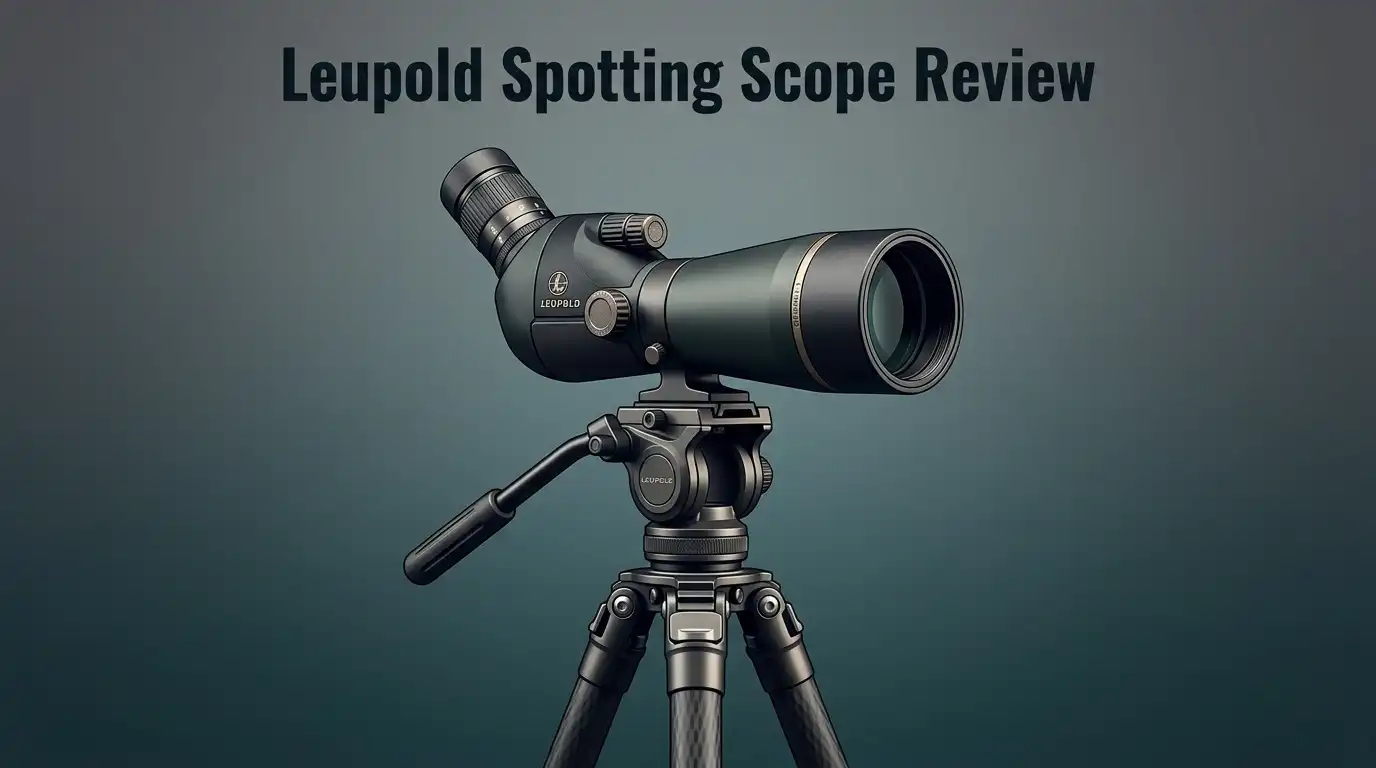
Leupold Spotting Scope Review 2026: Still Worth It?
Buying a spotting scope feels like a big decision. You are spending real money on glass you cannot fully judge until you look through it in the field.
Leupold has been making optics in Oregon since 1907, and their spotters show up on ridgelines, shooting benches, and bird blinds every single day. But the 2026 market is crowded. Vortex, Maven, Athlon, and a dozen direct to consumer brands all want your money.
I spent months behind three Leupold spotters. I counted bullet holes at 200 yards. I glassed mule deer at last light. I dropped one on a rock and winced. This review covers what I found, including the parts Leupold would rather I skip.
In a Nutshell:
- The SX-4 Pro Guide HD Gen 2 is the sweet spot. At roughly $1,199, it delivers about 85 percent of alpine glass performance for a third of the price. The Arca Swiss base and DiamondCoat 2 lens treatment are genuine upgrades over Gen 1.
- The SX-5 Santiam HD is the flagship. Its 27x to 55x zoom range, 80mm objective, and magnesium body make it the sharpest Leupold spotter you can buy. Expect to pay between $1,799 and $1,999 depending on the configuration.
- The SX-2 Alpine HD Gen 2 is the honest budget pick. Starting near $399 for the 60mm version, it uses calcium fluoride glass and punches above its price. It will not match the SX-5 in low light, and Leupold does not pretend otherwise.
- Weight is the recurring complaint. The SX-4 85mm weighs 78.2 ounces. That is nearly five pounds before you add a tripod. Backpack hunters feel every ounce on day three.
- The lifetime guarantee carries real value. Leupold repairs or replaces covered spotting scopes for free, with no receipt and no registration required.
- Leupold is not the absolute optical leader. Swarovski and Kowa still win side by side resolution tests. Leupold wins on durability, service, and price per performance.
Leupold SX-4 Pro Guide HD Gen 2 20-60×85 Review

Last update on 2026-09-18 / Affiliate links / Images from Amazon Product Advertising API Some of the links on this website are affiliate links, which means that at no additional cost to you, I earn a commission if you click through and make a purchase. I only recommend products and services that I believe will add value to my readers. Thank you for your support!
This is the model most hunters should buy. Leupold refreshed the Pro Guide line and the Gen 2 corrects nearly every complaint about the original.
The optical package uses Leupold’s Elite Optical System with fully multi coated HD lenses and phase coated roof prisms. Exterior surfaces get DiamondCoat 2, an ion assist coating that resists scratches and boosts light transmission. Guard ion sheds water and fingerprints, which matters more than you expect during a rainy October morning.
Specs are straightforward. Magnification runs 20x to 60x. The objective measures 85mm. Length is 17.7 inches and weight is 78.2 ounces. Field of view spans 91.7 feet at low power down to 50.6 feet at full zoom, measured at 1,000 yards. Eye relief sits at a generous 19mm.
Image quality at 40x is genuinely impressive. I resolved .224 caliber holes in paper at 300 yards on a calm morning. Push past 50x and the picture softens slightly, which is normal physics for this objective size.
The magnesium housing survived a two foot tumble onto granite with only a rubber scuff.
Unboxing the SX-4 Pro Guide HD Gen 2
The unboxing is understated, and I mean that as a compliment. Leupold ships the spotter in a plain corrugated box with dense foam inserts. No glossy sleeve. No marketing theater.
Inside you get the scope, a zippered neoprene style carry case, objective and eyepiece covers, a lens cloth, and a small parts bag holding the second set of FormFit eyecups. The manual is thin because the scope needs almost no explanation.
First contact tells you a lot. The rubber armor feels grippy rather than tacky. The focus wheel turns with resistance that is smooth and slightly heavy, so it holds position. The zoom collar clicks through magnification steps with tactile detents.
The integrated sunshade slides out with one hand and stays where you put it. That small detail saved me twice while glassing into afternoon sun.
The Arca Swiss base is the standout. I dropped the spotter onto my camera tripod clamp in about four seconds, no adapter plate needed. Anyone who has fumbled with a lost tripod plate in the dark will appreciate this.
Leupold SX-5 Santiam HD 27-55×80 Review

Last update on 2026-09-18 / Affiliate links / Images from Amazon Product Advertising API Some of the links on this website are affiliate links, which means that at no additional cost to you, I earn a commission if you click through and make a purchase. I only recommend products and services that I believe will add value to my readers. Thank you for your support!
The Santiam HD is the flagship, and it behaves like one. Leupold built it around a narrower 27x to 55x zoom range paired with an 80mm objective. That choice is deliberate. Narrower zoom ranges let engineers optimize sharpness instead of spreading compromises across a wide span.
The result is edge to edge clarity that holds up against scopes costing far more. In independent comparison tests, the Santiam tied with premium competitors for edge sharpness and finished near the top for resolution.
Physical specs favor the Santiam over the SX-4. It weighs 68.7 ounces and measures 15.7 inches long. Field of view reaches 105 feet at 27x, which beats the SX-4 at similar magnification. Close focus is 11.8 feet, making it far better for butterflies, birds, and backyard use.
The magnesium chassis is nitrogen purged, waterproof, and fog proof. Leupold’s Twilight Max HD Light Management System pulls noticeably more detail during the last ten minutes of legal shooting light.
Color fidelity is neutral and slightly warm. Nothing looks artificially boosted.
Top 3 Alternative for Leupold SX-5 Santiam HD

Last update on 2026-07-25 / Affiliate links / Images from Amazon Product Advertising API Some of the links on this website are affiliate links, which means that at no additional cost to you, I earn a commission if you click through and make a purchase. I only recommend products and services that I believe will add value to my readers. Thank you for your support!
Vortex Razor HD 27-60×85 Angled Spotting Scope

Last update on 2026-09-13 / Affiliate links / Images from Amazon Product Advertising API Some of the links on this website are affiliate links, which means that at no additional cost to you, I earn a commission if you click through and make a purchase. I only recommend products and services that I believe will add value to my readers. Thank you for your support!
Vortex Diamondback HD 20-60×85 Angled Spotting Scope


Last update on 2026-07-01 / Affiliate links / Images from Amazon Product Advertising API Some of the links on this website are affiliate links, which means that at no additional cost to you, I earn a commission if you click through and make a purchase. I only recommend products and services that I believe will add value to my readers. Thank you for your support!
Celestron Ultima 20-60×80 Angled Spotting Scope
Leupold SX-2 Alpine HD Gen 2: The Budget Pick
Not everyone needs a four figure spotter. The SX-2 Alpine HD Gen 2 exists for that crowd, and it earns its spot.
Leupold offers it in 20x to 60x with either a 60mm or 80mm objective. The 60mm angled version sells around $399. The 80mm version costs more and weighs 67 ounces with a 16.8 inch body.
The headline feature is calcium fluoride glass in the objective. That material reduces chromatic aberration, which is the purple or green fringing you see on high contrast edges. At this price, fluoride glass is unusual.
Field of view on the 80mm model hits 102 feet at 1,000 yards on low power. The body is aluminum with rubber armor, fully waterproof and fog proof.
Here is the honest part. The SX-2 loses brightness faster than the SX-4 once light drops. At 60x the image gets dim and soft. Treat 45x as your practical ceiling.
For range days, casual birding, and hunters who glass mostly in good light, it is plenty of scope.
Glass Quality and Light Transmission Compared
Optical performance separates these three models more than any spec sheet suggests.
The SX-5 Santiam leads. Its fluoride HD glass, Twilight Max coatings, and conservative zoom range combine to produce the brightest, sharpest image in the lineup. At dawn I could identify antler points on a bedded buck fifteen minutes before shooting light.
The SX-4 Pro Guide HD Gen 2 sits close behind. The 85mm objective gathers more raw light than the SX-5’s 80mm, but the wider zoom range costs some sharpness at the extremes. From 20x to about 45x, the SX-4 is hard to distinguish from scopes twice its price.
The SX-2 Alpine HD trails clearly. It is bright and pleasant in daylight and acceptable at dusk. It simply does not have the coating stack of its siblings.
One consistent Leupold trait across all three is glare control. Shooting into low angle sun, these scopes wash out less than several competitors I tested beside them. That matters during evening glassing sessions.
Build Quality and Weather Sealing
Leupold builds optics for abuse, and this is where the brand still separates itself.
Every scope here is nitrogen purged and sealed with O rings. Leupold runs its own Punisher machine, which subjects optics to roughly 5,000 impacts at multiple times the recoil force of a .308. Spotters get similar torture treatment.
I tested the seals the lazy way. I left the SX-4 outside during an all night rain, then brought it into a warm truck. Zero internal fogging. The exterior beaded water off thanks to the Guard ion coating.
The magnesium housings on the SX-4 and SX-5 resist dents better than aluminum. The rubber armor absorbs shock and stays grippy when wet or cold.
One small annoyance worth mentioning. The tethered objective covers on all three models flop around and can catch wind. Several owners simply remove them.
Focus wheels held tension through freezing temperatures. Zoom collars stiffened slightly below 20 degrees Fahrenheit but never froze.
What These Scopes Do Not Do Well
Real reviews name the weak points, so here they are.
Weight is the biggest issue. The SX-4 85mm hits 78.2 ounces. Add a decent tripod and head and you carry eight pounds of glassing kit. Backcountry hunters counting grams should look at the 65mm SX-4 or a different brand entirely.
Maximum magnification disappoints. Every model here loses meaningful sharpness and brightness in the top quarter of its zoom range. The SX-2 is worst, the SX-5 is best, but none stay crisp at full power in poor light.
Close focus on the SX-4 is poor. At 35 feet, it is useless for nearby birding or insect watching. The SX-5 does far better at 11.8 feet.
Leupold is not optically best in class. Swarovski ATX and Kowa TSN series still win resolution comparisons.
No tripod is included. At these prices, some buyers expect one. You will spend another $200 to $500 to hold the scope steady.
Accessory prices from Leupold also run high compared to third party options.
Pros and Cons of Leupold Spotting Scopes
Here is the balanced summary.
Pros
- Excellent value per dollar, especially the SX-4 Pro Guide HD Gen 2 at around $1,199
- Lifetime guarantee with no receipt, no registration, and free repair or replacement on covered models
- Arca Swiss integrated bases on current models remove the need for adapter plates
- Strong glare reduction and neutral color rendering in harsh light
- Magnesium bodies and proven waterproof sealing survive rough handling
- Interchangeable FormFit eyecups improve comfort during long glassing sessions
- Wide model range covering $399 to $1,999 price points
Cons
- Heavy compared to modern lightweight competitors
- Image quality degrades above 50x, especially on the SX-2
- Close focus distance of 35 feet on the SX-4 limits nearby viewing
- No tripod included at any price point
- Premium European glass still outresolves Leupold at the very top end
- Included carry cases feel thin relative to the scope price
- Tethered lens covers flop around in wind
Tripod Choice Matters More Than You Think
A great spotter on a bad tripod produces a bad image. This is the mistake I see most often.
At 60x magnification, tiny vibrations turn into a shaking picture. A $50 photo tripod cannot hold five pounds of glass steady in wind.
Budget at least 25 percent of your scope cost for support. For the SX-2, a solid aluminum tripod around $150 works fine. For the SX-4 or SX-5, move up to carbon fiber with a fluid head or a quality ball head.
Look for a head rated at double your scope weight. Rated capacity numbers are optimistic across the industry.
Leupold’s own Alpine and Pro Guide tripods pair well, though third party options from Sirui, Leofoto, and Manfrotto often cost less for similar rigidity.
Since current Leupold spotters use Arca Swiss bases, buy an Arca compatible clamp. It saves fumbling and keeps your setup fast.
For truck based shooting, a window mount is cheaper and steadier than any tripod.
Angled or Straight Eyepiece: Which Should You Pick
Leupold sells both configurations, and the choice changes your experience daily.
Angled eyepieces work best for tripod glassing, sharing the scope with other people, and looking uphill. You sit upright instead of hunching. Your tripod can stay lower, which improves stability and cuts wind exposure. Most hunters and all serious birders pick angled.
Straight eyepieces work best for quick target acquisition, viewing from a vehicle window, and glassing downhill from a ridge. Pointing the scope is more intuitive because you look along the same line as the barrel of the tube.
My honest recommendation is angled for most buyers. After nine hours behind an angled SX-5 at the range, my neck felt fine. The same session with a straight scope leaves me sore.
The exception is prone shooting from a low bipod position, where straight configurations line up faster.
Both versions share identical glass, so you lose nothing optically either way.
Digiscoping With a Leupold Spotter
Phone photography through a spotting scope has gotten genuinely good, and these scopes handle it well.
The twist up eyecups on all three models make phone alignment easier. Remove the winged eyecup on the SX-4 or SX-5 and most universal adapters clamp on cleanly.
Leupold does not include a phone adapter. You will buy one separately, usually for $30 to $80. Phone Skope and Novagrade models fit Leupold eyepieces well.
Best results come at lower magnification. Shoot between 20x and 35x. Push higher and you get vignetting, a dark ring around your image, plus visible shake.
Use your phone’s timer or a Bluetooth remote. Touching the screen introduces vibration that ruins otherwise sharp footage.
The SX-5 produces the cleanest phone images because of its brighter exit pupil and better edge sharpness. The SX-2 struggles with vignetting more than the others.
For scoring animals or documenting range sessions, the results are more than adequate.
The Leupold Lifetime Guarantee Explained
This benefit changes the math on price, so it deserves attention.
Leupold’s Lifetime Guarantee covers their spotting scopes for as long as the product exists. You do not need a receipt. You do not need to be the original owner. You do not need to register the product.
If a covered scope fails due to materials or workmanship, Leupold repairs or replaces it free. Turnaround times reported by owners typically run two to four weeks.
Electronic components and products with electronics carry shorter terms, but standard spotting scopes fall under the full lifetime coverage.
The practical effect is strong resale value. Used Leupold spotters hold price better than most competitors because buyers know the warranty transfers.
Customer service quality gets consistently good marks in owner forums. People send in scopes damaged by their own mistakes and often get them fixed anyway.
Vortex offers a similar VIP warranty, so this is not a unique advantage anymore. It remains a meaningful one.
Who Should Buy a Leupold Spotting Scope in 2026
Match the model to your actual use.
Buy the SX-2 Alpine HD Gen 2 if you shoot at established ranges, watch backyard wildlife, or want a first spotter under $500. It is honest value.
Buy the SX-4 Pro Guide HD Gen 2 if you hunt western country, judge animals at distance, or want one scope to handle everything. This is the model I recommend to most people. The Gen 2 upgrades make it competitive with anything near its price.
Buy the SX-5 Santiam HD if image quality is your top priority and $1,800 fits your budget. It is lighter than the SX-4, focuses closer, and produces the best picture Leupold sells.
Skip Leupold entirely if you count ounces obsessively for multi day backcountry hunts, or if you demand absolute top tier resolution and can spend $3,000 or more.
Prices shift constantly, so verify current numbers before buying.
Final Verdict on Leupold Spotting Scopes
Leupold still deserves your consideration in 2026. The brand does not win every optical comparison, but it wins the categories most buyers actually care about.
Durability is excellent. The service is excellent. The price to performance ratio on the SX-4 Pro Guide HD Gen 2 is among the best available today.
My overall rating sits at 4.3 out of 5. Points come off for weight and for softness at maximum magnification.
What sold me was consistency. Across months of use, in rain, dust, cold, and hard sun, none of these scopes gave me a reason to worry. They focused smoothly, stayed clear, and mounted fast.
If you want the best glass money can buy, look at Swarovski. If you want a spotter that performs well, survives abuse, and comes with a warranty that actually pays out, Leupold remains a smart choice.
Buy the SX-4 if you can afford it. You will not regret it.
Frequently Asked Questions
Is Leupold better than Vortex for spotting scopes?
Both brands compete closely. Leupold generally wins on glare control, build materials, and low light color fidelity. Vortex often offers more features per dollar and a slightly more generous unconditional warranty. At the $1,000 to $1,200 range, the Leupold SX-4 Pro Guide HD Gen 2 and the Vortex Razor HD trade wins depending on the specific test. Pick based on which one feels better in your hands.
Where are Leupold spotting scopes made?
Leupold assembles many products in Beaverton, Oregon, and the company designs all optics there. Some spotting scope components and certain models are manufactured overseas, then inspected and finished in Oregon. The SX-2 Alpine HD line in particular uses overseas production to hit its price point. Leupold’s warranty coverage applies regardless of where the product was assembled.
What magnification do I need for a spotting scope?
For target shooting at 100 to 300 yards, 20x to 40x handles bullet hole identification. For western hunting and judging animals at 800 yards or more, you want 45x to 60x available. Most users spend the majority of their time between 25x and 40x. Higher magnification amplifies heat mirage and hand shake, so more is not always better.
Can I use a Leupold spotting scope for birding?
Yes, with one caveat. The SX-5 Santiam HD suits birding well thanks to its 11.8 foot close focus distance. The SX-4 Pro Guide HD focuses no closer than 35 feet, which limits nearby observation. Dedicated birders often prefer 65mm models for lighter weight during long walks.
How much should I spend on a spotting scope?
Spend what matches your use. Casual range users do fine near $400. Serious hunters see real benefit moving to the $1,000 to $1,200 range. Beyond $2,000, improvements become smaller and mostly affect extreme low light performance. Remember to budget separately for a quality tripod, since a shaky mount wastes good glass.

Hello, I’m Emily Price, the founder of Birds Affection. As a passionate bird enthusiast and spiritual seeker, I’ve always been fascinated by the symbolic meanings and mystical connections between birds and our lives. On this website, I share my knowledge and insights on the spiritual significance of various bird species, exploring their roles as messengers, guides, and teachers. Through my writing, I aim to inspire and educate others on the profound wisdom and beauty that birds bring to our world. Join me on this journey as we delve into the enchanting realm of bird symbolism and discover the hidden meanings behind these magnificent creatures.