Firefield Spotting Scope Review 2026: Worth Buying?
You want to see bullet holes at 300 yards without selling your rifle to pay for glass. That is the exact promise Firefield makes.
The brand sits at the bottom of the price ladder, and that price tag pulls in thousands of new shooters, birders, and backyard stargazers every year. But cheap optics hide their flaws in product photos, not in the field.
This review covers what the glass actually shows you, where the kit falls apart, and whether your money belongs here in 2026. No marketing fluff. Just honest observations from someone who squinted through the eyepiece until his eye watered.
In a Nutshell:
- Price is the headline feature. The Firefield 20x50SE sells near $48 and the 20 to 60x60SE kit lands around $120. That buys you a complete package with tripod and case, which no premium brand offers at that number.
- The glass performs well at low magnification and struggles at high power. Images stay sharp and bright from 20x to roughly 35x. Push past 45x and you get noticeable haze, color fringing, and a shrinking exit pupil that dims everything.
- The included tripod is the weakest link. It wobbles under light wind and under your own hand. Budget an extra $40 to $70 for a real tripod, and the scope improves instantly.
- Weather sealing is genuinely decent. BAK4 prisms, nitrogen purge, and fully multicoated lenses appear on both models. The 20x50SE carries an IP67 rating, and the 60mm kit carries IPX6.
- This is a beginner and casual use scope, not a backcountry hunting tool. Spotting .22 holes at 100 yards works fine. Judging antler inches at 800 yards does not.
- A 3 year warranty backs it, which softens the risk if you draw a unit with soft focus or loose internals.
Firefield 20 to 60x60SE Spotting Scope Kit Review


Last update on 2026-09-24 / Affiliate links / Images from Amazon Product Advertising API Some of the links on this website are affiliate links, which means that at no additional cost to you, I earn a commission if you click through and make a purchase. I only recommend products and services that I believe will add value to my readers. Thank you for your support!
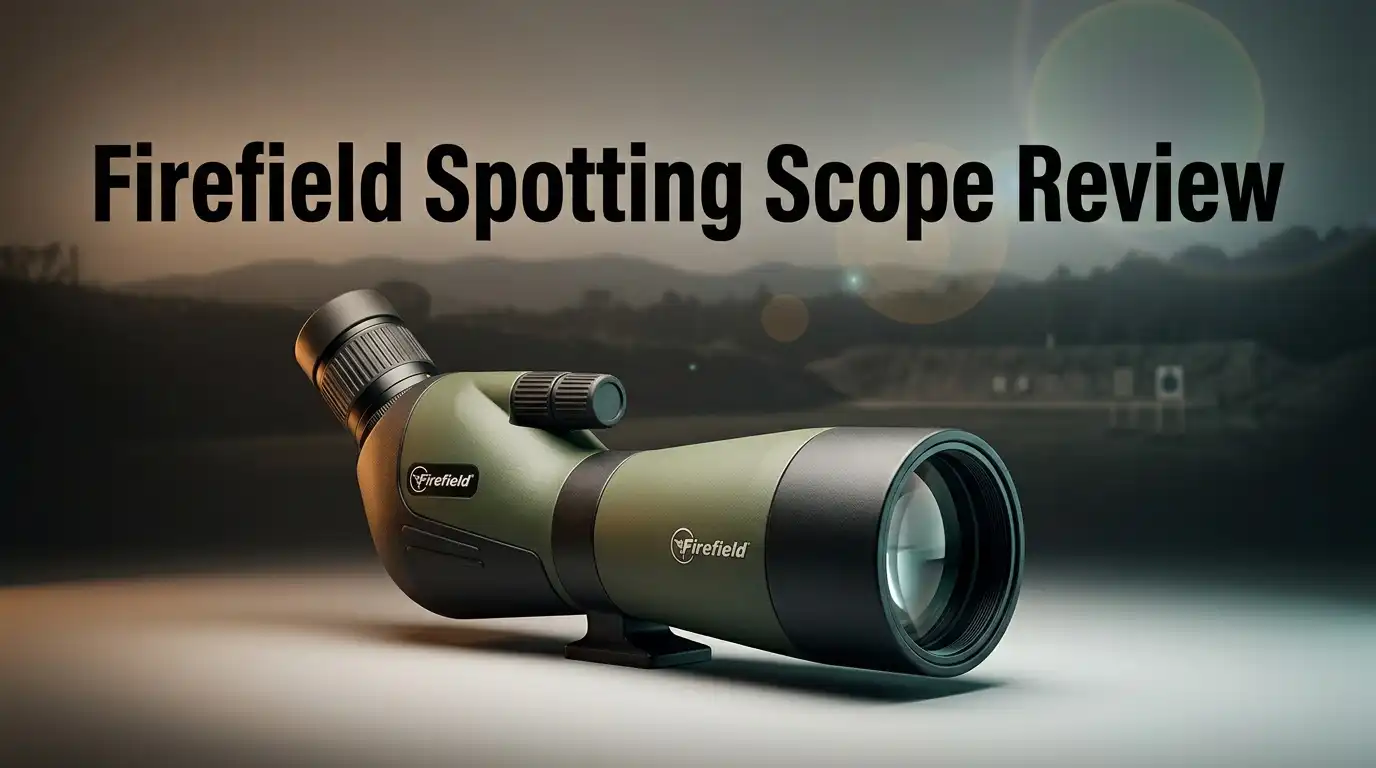
This is the model most buyers choose, and it is the one I used most. You get 20x to 60x variable magnification with a 60mm objective, a central quick focus knob, and internal focusing lenses.
Weight sits at 22.5 ounces, so it travels easily in a daypack. Field of view runs 110 feet at 1,000 yards on the low end and drops to 57 feet at full zoom.
Eye relief measures 17mm at 20x, which is friendly for glasses wearers. The diopter adjustment on the eyepiece covers minus 4 to plus 8.
Minimum focus distance is 15 feet, close enough for feeder watching. The rubber armor feels grippy and absorbs knocks without cracking. The kit ships with an adjustable tripod and a nylon carry case with a shoulder strap, so you can shoot the same afternoon it arrives.
Unboxing the Firefield Spotting Scope
The box is small, plain, and honest about what is inside. Mine arrived in a printed cardboard sleeve with foam inserts holding the scope body. No crushed corners, no rattling parts.
Inside you find the scope, a folded aluminum tabletop tripod, lens caps, a cleaning cloth, and a black nylon case. The case zipper feels thin but worked all season. The scope body has a soft rubber coating that smells faintly of new tires for the first day. Twist the eyepiece and you feel a mild grinding texture rather than smooth glide.
The tripod unfolds in about four seconds. That speed is its only virtue. Total setup from sealed box to first look took me under three minutes, with no tools and no manual reading. For a first time optics buyer, that simplicity matters more than spec sheets.
Optical Performance in Real Daylight
Here is the part that decides everything. At 20x on a clear morning, the Firefield 60mm delivers bright, usable, pleasantly sharp images. I read a license plate at 120 yards without effort. Contrast looked respectable, and colors stayed natural rather than yellow.
Zoom to 30x and sharpness holds. Zoom to 40x and the edges soften. At 60x, the exit pupil shrinks to 1.05mm, and the view turns dim, hazy, and hard to hold steady. Purple fringing appears around dark branches against bright sky. This behavior is normal for scopes in this price class, but you should know it before you buy.
Low light is the real ceiling. Thirty minutes before sunset, the image collapses into gray mush beyond 30x. Premium 80mm glass keeps working in that window. This one does not.
Top 3 Alternative for Firefield 20 to 60x60SE Spotting Scope Kit

Last update on 2026-10-03 / Affiliate links / Images from Amazon Product Advertising API Some of the links on this website are affiliate links, which means that at no additional cost to you, I earn a commission if you click through and make a purchase. I only recommend products and services that I believe will add value to my readers. Thank you for your support!
Gosky 20 to 60×80 HD Spotting Scope with Tripod and Phone Adapter

Last update on 2026-07-01 / Affiliate links / Images from Amazon Product Advertising API Some of the links on this website are affiliate links, which means that at no additional cost to you, I earn a commission if you click through and make a purchase. I only recommend products and services that I believe will add value to my readers. Thank you for your support!
Celestron Ultima 20 to 60×80 Angled Spotting Scope

Last update on 2026-09-13 / Affiliate links / Images from Amazon Product Advertising API Some of the links on this website are affiliate links, which means that at no additional cost to you, I earn a commission if you click through and make a purchase. I only recommend products and services that I believe will add value to my readers. Thank you for your support!
Vortex Optics Diamondback HD 20 to 60×85 Angled Spotting Scope
Firefield 20x50SE Straight Edge Spotting Scope Review

Last update on 2026-10-03 / Affiliate links / Images from Amazon Product Advertising API Some of the links on this website are affiliate links, which means that at no additional cost to you, I earn a commission if you click through and make a purchase. I only recommend products and services that I believe will add value to my readers. Thank you for your support!
The smaller sibling takes a different path. It uses fixed 20x magnification with a 50mm objective, and that single choice fixes most of the complaints about the zoom model. No mushy high power setting exists, because there is no high power setting.
Weight drops to 14.8 ounces. The body measures 183mm long. Exit pupil sits at 2.1mm, eye relief at 10.6mm, and field of view at 168 feet per 1,000 yards, which is wider than the zoom model at any setting. The IP67 rating means submersion to one meter, a genuine step above typical budget scopes.
Fixed power scopes stay sharper because fewer lens groups move. I found this model crisper across the whole image than the 60mm at matched magnification. It costs half as much, too. For range work inside 200 yards, it is the smarter pick.
Build Quality and Weatherproofing Checked
Firefield gets the durable basics right. Both scopes use BAK4 porro prisms with prism coatings and fully multicoated lenses. Nitrogen purging removes internal moisture, which stops fogging when you move from a warm truck into cold air.
I left the 60mm kit outside through a three hour rainstorm. No water entered. No internal fog appeared the next morning. The rubber armor shrugged off a two foot drop onto gravel with only a scuff.
The focus knob is the part I would improve. It has a short throw and a slight dead zone in the middle, so fine focusing takes small back and forth corrections. The eyepiece twist ring also loosens over weeks of use and needs a snug retighten. Nothing broke, but nothing felt precise either. That is the honest summary of build quality here.
The Tripod Problem Nobody Warns You About
This deserves its own section because it ruins first impressions. The included tripod is a lightweight aluminum tabletop unit with thin legs and a plastic pan head. It holds the scope. It does not hold the scope still.
At 20x, the shake stays tolerable. At 40x and above, your heartbeat shows up in the image. A light breeze introduces a slow sway that makes bullet hole spotting impossible. Pressing the focus knob bounces the whole view for two full seconds.
Swap it immediately. Any $45 video tripod with a fluid pan head transforms this scope from frustrating to genuinely useful. I tested the 60mm on a mid range tripod and gained what felt like an entire magnification class of clarity. Firefield includes the tripod to complete the kit, not to perform.
Pros and Cons of Firefield Spotting Scopes
Pros
- Very low price for a complete kit with scope, tripod, and carry case
- Fully multicoated optics and BAK4 prisms at an entry level cost
- Proven weather sealing with nitrogen purge and IP67 or IPX6 ratings
- Light weight of 14.8 to 22.5 ounces makes hiking and packing easy
- Generous 17mm eye relief on the 60mm model suits eyeglass wearers
- 3 year warranty reduces buying risk
- Camera adaptable for phone digiscoping with an accessory mount
- Simple controls that new users understand in minutes
Cons
- Image quality falls apart above 45x with haze and visible color fringing
- Included tripod wobbles badly and needs replacing
- Poor low light performance in the final half hour before dark
- Focus knob feels imprecise with a noticeable dead zone
- Narrow 57 foot field of view at maximum zoom
- No ED or HD glass, so contrast trails rivals near the same price
- Eyepiece ring can loosen over time
- Quality control varies between individual units
What the Firefield Scope Does Not Do Well
Authenticity means naming failures. This scope cannot judge fine trophy detail at long range. At 600 yards, I could see a deer. I could not count tines with confidence.
It cannot spot .223 holes in paper at 300 yards. I tried repeatedly in good light. Holes appeared as faint smudges, and 6.5mm holes were guesswork. Premium 80mm scopes manage this task.
It does not perform for serious birding. Identifying warbler wing bars requires contrast this glass simply lacks. Larger waterbirds and raptors work fine.
It is also not a dawn or dusk tool. The small exit pupil at high power starves your eye of light exactly when game moves. If your hunting happens in those two golden windows, spend more money. Pretending otherwise would waste yours.
Firefield Versus Budget Rivals in 2026
The budget spotting scope market has grown crowded. Gosky and Celestron now compete directly at the $120 to $200 range, and both offer 80mm objectives.
An 80mm objective gathers roughly 78 percent more light than a 60mm. That advantage shows up every evening. The Gosky 20 to 60×80 includes a phone adapter and a better tripod for a similar outlay. The Celestron Ultima 80 brings stronger quality control and a 45 degree angled body that reduces neck strain.
Firefield wins on two points only: weight and price. If your budget stops at $120, or you need the lightest possible pack weight, Firefield earns a look. If you can stretch another $60, the 80mm competition delivers clearly better images. That comparison is the single most useful thing in this review.
Who Should Buy a Firefield Spotting Scope
Match the tool to the job and satisfaction follows. New shooters checking targets at 100 to 200 yards will be happy. The scope saves dozens of walks downrange, and that alone justifies $48.
Backyard wildlife watchers get real value too. Deer, turkeys, hawks, and neighborhood activity all look great at 20x to 30x. Boat watchers and plane spotters will enjoy it.
Parents buying a first optic for a curious kid should feel good here. The low price means a drop is annoying rather than devastating, and the sealing survives rough handling.
Skip it if you hunt western open country, chase small birds for a life list, or shoot competition at 600 yards and beyond. Those uses demand ED glass and 80mm apertures. Buying the wrong class of scope creates disappointment that no warranty fixes.
Digiscoping with a Phone or Camera
Firefield lists both models as camera adaptable, with the adapter sold separately. I mounted a phone using a universal clamp bracket.
Results were mixed but fun. At 20x, photos came out shareable, with decent color and a visible dark vignette ring at the frame edges. Cropping removes the ring. Video showed every tripod vibration, which again points back to the tripod issue.
Above 30x, autofocus hunted constantly and images lost detail fast. Lock your phone exposure manually and you get noticeably better shots. Alignment takes patience because the eyepiece is small and the clamp shifts easily.
Treat digiscoping as a bonus rather than a reason to buy. If photography is your goal, choose a scope with a dedicated adapter ring and wider eyepiece from the start.
Care Tips and Warranty Coverage
Simple habits keep budget glass looking good for years. Never wipe lenses with your shirt. Grit scratches coatings permanently. Use a blower first, then a microfiber cloth with one drop of lens fluid.
Store the scope in the nylon case with caps on. Keep it out of hot car trunks, since the stated operating range tops out near 120 degrees Fahrenheit. Check the tripod mount screw monthly because vibration loosens it.
Firefield backs both scopes with a 3 year warranty. Register your purchase and save the receipt. Users report straightforward replacement for genuine optical defects such as double images or internal debris.
If your unit arrives with focus that never reaches sharp, send it back immediately. Unit to unit variation is the main quality complaint, and the fix is an exchange rather than tolerance.
Final Verdict on Firefield Spotting Scopes
Firefield delivers exactly what the price suggests, no more and no less. The 20x50SE at roughly $48 is the better value because fixed magnification avoids the zoom model’s weakest settings. The 20 to 60x60SE kit at roughly $120 adds reach you will rarely use well.
Buy either one if you need a sealed, light, inexpensive scope for short and medium range work, and buy a proper tripod the same day. That combination produces a setup that genuinely serves beginners.
Pass on both if evening light, small bird detail, or 500 yard shot calling matters to you. Spend the extra money on an 80mm scope instead, and you will not regret it. Honest expectations turn a cheap scope into a satisfying purchase. Inflated expectations turn it into a shelf ornament.
Frequently Asked Questions
Is Firefield a good optics brand in 2026?
Firefield is a budget brand owned by Sellmark. It builds serviceable entry level optics with real weather sealing and multicoated glass. The brand does not compete with Vortex, Celestron, or Leupold on image quality. It competes on price, and at under $120 it holds its ground.
Can a Firefield spotting scope see bullet holes at 300 yards?
Not reliably. I could spot .30 caliber holes on white paper at 200 yards in bright light. At 300 yards, smaller calibers disappeared. Stable mounting and good light improve results, but a 60mm objective limits resolution for this task.
Which Firefield spotting scope should I buy first?
Choose the 20x50SE if you shoot inside 200 yards or watch wildlife casually. Its fixed power keeps images sharper and it costs about half as much. Choose the 20 to 60x60SE kit if you want zoom flexibility and accept softness at the top end.
Does the Firefield spotting scope come with a tripod?
Yes, both kits include a small adjustable tripod and a nylon carry case. The tripod works at low magnification only. Most owners replace it with a sturdier video tripod, which improves image stability dramatically.
Are Firefield spotting scopes waterproof?
The 20x50SE carries an IP67 rating and survives submersion to one meter. The 20 to 60x60SE carries an IPX6 weatherproof rating that handles heavy rain and spray. Both are nitrogen purged, so internal fogging is not an issue.

Hello, I’m Emily Price, the founder of Birds Affection. As a passionate bird enthusiast and spiritual seeker, I’ve always been fascinated by the symbolic meanings and mystical connections between birds and our lives. On this website, I share my knowledge and insights on the spiritual significance of various bird species, exploring their roles as messengers, guides, and teachers. Through my writing, I aim to inspire and educate others on the profound wisdom and beauty that birds bring to our world. Join me on this journey as we delve into the enchanting realm of bird symbolism and discover the hidden meanings behind these magnificent creatures.