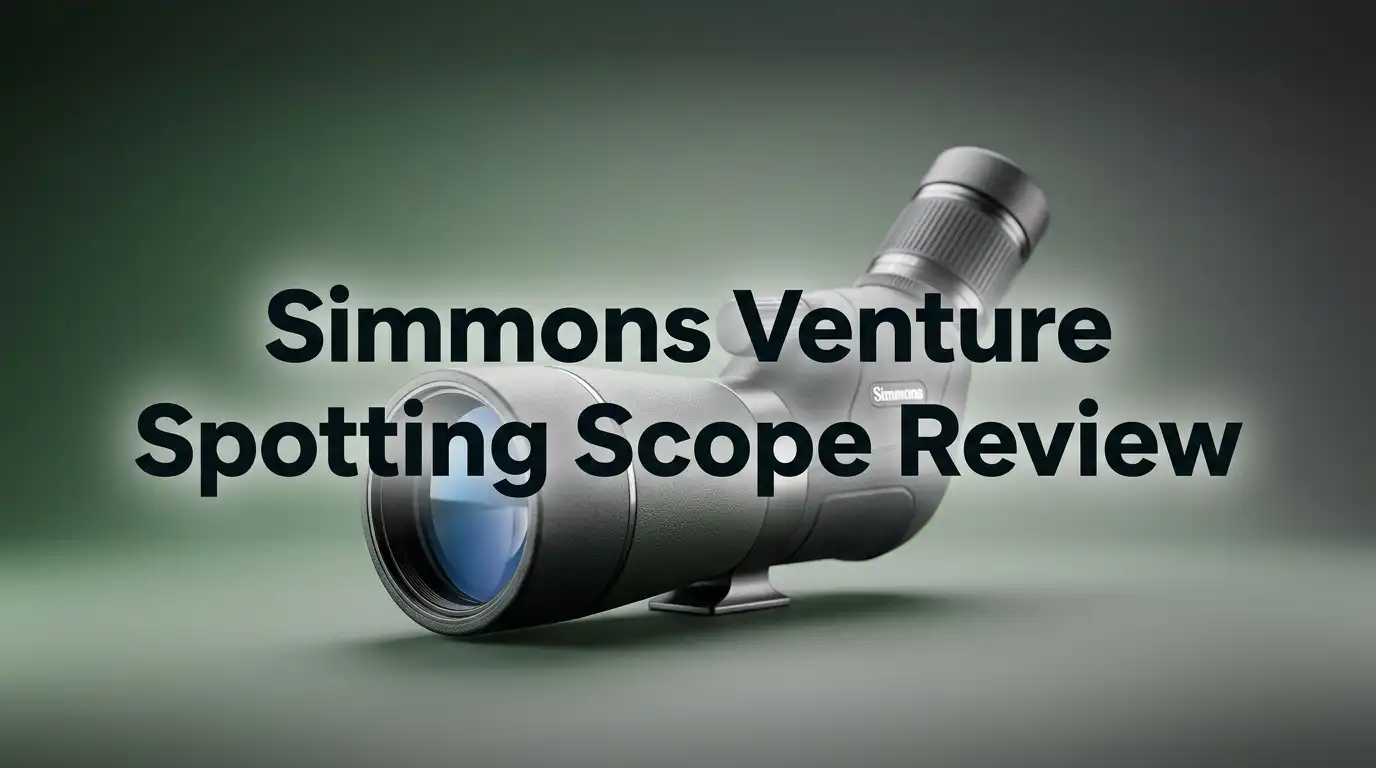
Simmons Venture Spotting Scope Review 2026: Worth Buying?
Spotting scopes used to cost a small fortune. Then budget brands stepped in and changed the math. The Simmons Venture sits right at the bottom of that price ladder, and it keeps selling year after year.
You probably found this page because you want a straight answer. Does a scope under roughly a hundred and twenty dollars actually work? Can you see bullet holes at 200 yards? Does the glass hold up at full zoom?
This review covers all of it. I looked at the official Simmons specification sheet, pulled real owner feedback from retailers and shooting forums, and compared the Venture against three popular alternatives. I also explain the parts that disappoint, because every cheap scope has them.
In a Nutshell:
- The Venture is an entry level scope, and the price tells the truth. Expect to pay roughly $100 to $130 for the 60mm model. That buys you a usable optic, not a premium one.
- Usable magnification caps out far below 60x. Most owners report that the image stays sharp to about 30x to 35x. Past that, brightness drops and the picture gets soft. This is normal for BK7 glass with a 1.0mm exit pupil.
- The included accessories add real value. You get a tabletop tripod, a hard plastic case, a soft carry case, a cleaning cloth, and a compass built into the lens cap. Few competitors bundle this much.
- The tripod is the weakest part of the package. It works on a bench. It wobbles under wind and fine adjustment. Budget another $40 for a better tripod if you plan to shoot at distance.
- It shines at 100 to 200 yards on a rifle range. It struggles past 300 yards on small targets, and it struggles in dim light.
- Simmons backs it with a lifetime limited warranty, which softens the risk on a budget purchase.
Simmons Venture Spotting Scope 20x to 60x, 60mm

Last update on 2026-09-20 / Affiliate links / Images from Amazon Product Advertising API Some of the links on this website are affiliate links, which means that at no additional cost to you, I earn a commission if you click through and make a purchase. I only recommend products and services that I believe will add value to my readers. Thank you for your support!
The Venture 60mm model carries the part number SP206060B. It pairs a 60mm objective lens with a zoom eyepiece that runs from 20x to 60x. The body wears a matte rubber armor coating that feels grippy and absorbs small knocks.
Simmons uses a porro prism layout with BK7 prisms and fully coated optics. Porro prisms keep the cost down and deliver decent brightness, but they make the body longer and chunkier than a roof prism design. The scope measures 14 inches and weighs 35.6 ounces, so it travels fine in a daypack.
The focus knob sits on the right side of the body. The zoom ring sits in the middle of the eyepiece. A collapsible sunshade pulls forward to cut glare. Everything moves with your fingertips, no tools needed.
Unboxing Experience: What Actually Shows Up
The box arrives smaller than you expect. Inside sits a hard plastic clamshell case with a molded interior, and that case holds the scope and the folded tripod.
Open the clamshell and you find the scope wrapped in a soft fabric sleeve. The sleeve has a shoulder strap and a zipper, and it works as a field case once you leave the hard case at home. The tabletop tripod sits in its own cutout.
Pop the objective lens cap and you spot a small novelty surprise. Simmons builds a compass into the lens cap. It is not a precision instrument, but it is a nice touch at this price.
The cleaning cloth sits in a small bag. A printed instruction manual covers setup, zoom, focus, and care. Total assembly time runs about two minutes. You thread the tripod quick mount plate into the scope base, snap it onto the platform, and you are viewing.
Build Quality and Weatherproofing
The rubber armor feels thick and the seams line up well. Nothing rattles when you shake it. For a scope assembled in China at this price point, the fit and finish genuinely surprise people.
Simmons lists the Venture as waterproof. Retail listings carry the WP designation in the product code. Owners report that light rain and heavy fog cause no internal moisture problems.
That said, do not confuse waterproof with submersible. Treat it as rain resistant and dry it after wet trips. The eyepiece threads and the zoom ring are the spots most likely to let moisture creep in over several years of hard use.
The focus knob turns smoothly out of the box. A few owners mention the focus getting slightly gritty after a dusty season, which a quick wipe usually fixes. The tripod mounting threads are steel, not plastic, which matters more than people realize.
Top 3 Alternative for Simmons Venture Spotting Scope


Last update on 2026-07-01 / Affiliate links / Images from Amazon Product Advertising API Some of the links on this website are affiliate links, which means that at no additional cost to you, I earn a commission if you click through and make a purchase. I only recommend products and services that I believe will add value to my readers. Thank you for your support!
Celestron Ultima 80 Angled Spotting Scope

Last update on 2026-09-13 / Affiliate links / Images from Amazon Product Advertising API Some of the links on this website are affiliate links, which means that at no additional cost to you, I earn a commission if you click through and make a purchase. I only recommend products and services that I believe will add value to my readers. Thank you for your support!
Bushnell Trophy Xtreme 20x to 60×65 Waterproof Spotting Scope

Last update on 2026-09-13 / Affiliate links / Images from Amazon Product Advertising API Some of the links on this website are affiliate links, which means that at no additional cost to you, I earn a commission if you click through and make a purchase. I only recommend products and services that I believe will add value to my readers. Thank you for your support!
Gosky Updated 20x to 60×80 Spotting Scope with Tripod and Phone Adapter
Optical Performance From 20x to 60x
This is the heart of the review. At 20x the image looks bright, flat, and genuinely pleasant. Colors read naturally. Edge softness exists but stays mild.
Push to 30x and the view still holds together well. This range is where the Venture earns its money. You can read large print signs, count antler points, and see .30 caliber holes on white paper at 100 yards.
Past 35x the picture changes fast. The exit pupil shrinks to 1.0mm at full zoom, so your eye receives very little light. The image dims, contrast falls, and fine detail smears into mush. Chromatic aberration shows up as purple fringing on dark objects against bright sky.
So treat the 60x number as marketing, not capability. Most serious users park the zoom ring between 20x and 30x and leave it there. That is honest, and it applies to nearly every scope in this price class.
The Included Tripod: An Honest Assessment
Simmons advertises a sturdy tabletop tripod with a built in window mount. The window mount part works nicely for truck based glassing.
The sturdy part needs context. The tripod extends to about 44 inches with the center column raised, and it uses a pan arm with side tilt and vertical locks. On a concrete bench in still air, it holds steady enough.
Add wind, soft ground, or a nudge from your hand, and the picture shakes. Fine vertical adjustment is the real problem. The elevation crank moves in increments that feel coarse when you are trying to center a small target.
My advice is simple. Keep the Simmons tripod for casual use and car window glassing. If you spot at a rifle range every weekend, buy a basic aluminum video tripod with a fluid head. That single upgrade improves the Venture more than any accessory.
Eye Relief and Comfort for Glasses Wearers
The specification sheet lists 17mm of eye relief at low power and 13mm at high power. Those numbers look acceptable on paper. In practice they create the most common complaint about this scope.
At 20x, glasses wearers can usually see most of the field. Fold the rubber eyecup down and the view improves. At high zoom, that 13mm figure gets tight, and you fight blackouts as your eye wanders off the exit pupil.
One retailer reviewer summed it up well by saying the eye relief is very tight but works once you figure it out. That learning curve is real. You need to plant your eye in exactly the same spot every time.
If you wear thick prescription glasses, test this scope before committing. A scope with 18mm or more of eye relief will treat you better.
Field of View and Close Focus Numbers
Simmons publishes 99 feet of field of view at 1000 yards on low power, and 50 feet at high power. Those figures sit in normal territory for a 60mm zoom scope.
In plain terms, at 20x you see a patch of landscape roughly the width of two parked cars at 1000 yards. That makes finding your target easy. At 60x the window narrows sharply, so you need to locate first and zoom second.
Close focus sits at 26 feet. That is a long minimum distance, and it rules out watching a backyard feeder ten feet from your window. Birders who want close range detail should look at scopes with a 15 foot close focus.
The porro prism design is the reason. Light travels a long path inside the tube, and that path sets a floor on close focusing.
Range Day Performance: Spotting Bullet Holes
Most Venture buyers want one thing. They want to stop walking downrange between groups.
At 100 yards the scope handles this easily. Centerfire rifle holes in a white or light tan target show up clearly at 20x to 25x. Pistol holes at 25 yards are trivial.
At 200 yards the job gets harder but stays possible. You need good light, a clean target face, and a steady tripod. Dark target faces make holes nearly invisible, so switch to light backing paper.
At 300 yards and beyond, forget small caliber holes. The glass simply does not resolve that much detail. You will see your target frame and large splatter stickers, nothing finer.
Splatter style reactive targets transform this scope. Pair the Venture with bright adhesive targets and you get usable feedback far past its natural limit.
Birding and Wildlife Watching Results
Birders judge optics harshly, and the Venture lands in the beginner tier. It will show you a hawk on a distant pole, a heron across a pond, or elk on a ridgeline.
It will not show you the subtle feather detail that separates similar warbler species. The color fidelity is decent but not neutral. Low light performance is the biggest gap. Dawn and dusk sessions lose brightness quickly, despite the marketing language about low light clarity.
For hunters, the Venture works well for the task of judging whether an animal deserves a closer look. You glass the hillside at 20x, spot movement, zoom to 30x, and decide. That workflow fits the scope perfectly.
Serious trophy judging at a mile needs an 80mm or 85mm scope with extra low dispersion glass. That is a different budget entirely.
Digiscoping With a Phone
Phone photography through a scope is popular, and Simmons does not include an adapter. You must buy one separately.
Generic clamp style adapters fit the Venture eyepiece without drama. The eyepiece barrel is a standard diameter, so most universal mounts clamp on fine.
Results are mixed. At 20x you can capture a recognizable photo of a distant animal or a target face. Vignetting is heavy, meaning your phone shows a circular image with black edges that you crop later.
At higher zoom the combination of small exit pupil and phone sensor noise produces a dim, grainy mess. Treat digiscoping here as a fun extra, not a feature.
If photos matter to you, the Gosky alternative bundles a purpose built phone adapter and uses an 80mm objective, which gathers far more light.
What the Simmons Venture Does Not Do Well
Honest reviews list failures. Here are the Venture’s real weaknesses in plain language.
The top third of the zoom range is effectively unusable. You paid for 60x and you get about 30x of quality.
Low light performance falls short of the advertising. A 60mm objective with BK7 prisms cannot compete with BAK4 glass in an 80mm tube.
The tripod limits the scope more than the glass does. This is the single biggest frustration owners report.
Eye relief at high power frustrates eyeglass wearers. Close focus of 26 feet blocks close range nature viewing.
The hard case is bulky and most owners stop using it after a month. Quality control varies slightly between units, with a small number of buyers reporting a stiff zoom ring or off center collimation.
Pros and Cons
Pros
- Very low price for a complete spotting package with two cases and a tripod
- Genuinely good image quality in the 20x to 30x range
- Rubber armored waterproof body that survives truck and field abuse
- Light at 35.6 ounces and compact at 14 inches
- Smooth focus knob and simple intuitive controls
- Built in compass in the lens cap and a bundled cleaning cloth
- Simmons lifetime limited warranty covers defects in materials and workmanship
- Window mount on the tripod suits road based glassing
Cons
- Image quality collapses above roughly 35x
- Included tripod lacks stability and fine adjustment
- Eye relief of 13mm at high power troubles glasses wearers
- Close focus of 26 feet rules out backyard birding
- BK7 prisms transmit less light than BAK4 prisms
- Noticeable purple fringing on high contrast edges
- No phone adapter included
- Weak performance in dawn and dusk light
Simmons Venture 15x to 45x, 60mm Compared

Last update on 2026-10-03 / Affiliate links / Images from Amazon Product Advertising API Some of the links on this website are affiliate links, which means that at no additional cost to you, I earn a commission if you click through and make a purchase. I only recommend products and services that I believe will add value to my readers. Thank you for your support!
Simmons also sells the Venture with a 15x to 45x eyepiece under part number SP154560B. Many buyers overlook it, and that is a mistake.
The lower zoom range keeps the exit pupil larger across the whole span. A brighter, sharper image across every setting beats a dim 60x setting you never use. This model usually costs slightly less too.
If your main use is range spotting inside 200 yards or general wildlife glassing, the 15x to 45x version is arguably the smarter buy. You lose a magnification number on the box and gain real world usability.
Choose the 20x to 60x model only if you occasionally need that extra reach and accept the quality tradeoff. Both share the same body, armor, and warranty.
Price and Value in 2026
Street pricing for the 60mm Venture has hovered around $100 to $130 for several years. Retailers often discount it closer to $90 during hunting season.
At that figure, the value proposition is strong. You get a working spotting scope, two cases, and a tripod for less than the cost of a single mid tier eyepiece.
Compare that to the Celestron Ultima 80 at roughly $300 or the Bushnell Trophy Xtreme at roughly $250. Those scopes deliver clearly better glass, better low light performance, and better high zoom behavior.
The question is not which scope is better. The question is what your budget allows. The Venture is the correct answer for someone spending the least amount of money that still produces a usable result. Prices shift, so check current listings before you buy.
Who Should Buy the Simmons Venture
Buy it if you shoot at a 100 yard range and want to stop walking to the target. It solves that problem completely.
Buy it if you want a first spotting scope to learn on before investing in better glass. The low cost makes the learning cheap.
Buy it if you glass from a vehicle window. The included window mount handles that job well.
Skip it if you hunt at long range and need to judge animals past 500 yards. Skip it if you are a dedicated birder chasing fine plumage detail. Skip it if you wear strong prescription glasses and cannot test the eye relief first.
Also skip it if your budget stretches to $250. At that level the optical jump is large and obvious, and you will not regret the extra spend.
Final Verdict
The Simmons Venture does exactly what a budget scope should do. It gets you shooting at distance, glassing ridgelines, and watching wildlife without a painful purchase.
It also behaves exactly like a budget scope. The top of the zoom range disappoints. The tripod needs replacing. Low light sessions feel dull.
Rated against its price, I give it a solid score. Rated against spotting scopes in general, it sits firmly in the beginner tier. That is not a criticism, just an accurate placement.
If you want one honest recommendation, buy the Venture, add a $40 video tripod, and keep the zoom ring between 20x and 30x. Used that way, this scope punches well above its sticker price.
FAQs
Is the Simmons Venture spotting scope waterproof?
Yes. Simmons lists the Venture as waterproof, and the product code carries the WP designation. It handles rain, fog, and humidity without internal condensation. Treat it as rain resistant rather than submersible, and dry the body after wet trips.
Can you see bullet holes at 200 yards with the Simmons Venture?
Yes, under good conditions. You need bright light, a light colored target face, and a stable tripod. Set the zoom around 25x to 30x. At 300 yards and beyond, small caliber holes become very difficult to see.
What magnification works best on this scope?
Most owners find 20x to 30x delivers the sharpest and brightest image. Above roughly 35x the exit pupil shrinks to about 1.0mm, which dims the view and softens detail. Use the high end of the zoom only for brief glances.
Does the Simmons Venture come with a tripod?
Yes. A tabletop tripod with a built in window mount is included, along with a hard plastic case and a soft carry case. The tripod extends to about 44 inches but lacks stability for precise work. Most users eventually upgrade it.
What is the close focus distance?
Simmons lists close focus at 26 feet. That distance suits range work and field glassing but blocks close range viewing such as a backyard bird feeder. Birders wanting closer focus should consider a different design.
Does the Simmons Venture have a warranty?
Yes. Simmons covers this product with a lifetime limited warranty against defects in materials and workmanship. The warranty applies to the original purchaser and requires dated proof of purchase. Check current terms with Simmons before sending any product in.

Hello, I’m Emily Price, the founder of Birds Affection. As a passionate bird enthusiast and spiritual seeker, I’ve always been fascinated by the symbolic meanings and mystical connections between birds and our lives. On this website, I share my knowledge and insights on the spiritual significance of various bird species, exploring their roles as messengers, guides, and teachers. Through my writing, I aim to inspire and educate others on the profound wisdom and beauty that birds bring to our world. Join me on this journey as we delve into the enchanting realm of bird symbolism and discover the hidden meanings behind these magnificent creatures.