Meade Spotting Scope Review 2026: Still Worth It?
Spotting scopes sit in a strange price gap. Binoculars cost less. Telescopes gather more light. A good spotter does something neither can do well, which is give you steady magnified detail at 200 to 1,000 yards from a tripod.
Meade built its name on telescopes, then moved that glass knowledge into the Wilderness spotting scope line. Those scopes still sell in 2026, often at discounts, and shooters keep asking the same question in forums. Does budget Meade glass hold up against Celestron, Athlon, and Vortex today?
This review answers that directly. I cover what arrives in the box, how the optics behave at full zoom, where the scopes disappoint, and which alternatives beat them at similar money.
In a Nutshell:
- Meade Wilderness scopes give strong value at the low end. You get BaK4 porro prisms, fully multi coated glass, nitrogen purging, and real waterproof sealing for roughly the price of a mid range scope body alone. The 80mm model is the sweet spot of the line.
- Image quality is good at 20x to 35x, then drops. Pushing the zoom to 60x produces a dimmer, softer, narrower view. This is normal for budget zoom eyepieces, but Meade shows it more than ED glass competitors do.
- Chromatic aberration is visible. High contrast edges such as a black target frame against snow, or a dark bird against bright sky, show purple or green fringing. ED glass scopes control this much better.
- Build quality beats the optics. Thick rubber armor, a sliding sunshade, and a rotating tripod collar feel more expensive than the price tag suggests.
- The brand situation is real and you should know it. Meade’s parent company shut its California operations in 2024, and the name has since changed hands. Warranty support is far less certain than it was five years ago.
- Better alternatives exist near the same money. Celestron, Athlon, and Vortex all compete hard in this bracket, and Vortex adds a transferable lifetime warranty.
Why Meade Spotting Scopes Still Get Attention in 2026

Last update on 2026-09-25 / Affiliate links / Images from Amazon Product Advertising API Some of the links on this website are affiliate links, which means that at no additional cost to you, I earn a commission if you click through and make a purchase. I only recommend products and services that I believe will add value to my readers. Thank you for your support!
Meade spent decades selling telescopes to beginners, so the brand carries recognition that newer optics companies lack.
That recognition keeps the Wilderness line visible on Amazon search results and in clearance listings. Buyers also find the price attractive. A large aperture spotter for under $300 is rare, and Meade offers 80mm and 100mm options in that zone.
There is a second reason. Many used and new old stock Meade scopes are circulating at steep discounts because retailers are clearing inventory.
A $450 scope selling for $220 changes the value math completely. If you shoot paper at 100 to 300 yards, or you watch waterfowl across a marsh, the optical limits matter far less than they would for a serious birder chasing warblers in dim forest light.
Meade Wilderness 20x to 60x80mm Spotting Scope
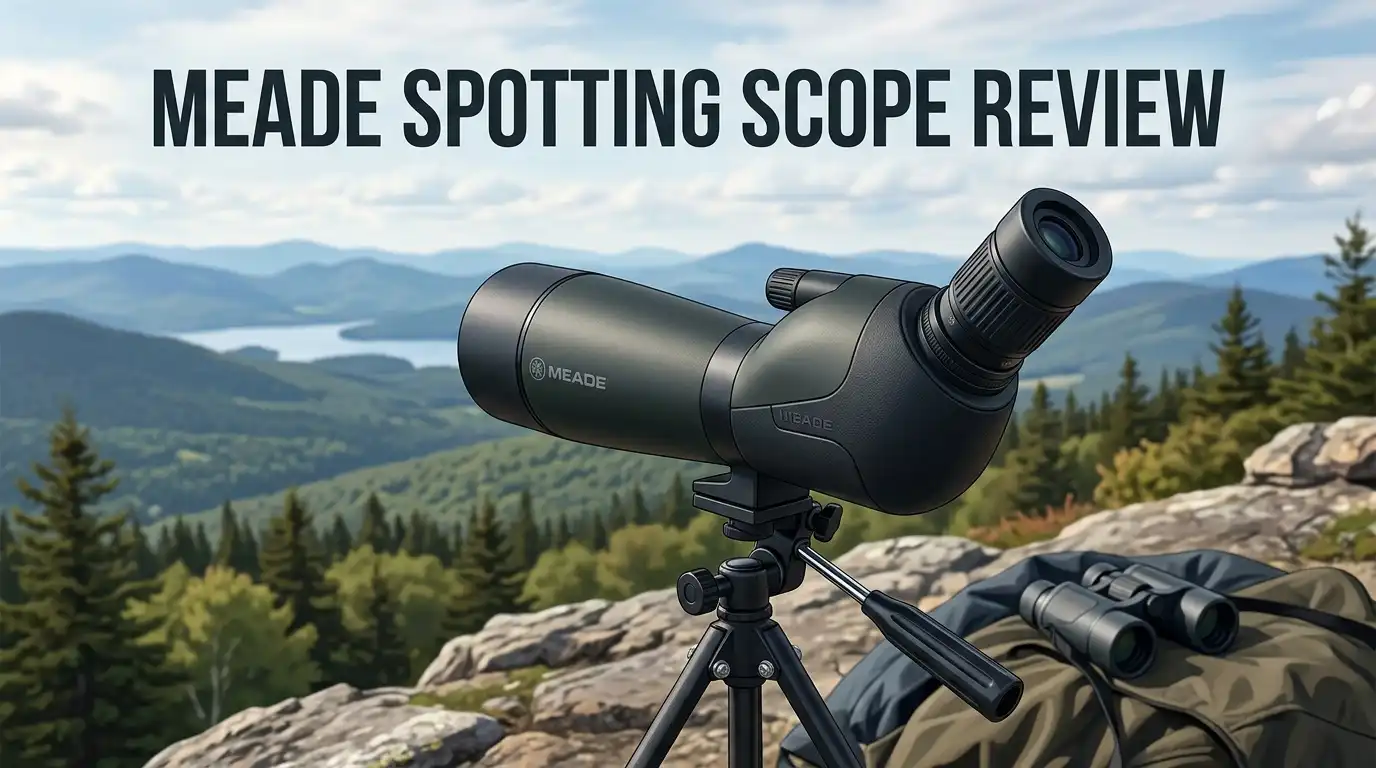
This is the model most people mean when they say Meade spotting scope. The 80mm objective collects a useful amount of light, the 45 degree angled body suits tripod use at mixed heights, and the zoom eyepiece covers 20x through 60x without swapping parts.
Meade specifies high index BaK4 prisms and multiple layers of anti reflection coating, which matches what competitors claim at this price.
In practical use, the scope performs best between 20x and 40x. At 25x on a sunny range day, .30 caliber holes on white paper were readable at 300 yards. At 60x, the same holes turned into soft grey smudges once heat shimmer appeared.
Field of view at 20x sits around 95 feet at 1,000 yards, which narrows to roughly 50 feet at 60x. Eye relief is adequate for glasses wearers at low power but tightens noticeably as you zoom in.
Pros
- Large 80mm objective delivers brighter images than 60mm and 65mm scopes at dawn and dusk
- Genuine nitrogen purged waterproof and fogproof construction, not just water resistant
- Sliding sunshade cuts glare and protects the front lens from light rain
- Rotating tripod collar lets you shift between seated and standing viewing quickly
- Thick rubber armor survives bumps in a truck bed or pack
Cons
- Visible chromatic aberration on high contrast subjects
- Image softens and dims considerably above 45x
- Included soft case offers padding but little structure
- Heavy at over three pounds, which demands a serious tripod
- No ED or HD glass at this price point
Unboxing the Meade Wilderness 80mm
The box is plain cardboard with a product photo on the front. Inside, the scope sits in a molded foam cradle with the soft carry case packed beside it. There is no premium presentation here, and that is honest for the money. You get the scope, a zippered nylon case with a shoulder strap, front and rear lens caps, a basic lens cloth, and a short manual.
First impressions are physical rather than optical. The scope feels heavier than photos suggest. The rubber armor has a grippy texture that holds up in cold weather with gloves on. The focus wheel turns with light resistance and no gritty feel, which is better than expected. The zoom collar is stiffer and needs a firm grip.
The soft case has a cutout design that lets you keep the scope cased while viewing. It works, though it adds bulk and the zipper feels thin. No tripod is included with most listings, so budget for that separately.
Meade Wilderness 15x to 45x65mm Spotting Scope

Last update on 2026-09-25 / Affiliate links / Images from Amazon Product Advertising API Some of the links on this website are affiliate links, which means that at no additional cost to you, I earn a commission if you click through and make a purchase. I only recommend products and services that I believe will add value to my readers. Thank you for your support!
The 65mm version is the travel option. It weighs roughly a pound less than the 80mm, packs shorter, and uses a more conservative 15x to 45x zoom range. That lower top magnification is actually a design advantage. Smaller objectives struggle at extreme power, so capping the zoom at 45x keeps the image usable across the whole range.
Birders tend to prefer this model. The wider low power field of view makes finding small moving subjects far easier, and the lighter body works on mid size travel tripods that would wobble under the 80mm. Close focus is reasonable for watching feeders and shorelines.
The tradeoff is light gathering. In early morning shade or under heavy tree cover, the 65mm noticeably dims before the 80mm does. For hunters glassing at first light, that difference matters. For daytime use, it rarely does.
Pros
- Lighter and more packable for hiking and travel
- Sensible 15x to 45x range keeps images usable at full zoom
- Easier to stabilize on affordable tripods
- Same waterproof and fogproof sealing as the larger models
Cons
- Dimmer in low light than 80mm options
- Less reach for long range target spotting past 400 yards
- Same chromatic aberration behavior as the rest of the line
Top 3 Alternative for Meade Wilderness Spotting Scope


Last update on 2026-09-22 / Affiliate links / Images from Amazon Product Advertising API Some of the links on this website are affiliate links, which means that at no additional cost to you, I earn a commission if you click through and make a purchase. I only recommend products and services that I believe will add value to my readers. Thank you for your support!
Celestron TrailSeeker 80mm Angled Spotting Scope

Last update on 2026-10-05 / Affiliate links / Images from Amazon Product Advertising API Some of the links on this website are affiliate links, which means that at no additional cost to you, I earn a commission if you click through and make a purchase. I only recommend products and services that I believe will add value to my readers. Thank you for your support!
Vortex Optics Crossfire HD Spotting Scope

Last update on 2026-09-13 / Affiliate links / Images from Amazon Product Advertising API Some of the links on this website are affiliate links, which means that at no additional cost to you, I earn a commission if you click through and make a purchase. I only recommend products and services that I believe will add value to my readers. Thank you for your support!
Athlon Optics Talos Spotting Scope
Optical Quality Tested at Real Distances
Numbers on a spec sheet mean little without context, so here is how the 80mm behaved in the field. At 100 yards on paper, .22 caliber holes were visible at 30x in good light. At 200 yards, .223 holes required 40x and steady conditions. At 300 yards, you can confirm hits on a steel plate easily, but reading small bullet holes becomes unreliable.
For wildlife, a mule deer at 600 yards showed clear body outline and antler shape at 40x. Counting tine points was possible but not comfortable. Color rendition leans slightly cool, and contrast falls behind ED glass scopes in the same bracket.
The honest summary is that this glass performs like a competent entry level spotter. It does not punch above its class optically. It simply delivers what the price promises without unpleasant surprises in the lower half of the zoom range.
Build Quality and Weather Sealing
This is where Meade earns points. The armor is thick and well bonded, with no peeling at the seams after repeated handling. The sliding sunshade extends smoothly and stays where you put it. The nitrogen purge and O ring sealing are genuine, and the scope handled steady rain without internal fogging.
The rotating collar deserves mention. Loosen one knurled ring, rotate the body, and lock it again. This lets a seated shooter and a standing shooter share one setup without moving the tripod. Many cheaper scopes skip this feature entirely.
Weak points exist. The lens caps are loose fitting rubber that pop off in a pack. The eyecup twists up and down but lacks firm click stops. Neither issue affects image quality, though both signal where the cost was saved.
Zoom Eyepiece Performance and Where It Falls Apart
Every budget zoom spotter shares one problem, and Meade is no exception. As magnification climbs, exit pupil shrinks, field of view narrows, and eye relief tightens all at once. At 20x the 80mm scope produces a 4mm exit pupil, which is comfortable and bright. At 60x that drops to roughly 1.3mm.
A 1.3mm exit pupil means your eye placement must be nearly perfect or the image blacks out at the edges. Combine that with reduced brightness and the top third of the zoom range becomes something you use briefly rather than continuously.
Practical advice: treat this as a 20x to 45x scope that happens to go higher. Use 60x only in bright, still conditions for short confirmation looks. You will enjoy the scope far more.
Digiscoping with a Phone
Phone photography through a spotting scope is popular, and Meade scopes work for it with caveats. The eyepiece diameter accepts most universal clamp style phone adapters. Alignment takes patience, because the small exit pupil at higher zoom makes centering fussy.
Best results come at 20x to 25x. At those settings, you get a full circular image with acceptable brightness and your phone’s digital stabilization has enough light to work with. Push past 35x and you will fight vignetting, blur, and focus hunting constantly.
Chromatic aberration becomes more obvious in photos than through the eyepiece, since the camera sensor records fringing that your brain tends to ignore. For casual documentation of birds or hunting trophies, it works fine. For publishable wildlife photography, you want ED glass.
What Meade Spotting Scopes Do Not Do Well
Authentic reviews name the failures, so here they are plainly. These scopes do not deliver clean color at high contrast edges. Expect purple fringing on branches against bright sky and on target frames in snow.
They do not perform in low light the way the aperture suggests. An 80mm objective with average coatings loses to a 65mm ED scope with excellent coatings during the last twenty minutes of legal shooting light.
They do not come with usable tripods. Any bundle tripod included by a third party seller will shake at 40x.
They do not focus especially close, which limits insect and flower viewing.
Finally, they do not offer the eyepiece upgrade path that Celestron and higher tier brands provide. What you buy is what you keep, and the warranty picture is genuinely uncertain in 2026.
Meade Compared to Celestron, Athlon, and Vortex
Celestron TrailSeeker and Ultima models sit in the same price band and generally match Meade on brightness while offering a dual focus system that speeds up fine adjustment. Celestron also maintains active customer service, which matters.
Athlon Talos undercuts most competitors on price and backs it with a strong warranty from a company that is actively growing. Optically it trades blows with Meade rather than clearly beating it.
Vortex Crossfire HD costs more but includes the VIP unlimited unconditional warranty, which transfers to future owners. For many buyers, that warranty alone justifies the extra hundred dollars.
Meade’s argument is purely price. When a Wilderness 80mm sells under $250, it competes well. At full retail, the others win.
Is Meade Still in Business?
This deserves a clear answer. Optronic Technologies, the parent company that owned both Meade Instruments and Orion Telescopes, closed its California facilities and released its staff in July 2024. The assets went to auction. Since then the Meade name has continued appearing on products through new ownership arrangements.
What this means for you is simple. Treat any Meade warranty as uncertain. Buy from a retailer with a solid return policy, inspect the scope within the return window, and do not count on long term factory service or spare parts.
This is not a reason to avoid the brand entirely. It is a reason to pay a discounted price rather than full retail, and to prefer sellers who handle defects themselves. Information here reflects the situation as of mid 2026, so verify current ownership before buying.
Overall Pros and Cons
Pros
- Strong price to aperture ratio, especially on discounted listings
- Honest waterproof and fogproof construction with nitrogen purging
- Durable rubber armor and a useful rotating tripod collar
- Comfortable, bright viewing in the 20x to 40x range
- Sliding sunshade included on all Wilderness models
Cons
- Noticeable chromatic aberration on high contrast subjects
- Weak performance above 45x magnification
- No ED glass option anywhere in the line
- Uncertain warranty support following the 2024 company closure
- Heavy enough to require a sturdy, separately purchased tripod
- No eyepiece upgrade path
Who Should Buy a Meade Spotting Scope
Buy one if you are a recreational target shooter confirming hits at 100 to 300 yards in daylight. The scope handles that job well and the price leaves money for a decent tripod.
Buy one if you want a first spotting scope to learn on before committing serious money. You will discover your preferences on magnification, angle, and weight without a large loss if you upgrade.
Buy one if you watch wildlife in open, bright environments such as shorelines, prairies, and lakes.
Skip it if you are a dedicated birder chasing color accuracy, if you hunt at first and last light, if you plan to digiscope seriously, or if long term warranty coverage is a priority. In those cases, spend more and buy ED glass from a company with stable support.
Final Verdict
The Meade Wilderness line is a competent budget spotter that does nothing badly in its comfort zone and nothing exceptionally anywhere. The 80mm model is the one to get, and it is worth buying only at a discount. Mechanically it feels better than its price. Optically it sits mid pack. The brand uncertainty is the biggest reason for hesitation in 2026.
If you find one at $200 to $250, it is a reasonable purchase for casual daytime use. At $400 or more, the Celestron TrailSeeker, Athlon Talos, and Vortex Crossfire HD all make stronger cases. Judge the deal, not the badge.
Frequently Asked Questions
Is the Meade Wilderness spotting scope good for target shooting?
Yes, for daytime use at moderate distances. You can confirm .223 holes at 200 yards and steel hits well beyond that. Heat shimmer and the soft high zoom range limit it past 300 yards for fine hole reading.
Can I see bullet holes at 1,000 yards?
No. No scope in this price class resolves small bullet holes at 1,000 yards. You can see large splash on steel and spotting discs, but paper holes require premium ED glass and ideal conditions.
Does Meade still honor warranties in 2026?
Warranty support is unreliable after the 2024 closure of the parent company. Buy from a retailer with a strong return policy and treat the factory warranty as a bonus rather than a guarantee.
Which Meade spotting scope is best overall?
The Wilderness 20x to 60x80mm model offers the best balance of light gathering, reach, and price. The 65mm suits hikers and travelers, while the 100mm is bright but too heavy for most field use.
Do I need an expensive tripod?
You need a sturdy one. A tripod rated for at least eight pounds with a fluid pan head prevents the shake that ruins high magnification viewing. Budget roughly a third of your scope cost for it.
Angled or straight body, which is better?
Angled suits tripod sharing, seated shooting, and upward viewing. Straight suits quick target acquisition from a vehicle window or prone position. Most buyers find angled more comfortable for long sessions.

Hello, I’m Emily Price, the founder of Birds Affection. As a passionate bird enthusiast and spiritual seeker, I’ve always been fascinated by the symbolic meanings and mystical connections between birds and our lives. On this website, I share my knowledge and insights on the spiritual significance of various bird species, exploring their roles as messengers, guides, and teachers. Through my writing, I aim to inspire and educate others on the profound wisdom and beauty that birds bring to our world. Join me on this journey as we delve into the enchanting realm of bird symbolism and discover the hidden meanings behind these magnificent creatures.