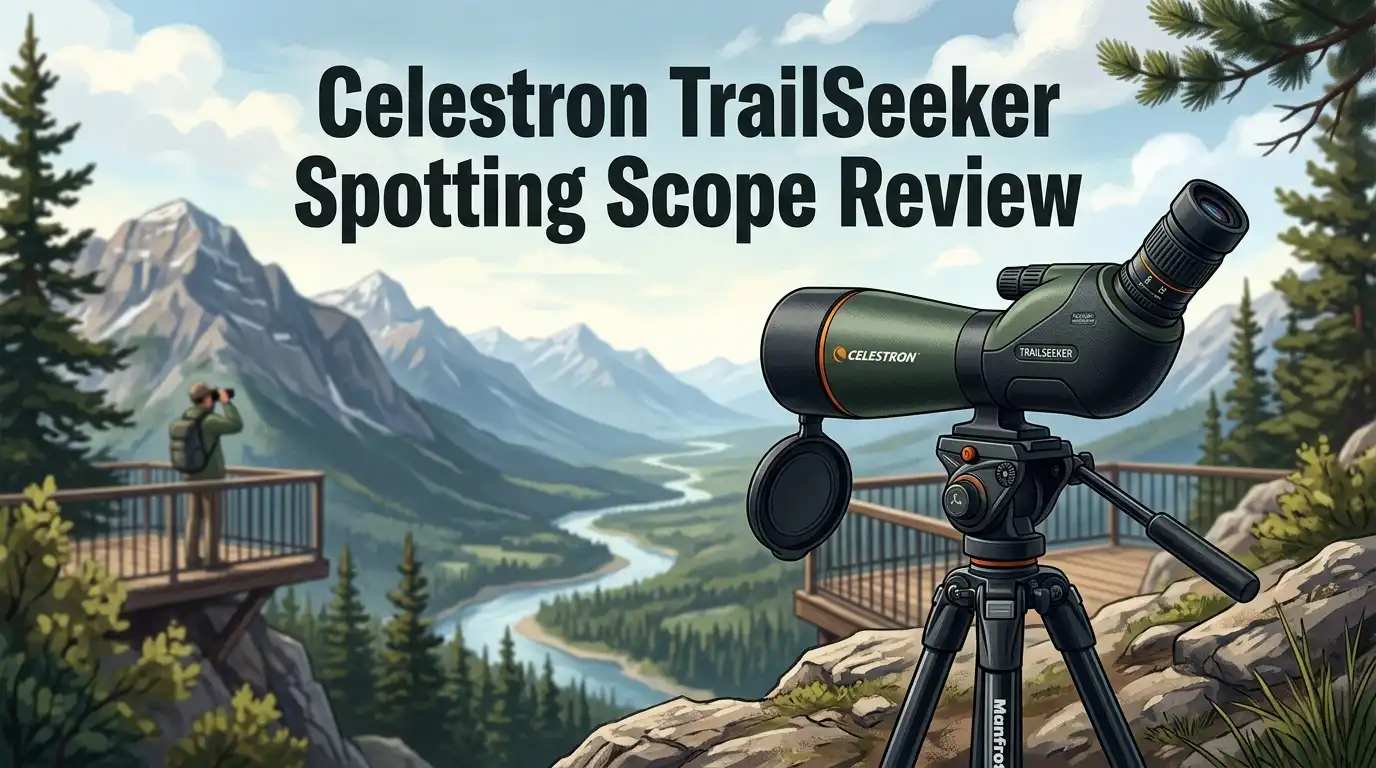
Celestron TrailSeeker Spotting Scope Review 2026: Worth Buying?
Spotting scopes used to cost a small fortune. That changed when Celestron pushed features from premium glass down into the mid price range.
The TrailSeeker line sits right in that sweet spot. It gives you a sliding sunshade, a rotating tripod collar, an interchangeable eyepiece, and a dual focus knob for a price that will not wreck your bank account.
But a spec sheet never tells the full story. A scope can look great on paper and still frustrate you at 60x on a windy ridge. So this review digs into what the TrailSeeker actually does in the field, what it struggles with, and whether it still makes sense in 2026 against newer rivals.
Key Takeaways
- The TrailSeeker is a value champion, not an optical miracle. You get sharp center detail, honest color, and real waterproofing for roughly a third of what premium ED scopes cost. Expect compromises at the edges of the frame.
- The 80mm model is the sweet spot for most buyers. It pulls in plenty of light, holds 54.6 ounces of weight on a solid tripod, and runs 20x to 60x. The 65mm version trades aperture for portability at 48 ounces and 16x to 48x.
- Image quality falls apart above 45x. This is the honest truth. Below 45x the view is bright and crisp. Push past it and contrast drops, the exit pupil shrinks to 1.3mm, and heat shimmer takes over.
- The dual focus knob is a genuine highlight. Coarse focus gets you close fast. Fine focus locks the detail in. Few scopes at this price offer both.
- You must budget for a tripod. A cheap photo tripod will ruin this scope. Plan on spending 100 to 200 dollars extra on a stable head and legs.
- Celestron glass is not ED glass here. You will see some color fringing on high contrast edges. The Regal M2 fixes that for more money.
Celestron TrailSeeker 20 to 60×80 Angled Spotting Scope


Last update on 2026-09-22 / Affiliate links / Images from Amazon Product Advertising API Some of the links on this website are affiliate links, which means that at no additional cost to you, I earn a commission if you click through and make a purchase. I only recommend products and services that I believe will add value to my readers. Thank you for your support!
This is the model most people mean when they say TrailSeeker. The 80mm objective gathers serious light, and the 20x to 60x zoom eyepiece covers nearly every situation a birder or hunter faces. Celestron gives it a 480mm focal length, phase coated BaK4 prisms, and the company’s proprietary XLT multicoatings across the optical path.
Field of view runs 105 feet at 20x down to 52 feet at 60x, measured at 1000 yards. Close focus sits at 24.6 feet, which is fine for distant waterfowl but too far for butterflies in your backyard. Eye relief measures 18mm at the low end and 15mm at the top. Eyeglass wearers will manage, though the view tightens noticeably once you zoom past 40x.
The body is fully waterproof, nitrogen purged, and wrapped in rubber armor. It weighs 54.6 ounces and stretches 19.9 inches long with the sunshade retracted.
The Unboxing Experience
Celestron keeps the packaging simple. The scope arrives in a plain cardboard box with molded foam inserts. Inside you find the scope body, the zoom eyepiece already mounted, a soft carry case, objective and eyepiece caps, a lens cloth, and a short manual.
The first thing you notice is the weight. This scope feels heavier than the photos suggest. The rubber armor has a grippy texture that holds well in wet hands. Seams look tight and the focus knobs turn smoothly straight out of the box with no gritty feel.
The included nylon case is the weak point. It is a stay on style cover with velcro closures, and the zippers feel thin. It protects against scratches and light rain, but it will not survive a hard drop or years of rough handling. Most owners replace it eventually.
Build Quality and Weather Sealing
Celestron built the TrailSeeker to survive outdoor abuse, and the construction backs that up. The housing is nitrogen filled, which stops internal fogging when you move from a warm truck into freezing air. The waterproof seal holds up in steady rain and heavy fog without issue.
The rotating tripod collar is a standout feature at this price. You loosen one knob, rotate the scope barrel, and lock it again. That lets you switch from level viewing to steep uphill glassing without unmounting anything. The detents are soft rather than clicky, so positioning takes a light touch.
The sliding metal sunshade extends about two inches. It cuts glare and keeps rain off the objective lens. One small complaint, the sunshade can slide back on its own if the fit loosens over time. Beyond that, nothing on this scope feels fragile.
Celestron TrailSeeker 16 to 48×65 Compact Spotting Scope

Last update on 2026-10-03 / Affiliate links / Images from Amazon Product Advertising API Some of the links on this website are affiliate links, which means that at no additional cost to you, I earn a commission if you click through and make a purchase. I only recommend products and services that I believe will add value to my readers. Thank you for your support!
The 65mm version is the TrailSeeker you carry rather than the one you drive to. It weighs 48 ounces and measures 16.4 inches long, so it slides into a daypack without a fight. Magnification runs 16x to 48x through the same style zoom eyepiece.
Two specs make this model interesting. First, close focus drops to 18 feet, which is far better for garden birding and insect watching. Second, the lower top magnification actually works in your favor. A 48x ceiling on a 65mm objective keeps the exit pupil usable, so the image stays brighter at maximum zoom than the 80mm does at 60x.
Audubon testers scored this model 7.1 and praised the center sharpness and the easy focus action. That is strong feedback for a scope in this bracket. The tradeoff is simple, less aperture means less light at dawn and dusk.
Top 3 Alternative for Celestron TrailSeeker Spotting Scope

Last update on 2026-09-17 / Affiliate links / Images from Amazon Product Advertising API Some of the links on this website are affiliate links, which means that at no additional cost to you, I earn a commission if you click through and make a purchase. I only recommend products and services that I believe will add value to my readers. Thank you for your support!
Celestron Regal M2 80ED Spotting Scope

Last update on 2026-09-13 / Affiliate links / Images from Amazon Product Advertising API Some of the links on this website are affiliate links, which means that at no additional cost to you, I earn a commission if you click through and make a purchase. I only recommend products and services that I believe will add value to my readers. Thank you for your support!
Vortex Optics Diamondback HD 20 to 60×85 Angled Spotting Scope

Last update on 2026-09-13 / Affiliate links / Images from Amazon Product Advertising API Some of the links on this website are affiliate links, which means that at no additional cost to you, I earn a commission if you click through and make a purchase. I only recommend products and services that I believe will add value to my readers. Thank you for your support!
Gosky Updated 20 to 60×80 Spotting Scope with Tripod
Optical Performance in Daylight
In good light the TrailSeeker delivers exactly what the price promises. Center sharpness is genuinely good. At 20x to 30x you can read fine feather detail, count antler points, and pick out bullet holes in paper at 100 yards without squinting.
Color rendering leans slightly warm but stays natural. Contrast holds up well in open sky conditions thanks to the XLT coatings. The usable sweet spot covers roughly the central 70 percent of the frame. Past that, softness creeps in toward the edges.
Chromatic aberration shows up where you would expect it. Point the scope at a dark bird against bright sky and you will see a faint purple or yellow halo on the edges. It is visible but not distracting at moderate magnification. This is the main thing that separates the TrailSeeker from ED glass scopes costing twice as much.
Low Light Performance at Dawn and Dusk
Aperture rules in dim conditions, and the 80mm model makes the most of what it has. At 20x the exit pupil measures 4mm, which is enough to keep the view bright during the first and last half hour of shooting light.
The problem appears when you zoom. At 60x the exit pupil shrinks to just 1.3mm. That is a dramatic drop, and the image dims accordingly. In twilight you will find yourself backing off to 25x or 30x simply to keep the view usable.
One birder who tested the 80 reported being able to see real color on birds beyond 30x, which many budget scopes cannot manage. That is a fair benchmark for this class. Still, if dawn and dusk glassing is your main activity, an ED scope will give you a noticeably cleaner image in the final minutes of light.
The Zoom Eyepiece and Magnification Range
The TrailSeeker uses a removable 8mm to 24mm zoom eyepiece with a 1.25 inch barrel. That removable design matters more than people realize. You can swap in fixed focal length astronomy eyepieces and often get a wider, sharper view than the stock zoom offers.
The zoom collar turns with firm, even resistance. There is no wobble and no sudden stiff spot. Magnification markings sit on a clearly printed ring that stays readable in low light.
Practical advice from field use is consistent. Treat 20x to 40x as your working range and treat 50x to 60x as a bonus for calm, bright days. Pushing the top end on a hot afternoon gives you nothing but boiling heat shimmer. That limitation applies to every scope in this price class, not just Celestron.
The Dual Focus System
This is the feature that wins people over. The TrailSeeker has two separate focus knobs stacked together. The large coarse knob swings the focus across its full range in about one and a half turns. The smaller fine knob then makes tiny adjustments for critical sharpness.
In practice the workflow is fast. You find the bird with the coarse knob and lock the detail with the fine knob. Single speed focusers force you to choose between speed and precision. This design removes that compromise.
Both knobs sit on top of the barrel where your hand naturally falls. The action is smooth with no backlash in either direction. Several reviewers singled out the focus as the best part of the whole package, and that assessment holds up. It is the kind of feature you normally find on scopes costing far more.
Pros and Cons of the Celestron TrailSeeker
Here is the honest balance sheet after extended use.
Pros
- Excellent center sharpness for the price, with natural color and solid contrast in daylight
- Dual focus knobs give you both speed and precision, a rare feature under 500 dollars
- Fully waterproof and nitrogen purged, so fogging and rain are not concerns
- Rotating tripod collar lets you reposition the eyepiece without unmounting the scope
- Interchangeable 1.25 inch eyepiece opens the door to upgrades and astronomy use
- Sliding metal sunshade cuts glare and shields the objective lens
- Available in 65mm, 80mm, and 100mm sizes with straight and angled body options
Cons
- No ED glass, so color fringing appears on high contrast edges
- Image quality degrades sharply above 45x to 50x magnification
- The 80mm body weighs 54.6 ounces, which is heavy for backpacking
- Included soft case feels cheap and wears out quickly
- Close focus of 24.6 feet on the 80mm limits nearby subject viewing
- Edge of field softness is noticeable in the outer third of the view
What the TrailSeeker Does Not Do Well
Let us be direct about the weak spots, because every review should name them.
The top of the zoom range is largely marketing. At 60x the view is dim, soft, and heavily affected by air turbulence. You will rarely use it. If you buy this scope expecting crisp 60x images, you will be disappointed.
Digiscoping at high power is frustrating. Owners report a pale, washed out diamond shaped patch appearing in the frame at 60x. The usable digiscoping window sits around 30x to 40x.
It is not a travel scope. The 80mm model at nearly 20 inches long and 3.4 pounds does not belong in a hiking pack for long distances. Choose the 65mm if weight matters to you.
Edge sharpness is average. Panning across a landscape reveals softening before you reach the field stop. Premium scopes hold detail much closer to the edge.
Digiscoping With the TrailSeeker
Plenty of people buy a spotting scope to photograph wildlife through it. The TrailSeeker can do this, with limits. The 1.25 inch eyepiece barrel accepts standard phone adapters, and Celestron sells a T adapter for attaching a camera body directly.
The best results come at moderate magnification. Set the zoom between 30x and 40x and the image circle fills the frame cleanly with good sharpness. Below 30x you may get vignetting. Above 45x the image softens and that washed out central patch becomes visible.
Stability is everything here. Even a tiny vibration ruins a photo at 40x, so a heavy tripod and a remote shutter or timer are not optional. Results will not match a dedicated telephoto lens, but for documenting a rare bird or sharing a sighting, the TrailSeeker gets the job done.
Tripod Pairing Advice
This is the most common mistake new buyers make. They spend 400 dollars on a scope and mount it on a 40 dollar tripod. The result is a shaky, unusable image, and they blame the optics.
A spotting scope magnifies vibration just as much as it magnifies the subject. At 60x, a breath of wind becomes visible shake. You need legs rated well above the 3.4 pound weight of the scope.
Look for a tripod with a fluid video head rather than a ball head. Fluid heads pan smoothly, which matters when you track a moving animal. Carbon fiber legs reduce vibration and weight, though aluminum works fine if you are driving to your spot. Budget at least 100 dollars, and ideally closer to 200. A good tripod will outlast several scopes.
TrailSeeker 65 vs 80 vs 100 Comparison
Celestron offers three apertures in this line, and the right choice depends on how you move.
The 65mm runs 16x to 48x, weighs 48 ounces, measures 16.4 inches, and focuses as close as 18 feet. Pick it for hiking, backyard birding, and travel.
The 80mm runs 20x to 60x, weighs 54.6 ounces, measures 19.9 inches, and focuses at 24.6 feet. It balances light gathering against portability and suits most buyers.
The 100mm pushes field of view to 94 feet down to 47 feet at 1000 yards, but weighs 71 ounces with a 29.5 foot close focus. That is over four pounds, which means a serious tripod and a vehicle. Choose it only for fixed position use like range shooting or hide based birding.
Price and Value in 2026
The TrailSeeker has held its price position well. The 65mm typically lands near 280 dollars and the 80mm sits around 350 to 400 dollars, with the 100mm higher. Street prices move with sales, so patience pays off.
At those numbers the value is strong. You are getting features from the 800 dollar tier in a 350 dollar body. Waterproofing, nitrogen purging, dual focus, a rotating collar, and an interchangeable eyepiece all appear here.
The competition has tightened though. The Vortex Diamondback HD brings HD glass and an unlimited lifetime warranty. The Celestron Regal M2 80ED adds genuine ED optics for a few hundred more. If your budget stretches, ED glass is the single biggest upgrade you can make. If it does not, the TrailSeeker remains a smart buy.
Final Verdict on the Celestron TrailSeeker
The Celestron TrailSeeker earns a solid recommendation with clear conditions attached. It is a well built, weatherproof scope with sharp center optics and a focus system that punches above its price. For birders, hunters, and range shooters working within a mid range budget, it delivers real performance.
Buy the 80mm if you want the best all around balance. Buy the 65mm if you carry your gear on foot. Skip the 100mm unless you have a heavy tripod and a fixed viewing spot.
Just set your expectations correctly. This is not an ED scope, and no amount of coating technology changes that. You will see color fringing, soft edges, and a dim view at maximum zoom. Accept those limits and the TrailSeeker will serve you well for years.
Frequently Asked Questions
Is the Celestron TrailSeeker waterproof?
Yes. Every TrailSeeker model is fully waterproof and nitrogen purged. The nitrogen filling prevents internal fogging when temperature changes quickly. The rubber armored housing handles rain, fog, and snow without problems. You should still dry the lenses and avoid full submersion.
Should I choose the angled or straight body?
Angled models suit birding, group viewing, and uphill glassing because the eyepiece stays comfortable at any height. Straight models suit target shooting from a bench and tracking from inside a vehicle. Angled is the more versatile choice for most users.
Does the TrailSeeker work for astronomy?
It works for basic astronomy. You can see lunar craters clearly, spot the four large moons of Jupiter, and view bright star clusters. The removable 1.25 inch eyepiece lets you fit astronomy eyepieces for better results. It will not replace a real telescope for deep sky objects.
What magnification should I actually use?
Stay between 20x and 40x for most viewing. The image stays bright and sharp through that range. Use 50x and 60x only on calm, clear days with a very stable tripod. Higher magnification is not always better.
Does Celestron cover the TrailSeeker under warranty?
Celestron provides a limited lifetime warranty on TrailSeeker optics for the original owner in the United States and Canada. Coverage applies to defects in materials and workmanship, not accidental damage. Register your purchase after you buy it.
Is the TrailSeeker good for long range shooting?
Yes, for ranges out to about 600 yards. You can spot bullet holes on paper at 100 to 200 yards easily. Beyond that, heat shimmer and the lack of ED glass make hole spotting harder. Serious benchrest shooters usually step up to ED optics.

Hello, I’m Emily Price, the founder of Birds Affection. As a passionate bird enthusiast and spiritual seeker, I’ve always been fascinated by the symbolic meanings and mystical connections between birds and our lives. On this website, I share my knowledge and insights on the spiritual significance of various bird species, exploring their roles as messengers, guides, and teachers. Through my writing, I aim to inspire and educate others on the profound wisdom and beauty that birds bring to our world. Join me on this journey as we delve into the enchanting realm of bird symbolism and discover the hidden meanings behind these magnificent creatures.