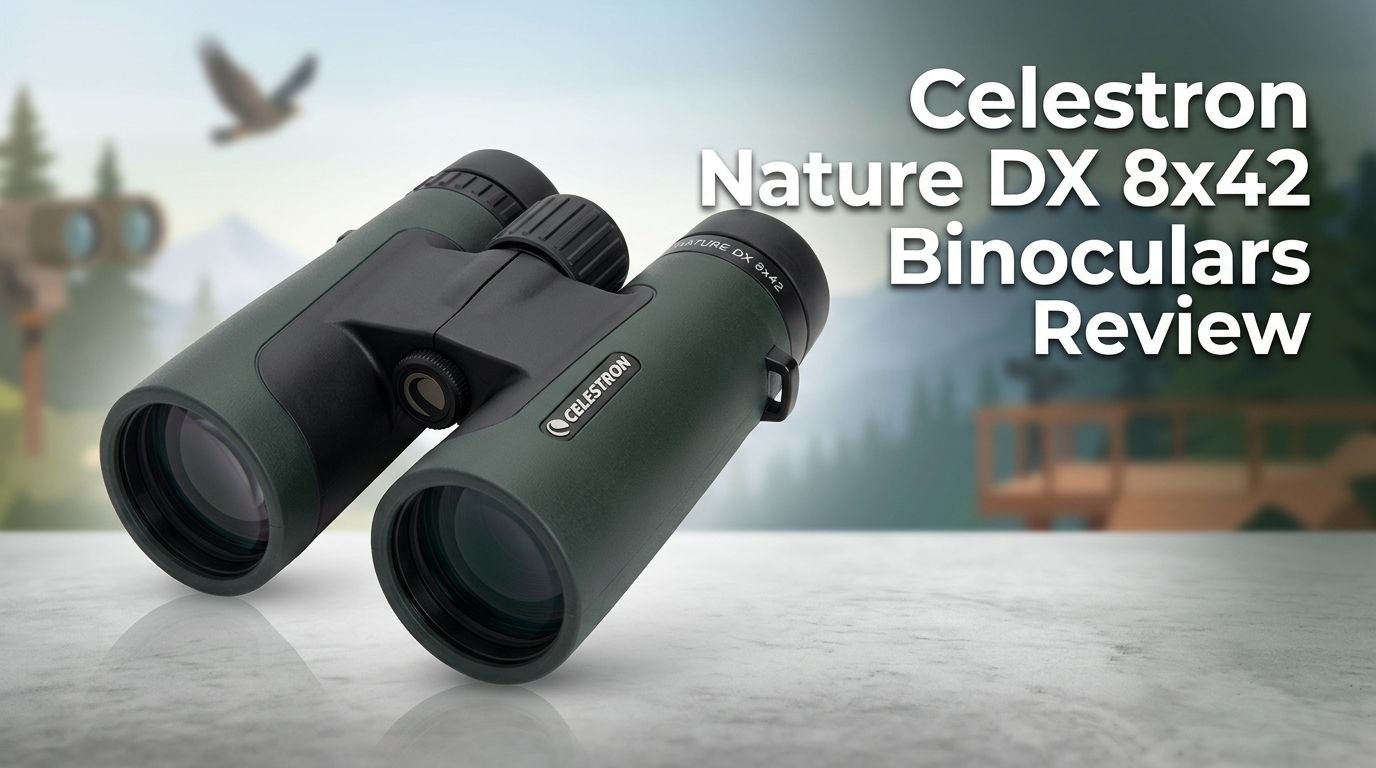
Celestron Nature DX 8×42 Binoculars Review 2026
Are you looking for a pair of binoculars that delivers clear, bright views without draining your wallet? The Celestron Nature DX 8×42 has been a favorite among birders, hikers, and outdoor lovers for years. It combines solid optical performance with an affordable price tag that few competitors can match.
This pair sits right in the sweet spot of the budget binocular market. It offers BaK-4 prisms, fully multi-coated lenses, and a waterproof body.
Thousands of users on Amazon have rated it highly, and professional review sites continue to recommend it year after year.
Key Takeaways:
- The Celestron Nature DX 8×42 offers impressive optical clarity for its price range. Phase-coated BaK-4 prisms and fully multi-coated lenses produce bright, sharp images with good color accuracy. You get performance that rivals binoculars costing twice as much.
- The 7.4-degree field of view is wider than average for an 8×42 binocular. This makes it easy to locate birds in trees and follow them in flight. Beginners will appreciate how forgiving this wide field is.
- A close focus distance of just 6.5 feet sets the Nature DX apart from many competitors. You can observe butterflies, insects, and nearby plants with surprising detail. This feature adds real value for nature study and garden observation.
- The body is waterproof, fogproof, and nitrogen-purged. You can use these binoculars in rain, humidity, and cold conditions without worry. The polycarbonate housing with rubber armor absorbs bumps and drops well.
- At roughly 1.39 pounds (626 grams), the Nature DX 8×42 is lightweight and easy to carry on long hikes. It fits into an oversized jacket pocket or a small daypack without adding bulk.
- Eye relief of 17.5mm makes it comfortable for eyeglass wearers. The twist-up eyecups lock into multiple positions. This allows both glasses and non-glasses users to find the right eye position quickly.


Last update on 2026-08-27 / Affiliate links / Images from Amazon Product Advertising API Some of the links on this website are affiliate links, which means that at no additional cost to you, I earn a commission if you click through and make a purchase. I only recommend products and services that I believe will add value to my readers. Thank you for your support!
Celestron Nature DX 8×42 Binoculars: Overview and First Impressions
The Celestron Nature DX 8×42 arrives in a compact box with a carrying case, neck strap, lens caps, and a cleaning cloth. The first thing you notice is how light and compact these binoculars feel in your hands. They do not look or feel cheap despite their budget-friendly price.
The green rubber armor gives the body a clean, outdoor-ready appearance. The texture provides a good grip even with wet or sweaty hands. The overall build quality matches what you would expect from a mid-range product, not a budget one.
Picking them up and looking through the eyepieces for the first time, the image is noticeably bright and clear. Colors appear natural, and the focus wheel moves smoothly. There is no stiffness or play in the mechanism.
The eyecups twist up easily and stay in place at each stop. The diopter adjustment ring sits near the right eyepiece and holds its setting firmly. These small touches show that Celestron paid attention to the user experience.
For a first impression, the Nature DX 8×42 punches well above its weight class. It creates an immediate sense of confidence that your money was well spent. Many users report feeling surprised at the quality they receive for this price.
Optical Performance and Image Quality
The optics are the most important part of any binocular, and the Nature DX 8×42 delivers strong results here. It uses BaK-4 glass prisms with phase coatings. These coatings increase contrast and resolution, giving you sharper images across the entire field of view.
The lenses are fully multi-coated. This means every air-to-glass surface has multiple layers of anti-reflective coating. The result is maximum light transmission and minimal glare. Colors look true to life, and details remain crisp in good lighting conditions.
In bright daylight, the image is sharp from the center to about 70 to 80 percent of the way to the edge. Some softness appears at the very edges, which is normal for binoculars in this price range. Center sharpness is excellent and competitive with models that cost significantly more.
Low-light performance is decent for an 8×42 binocular. The 42mm objective lenses gather enough light for early morning or late evening observation. You will notice some loss of contrast and brightness compared to premium glass, but the image remains usable during golden hour.
Chromatic aberration, the colored fringing around high-contrast edges, is present but controlled. You may see slight purple or green fringing around dark branches against a bright sky. For the price point, this level of control is acceptable.
Build Quality and Durability
Celestron built the Nature DX 8×42 with a polycarbonate chassis wrapped in rubber armor. This combination keeps weight low while providing solid protection against impacts. The rubber coating absorbs shocks from accidental bumps and drops during outdoor use.
The binoculars carry an IPX7 waterproof rating. They can handle rain, splashes, and brief submersion without any damage. Nitrogen purging prevents internal fogging when you move between temperature extremes. This makes them reliable in humid forests, cold mountain mornings, and rainy coastal areas.
The focus wheel sits in the center bridge and has a smooth, consistent rotation. It covers the full focus range from close to infinity with about 1.5 turns. The resistance feels just right. It is easy to make fine adjustments without overshooting your target.
The lens caps attach to the strap, so you will not lose them in the field. The objective lens covers fit snugly but release easily when needed. The included carrying case is basic but functional. It provides enough padding for storage and travel.
Overall, the build quality is a clear strength of the Nature DX 8×42. These binoculars feel like they can handle years of regular outdoor use without problems. Many owners report using them for several years with no mechanical issues.
Top 3 Alternatives for Celestron Nature DX 8×42 Binoculars
1. Nikon Prostaff P3 8×42 Binoculars

Last update on 2026-07-01 / Affiliate links / Images from Amazon Product Advertising API Some of the links on this website are affiliate links, which means that at no additional cost to you, I earn a commission if you click through and make a purchase. I only recommend products and services that I believe will add value to my readers. Thank you for your support!
2. Vortex Crossfire HD 8×42 Binoculars

Last update on 2026-08-28 / Affiliate links / Images from Amazon Product Advertising API Some of the links on this website are affiliate links, which means that at no additional cost to you, I earn a commission if you click through and make a purchase. I only recommend products and services that I believe will add value to my readers. Thank you for your support!
3. Celestron Nature DX ED 8×42 Binoculars

Last update on 2026-08-28 / Affiliate links / Images from Amazon Product Advertising API Some of the links on this website are affiliate links, which means that at no additional cost to you, I earn a commission if you click through and make a purchase. I only recommend products and services that I believe will add value to my readers. Thank you for your support!
Field of View and Close Focus Performance
The Celestron Nature DX 8×42 offers a 7.4-degree apparent field of view. This translates to roughly 388 feet at 1,000 yards. That is wider than many competing 8×42 binoculars in this price bracket.
A wider field of view helps you find birds faster. You spend less time scanning and more time watching. This is especially valuable for beginners who are still learning to aim binoculars at small, moving targets. Experienced birders will appreciate the reduced search time as well.
The close focus distance of 6.5 feet is another standout feature. Most budget 8×42 binoculars have a close focus of 8 to 10 feet. The Nature DX lets you observe insects, flowers, and small creatures at much shorter distances.
This close focus ability adds a second dimension to your outdoor experience. You can watch a hawk soaring overhead and then shift your attention to a butterfly resting on a bush just a few feet away. The transition between distant and near subjects is smooth and fast.
The focus wheel moves precisely across the entire range. There is no dead zone or loose movement at any point. The smooth travel makes it easy to lock onto subjects at any distance without frustration. This is a key usability advantage for everyday outdoor observation.
Comfort and Ergonomics
Comfort matters when you carry binoculars for hours. The Nature DX 8×42 weighs just 1.39 pounds, which makes it one of the lighter 8×42 models available. Your neck and arms will thank you on long birding walks.
The body shape fits naturally in most hand sizes. The rubber armor provides a secure grip, and the finger indentations near the objective barrels help you hold steady. You can use these binoculars one-handed for quick glances without difficulty.
The twist-up eyecups offer multiple stop positions. This gives you flexibility to find the perfect eye relief distance. Eyeglass wearers get 17.5mm of eye relief, which is generous enough to see the full field of view without removing glasses.
The interpupillary distance adjusts smoothly across a standard range. Both adults and teenagers can find a comfortable setting. The hinge mechanism feels solid and stays in position once set.
The included neck strap is basic and thin. Many users replace it with a harness-style strap for added comfort during long outings. This is a minor complaint, but it is worth noting. Overall, the ergonomic design makes these binoculars pleasant to use for extended periods.
Birding Performance: How Well Do They Work in the Field?
Birding is the primary use case for the Nature DX 8×42, and it performs very well for this purpose. The wide field of view helps you locate birds quickly in dense foliage and open skies. The 8x magnification is ideal for general birding, offering enough power to see field marks without excessive hand-shake.
Color reproduction is good enough to distinguish between similar species. You can identify the subtle differences in plumage that separate a Downy Woodpecker from a Hairy Woodpecker. Feather details, eye rings, and bill shapes come through clearly at moderate distances.
The quick, smooth focus mechanism is a real asset in the field. When a bird moves from a near perch to a distant treetop, you can refocus in less than a second. This responsiveness keeps you connected to the action.
In forest environments, the Nature DX performs well under the dappled light of the canopy. The bright image helps you spot birds sitting in shade. Early morning birding sessions are also productive, thanks to the decent low-light performance of the 42mm objectives.
For beginning birders, these binoculars remove many of the frustrations that cause people to give up. The easy focus, wide field, and bright image create a positive first experience. Many birders who started with the Nature DX 8×42 still keep them as a trusted pair even after upgrading.
Hiking and Outdoor Use
Beyond birding, the Nature DX 8×42 is an excellent companion for hiking and general outdoor exploration. Its lightweight body and compact size mean you can carry it all day without fatigue. It fits easily into a hip belt pocket or the top compartment of a backpack.
The waterproof and fogproof construction gives you confidence in unpredictable mountain weather. You can pull these binoculars out during a rain shower without worrying about moisture damage. The rubber armor also protects against scratches from rocks and branches.
Hikers use the Nature DX to scan ridgelines, identify distant landmarks, and observe wildlife from safe distances. The 8x magnification provides a stable, easy-to-view image even while standing on uneven terrain. Higher magnification binoculars tend to amplify hand shake, but 8x keeps the view steady.
The close focus feature is useful for trail-side nature study. You can examine wildflowers, insects, and reptiles from a respectful distance without disturbing them. This adds an educational element to any hike.
For casual stargazing at camp, the 42mm objectives gather enough light to reveal star clusters, the moon’s craters, and bright planets. You will not replace a dedicated astronomy binocular, but the Nature DX offers enjoyable views of the night sky as a bonus.
Celestron Nature DX 8×42 vs. Celestron Nature DX ED 8×42
Many buyers wonder whether to spend extra on the ED (Extra-Low Dispersion) version. The Nature DX ED 8×42 uses special ED glass that reduces chromatic aberration more effectively than the standard model.
Last update on 2026-08-27 / Affiliate links / Images from Amazon Product Advertising API Some of the links on this website are affiliate links, which means that at no additional cost to you, I earn a commission if you click through and make a purchase. I only recommend products and services that I believe will add value to my readers. Thank you for your support!
In side-by-side comparisons, the ED version produces slightly sharper images with less color fringing. The difference is most visible around high-contrast edges. If you frequently observe backlit birds against bright skies, the ED glass provides a noticeable improvement.
The standard Nature DX 8×42 weighs slightly less and costs considerably less. For most casual users, the standard version offers more than enough optical quality. The savings can go toward accessories like a better strap or a field guide.
Both models share similar build quality, field of view, and close focus distances. The eyecup design and focus mechanism feel nearly identical. The main upgrade in the ED version is strictly in the glass quality.
If you are a serious birder who wants the best image quality under $200, the ED version is a smart investment. If you are a casual observer or a beginner, the standard Nature DX 8×42 delivers excellent value. Either way, Celestron gives you a strong product.
Accessories and What Comes in the Box
The Celestron Nature DX 8×42 comes with a practical set of accessories right out of the box. You get a padded carrying case, a neck strap, objective lens covers, a rainguard eyepiece cover, and a microfiber cleaning cloth.
The carrying case has a belt loop and a shoulder strap option. It protects the binoculars well during storage and transport. The zipper closure is easy to open quickly when you need your binoculars in a hurry.
The objective lens caps stay attached to the binocular barrels with a small rubber tether. This prevents them from getting lost in the field. The rainguard covers both eyepieces and hangs around your neck when not in use.
The included microfiber cloth is useful for basic lens cleaning. However, investing in a proper lens pen or cleaning kit is a good idea for long-term lens care. Fingerprints and dust can reduce image quality if not cleaned properly.
One missing accessory is a binocular harness. The basic neck strap works fine for short sessions. For all-day use, a padded harness distributes weight across your shoulders and back much better. Many popular harness options are available for under $20 on Amazon.
Pros and Cons of the Celestron Nature DX 8×42
Pros:
The optical quality punches above its weight class. BaK-4 prisms with phase coatings deliver sharp, bright images that surprise at this price point. The 7.4-degree field of view is wider than most competitors, and the 6.5-foot close focus is exceptional.
Build quality is strong. Waterproof, fogproof, and nitrogen-purged construction means these binoculars handle bad weather without complaint. The rubber armor absorbs impacts and provides a sure grip.
The lightweight design makes all-day carry comfortable. At just 1.39 pounds, your neck and arms stay fresh during long outings. The twist-up eyecups and generous eye relief work well for eyeglass wearers.
Cons:
Edge sharpness drops off in the outer 20 to 30 percent of the field. This is typical for the price range but noticeable if you compare against premium glass. Some chromatic aberration appears around high-contrast edges.
The included neck strap is thin and basic. Most users will want to upgrade to a padded harness. The carrying case, while functional, lacks premium padding.
Low-light performance is adequate but not outstanding. During the last minutes of twilight, images lose contrast faster than higher-end models. For dedicated dawn and dusk observation, a larger objective lens or ED glass may serve you better.
How Does It Compare to the Nikon Prostaff P3 8×42?
The Nikon Prostaff P3 8×42 is one of the closest competitors to the Celestron Nature DX 8×42. Both binoculars target the same budget-friendly segment and offer similar core features. Choosing between them comes down to small differences.
The Nikon Prostaff P3 has a slightly brighter image in some lighting conditions. Its lens coatings produce a neutral, clean color tone that many users prefer. The Celestron Nature DX shows a slightly warmer color temperature.
Field of view favors the Celestron Nature DX. Its 7.4-degree field is wider than the Prostaff P3, which makes bird finding easier. Close focus is also tighter on the Celestron at 6.5 feet versus around 8 feet for the Nikon.
Build quality is comparable between both models. Both are waterproof, fogproof, and rubber-armored. The Nikon feels slightly more compact, while the Celestron has a marginally better grip texture.
Eye relief is excellent on both, making them suitable for eyeglass wearers. The Nikon offers smooth focus action, but the Celestron’s focus wheel has a slightly wider diameter that some users find easier to operate.
Both binoculars are excellent choices. If you value wider field of view and closer focus, pick the Celestron. If you prefer slightly sharper low-light images and the Nikon brand, the Prostaff P3 is a strong option.
Long-Term Reliability and Warranty
Celestron backs the Nature DX 8×42 with a limited lifetime warranty. This warranty covers defects in materials and workmanship for the life of the product. It gives you peace of mind that your purchase is protected.
Many users have owned these binoculars for three to five years or more without issues. The focus mechanism stays smooth, the coatings hold up, and the waterproof seals remain intact. This kind of long-term reliability is rare at this price level.
The rubber armor may show minor wear over time, especially at the edges. This is cosmetic and does not affect performance. The internal optics remain well-aligned even after years of regular use and the occasional bump.
Celestron’s customer service has a solid reputation in the optics community. If you do encounter a problem, the warranty process is straightforward. Most issues are resolved with a repair or replacement without excessive hassle.
Storing your binoculars in the included case when not in use extends their lifespan. Keeping the lenses clean with a microfiber cloth and avoiding touching the glass with your fingers will maintain image quality for years. A small amount of care goes a long way with the Nature DX.
Final Verdict: Is the Celestron Nature DX 8×42 Worth It in 2026?
The answer is a confident yes. The Celestron Nature DX 8×42 remains one of the best values in the binocular market in 2026. It delivers optical performance, build quality, and user-friendly features that consistently exceed expectations for its price.
Beginners get an easy, enjoyable entry point into birding and outdoor observation. Experienced users get a reliable backup pair or a lightweight travel option. Budget-conscious buyers get the most performance possible without overspending.
The wide field of view, excellent close focus, and comfortable ergonomics make it a versatile tool for many activities. Birding, hiking, sporting events, and casual stargazing all benefit from what this binocular offers.
Small compromises in edge sharpness and low-light performance are expected at this price. They do not diminish the overall experience for most users. If you need premium optics, the Nature DX ED or a higher-tier brand will serve you better.
For everyone else, the Celestron Nature DX 8×42 is a smart, satisfying purchase. It has earned its place as a top recommendation among budget 8×42 binoculars, and it continues to deserve that status in 2026.
Frequently Asked Questions
Is the Celestron Nature DX 8×42 good for beginners?
Yes, the Nature DX 8×42 is one of the best beginner binoculars available. The wide 7.4-degree field of view makes it easy to find and follow birds. The smooth focus wheel and lightweight body reduce the learning curve. Many birding guides recommend it as a first serious pair of binoculars.
Can you use the Celestron Nature DX 8×42 with eyeglasses?
Absolutely. The 17.5mm eye relief provides enough distance between the eyepiece and your eye to see the full field of view while wearing glasses. The twist-up eyecups fold down to create the right spacing. This is one of the most glasses-friendly budget binoculars on the market.
Is the Celestron Nature DX 8×42 waterproof?
Yes, it is fully waterproof and fogproof. The body is sealed with O-rings and filled with nitrogen gas. This prevents moisture and internal fogging. You can use it safely in rain, snow, and humid conditions.
How far can you see with the Celestron Nature DX 8×42?
The 8x magnification makes objects appear eight times closer than they do to the naked eye. In practical terms, you can identify birds and wildlife clearly at distances of 100 to 300 yards or more. The field of view covers about 388 feet at 1,000 yards.
Does the Celestron Nature DX 8×42 come with a case?
Yes, it includes a padded carrying case with a belt loop. You also receive a neck strap, objective lens covers, a rainguard for the eyepieces, and a microfiber cleaning cloth. Everything you need to get started is included in the box.
What is the difference between Celestron Nature DX and Nature DX ED?
The main difference is the glass. The Nature DX ED uses extra-low dispersion glass that reduces chromatic aberration and produces slightly sharper images. The standard Nature DX costs less and offers very good quality for casual use. The ED version is the better choice for serious birders who want the cleanest possible image.

Hello, I’m Emily Price, the founder of Birds Affection. As a passionate bird enthusiast and spiritual seeker, I’ve always been fascinated by the symbolic meanings and mystical connections between birds and our lives. On this website, I share my knowledge and insights on the spiritual significance of various bird species, exploring their roles as messengers, guides, and teachers. Through my writing, I aim to inspire and educate others on the profound wisdom and beauty that birds bring to our world. Join me on this journey as we delve into the enchanting realm of bird symbolism and discover the hidden meanings behind these magnificent creatures.