Sightron Spotting Scope Review 2026: Worth Buying?
Long range shooting has changed a lot in the last few years. Rifles shoot flatter, slugs fly farther, and shooters now want to see a tiny hole in paper from 500 yards away. Your rifle scope cannot always do that job. A spotting scope can.
Sightron sits in an interesting spot in the optics market. The brand is not as loud as Vortex or Leupold. Yet range officers, benchrest competitors, and birdwatchers keep recommending it. Sightron even served as the official spotting scope provider for Extreme Benchrest events, which says something about real world trust.
So is a Sightron spotting scope the right pick for you in 2026? I spent time with the SII Blue Sky HD series, dug through owner feedback from shooting forums and birding groups, and compared it against the usual rivals. This review covers the good, the average, and the parts that genuinely annoyed me. No fluff. Just what you need before you spend your money.
In A Nutshell:
- The glass is the main selling point. The SII Blue Sky HD uses ED (extra low dispersion) glass with fully multicoated lenses. Color fringing stays low, contrast stays high, and the image holds sharp near the edges. Testers resolved lines just 25 thousandths of an inch wide at 60 yards on maximum power.
- It is a heavy instrument. The 85mm model weighs about 4 pounds 2 ounces and measures 17 inches with the hood closed. You cannot hand hold this. A solid tripod is mandatory, and it costs extra.
- Weather sealing is genuinely good. Nitrogen charged, waterproof, and fogproof. A stay on Cordura field cover ships in the box, so you can leave it mounted in light rain without panic.
- Dual focus works better than you expect. A fast knob and a fine knob sit on top. You find the target at 20x, then nudge the fine knob at 60x for a crisp view.
- Value is strong, but not shocking. Street pricing usually lands near the 740 dollar mark, sometimes discounted lower. You get alpha adjacent clarity at a midrange price, backed by a limited lifetime warranty.
- The weak points are real. No included tripod, thin accessory ecosystem, patchy retail availability, and mirage will still ruin your view on hot afternoons no matter how good the glass is.
Sightron SII Blue Sky 85mm HD Angled Spotting Scope

Last update on 2026-09-28 / Affiliate links / Images from Amazon Product Advertising API Some of the links on this website are affiliate links, which means that at no additional cost to you, I earn a commission if you click through and make a purchase. I only recommend products and services that I believe will add value to my readers. Thank you for your support!
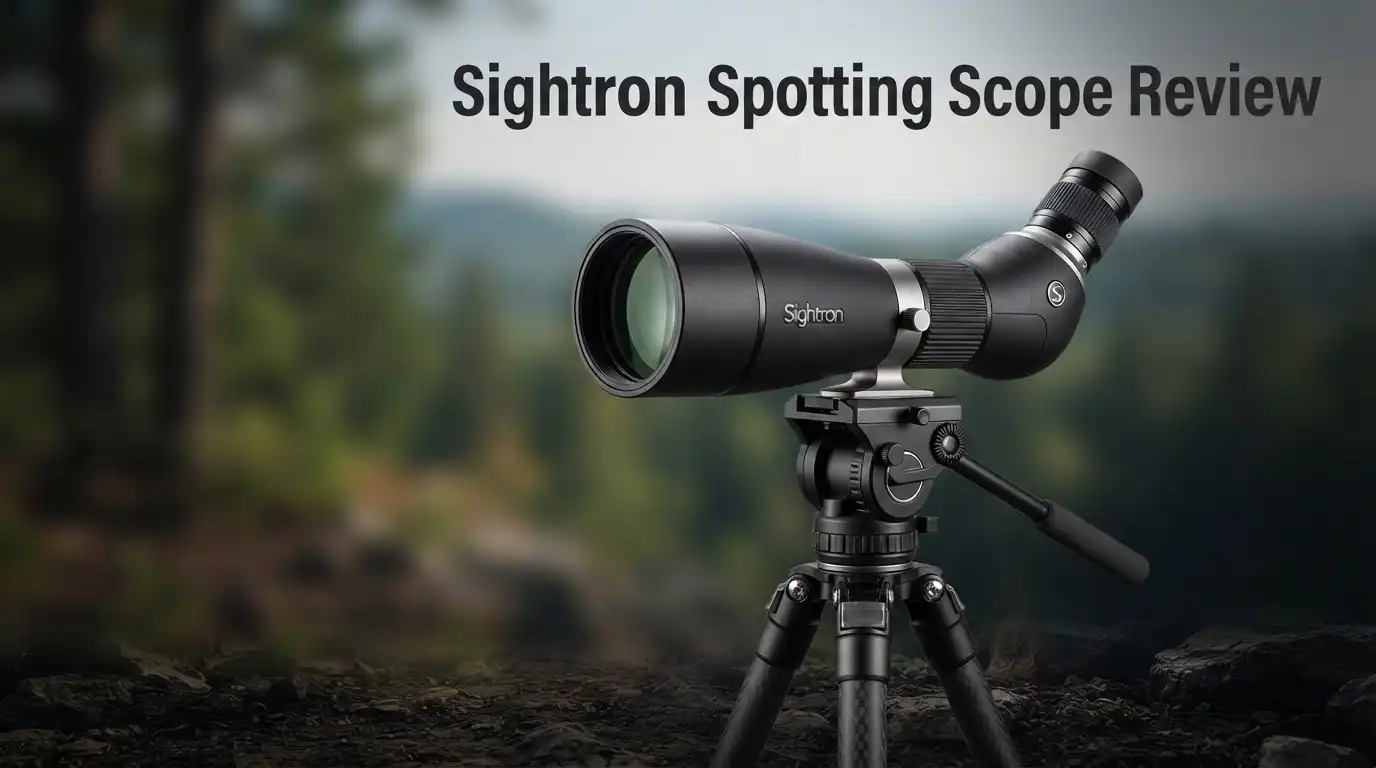
This is the model most people mean when they say “Sightron spotting scope.” It offers 20x to 60x magnification with an 85mm objective lens. The body wears black rubber armor. The eyepiece sits at an angle, which makes long observation sessions far more comfortable on your neck.
Sightron designed it for two crowds at once. Hunters get a rugged sealed body. Target shooters get resolution sharp enough to call .177 caliber holes. The field of view runs from 96 feet down to 48 feet at 1000 yards depending on your zoom setting. Close focus is roughly 8 yards, which is impressively short for an 85mm scope.
A straight eyepiece version also exists. Choose angled for tripod comfort and shared viewing. Choose straight if you scan uphill terrain often.
The Unboxing Experience
The box arrives plain and understated. No glossy lifestyle photos, no branded tissue paper. Sightron clearly spends money on glass instead of packaging.
Inside you find the scope already wrapped inside its Cordura stay on cover. That cover surprised me. It is not a flimsy sleeve. It zips and folds around the body, leaves the focus knobs and eyepiece exposed, and protects the scope while it stays mounted on a tripod. Most brands charge sixty dollars extra for something like this.
Push on caps cover both the objective and the eyepiece. A short manual and warranty card sit underneath. That is the whole kit. No tripod, no phone adapter, no cleaning cloth worth mentioning.
Lifting it out, the weight registers immediately. It feels dense and serious, like a tool rather than a toy.
Build Quality And Weather Sealing
The rubber armor grips well, even with wet hands. Panel gaps are tight. The rotating collar and focus knobs turn with steady resistance rather than gritty friction. Nothing rattles when you shake it, which is always a good sign.
Sightron charges the body with nitrogen and seals it fully. That combination stops internal fogging and blocks water intrusion. I left the scope under a garden sprinkler for several minutes. The image stayed clear and the interior stayed dry.
The sunshade extends about 3 inches. It reduces glare and keeps raindrops off the front lens. Small built in aiming marks on the shade help you point the scope roughly at your target before you look through it.
Owners on shooting forums report multi year use with no seal failures. That matches what the hardware feels like in hand.
Top 3 Alternatives For Sightron SII Blue Sky HD

Last update on 2026-09-13 / Affiliate links / Images from Amazon Product Advertising API Some of the links on this website are affiliate links, which means that at no additional cost to you, I earn a commission if you click through and make a purchase. I only recommend products and services that I believe will add value to my readers. Thank you for your support!
Vortex Optics Diamondback HD Spotting Scope 85mm Angled


Last update on 2026-09-17 / Affiliate links / Images from Amazon Product Advertising API Some of the links on this website are affiliate links, which means that at no additional cost to you, I earn a commission if you click through and make a purchase. I only recommend products and services that I believe will add value to my readers. Thank you for your support!
Celestron Regal M2 80ED Spotting Scope

Last update on 2026-09-13 / Affiliate links / Images from Amazon Product Advertising API Some of the links on this website are affiliate links, which means that at no additional cost to you, I earn a commission if you click through and make a purchase. I only recommend products and services that I believe will add value to my readers. Thank you for your support!
Athlon Optics Talos 80mm Spotter Scope
Optical Performance And Image Clarity
This is where the Sightron earns its reputation. ED glass reduces chromatic aberration, so high contrast edges stay clean instead of glowing purple or green. Fully multicoated surfaces push more light to your eye.
In testing on a resolution target at 60 yards, the scope separated lines only 25 thousandths of an inch wide at full 60x power. Black stayed black. White stayed white. There was no smeary halo between them.
At the range, .22 caliber holes in paper appear easily at 100 yards and beyond. Several forum users report spotting 6mm holes at 500 meters in good conditions. Edge to edge sharpness holds better than most scopes in this price bracket.
Low light performance is respectable rather than outstanding. Expect usable images into dusk, then a fairly quick fade.
Magnification And Field Of View
The 20x to 60x zoom range covers most practical needs. You change power with a rotating collar on the eyepiece. The collar moves smoothly and the zoom feels linear rather than jumpy.
At 20x you get a wide 96 foot field of view at 1000 yards. That is your searching setting. It helps you find a target, an animal, or a bird quickly.
At 60x the field narrows to 48 feet. Detail climbs, but so does every problem. Heat shimmer becomes obvious. Tripod vibration becomes obvious. Your own breathing becomes obvious.
My honest advice is to live around 30x to 40x. That range delivers the best balance of brightness, stability, and detail. Push to 60x only when air conditions are calm and cool.
The Dual Focus System
Two knobs sit on top of the barrel. One is a coarse focus for fast changes. The other is a fine focus for precision.
The workflow is simple. Set 20x magnification, use the coarse knob to get close, then zoom to your working power and refine with the fine knob. It takes about two seconds once you build the habit.
The top mounted position feels odd if you come from rifle scopes with side wheels. After an afternoon it becomes natural, and it keeps your hand away from the eyepiece.
The fine focus is the star here. It has enough travel to nail focus without hunting back and forth. Bird watchers tracking moving subjects will still prefer a single helical focus design, which is faster for quick refocusing.
Eyepiece, Eye Relief And Glasses
Eye relief measures roughly 17.7mm at 20x and 15.6mm at 60x. That is generous for a spotting scope.
The twist up eyecup makes the difference. Twist it out and the rubber collar blocks side glare for naked eye viewing. Twist it in and eyeglass wearers get the full field of view without pressing their lenses against the glass.
I wear glasses. I could see the whole field at 20x with almost no vignetting. At 60x a slight darkening crept in at the edges, which is normal physics rather than a defect.
Eye positioning does get fussy above 50x. Move your head half an inch and the image blacks out. Steady head placement solves it, but beginners will find this frustrating at first.
Sightron SI Series Spotting Scope For Budget Buyers

Last update on 2026-09-28 / Affiliate links / Images from Amazon Product Advertising API Some of the links on this website are affiliate links, which means that at no additional cost to you, I earn a commission if you click through and make a purchase. I only recommend products and services that I believe will add value to my readers. Thank you for your support!
Not everyone needs an 85mm ED glass instrument. Sightron also sells the SI Series, a smaller and far cheaper option built around a 40mm objective with 15x to 45x magnification.
This one targets casual users. Think backyard birding, scanning a hillside, or checking targets at 100 yards with a .22 rimfire. It packs down small, weighs little, and includes an attached 1.5 inch sunshade.
The trade offs are obvious. The 40mm objective gathers far less light, so dusk performance drops sharply. There is no ED glass, so some color fringing shows at higher power. Resolution cannot match the 85mm model.
Buy this only as a starter or travel scope. If you shoot past 200 yards regularly, save your money and step up to the HD.
Tripod Requirements And Mounting
You need a tripod. This is not optional advice. A 4 pound scope at 60x amplifies every tiny wobble into a shaking blur.
The base includes a standard quarter inch by twenty threaded socket. Any photographic tripod or mounting plate works. The barrel also rotates on its axis with a locking screw, which lets you angle the eyepiece for seated, standing, or prone viewing.
Sightron sells a matched carbon fiber Blue Sky tripod kit. It weighs about 3 pounds 5 ounces, supports 7 pounds, and extends to roughly 5 feet 8 inches. It is excellent and it is expensive.
A cheap 40 dollar tripod will waste your investment. Budget at least 150 dollars for a stable head and legs, more if you shoot in wind.
Performance For Target Shooting
Target shooters are the natural audience here. The resolution does exactly what they need, which is separating small holes in paper without walking downrange.
At 100 yards, .17 and .22 caliber holes read clearly at 40x. At 300 yards, .22 centerfire holes are visible in decent light. At 500 yards and beyond, success depends far more on mirage than on the scope.
The angled eyepiece helps enormously at a bench. You keep your cheek near the rifle and glance sideways instead of sitting up fully.
Spotters calling shots for a partner will appreciate the bright, wide 20x view. You can watch trace, then zoom in to confirm the hit. That two step routine is smooth on this scope.
Birdwatching And Wildlife Use
Birders have adopted this scope more than Sightron probably expected. The ED glass delivers accurate color, which matters when you are separating similar species by plumage tone.
The 8 yard close focus is a genuine bonus. Butterflies, dragonflies, and nearby shorebirds all stay in reach. Many 85mm scopes cannot focus closer than 15 feet.
Brightness at 20x to 30x makes dawn hedgerow scanning pleasant. Detail at 40x resolves feather edges on perched raptors at long distance.
The downsides are practical rather than optical. It is heavy for hiking, and the dual knob focus is slower than a helical ring when a bird moves. Serious walkers may prefer a lighter 65mm alternative, but for a fixed hide or a car window, this scope performs well above its price.
Digiscoping And Phone Photos
Digiscoping means shooting photos or video through the scope with a phone or camera. The Sightron handles it adequately but not gracefully.
The image quality is there. ED glass produces clean files with little purple fringing, which saves editing time. Sharp detail survives at moderate zoom.
The problem is ecosystem support. Sightron does not supply a dedicated phone adapter in the box, and third party universal clamps take fiddling to align correctly. Brands like Celestron and Vortex offer purpose built adapters that snap on quickly.
Vignetting appears below roughly 30x, so plan to shoot in the 30x to 45x window. Expect some trial and error. If phone photography is your main goal, check adapter compatibility before you buy.
What The Sightron Does Not Do Well
Honest reviews list the flaws, so here they are.
It is heavy and bulky. Carrying it several miles is unpleasant. No tripod is included, which effectively raises your real cost by 150 dollars or more.
Availability is inconsistent. Stock comes and goes at online retailers, and some configurations disappear for months. Finding one in a physical store is rare.
Accessory support is thin. There are fewer eyepieces, adapters, and cases than the big brands offer. The 60x setting is also more of a marketing number than a working one in warm weather.
The warranty is a limited lifetime warranty, not the unconditional no fault coverage Vortex provides. If you drop your gear often, that difference matters.
Pros And Cons
Pros
- ED glass delivers sharp, high contrast images with minimal color fringing
- Excellent resolution for spotting small caliber holes at long distance
- Fully waterproof, fogproof, and nitrogen charged body
- Stay on Cordura field cover included at no extra cost
- Dual focus knobs allow fast acquisition and precise fine tuning
- Generous eye relief with a twist up eyecup for eyeglass wearers
- Close focus near 8 yards, which is unusually short for an 85mm scope
- Strong price to performance ratio against alpha tier competitors
Cons
- Heavy at over 4 pounds and 17 inches long
- Tripod is not included and a good one costs extra
- 60x magnification is rarely usable due to mirage
- Eye placement becomes fussy at high power
- Limited accessory range compared to larger brands
- Retail availability is inconsistent
- Warranty terms are less generous than some rivals
- Focus knobs are slower than helical designs for moving subjects
Price, Value And Warranty
The SII Blue Sky HD carries an MSRP around 740 dollars, and retailers often discount it from a higher list price. That places it squarely in the midrange bracket.
Value looks strong from that angle. You get ED glass, full weather sealing, and an included field cover. Competing scopes near this price often skip one of those three.
Sightron backs the scope with a limited lifetime warranty. Coverage handles defects in materials and workmanship. It does not cover accidental damage the way some unconditional policies do.
My take is that you pay midrange money for upper midrange optics. Nobody is claiming this beats a Swarovski or Kowa. It gets closer than the price suggests, and that is the whole point.
Who Should Buy A Sightron Spotting Scope
Buy the SII Blue Sky HD if you shoot from a fixed position and care most about resolution per dollar. Benchrest shooters, F Class competitors, airgun slug shooters, and range regulars will all be satisfied.
It also suits stationary wildlife watchers. Hide sitting, car window observation, and backyard setups all play to its strengths.
Skip it if you hike long distances. The weight will wear you down. Skip it if you want an all in one kit with a tripod and phone adapter included, because you will assemble that yourself.
Choose the smaller SI Series only for casual, short range, lightweight use. Choose a Vortex or Celestron alternative if warranty coverage or accessory availability matters more to you than raw glass quality.
Frequently Asked Questions
Is Sightron a good optics brand?
Yes. Sightron builds solid rifle scopes and spotting scopes with quality Japanese influenced glass. The brand advertises less than its rivals, which keeps prices lower and awareness smaller.
Where are Sightron spotting scopes made?
Sightron is an American company with strong Japanese manufacturing ties. Production locations vary by product line, with higher tier optics typically built in Japan and the Philippines.
Does the Sightron spotting scope come with a tripod?
No. The scope ships with lens caps and a stay on field cover only. Sightron sells a carbon fiber Blue Sky tripod kit separately.
Can I see bullet holes at 1000 yards?
Rarely, and only with ideal conditions. Mirage and light limit you far more than optics do. Expect reliable hole spotting to around 300 to 500 yards depending on caliber and air quality.
Is the angled or straight eyepiece better?
Angled suits tripod use, shared viewing, and bench shooting. Straight suits uphill scanning and quick target finding. Most buyers prefer angled.
How does it compare to Vortex Diamondback HD?
The Sightron generally shows better edge sharpness and color control. The Vortex offers a lighter body, easier helical focus, and an unconditional lifetime warranty.
Is the 85mm version worth the extra weight?
If you shoot long range or watch wildlife at dawn, yes. The larger objective gathers meaningfully more light. For casual daytime use, a smaller scope is easier to carry.

Hello, I’m Emily Price, the founder of Birds Affection. As a passionate bird enthusiast and spiritual seeker, I’ve always been fascinated by the symbolic meanings and mystical connections between birds and our lives. On this website, I share my knowledge and insights on the spiritual significance of various bird species, exploring their roles as messengers, guides, and teachers. Through my writing, I aim to inspire and educate others on the profound wisdom and beauty that birds bring to our world. Join me on this journey as we delve into the enchanting realm of bird symbolism and discover the hidden meanings behind these magnificent creatures.