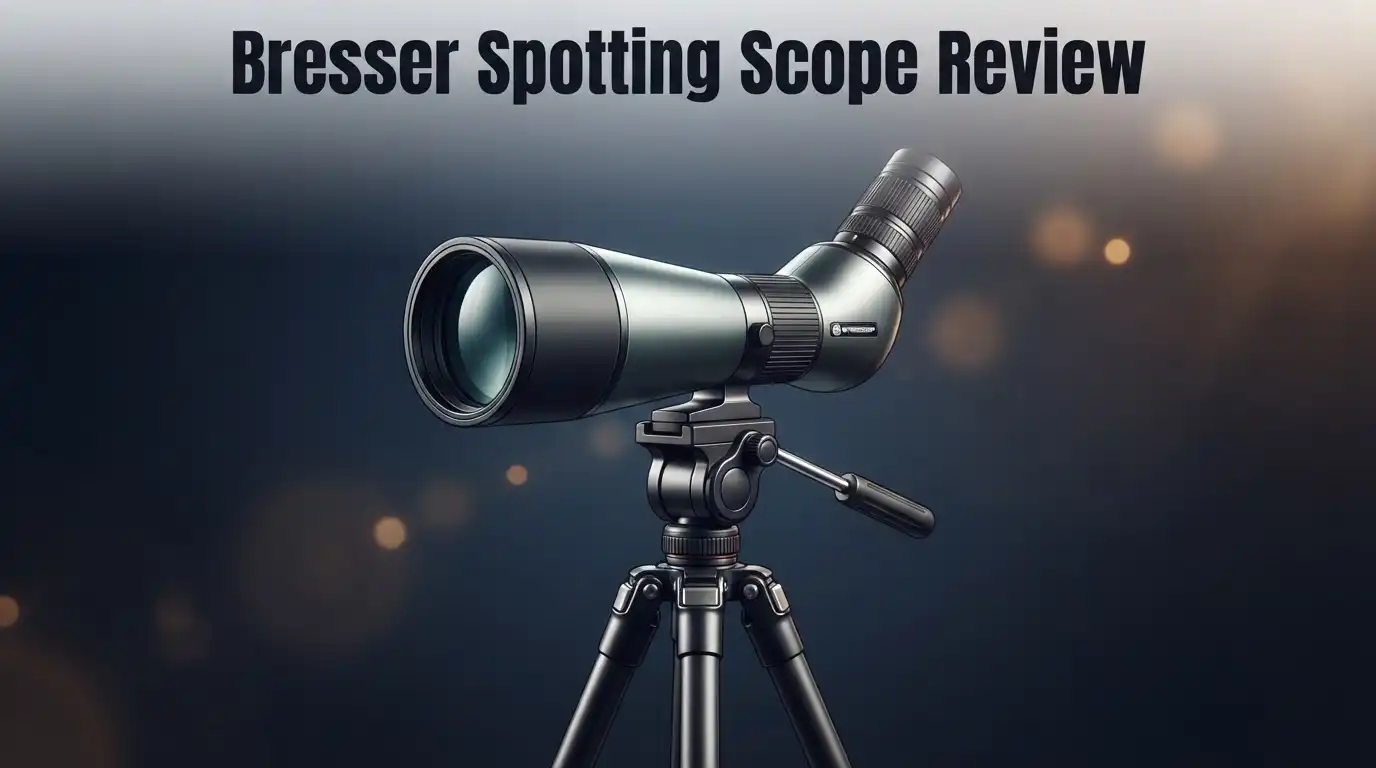
Bresser Spotting Scope Review 2026: Worth Buying?
Spotting scopes used to be a luxury item. In 2026, a good one costs about the same as a decent pair of hiking boots and a weekend away. Bresser sits right in that sweet spot. The German brand builds scopes that look expensive, feel solid, and cost far less than the big names on the shelf next to them.
But marketing copy tells you nothing useful. You want to know how the glass behaves at 60x when the sun drops. You want to know if the focus wheel feels gritty after six months. You want to know where Bresser cuts corners, because every brand cuts corners somewhere.
This review covers the full Bresser spotting scope lineup for 2026. I look at the Pirsch Gen II models, the budget Travel and Corvette scopes, and how they stack up against Celestron and Vortex. I also list the things Bresser does poorly, because a review without complaints is just an advertisement.
In a Nutshell:
- Bresser punches above its price tag. The Pirsch Gen II 80mm scope sells for roughly $399 and uses metal parts where cheaper scopes use plastic. The sunshade, collar, mounting foot, and eyecup housing are all metal. That matters for durability.
- The dual speed focus system is the standout feature. A 10:1 fine focus knob sits right next to the coarse knob. At 60x magnification, this makes locking in sharp detail genuinely easy instead of frustrating.
- Image quality is very good, not elite. Colors look true to life and the image stays flat to the edges. Color fringing shows up clearly at 60x though, because most Pirsch models skip ED glass.
- Brightness drops hard at maximum zoom. An 80mm lens at 60x gives you a tiny exit pupil. In good light this is fine. At dusk, the view dims noticeably.
- The accessories feel cheap compared to the scope. Generic unbranded lens caps, a basic cloth, and a thin manual. The carry case is the one exception and it is actually excellent.
- The lifetime warranty is the hidden value. Register online and Bresser upgrades the standard two year cover to an unlimited repair warranty.
Why Bresser Still Gets Attention in 2026

Last update on 2026-09-28 / Affiliate links / Images from Amazon Product Advertising API Some of the links on this website are affiliate links, which means that at no additional cost to you, I earn a commission if you click through and make a purchase. I only recommend products and services that I believe will add value to my readers. Thank you for your support!
Bresser has been making optics since 1957. The brand sits under the same umbrella as Explore Scientific in the United States, which means parts and service are easier to find than most people assume.
The appeal is simple. Bresser targets the gap between cheap Amazon scopes and premium European glass. A Swarovski or Kowa costs $2,500 and up. A no name 20x to 60x scope costs $90 and shows mushy detail past 30x.
Bresser lands between them. You get real optical engineering at a price a weekend birder can justify. That positioning has not changed in 2026, but competition has tightened. Vortex and Celestron both pushed hard into this bracket. Bresser still wins on build materials, and that is why it stays relevant.
Bresser Pirsch Gen II 20x to 60x 80mm Spotting Scope
This is the model most buyers should look at first. The Pirsch Gen II 80mm scope is the middle of the Bresser range and the best balance of size, brightness, and price.
The specs are straightforward. An 80mm objective lens, a 20x to 60x zoom eyepiece, a 45 degree angled body, and a weight of 1,492g. Field of view measures 38m at 1,000m at the lowest magnification. Minimum focus sits around 5.5m, though I focused closer than that in practice.
The Gen II update brought three real changes. Better mirror coatings on the prisms, nitrogen filling to stop internal fogging, and a slightly cleaner body design. The nitrogen purge alone justifies buying the Gen II over an older secondhand unit. Fogged internal glass cannot be fixed at home.
The Unboxing Experience
The box is plain cardboard with a product photo. Nothing fancy. Open it and the scope sits inside its stay on carry case, already dressed, which is a nice touch because you see the case quality immediately.
That case surprised me. The stitching is tight, the zipper runs the full body length, and the fit over the scope is snug rather than baggy. A padded shoulder strap clips on with quick release swivels and comes off entirely if you prefer.
Under the scope you find the eyepiece already fitted, two rubber eyepiece caps, a tethered objective cap, a microfiber cloth, and a thin multilingual manual. There is no tripod in the box. Budget for one separately. A cheap tripod ruins a good scope faster than bad glass does.
Build Quality and Body Feel
Pick up the Pirsch Gen II and it feels denser than the price suggests. Bresser mixes aluminum and polycarbonate. The barrel body appears to be polycarbonate, while the objective housing, collar, mounting foot, and sunshade are metal.
That metal sunshade is the detail I keep coming back to. It slides out smoothly with even tension. Plastic shades wobble or jam. This one does not.
The rubber armor is thin but tight. It does not slide or bunch up, which cheap armor often does after a season. The textured finish kills reflections, useful when you are close to skittish birds.
The rotating collar loosens with a single knob and locks firmly. Nothing creaks, nothing flexes. Body construction is honestly the strongest part of this scope.
Top 3 Alternative for Bresser Pirsch Gen II Spotting Scope


Last update on 2026-07-01 / Affiliate links / Images from Amazon Product Advertising API Some of the links on this website are affiliate links, which means that at no additional cost to you, I earn a commission if you click through and make a purchase. I only recommend products and services that I believe will add value to my readers. Thank you for your support!
Celestron Ultima 80 Angled Spotting Scope

Last update on 2026-09-13 / Affiliate links / Images from Amazon Product Advertising API Some of the links on this website are affiliate links, which means that at no additional cost to you, I earn a commission if you click through and make a purchase. I only recommend products and services that I believe will add value to my readers. Thank you for your support!
Vortex Diamondback HD Spotting Scope 16x to 48x 65mm

Last update on 2026-09-17 / Affiliate links / Images from Amazon Product Advertising API Some of the links on this website are affiliate links, which means that at no additional cost to you, I earn a commission if you click through and make a purchase. I only recommend products and services that I believe will add value to my readers. Thank you for your support!
Celestron Regal M2 80ED Spotting Scope
Optics and Image Quality in Real Light
Bresser uses BaK4 prisms with fully multicoated optics across the Pirsch line. That wording matters. Fully multicoated means every air to glass surface gets treated, not just the front and back elements.
The Gen II also adds Bresser’s Ultimate Reflection mirror coating on the secondary prism surface. Reflectivity sits around 95 to 98 percent. Premium dielectric coatings hit 99 percent, so there is a gap, but it is a small one.
In practice the image looks bright and natural at 20x through about 40x. Colors stay true without the oversaturated cartoon look some budget scopes produce. Edge sharpness is excellent and the field stays flat, so you do not need to recenter your subject constantly.
Color fringing is the weak point. At 20x you barely notice it. At 60x, a dark branch against bright sky shows a visible purple halo.
Focus System and Zoom Eyepiece
The dual speed focus is the feature I would pay extra for. Two knobs sit on top of the barrel, centered so either hand works.
The larger rear knob moves fast. Three and a half turns takes you across the whole focus range. Slide your finger forward to the smaller knob and you get a 10:1 reduction ratio for fine tuning.
At 60x, depth of field is razor thin. Without fine focus you overshoot constantly. With it, you creep into sharpness in one smooth motion. On my sample both knobs ran silky with zero free play.
The 20x to 60x eyepiece unscrews and swaps out, which almost no scope at this price allows. The twist up eyecup has two intermediate stops and plenty of eye relief for glasses wearers.
Bresser Pirsch 25x to 75x 100mm Spotting Scope

Last update on 2026-09-28 / Affiliate links / Images from Amazon Product Advertising API Some of the links on this website are affiliate links, which means that at no additional cost to you, I earn a commission if you click through and make a purchase. I only recommend products and services that I believe will add value to my readers. Thank you for your support!
If you glass across canyons or watch shorebirds at extreme range, the 100mm Pirsch is the step up. It uses the same body architecture, the same dual speed focus, and the same coatings.
The gains are real. A 100mm objective gathers roughly 56 percent more light than an 80mm. At 60x that means a usable exit pupil where the 80mm starts to struggle. Push to 75x and you get detail the smaller scope simply cannot resolve.
The costs are also real. This scope is heavy, bulky, and demands a serious tripod. A lightweight travel tripod will vibrate at 75x and make the extra magnification useless.
Buy the 100mm only if you glass from a fixed position. Hikers and travelers should stay with the 80mm.
Budget Picks: Bresser Travel and Corvette
Not everyone needs a $399 scope. Bresser sells cheaper options and they serve different buyers.
The Travel 20x to 60x 80mm is the entry model. It uses BK7 glass rather than BaK4, ships with a small table tripod, and weighs less. Image quality drops off past 40x and edge softness appears, but for casual garden watching or occasional range trips it works.
The Corvette 20x to 60x 80mm sits between the two. It is waterproof, has a 340 degree rotating body, and uses fully multicoated optics. Build feels sturdier than the Travel.
My honest take: the Travel is a toy next to the Pirsch. If your budget only reaches the Travel, consider saving longer instead. The Pirsch is not twice the price, but it is more than twice the scope.
Field Testing for Birding, Hunting and Range Work
I used the Pirsch Gen II across three scenarios over several weeks.
For birding, the wide field of view at 20x makes finding a moving bird straightforward. Zoom in once locked on. Plumage detail at 40x on a bird 80m away was sharp enough to separate similar species confidently.
For target shooting, the 10:1 focus earns its keep. Spotting .22 holes at 100 yards was easy in good light. At 200 yards with .223 holes, conditions had to be bright and mirage free.
For wildlife at distance, the 45 degree angled body reduced neck strain during long sessions. The angled design also lets short and tall viewers share one scope without constant tripod adjustment. Close focus around 4.5m produced stunning views of flowers and insects.
Digiscoping Results
Bresser sells camera adapters, and the eyepiece uses a standard diameter so universal phone adapters fit fine.
Setup takes patience the first time. You align the phone camera with the eyepiece, adjust the twist up eyecup for correct eye relief, then lock everything down. Expect 15 minutes of fiddling before your first usable frame.
Results at 20x are good. Flowers, static wildlife, and landscape detail come out clean and bright. Push past 40x and photo quality collapses. The exit pupil shrinks, the camera hunts for light, and vignetting creeps in.
One limitation deserves attention. The mounting foot has a single threaded hole, not two. Adding a camera shifts the balance point and you cannot compensate by sliding the foot. A tripod head with a long sliding plate solves this.
What Bresser Scopes Do Not Do Well
Every review should have this section. Here is where Bresser falls short.
Color fringing at high magnification is the biggest optical flaw. Most Pirsch models use standard glass, not ED glass. Competitors like the Celestron Regal M2 80ED handle high contrast edges noticeably better.
The included accessories feel like an afterthought. The lens caps are generic, unbranded, and sit over the barrel rather than inside it. The cleaning cloth is the sort you get free with sunglasses. The manual is four pages of diagrams.
Low light performance at 60x is weak, which is physics rather than a Bresser failing, but buyers still get surprised.
No tripod is included with the Pirsch models. Availability in North America is also patchy. Some models appear and disappear from listings without warning.
Pros and Cons
Here is the quick scorecard.
Pros
- Metal sunshade, collar, mounting foot, and eyecup housing lift build quality well above the price bracket
- Dual speed focus with 10:1 fine adjustment is the best in its class
- Removable and swappable zoom eyepiece, rare below $500
- Generous eye relief that works properly with glasses
- Bright, flat image with minimal edge softening
- Light weight for an 80mm scope at 1,492g
- Nitrogen filled and waterproof on all Gen II models
- Lifetime repair warranty after online registration
Cons
- Visible purple color fringing at 60x on high contrast edges
- No ED glass option in the standard Pirsch line
- Cheap, unbranded lens caps and a throwaway cleaning cloth
- Image dims sharply at maximum zoom in poor light
- Only one tripod mounting hole, awkward for digiscoping balance
- No tripod included with mid range models
- Entry level Travel model uses lower grade BK7 glass
- Stock availability in the United States can be inconsistent
Bresser vs Celestron vs Vortex
Three brands dominate this price bracket, and each wins at something different.
Celestron offers the widest availability and the best service network in the United States. The Ultima 80 costs less than the Pirsch but feels more plastic in the hand. The Regal M2 80ED costs roughly double and delivers clearly better color correction thanks to ED glass.
Vortex wins on warranty and resale value. The Diamondback HD range includes genuine HD glass and an unconditional lifetime warranty with no registration needed. Optically the Diamondback edges ahead on fringing control.
Bresser wins on materials per dollar. You get more metal, a better focus mechanism, and a swappable eyepiece for less money. Choose Bresser for mechanics, Vortex for warranty peace of mind, and Celestron for ED glass on a budget.
Price, Warranty and Value in 2026
Pricing has stayed reasonably stable. The Pirsch Gen II 80mm sits near $399. The 100mm version runs higher. The Corvette and Travel models land well under $250.
The warranty deserves more attention than it gets. Bresser ships with a standard two year guarantee. Register the product online and that becomes a lifetime repair warranty. Most buyers never bother registering, which is a mistake that costs nothing to avoid.
Value depends entirely on which model you choose. The Pirsch Gen II is excellent value. The Corvette is fair value. The Travel is only good value if your expectations stay modest.
Factor in a tripod costing $100 to $300 when you budget. A scope on a shaky tripod performs worse than a cheaper scope on a stable one.
Who Should Buy a Bresser Spotting Scope
Buy the Pirsch Gen II 80mm if you are a serious hobbyist on a real budget. Birders, hunters, range shooters, and plane spotters all get strong performance here.
Buy the Pirsch 100mm if you glass from a fixed position at long range and already own a heavy tripod.
Buy the Corvette if you want waterproof durability for occasional use and $399 feels like too much.
Skip Bresser entirely if color fringing bothers you or if you photograph wildlife seriously. Save for an ED glass scope instead. The difference is visible and permanent.
Bresser rewards the buyer who values mechanics and durability over the last five percent of optical purity. For most people, that trade makes sense.
Frequently Asked Questions
Is Bresser a good spotting scope brand?
Yes, for the mid range market. Bresser builds with more metal components than most rivals at similar prices, and the Pirsch focus system is genuinely excellent. The glass is good rather than exceptional. Premium brands still beat it on color correction.
Which Bresser spotting scope is best for birdwatching?
The Pirsch Gen II 80mm is the best all round choice. It combines a wide field of view at 20x, a close focus near 4.5m, and enough eye relief for glasses wearers. The 100mm model works better for shorebirds at extreme distance.
Does the Bresser Pirsch come with a tripod?
No. The Pirsch models ship with a carry case, lens caps, cloth, and manual only. You must buy a tripod separately. Budget for a sturdy one with a fluid pan head, because vibration ruins high magnification viewing.
Is the Bresser Pirsch waterproof?
Yes. All Gen II Pirsch models are waterproof and nitrogen filled. The nitrogen prevents internal fogging during rapid temperature changes, such as walking outside on a cold morning.
Can you use a Bresser spotting scope for astronomy?
Partly. An 80mm scope at 60x shows lunar craters, Jupiter’s moons, and Saturn’s rings clearly. It cannot match a dedicated telescope for deep sky objects. Treat astronomy as a bonus, not a main purpose.
Does Bresser offer a lifetime warranty?
Effectively yes. The standard guarantee runs two years. After free online registration, Bresser upgrades it to an unlimited repair warranty. Register immediately after purchase so you do not forget.

Hello, I’m Emily Price, the founder of Birds Affection. As a passionate bird enthusiast and spiritual seeker, I’ve always been fascinated by the symbolic meanings and mystical connections between birds and our lives. On this website, I share my knowledge and insights on the spiritual significance of various bird species, exploring their roles as messengers, guides, and teachers. Through my writing, I aim to inspire and educate others on the profound wisdom and beauty that birds bring to our world. Join me on this journey as we delve into the enchanting realm of bird symbolism and discover the hidden meanings behind these magnificent creatures.