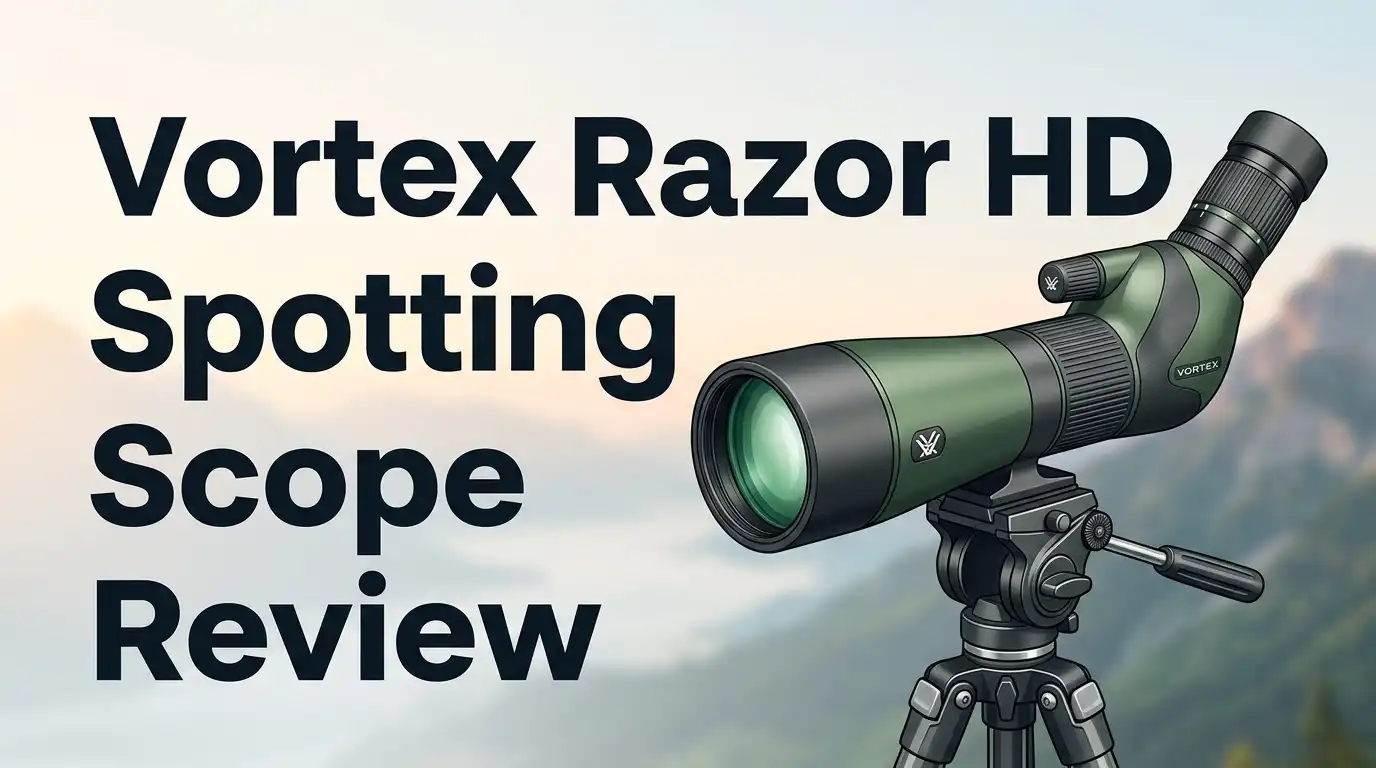
Vortex Razor HD Spotting Scope Review 2026: Worth Buying?
Long range glassing punishes cheap optics. You squint, the mirage boils, and the ram on the far ridge stays a brown blob.
The Vortex Razor HD spotting scope promises to fix that problem without Austrian pricing. It sits at the top of the Vortex spotting scope line, above the Viper HD and Diamondback HD, and it has become a default pick for western hunters and precision rifle shooters.
I spent time behind the Razor HD in real conditions: dawn glassing, midday heat shimmer, and dusty range days calling impacts at 1000 yards. This review covers the good glass, the sturdy build, and the parts that annoy owners.
In a Nutshell:
- Optical quality is the main reason to buy. The Razor HD uses a triplet apochromatic objective with high density extra low dispersion glass, XR Plus coatings, and dielectric prism coatings. Resolution is strong, images stay sharp near the edges, and chromatic aberration stays low in the center. The sweet spot lands near 44x on the 85mm model.
- The 85mm model starts at 27x, not 20x. Vortex shortened the zoom range to widen the apparent field of view. You gain a roomier view. You lose the very bright low power setting that many hunters use for scanning big basins.
- Eye relief is short at 16.7mm to 17mm. Most eyeglass wearers manage with the eyecup down, but people with thick lenses feel cramped. The optional long eye relief eyepiece gives 31mm, and it costs real money.
- Build quality is excellent. Rubber armor covers nearly the whole body, the sunshade slides smoothly, the rotating collar clicks every 45 degrees, and the body is argon purged and O ring sealed. The Arca Swiss compatible base mounts straight to a tripod head.
- The proprietary eyepiece mount is a genuine limitation. Razor HD eyepieces do not fit other Vortex spotters, and astronomy eyepieces do not fit at all. Your upgrade path is short and expensive.
- Value depends on the price you find. Street prices swing widely, so patient shoppers do far better. The unlimited lifetime VIP warranty adds real peace of mind.
Vortex Razor HD Spotting Scope: The 2026 Snapshot

Last update on 2026-07-25 / Affiliate links / Images from Amazon Product Advertising API Some of the links on this website are affiliate links, which means that at no additional cost to you, I earn a commission if you click through and make a purchase. I only recommend products and services that I believe will add value to my readers. Thank you for your support!
The Razor HD family covers four sizes now: an 85mm angled or straight body at 27x to 60x, a 65mm body at 22x to 48x, a 56mm compact at 13x to 39x, and a 50mm ultralight at 11x to 33x. The 85mm angled model remains the flagship and the one most reviewers test.
Core numbers for the 85mm version tell the story. Magnification runs 27x to 60x. The objective measures 85mm. Linear field of view spans 117 feet down to 68 feet at 1000 yards. Close focus sits at 16.4 feet. Length is 15.5 inches and weight is 65.6 ounces, or about 4.1 pounds. Eye relief measures 16.7mm to 17mm.
Vortex lists a high MSRP on the flagship, but real world pricing lands far lower, often in the 1400 to 1800 dollar band depending on dealer and season. Check current pricing before you commit, because this model gets discounted often.
Every unit ships with the zoom eyepiece already attached, and the whole body carries ArmorTek coatings on the exterior glass. The headline feature is the APO objective, which corrects color across the visible spectrum instead of just reducing purple fringing at high power. That single design choice explains most of the price gap over the Viper HD.
Unboxing the Razor HD: First Impressions
The box is plain and honest. Vortex does not spend your money on unboxing theater. Inside you find the spotting scope with the zoom eyepiece mounted, an ocular lens cover, an objective lens cover, a fitted neoprene view through cover, and a lens cloth. That is it.
The first thing you notice is density. The scope feels heavier than it looks because the chassis under the rubber is metal. The armor has a slightly rough texture that grabs your palm, which matters on a frosty morning when your hands are numb.
The neoprene cover deserves a mention. It stays on the scope while you glass, with flaps that fold back off the objective and the eyepiece. It protects the body from pack abrasion and muffles the metallic clink against rock. It is not a padded travel case, though. If you fly with your spotter, budget for a separate hard or padded case.
Pull the sunshade and you feel the tolerance quality right away. It slides out with even resistance and no rattle, revealing bare metal underneath. Twist the zoom ring and the action is firm and smooth without notches or gritty spots. Nothing about this scope feels like it was built to a budget, which is reassuring the first time you set it on a tripod in a river bottom.
Build Quality, Armor, and Weather Sealing
Vortex sealed this body properly. The tube is O ring sealed and argon purged, so it resists fogging across a wide temperature range and handles rain and snow without complaint. Argon migrates out of the housing slower than nitrogen, which is why premium spotters use it.
The rotating tripod collar is my favorite mechanical touch. Loosen the thumbscrew, rotate the body, and it clicks into a detent every 45 degrees. That lets you drop the eyepiece into a comfortable position when you glass from a sidehill or prone behind a rifle. The base is Arca Swiss compatible, so it clamps directly onto most modern tripod heads with no adapter plate.
Look inside the tube with a flashlight and you see careful blackening. Surfaces are matte and clean, with baffles dividing the barrel. One small criticism from bench testers is the lack of internal ribbing, which would kill stray reflections better than smooth flat black paint.
Field durability reports are mostly positive, though the internet holds a handful of threads about failures, including internal fogging and focus issues on older samples. Those stories almost always end the same way: Vortex repaired or replaced the scope free. The VIP warranty is unlimited, unconditional, lifetime, and transferable, which means a used Razor HD still carries full coverage.
Top 3 Alternative for Vortex Razor HD Spotting Scope

Last update on 2026-09-13 / Affiliate links / Images from Amazon Product Advertising API Some of the links on this website are affiliate links, which means that at no additional cost to you, I earn a commission if you click through and make a purchase. I only recommend products and services that I believe will add value to my readers. Thank you for your support!
Vortex Viper HD 20x to 60x 85mm Spotting Scope

Last update on 2026-09-13 / Affiliate links / Images from Amazon Product Advertising API Some of the links on this website are affiliate links, which means that at no additional cost to you, I earn a commission if you click through and make a purchase. I only recommend products and services that I believe will add value to my readers. Thank you for your support!
Athlon Optics Ares G2 UHD 20x to 60x 85mm Spotting Scope

Last update on 2026-09-13 / Affiliate links / Images from Amazon Product Advertising API Some of the links on this website are affiliate links, which means that at no additional cost to you, I earn a commission if you click through and make a purchase. I only recommend products and services that I believe will add value to my readers. Thank you for your support!
Maven CS.1 15x to 45x 65mm Spotting Scope
Optical Performance in Daylight and Low Light
Put your eye behind this scope and the image jumps out as bright and crisp. Testers consistently describe the Razor HD as sharp nearly to the edge of the field with good light transmission. Vapor trails, growth rings on a bull elk, and 22 caliber holes at 300 yards all resolve cleanly in decent light.
Chromatic aberration control is good but not flawless. Bench testing shows very low color fringing in the center of the field around the middle of the zoom range, with slightly more at 27x and 60x. Toward the field edge, fringing rises to moderate levels. The APO label sets a high bar, and the Razor HD gets close without reaching perfection.
Color rendering carries a faint magenta or cool bias according to some reviewers, and a side by side against a premium fixed eyepiece setup shows slightly more natural color from the fixed glass. Most users never notice.
Distortion is handled well. You see mild barrel curvature at 27x, almost nothing at mid power, and a touch of pincushion at 60x. Night testing shows near point like stars with low astigmatism and minimal brightness falloff at the edges. Coma appears in the outer 20 percent of the field and stays low to moderate. For the money, the optical package is hard to beat.
Magnification Range and Field of View
This section matters more than any other, because it drives the main complaint about the 85mm Razor HD. The zoom range starts at 27x. Older Vortex spotters and most rivals start near 20x. Vortex made that choice on purpose.
Shortening the zoom range let engineers widen the apparent field of view and correct it well from edge to edge. The result is an eyepiece with an apparent field around 60 degrees at low power, climbing toward 78 degrees at 60x. Those figures are genuinely impressive for a zoom eyepiece on a hunting spotter.
The tradeoff is real, though. Low magnification produces a bigger exit pupil and a brighter, calmer image, which is exactly what you want when you scan a mile wide basin at first light or when heat shimmer wrecks high power. Starting at 27x takes that option away.
The 65mm Razor HD handles this smarter. It runs 22x to 48x with the same field of view at 22x that the older 16x to 48x model gave at 16x. You see the same amount of country at a closer perspective.
Practical advice: if you scan wide country more than you inspect details, the shorter zoom range will bother you. If you call shots, judge antlers, or count points, the wide corrected field wins.
Eye Relief, Eyecup, and Comfort
Eye relief on the 85mm model measures 16.7mm at the low end of the zoom and 17mm at the top. That number is adequate but modest. The 65mm model does better, with roughly 18mm to 20mm depending on generation.
The eyecup is rubberized with a four position twist up design. Roll it down for eyeglasses and up for bare eye viewing. The adjustment holds position firmly and does not creep during use.
Glasses wearers report mixed results. Thin lens frames work fine and let you see the full field. Thick prescriptions or wraparound sunglasses cause blackouts at the field edge, which gets tiring during long glassing sessions. If you wear heavy glasses, try before you buy.
Vortex sells two extra eyepieces for the Razor HD that solve this. The long eye relief wide angle eyepiece delivers 31mm of eye relief with 22x magnification on the 85mm body, and the reticle eyepiece matches those specs while adding a ranging grid. Both cost several hundred dollars.
Eye placement forgiveness at 60x takes practice. You must center your pupil carefully or the image dims at the edges. That is normal physics at high power, not a defect, but new spotter users often mistake it for a problem with the scope.
Helical Focus: Smooth but Single Speed
The Razor HD uses a helical focus collar wrapped around the body between the objective and the prism housing. You rotate the whole ring instead of turning a knob. The ribbed rubber grip is wide, easy to find with gloves, and snag free when you slide the scope into a pack.
The action is smooth and well damped with no backlash. Travel from 16.4 feet to infinity takes about 450 degrees of rotation, which is less than the Viper HD needs despite covering a wider distance range.
Here is the honest criticism. A single speed helical collar is slower than a dual speed knob at 60x. At maximum power, the depth of field shrinks to almost nothing and you need tiny adjustments. Turning a large collar with your whole hand introduces vibration into the tube, and the image wobbles while you hunt for focus.
A small external knob with fine and coarse settings, like Kowa and Swarovski offer on some models, lets you focus with one fingertip and almost no shake. Vortex chose packability instead, and that is a defensible call for a hunting scope.
In practice you adapt. Set your magnification, rough focus, then make final adjustments with light fingertip pressure and pause a second for the image to settle. The system works well once your hands learn it.
Vortex Razor HD 65mm Spotting Scope: The Backpack Option

Last update on 2026-09-13 / Affiliate links / Images from Amazon Product Advertising API Some of the links on this website are affiliate links, which means that at no additional cost to you, I earn a commission if you click through and make a purchase. I only recommend products and services that I believe will add value to my readers. Thank you for your support!
Many backcountry hunters skip the 85mm entirely and run the 65mm instead. The math favors it. The 65mm angled body measures about 14.8 inches, weighs roughly 56.8 ounces, runs 22x to 48x, and shows 138 feet to 84 feet of field at 1000 yards.
That is roughly half a pound lighter than the 85mm with a shorter tube, which matters when you carry it 15 miles into a wilderness unit. You give up light gathering and top end magnification, and the 26.2 foot close focus is worse than the 85mm model.
The redesign brought real changes. The helical focus replaced the old external wheel, rubber armor now covers nearly the entire body instead of the old bare metal finish, and the eyepiece diameter grew. Field testers who compared the new version against the old one reported no meaningful improvement in glass quality, only in ergonomics and durability.
The larger eyepiece created one practical headache. Older phone adapters built for the previous Razor eyepiece do not fit the current one, so digiscoping users must buy a new adapter ring.
For most western hunting, 48x is plenty. Heat shimmer usually destroys usable image quality above 45x anyway, especially after 9 in the morning. The 65mm gives you nearly all the practical performance at a lower weight and a lower price.
Eyepieces and the Proprietary Mount
This is the part of the Razor HD that frustrates optics enthusiasts the most. The eyepiece attaches with a bayonet fitting unique to the Razor HD line. It does not accept eyepieces from the Viper HD or Diamondback HD. It does not accept 1.25 inch astronomy eyepieces either.
Vortex offers exactly two alternatives: the long eye relief wide angle eyepiece and the reticle eyepiece. Both provide 22x on the 85mm body with 31mm of eye relief. Both cost roughly 400 to 500 dollars. Strangely, the reticle eyepiece does not fit the 65mm body at all.
Think about what that means. You own an 85mm apochromatic objective capable of supporting 80x to 100x magnification with good eyepieces. The system caps you at 60x because no compatible high power eyepiece exists.
Compare that to an astronomy style spotter with a standard eyepiece thread, where a 40 dollar Plossl adds a bright wide low power view and a 150 dollar wide angle eyepiece pushes resolution further. That flexibility simply does not exist here.
The reticle eyepiece does earn its keep for precision shooters. It lets a spotter call wind corrections in mils or MOA without a rangefinder calculation. If you shoot competition, budget for it from day one.
Field Testing for Hunting and Long Range Shooting
On the range, the Razor HD earns its name. Paired with a stable tripod, testers called impacts and estimated corrections at distances from 100 yards out to a full mile. Bullet trace shows up clearly in the wide corrected field, which is the main job a spotter does at a precision rifle match.
On the mountain, the story is about time saved. Glassing a north facing slope at 40x for an hour reveals bedded deer that binoculars miss entirely. Antler mass and tine length become judgeable rather than guessable, which keeps you from burning a day on a hike to a two point.
Low light behavior is strong thanks to the 85mm objective and XR Plus coatings. Usable images hold up roughly 15 to 20 minutes longer at dusk than with a 65mm spotter, which lines up with the last legal shooting light.
Mirage remains the boss. Over baking sagebrush at midday, you will dial back to 30x or 35x because 60x turns into soup. No spotter beats physics, and this is where a lower starting magnification would help.
Rain and snow caused no fogging or seal issues in testing. The sunshade meaningfully cuts veiling glare when the sun sits low and off axis. The scope performs like premium gear in hard weather.
Digiscoping, Weight, and Tripod Needs
Phone photography through the Razor HD works well because the eye relief is consistent and the eyecup gives a stable platform for an adapter. Image quality at 30x to 40x is good enough to text a photo of a bull to your hunting partner and get a real opinion on size.
Two cautions apply. Confirm your adapter matches the current eyepiece diameter, since the redesign broke compatibility with older rings. Also expect vignetting at the low end of the zoom, which usually clears up as you increase magnification.
Weight planning matters. The 85mm model runs 4.1 pounds, the 65mm about 3.55 pounds. Add a tripod and head and you are carrying 6 to 9 pounds of glassing kit.
Do not cheap out on the tripod. A wobbly support ruins the optical advantage you paid for, especially above 40x. Look for an aluminum or carbon fiber tripod rated well above the scope weight with a smooth pan and tilt head. The Arca Swiss compatible base saves you from stacking adapter plates, which removes a flex point.
For truck and blind use, a window mount works nicely and costs little. Budget the support system as part of the purchase, not as an afterthought.
What the Razor HD Does Not Do Well
Authentic reviews name the weak spots, so here they are without softening.
The 85mm zoom starting at 27x remains the biggest design compromise. You lose the bright wide scanning view that a 20x setting provides, and Vortex charges extra for the eyepiece that restores it.
Eye relief of 16.7mm to 17mm is short for a flagship. Heavy eyeglass wearers will feel the field shrink.
The proprietary eyepiece mount locks you into two expensive Vortex options. No third party path exists.
Single speed helical focus is slower and shakier at 60x than a dual speed external knob.
Close focus of 16.4 feet on the 85mm and 26.2 feet on the 65mm makes this a poor choice for butterfly watchers, insect photographers, or backyard birding at a feeder.
Optically, chromatic aberration climbs to moderate levels at the field edge, coma appears in the outer fifth of the field, and color rendering shows a slight cool bias. Internal tube surfaces lack ribbing.
It also does not beat the best European glass. Against a top Swarovski or Kowa, the Razor HD gives up a visible margin in edge sharpness and color neutrality. It is a superb value scope, not a giant killer.
Pros and Cons of the Vortex Razor HD
Pros
- Apochromatic triplet objective with HD extra low dispersion glass delivers bright, high resolution images with low center field color fringing and good sharpness toward the edges.
- Wide, well corrected apparent field of view from the included zoom eyepiece, reaching around 78 degrees at high power, which beats the Viper HD by a clear margin.
- Excellent mechanical build with full rubber armor, a smooth retractable sunshade, and a rotating collar that clicks every 45 degrees for comfortable viewing angles.
- Fully sealed and argon purged body that shrugs off rain, snow, and temperature swings without fogging.
- Arca Swiss compatible base mounts directly to modern tripod heads with no extra plate, which removes weight and flex.
- Unlimited, unconditional, lifetime VIP warranty that transfers to future owners, so used purchases stay protected.
- Frequent real world discounts put flagship optical quality well below European pricing.
Cons
- Zoom starts at 27x on the 85mm model, removing the bright low power scanning view that many hunters want.
- Short eye relief at 16.7mm to 17mm cramps the view for people with thick eyeglass lenses.
- Proprietary eyepiece mount blocks third party and other Vortex eyepieces, leaving two costly official options.
- Single speed helical focus introduces vibration and slows precise focusing at maximum magnification.
- Long close focus distance rules it out for close range nature study.
- Moderate edge chromatic aberration and coma, plus a faint cool color bias.
- No padded travel case included, only a neoprene view through cover.
Price, Warranty, and Value in 2026
Pricing on this line moves constantly. Vortex lists a high MSRP on the current 85mm angled model, yet dealers routinely sell it in the 1400 to 1800 dollar range, and the 65mm often lands near 1300 dollars. Patience pays here. Watch authorized dealers through late summer and post season clearance windows.
Value comparisons make the case clearly. The Viper HD 85mm sells for roughly 900 dollars and delivers very good glass with a narrower field of view and weaker color correction. The Razor HD costs several hundred more and gives you the APO objective, a wider corrected field, lighter weight, and a much closer minimum focus.
Owners who compared both side by side usually describe the Razor HD as noticeably brighter with better contrast, especially in the final minutes of legal light. Whether that gap justifies the price depends on how often you glass in marginal light.
The warranty deserves weight in the value math. Unlimited, unconditional, lifetime coverage that transfers between owners is rare in optics. Drop the scope off a cliff and Vortex repairs or replaces it. That policy does not cover loss or theft, but it covers nearly everything else.
Against premium European spotters costing two to four times more, the Razor HD captures most of the performance for a fraction of the money.
Who Should Buy It and Who Should Skip It
Buy the Razor HD if you hunt western country, judge animals at distance, or call shots at a precision rifle match. The wide corrected field, strong resolution, and sealed build suit those jobs perfectly. Choose the 85mm for maximum reach and low light performance. Choose the 65mm if pack weight drives your decisions.
Skip it if you scan huge areas at low power and refuse to buy a second eyepiece. Skip it if you wear heavy prescription glasses and cannot try one first. Skip it if you watch birds at close range in a garden, because the close focus distance defeats you.
Serious birders should look elsewhere too. The proprietary eyepiece system and shorter zoom range fit hunting better than birding, where wide low power views and interchangeable eyepieces matter more.
Budget shoppers have honest alternatives. The Viper HD 85mm saves several hundred dollars with a modest optical penalty. The Athlon Ares G2 UHD competes hard near 900 dollars. The Maven CS.1 65mm offers strong glass in a compact package.
My verdict: the Vortex Razor HD remains one of the best value flagship spotting scopes you can buy in 2026, provided you accept the 27x starting point and the closed eyepiece ecosystem. Buy it on sale, pair it with a solid tripod, and it will outlast your hunting career.
FAQs
Is the Vortex Razor HD worth the upgrade over the Viper HD?
It depends on your use. The Razor HD gives a wider corrected field of view, better color correction from its apochromatic objective, lighter weight, and closer minimum focus. Side by side, most users see brighter images with better contrast in low light. If you glass at dawn and dusk regularly, the upgrade shows. If you mostly glass in good light at moderate power, the Viper HD saves several hundred dollars with a small performance penalty.
Which size Razor HD should I buy?
Choose the 85mm at 27x to 60x for maximum reach, brightness, and low light performance when weight is not critical. Choose the 65mm at 22x to 48x for backcountry hunts, since it saves about half a pound and shortens the tube. The 56mm and 50mm compacts suit ultralight setups where packability beats optical power. Most western hunters land on the 65mm.
Does the Razor HD work for eyeglass wearers?
Partly. Eye relief of 16.7mm to 17mm on the 85mm model works for thin frames but feels tight with thick prescriptions. The multi position eyecup rolls down to help. If you need more room, the optional long eye relief eyepiece delivers 31mm at 22x, though it costs several hundred dollars.
Can I use other eyepieces with the Razor HD?
No. The Razor HD uses a proprietary bayonet mount that rejects astronomy eyepieces, third party eyepieces, and eyepieces from other Vortex spotting scope lines. Vortex sells two compatible options: a long eye relief wide angle eyepiece and a reticle eyepiece. The reticle version does not fit the 65mm body.
What tripod do I need for a Razor HD?
Pick a tripod rated well above the scope weight with a smooth pan and tilt head. Above 40x, any wobble ruins the image. The Arca Swiss compatible base mounts directly to most modern heads without an adapter plate. Aluminum works for truck and range use, while carbon fiber saves weight on long hikes.
Does the Vortex warranty really cover everything?
The VIP warranty is unlimited, unconditional, lifetime, and transferable. Vortex repairs or replaces a damaged or defective scope with no proof of purchase required. It excludes loss, theft, deliberate damage, and cosmetic damage that does not affect performance. Owners who reported fogging or focus failures consistently got their scopes fixed or replaced free.
Is the Razor HD good for digiscoping?
Yes, with the right adapter. Consistent eye relief and a stable eyecup make phone photography straightforward, and results at 30x to 40x look good. Confirm your adapter matches the current eyepiece diameter, because the redesigned eyepiece is larger than the older version and breaks compatibility with legacy rings.

Hello, I’m Emily Price, the founder of Birds Affection. As a passionate bird enthusiast and spiritual seeker, I’ve always been fascinated by the symbolic meanings and mystical connections between birds and our lives. On this website, I share my knowledge and insights on the spiritual significance of various bird species, exploring their roles as messengers, guides, and teachers. Through my writing, I aim to inspire and educate others on the profound wisdom and beauty that birds bring to our world. Join me on this journey as we delve into the enchanting realm of bird symbolism and discover the hidden meanings behind these magnificent creatures.