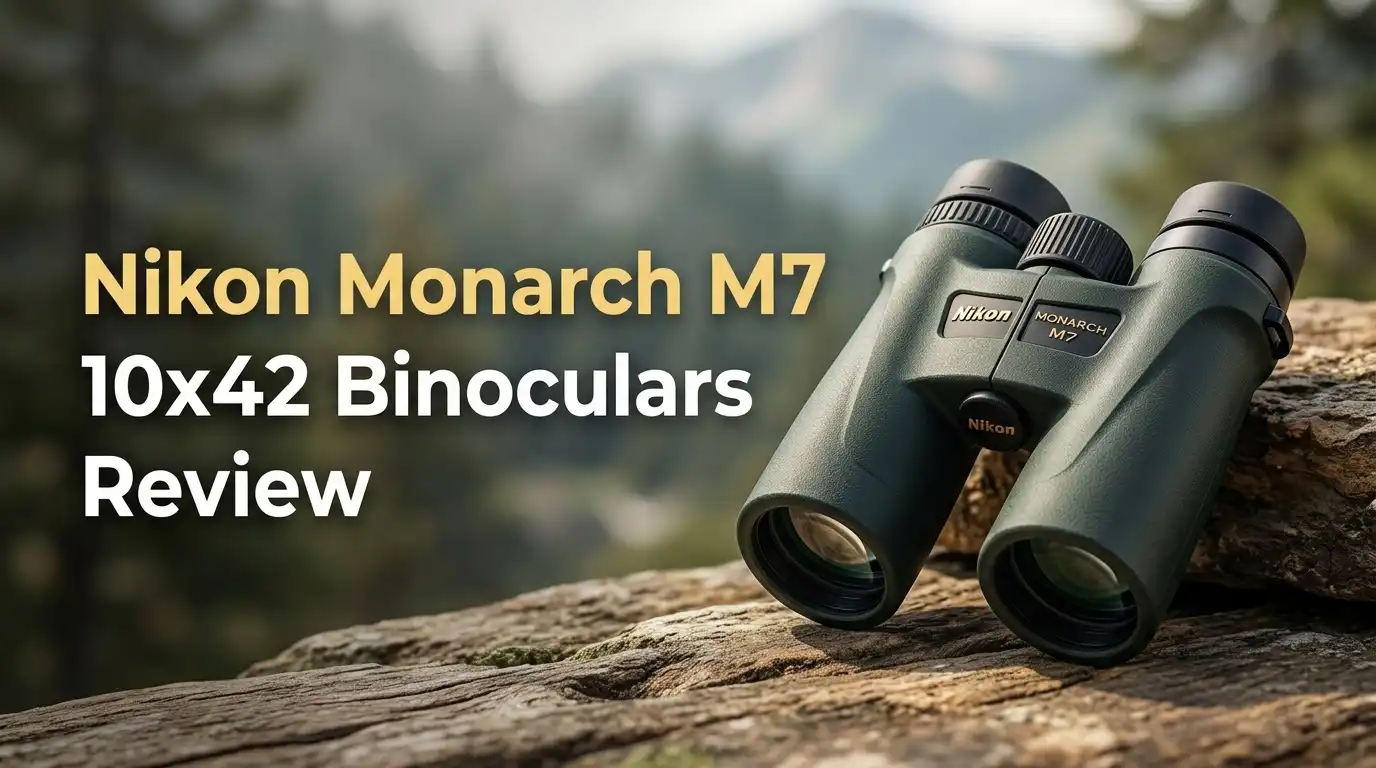
Nikon Monarch M7 10×42 Binoculars Review 2026: Still Worth It?
Choosing a pair of binoculars feels harder every year. Prices climb, brands make bold claims, and the glass all looks the same in photos.
The Nikon Monarch M7 10×42 sits right in that confusing middle ground between budget optics and premium European glass. It promises ED glass, a locking diopter, and a view that punches above its price. Does it deliver in 2026? I spent weeks with this pair in forests, fields, and backyards.
This review covers the good, the frustrating, and the honest limits of these binoculars. No fluff, no marketing speak, just what you actually see when you lift them to your eyes.
In a Nutshell:
- Optical clarity is the star. The ED glass and dielectric prism coatings deliver sharp, color accurate views with very little fringing around high contrast edges. Independent testing scored its clarity above the Vortex Viper HD in side by side comparisons.
- The field of view is narrow for a 10×42. You get 362 feet at 1,000 yards. Several rivals push past 390 feet. Tracking fast moving warblers takes more patience with this pair.
- Adjustment quality is excellent. The locking diopter stops accidental changes, and the focus wheel moves smoothly from close to infinity with roughly one and a half turns.
- Close focus beats the spec sheet. Nikon claims 8.2 feet. Real world testing reached about 5.8 feet, which makes butterflies and dragonflies genuinely viewable.
- Weight sits at 24 ounces. That is light for a full size 42mm roof prism binocular, and the balance makes it feel even lighter in hand.
- Brightness is good but not class leading. The 4.2mm exit pupil limits dusk performance compared to 8×42 models.
What Is the Nikon Monarch M7 10×42?


Last update on 2026-10-26 / Affiliate links / Images from Amazon Product Advertising API Some of the links on this website are affiliate links, which means that at no additional cost to you, I earn a commission if you click through and make a purchase. I only recommend products and services that I believe will add value to my readers. Thank you for your support!
The Monarch M7 is Nikon’s upper midrange roof prism binocular. It replaced the much loved Monarch 7 line and slots between the affordable M5 and the premium Monarch HG. The 10×42 version gives you ten times magnification through 42mm objective lenses. That combination suits open country, hunting, and distance work.
Nikon builds the body from fiberglass reinforced polycarbonate resin. This keeps weight down without making the housing feel cheap. Rubber armor wraps the entire chassis. Inside, you get extra low dispersion glass, phase correction coated prisms, and dielectric high reflective coatings on every prism surface.
The M7 targets birders, hunters, and hikers who want serious optical quality without spending thousands. It occupies the sweet spot where performance gains start costing real money. Street prices hover near the $450 to $550 range depending on sales.
Unboxing Experience: What Arrives in the Box
Nikon keeps packaging simple. The box is clean white and green cardboard with a product photo on the front. Nothing flashy. Open it and the binoculars sit in a molded tray with a soft carrying case beside them.
The first thing you notice is the neck strap. It is thick, padded, and genuinely soft against skin. Many brands cheap out here. Nikon did not. You also get flip down objective lens caps that stay attached to the barrels, a rainguard for the eyepieces, a nylon case with a shoulder strap, and the instruction booklet with warranty paperwork.
Lifting the binoculars out, the rubber armor feels grippy rather than tacky. The finish is matte black with subtle texture. First impressions are solidly premium without being showy. Assembly takes under two minutes. Attach the strap, clip the caps, adjust the barrels, and you are glassing.
Full Specifications Breakdown
Numbers tell part of the story. Here is what Nikon lists for the 10×42 model.
Magnification sits at 10x with 42mm objective lenses. The real angular field of view measures 6.9 degrees, which translates to 121 meters at 1,000 meters or 362 feet at 1,000 yards. Apparent field of view reaches 62.2 degrees, a respectable figure calculated under the ISO 14132 standard.
Exit pupil measures 4.2mm. Relative brightness comes in at 17.6. Eye relief is listed at 16.5mm, though testing often measures closer to 17mm. Close focusing distance officially stands at 2.5 meters or 8.2 feet.
The body measures 142mm long, 130mm wide, and 57mm deep. Weight is 680 grams or 24 ounces. Interpupillary adjustment spans 56mm to 72mm. Waterproofing holds to 1 meter for 10 minutes, and nitrogen purging prevents internal fogging.
Optical Clarity and Sharpness
This is where the M7 earns its reputation. The ED glass genuinely works. Point these at a dark branch against bright sky, the classic chromatic aberration test, and color fringing stays remarkably controlled. You see a faint hint at the extreme edges and almost nothing in the center.
Resolution across the central seventy percent of the image is excellent. Feather detail on a chickadee at thirty yards resolves cleanly. Bark texture on distant trees stays crisp. The phase correction coating on the roof prisms is doing real work here.
Edge sharpness softens noticeably in the outer fifteen percent of the view. This is normal at this price. Premium alpha glass holds sharpness further out. For the money, the M7 delivers clarity that embarrasses binoculars costing significantly more. Independent testing rated its clarity higher than the Vortex Viper HD, which is a meaningful win.
Top 3 Alternative for Nikon Monarch M7 10×42

Last update on 2026-10-26 / Affiliate links / Images from Amazon Product Advertising API Some of the links on this website are affiliate links, which means that at no additional cost to you, I earn a commission if you click through and make a purchase. I only recommend products and services that I believe will add value to my readers. Thank you for your support!
Vortex Viper HD 10×42 Binoculars

Last update on 2026-08-28 / Affiliate links / Images from Amazon Product Advertising API Some of the links on this website are affiliate links, which means that at no additional cost to you, I earn a commission if you click through and make a purchase. I only recommend products and services that I believe will add value to my readers. Thank you for your support!
Athlon Optics Midas G2 UHD 10×42 Binoculars

Last update on 2026-07-11 / Affiliate links / Images from Amazon Product Advertising API Some of the links on this website are affiliate links, which means that at no additional cost to you, I earn a commission if you click through and make a purchase. I only recommend products and services that I believe will add value to my readers. Thank you for your support!
Nikon Monarch M5 10×42 Binoculars
Brightness and Low Light Performance
Brightness is the M7’s most debated trait. The dielectric prism coatings and fully multicoated lenses transmit light efficiently. Daytime views look bright and natural with neutral color rendering. Nikon avoids the warm yellow cast some brands add to fake warmth.
Low light is more complicated. The 4.2mm exit pupil is the limiting factor. As your pupils dilate at dusk, they grow wider than the light column the binoculars deliver. Controlled lux testing measured around 1,064 lux, which trailed several competitors in the same price tier.
Practically, you get solid performance until roughly twenty minutes before full dark. After that, an 8×42 pulls ahead clearly. If you hunt the last light of legal shooting hours, the 8×42 M7 is the smarter choice. Shadow detail also renders darker than some rivals, giving images extra contrast that some viewers love and others find heavy.
Field of View: The Honest Weak Point
Let me be direct. The field of view is the M7 10×42’s biggest compromise. You get 362 feet at 1,000 yards. The Vortex Viper HD 8×42 delivers 409 feet. Even budget models like the Vortex Diamondback HD reach 393 feet.
In practice this means finding small moving birds takes longer. You lift the binoculars, scan, and sometimes miss the target entirely before it flits away. Experienced birders develop the muscle memory to compensate. Beginners will feel the difference.
It is worth noting the 8×42 M7 is genuinely wide at 435 feet. The 10x version trades that width for reach. This is a physics tradeoff, not a design flaw, but shoppers should understand it before buying. You do not get tunnel vision. The view stays immersive thanks to the 62.2 degree apparent field. It simply is not generous.
Build Quality and Weather Resistance
The M7 survives real weather. O ring seals and nitrogen gas filling make it waterproof to one meter for ten minutes and completely fogproof across temperature swings. I used mine in steady rain and heavy humidity with zero internal condensation.
The polycarbonate chassis resists impacts well. Rubber armor covers everything, providing shock absorption and a confident grip even with wet hands. The hinge holds its position firmly. There is no drift once you set your interpupillary distance.
A detail many reviews skip is the oil and water repellent coating on the objective and eyepiece lenses. Fingerprints and raindrops wipe away with a single pass. This matters more than it sounds during an active day outdoors.
Nikon backs the M7 with a limited lifetime warranty in the United States, which adds real value against brands offering shorter coverage.
Focus Wheel and Locking Diopter
The focusing system deserves specific praise. The central focus wheel is large, ribbed, and moves with just the right resistance. No stiffness, no slop, no backlash. Going from a bird at twenty feet to a ridgeline a mile away takes about one and a half rotations.
The standout feature is the locking diopter ring. You pull it up, set your right eye correction, then push it down to lock. It stays locked. Anyone who has lost their diopter setting mid hunt will appreciate this immediately.
Eyecups twist and slide with firm multiclick detents. They hold position reliably. Eyeglass wearers get genuine comfort here thanks to roughly 17mm of usable eye relief.
One honest criticism: people with smaller hands report their fingers catch the side of the focus knob rather than the top. Leverage suffers slightly, though the mechanism is smooth enough that it rarely matters.
Close Focus Performance
Here the M7 overdelivers. Nikon rates close focus at 8.2 feet. Measured testing reached roughly 5.8 feet, nearly two full feet better than the official claim.
That matters more than you might expect. A 10x binocular that focuses under six feet becomes a portable microscope for the natural world. Butterflies on flowers, dragonflies on reeds, spiders on webs, all become viewable in stunning detail.
Birders visiting aviaries and families at zoos benefit directly. The combination of 10x magnification and close focus produces images that feel almost three dimensional.
Among 10x binoculars, this close focus ranks near the top of the category. It is one of the quieter reasons owners keep recommending the M7 years after release. Few competitors at any price combine this reach with this intimacy.
Comfort During Extended Use
Twenty four ounces sounds heavy on paper. In hand, the M7 feels lighter because the weight distributes evenly between the barrels. The thumb indents on the underside guide your hands into a natural hold.
The included neck strap genuinely helps. It is wide and padded, spreading load across your neck rather than cutting into it. After three hours of continuous birding, fatigue was noticeable but manageable.
Users with larger hands report the most comfort. Smaller hands may find the barrel spacing slightly wide, though the 56mm minimum interpupillary distance accommodates narrow faces fine.
A harness instead of the neck strap transforms all day comfort, and I recommend one for anyone glassing more than a few hours. For hiking, the M7 rides well against the chest without excessive bounce.
What the Monarch M7 Does Not Do Well
Honest reviews name the flaws. Here are the M7 10×42’s real shortcomings.
The narrow field of view is the headline weakness. If you chase fast songbirds in dense cover, this pair will frustrate you. Edge softness in the outer region is visible when you look for it.
Low light brightness trails competitors. The measured lux reading placed it behind several rivals at similar prices. The deep shadow contrast can hide detail in dark undergrowth.
The included carrying case is forgettable. It is thin nylon with minimal padding. Most owners replace it. The rainguard fits loosely and falls off during active hiking.
There is no tripod adapter included, and the optional Nikon adapter costs extra. Finally, Nikon’s international warranty coverage varies by region, so gray market units may leave you unprotected.
Pros and Cons
Pros
- Outstanding clarity with effective ED glass and minimal chromatic aberration
- Locking diopter prevents accidental setting changes in the field
- Exceptional close focus near 5.8 feet, far better than the stated spec
- Smooth, fast focus wheel with no backlash
- Light 24 ounce weight with excellent balance
- Generous 17mm eye relief suits eyeglass wearers
- Waterproof and fogproof construction that handles real weather
- Soft, well padded neck strap included
- Limited lifetime warranty in the United States
Cons
- Narrow 362 foot field of view for a 10×42 binocular
- Brightness trails rivals in the same price bracket
- Noticeable edge softness in the outer image region
- Small hands struggle slightly with focus wheel leverage
- Basic carrying case and loose fitting rainguard
- Tripod adapter sold separately
- Deep shadows can obscure detail in low contrast scenes
Monarch M7 Versus M5 and Monarch HG
Nikon’s lineup can confuse shoppers. The M5 10×42 costs roughly $150 less. It uses ED glass too, but with a significantly narrower field of view near 98 meters at 1,000 meters. Edge clarity, chromatic aberration control, and light transmission all favor the M7.
The M5 lacks the locking diopter and the oil repellent lens coating. Its sweet spot is smaller. For most buyers, the M7 upgrade is worth the money.
Above the M7 sits the Monarch HG, priced around twice as much. The HG uses a magnesium alloy body, wider field of view, and field flattener lenses for edge to edge sharpness. The difference is real but subtle.
The M7 captures roughly eighty five percent of HG performance at half the price. That ratio explains why it remains Nikon’s value champion in 2026.
Who Should Buy the Nikon Monarch M7 10×42?
This pair suits specific users well. Hunters glassing open country benefit most from the 10x reach and excellent clarity. Western hunters scanning distant ridgelines will appreciate the detail resolution.
Birders who watch water, fields, and open habitat get strong value. Shorebirds, raptors, and waterfowl are perfect targets for 10x magnification.
Travelers and hikers find the 24 ounce weight manageable for all day carry. Stargazers get surprisingly good views of the moon and bright clusters, though a tripod helps at 10x.
Skip the M7 10×42 if you primarily watch forest songbirds, hunt in deep timber, or need maximum dusk brightness. In those cases the 8×42 version serves you better with its wider 435 foot view and brighter 5.3mm exit pupil. Shaky hands also favor 8x over 10x.
Final Verdict: Is It Worth Buying in 2026?
Yes, with clear conditions attached. The Nikon Monarch M7 10×42 remains one of the best optical values in the $450 to $550 range. The clarity, build quality, and adjustment refinement feel genuinely premium.
The narrow field of view is a real limitation, and buyers should accept it knowingly rather than discover it later. Low light performance is good, not great.
What you get is a binocular that shows you more detail than its price suggests, survives bad weather, and stays comfortable through long sessions. The locking diopter and close focus are features you will use constantly.
Buy the 10×42 for open country and distance work. Buy the 8×42 for forests, dusk, and general birding. Either way, the M7 line continues earning its reputation five years after launch.
Frequently Asked Questions
Is the Nikon Monarch M7 waterproof?
Yes. The M7 is waterproof to one meter for ten minutes using O ring seals. Nitrogen gas filling prevents internal fogging across temperature changes. Rain, snow, and humidity pose no problem. Note that waterproof does not mean submersible for extended periods.
Does the Monarch M7 10×42 work for eyeglass wearers?
Yes, very well. Eye relief measures around 17mm, which is generous. The twist and slide eyecups retract fully with firm click stops. Most eyeglass wearers see the full field with eyecups fully down and report no blackout issues.
Can the Monarch M7 attach to a tripod?
Yes, but you need the optional Nikon TRA-3 tripod adapter or the Adaptor H hard type. Neither comes in the box. At 10x magnification, a tripod noticeably improves steadiness for extended observation and astronomy.
How does the M7 compare to the Vortex Viper HD?
The M7 scores higher on clarity, ease of adjustment, and close focus. The Viper HD wins on brightness and field of view. Vortex offers an unconditional lifetime warranty covering accidental damage, while Nikon’s covers defects.
Is 10×42 or 8×42 better for birdwatching?
The 8×42 suits most birders better. It offers a wider field of view, a brighter 5.3mm exit pupil, and steadier handheld images. Choose 10×42 only if you watch open habitats where extra reach matters more than width.
What is the warranty on the Nikon Monarch M7?
Nikon provides a limited lifetime warranty on Monarch binoculars purchased in the United States, covering defects in materials and workmanship. Coverage varies internationally. Always buy from authorized dealers to keep your warranty valid.

Hello, I’m Emily Price, the founder of Birds Affection. As a passionate bird enthusiast and spiritual seeker, I’ve always been fascinated by the symbolic meanings and mystical connections between birds and our lives. On this website, I share my knowledge and insights on the spiritual significance of various bird species, exploring their roles as messengers, guides, and teachers. Through my writing, I aim to inspire and educate others on the profound wisdom and beauty that birds bring to our world. Join me on this journey as we delve into the enchanting realm of bird symbolism and discover the hidden meanings behind these magnificent creatures.