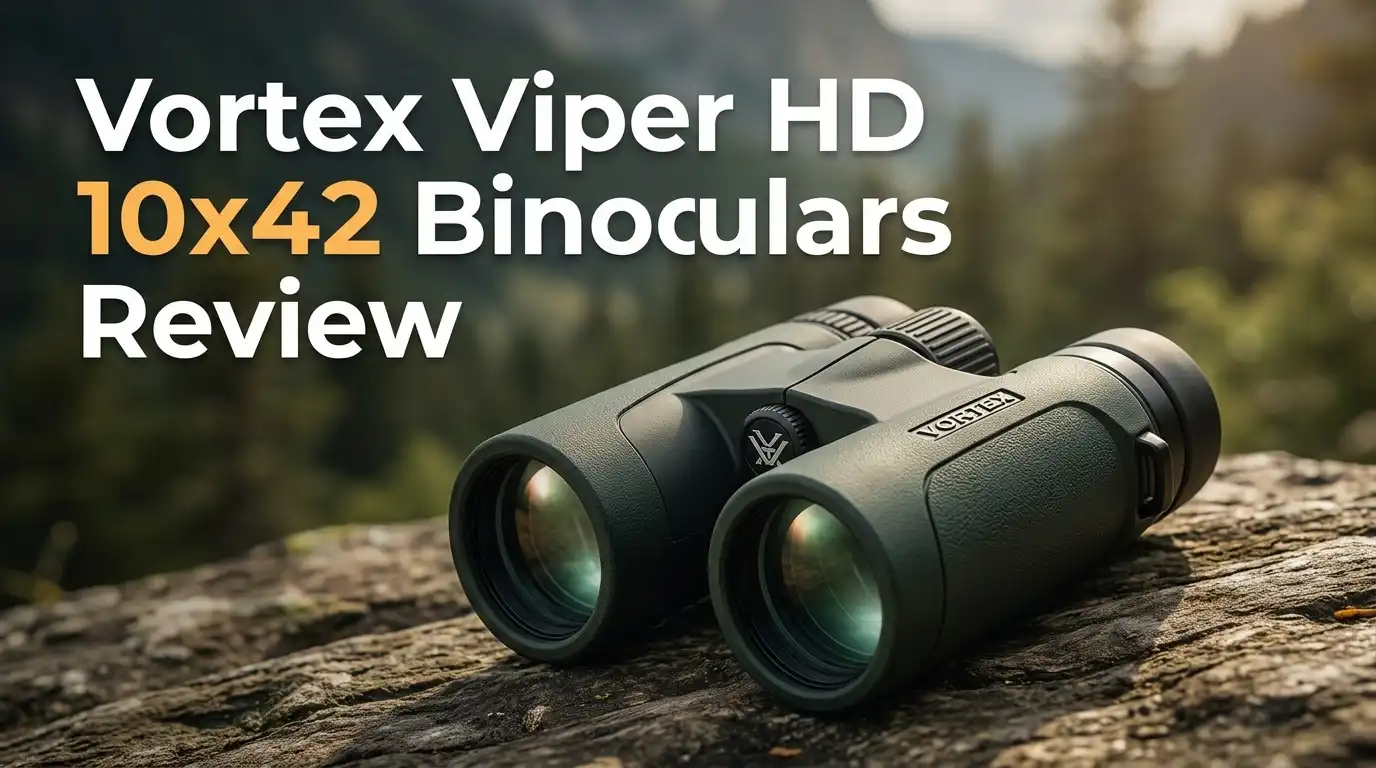
Vortex Viper HD 10×42 Binoculars Review 2026: Still Worth It?
Good glass changes everything. A deer at 500 yards becomes a deer instead of a brown smudge. A warbler in a shadowy canopy becomes a species you can actually name.
The Vortex Viper HD 10×42 has sat in that sweet middle spot of the binocular market for years, and plenty of hunters and birders still call it the smartest money they ever spent on optics.
But 2026 is a crowded year for binoculars. Nikon, Athlon, Leupold, and Maven all sell strong 10×42 models in the same price window. So the real question is simple. Does the Viper HD still earn its price tag, or has the competition finally passed it?
In a Nutshell:
- The glass is the main reason to buy. HD extra low dispersion elements and XR multi coatings produce sharp, neutral color images with very little purple fringing along bright edges. Center sharpness is the standout feature.
- Low light performance punches above the price. Dielectric prism coatings and phase correction keep the image usable through most of legal shooting light at dawn and dusk.
- Durability is excellent. The rubber armored chassis, nitrogen purge, and sealed body survive rain, cold, and drops without fogging or loosening.
- Weight is the biggest complaint. At roughly 24.9 ounces, this is a heavy 10×42. You feel it by hour six on a neck strap.
- The field of view is average, not wide. You get 341 feet at 1000 yards, which trails several rivals and makes fast scanning slightly slower.
- The VIP warranty is unconditional and transferable. No receipt. No registration. That safety net adds real long term value and keeps resale prices strong.
Vortex Viper HD 10×42 Binoculars

Last update on 2026-10-26 / Affiliate links / Images from Amazon Product Advertising API Some of the links on this website are affiliate links, which means that at no additional cost to you, I earn a commission if you click through and make a purchase. I only recommend products and services that I believe will add value to my readers. Thank you for your support!
The Viper HD sits one full step above the Diamondback HD and one step below the Razor UHD in the Vortex lineup. That middle position shapes everything about it. Vortex spent the budget on glass and coatings rather than on shaving ounces or adding luxury accessories.
The build uses a magnesium and aluminum chassis wrapped in textured rubber armor. The roof prisms carry dielectric and phase correction coatings. The exterior lenses use ArmorTek, a hard coating that resists scratches, oil, and dirt.
This is a working binocular, not a showpiece. It feels dense in the hands, slightly front heavy, and completely solid. Nothing rattles. Nothing flexes. That reassuring heft is both the best and the worst thing about the Viper HD, depending on how far you plan to walk with it.
Unboxing Experience: What Arrives in the Box
The box is plain and compact. No glossy marketing imagery, no plastic clamshell, just a simple carton with the binoculars nested in foam. Opening it takes about ten seconds.
Inside you get the binoculars, a GlassPak chest harness case, a neck strap, tethered objective lens covers, a rainguard eyepiece cover, a microfiber cloth, and the warranty card.
The GlassPak is the pleasant surprise. Most brands at this price hand you a floppy nylon pouch. Vortex includes a semi rigid chest case that clips on with four adjustable straps and keeps the binoculars flat against your sternum. It solves the weight problem before you even notice there is one.
First impressions on the glass itself are strong. Hold them up to a window and the image snaps into focus with a clarity that cheaper binoculars simply do not deliver.
Key Specifications Explained Simply
Numbers alone mean little, so here is what each one actually does for you in the field.
Magnification is 10x and the objective lenses are 42mm. That combination gives a 4.2mm exit pupil, which is the width of the light beam reaching your eye. Larger exit pupils help in dim conditions.
Eye relief measures 17mm. That is generous and comfortable for eyeglass wearers. Linear field of view is 341 feet at 1000 yards, or 6.5 degrees. Close focus is roughly 6 feet. Weight is 24.9 ounces, height is 5.6 inches, and width is 4.9 inches. Interpupillary distance adjusts from 55mm to 74mm, which covers almost every adult face.
Translation: bright, comfortable, average width, and noticeably heavy.
Top 3 Alternatives for Vortex Viper HD 10×42

Last update on 2026-07-01 / Affiliate links / Images from Amazon Product Advertising API Some of the links on this website are affiliate links, which means that at no additional cost to you, I earn a commission if you click through and make a purchase. I only recommend products and services that I believe will add value to my readers. Thank you for your support!
Vortex Diamondback HD 10×42 Binoculars


Last update on 2026-07-11 / Affiliate links / Images from Amazon Product Advertising API Some of the links on this website are affiliate links, which means that at no additional cost to you, I earn a commission if you click through and make a purchase. I only recommend products and services that I believe will add value to my readers. Thank you for your support!
Nikon Monarch M5 10×42 Binoculars

Last update on 2026-08-28 / Affiliate links / Images from Amazon Product Advertising API Some of the links on this website are affiliate links, which means that at no additional cost to you, I earn a commission if you click through and make a purchase. I only recommend products and services that I believe will add value to my readers. Thank you for your support!
Athlon Optics Midas G2 UHD 10×42 Binoculars
Optical Performance and Image Quality
This is where the Viper HD earns its reputation. Point it at a distant ridgeline and the center of the image is crisp, bright, and honest in color. There is no green cast, no yellow warmth, and no washed out haze that cheaper glass throws at you in flat light.
Chromatic aberration is well controlled. Scan a bare branch against a white sky, the classic torture test, and you see only a faint color edge rather than an obvious purple halo.
The weak spot is the outer edge. Roughly the outer 15 percent of the image softens slightly. Most users never notice this because the eye naturally reads the center, but birders who scan across the full field will see it.
Overall, the optical quality lands close to binoculars costing considerably more.
Low Light Performance at Dawn and Dusk
Animals move in the last twenty minutes of light. That is when binoculars prove their worth, and the Viper HD holds up well.
The dielectric prism coatings reflect a very high percentage of light back to your eye. Combined with the 4.2mm exit pupil, the image stays usable far longer than the price class suggests. You can still separate antler from branch when the naked eye has given up.
There is a limit. High end European glass stretches that window by another five to ten minutes, and the Viper cannot match it. But against other binoculars in the same bracket, it performs strongly.
If dawn and dusk glassing is your main use case, this is a genuine strength and not marketing fluff.
Field of View and Scanning Speed
The 341 foot field of view at 1000 yards is adequate rather than impressive. Several competitors offer wider views in the same price range, and you notice the difference when you drop the binoculars and then try to relocate a moving animal.
For slow, deliberate grid scanning across a basin or a treeline, the narrower field causes no real problem. You simply cover ground in smaller sections.
For fast action like flushing birds, running game, or sports, a wider field would help. This is the single specification where the Viper HD clearly trails modern rivals.
If scanning speed matters more to you than image quality, consider an 8×42 instead. Dropping the magnification widens the view and steadies the image at the same time.
Build Quality and Weather Resistance
The Viper HD feels bulletproof. The chassis is nitrogen purged and sealed, so internal fogging does not happen even when you move from a freezing truck into a warm cabin repeatedly.
Rain rolls off the exterior coatings. Dust wipes away without scratching. The rubber armor absorbs knocks without cracking, and chest height drops onto rock leave scuffs rather than damage.
Hinges stay where you set them. The barrels do not drift. After seasons of use, owners consistently report the same tight feel they had on day one.
This is the kind of durability that makes a binocular a decade long purchase rather than a three year one. Combined with the warranty, it is a major part of the value argument.
Ergonomics, Focus Wheel, and Eyecups
The focus wheel is smooth, firm, and free of slop. One finger turns it easily, and it travels from close focus to infinity in about one and a half rotations. That ratio balances speed with precision nicely.
Cold hands and thin gloves still work fine on the textured wheel. The locking right eye diopter is a thoughtful touch. Once you set your personal adjustment, you push the collar down and it stays locked.
The twist up eyecups click into two positions. They hold firmly, though a third intermediate detent would give more flexibility.
Thumb indents on the underside sit in a natural spot. Balance feels slightly front heavy, which steadies the image but adds to arm fatigue over long sessions.
Eye Relief for Glasses Wearers
Eyeglass wearers get a fair deal here. The 17mm of eye relief lets you keep your glasses on, roll the eyecups fully down, and still see the complete field of view without black crescents creeping in from the edges.
The eyebox is forgiving too. Your eye can drift slightly off center before the image blacks out, which matters when you are grabbing the binoculars quickly rather than settling in carefully.
Many 10x binoculars in this price class offer only 14mm or 15mm of eye relief, and glasses wearers lose part of the image. The Viper HD avoids that frustration entirely.
If you wear glasses and hate fighting for a full picture, this is a strong reason to pick the Viper over several rivals.
Close Focus and Birding Use
Close focus sits around 6 feet. That is decent but not class leading. Dedicated birding binoculars often focus down to 5 feet or closer, which helps with butterflies, dragonflies, and birds feeding near the trail.
For general birding, the Viper HD works very well. The color accuracy helps with plumage identification, and the center sharpness reveals fine feather detail at range.
Two things hold it back for serious birders. The weight tires your arms over a long morning walk, and the narrower field of view makes following a flitting songbird harder than it should be.
Hunters will love this binocular. Birders should weigh it against lighter, wider options before committing.
What the Viper HD Does Not Do Well
Honest reviews list the flaws, so here they are without softening.
The weight is the headline problem. At nearly 25 ounces, this is one of the heaviest 10×42 binoculars in its class. A neck strap becomes uncomfortable within a couple of hours, and the included harness is basically mandatory rather than optional.
The field of view trails competitors by a meaningful margin. Edge softness is visible in the outer portion of the image. The eyecups offer only two positions.
Price is another issue. Street prices have crept upward, and several newer models now deliver comparable glass for less money.
None of these are deal breakers on their own. Together, they explain why the Viper HD no longer dominates its category the way it once did.
Pros and Cons
Pros
- Excellent HD glass with sharp center resolution and neutral, accurate color reproduction
- Strong low light performance thanks to dielectric and phase correction prism coatings
- Generous 17mm eye relief with a forgiving eyebox that suits eyeglass wearers
- Extremely durable sealed chassis that resists fogging, moisture, and hard knocks
- Smooth focus wheel with a locking diopter that stays set
- Useful GlassPak chest harness included rather than a cheap pouch
- Unconditional VIP lifetime warranty that transfers to future owners
Cons
- Heavy at 24.9 ounces compared with lighter rivals in the same class
- Field of view of 341 feet at 1000 yards is only average
- Noticeable image softening in the outer edges of the field
- Eyecups offer just two detented positions
- Close focus of 6 feet trails dedicated birding models
- Price has risen while competitors have improved
Who Should Buy It and Who Should Skip It
Buy the Viper HD if you hunt open country, glass for long periods from a seated or braced position, wear glasses, and want optics that survive a decade of abuse. Western hunters chasing elk, mule deer, and pronghorn are the ideal buyers.
Buy it also if the warranty matters to you. Vortex replaces damaged binoculars without arguments, receipts, or registration.
Skip it if you count ounces in your pack, hike many miles per day, or need the widest possible field for fast moving subjects. Skip it also if your budget is tight, because the Diamondback HD delivers most of the experience for considerably less.
Match the binocular to how you actually use it, not to the spec sheet.
Final Verdict: Vortex Viper HD 10×42 in 2026
Last update on 2026-10-26 / Affiliate links / Images from Amazon Product Advertising API Some of the links on this website are affiliate links, which means that at no additional cost to you, I earn a commission if you click through and make a purchase. I only recommend products and services that I believe will add value to my readers. Thank you for your support!
The Vortex Viper HD 10×42 remains a very good binocular in 2026. The glass is genuinely impressive, the build quality inspires confidence, and the warranty removes all long term risk from the purchase.
It is no longer the automatic winner of its price bracket. Lighter and wider rivals have closed the optical gap, and buyers who prioritize comfort over toughness have better choices now.
Here is the honest summary. If image quality and durability top your list, the Viper HD still deserves your money. If weight and field of view top your list, shop the alternatives first.
Great glass, built to last, with a few trade offs you should understand before you buy.
Frequently Asked Questions
Is the Vortex Viper HD 10×42 worth the money in 2026?
Yes, for hunters and long range observers who value optical quality and durability. The HD glass and dielectric coatings deliver sharp, bright images, and the VIP lifetime warranty protects your investment permanently. Buyers who need lighter weight or a wider field should compare alternatives first.
How much does the Vortex Viper HD 10×42 weigh?
It weighs approximately 24.9 ounces, which is heavier than most 10×42 binoculars in its class. The included GlassPak chest harness distributes that weight well and makes long days far more comfortable than a standard neck strap.
Is the Viper HD better than the Diamondback HD?
Yes, noticeably. The Viper HD uses higher grade extra low dispersion glass, better prism coatings, and a more refined chassis. The result is sharper detail, truer color, and better performance in dim light. The Diamondback HD remains excellent value for casual use.
Can you use the Vortex Viper HD 10×42 with eyeglasses?
Yes. The 17mm of eye relief lets you keep your glasses on and still see the full field of view. Simply twist the eyecups fully down before use.
Is 10×42 or 8×42 better for beginners?
An 8×42 is usually easier for beginners. It offers a wider field of view, a steadier image, and brighter performance in low light. Choose 10×42 when you regularly identify subjects beyond 400 yards.
Does the Vortex VIP warranty cover accidental damage?
Yes. The VIP warranty is unconditional and transferable. Vortex repairs or replaces damaged binoculars regardless of cause, with no receipt or product registration required.
Are the Viper HD binoculars waterproof?
Yes. The body is sealed with rubber gaskets and purged with nitrogen gas, which blocks moisture intrusion and prevents internal fogging across sudden temperature changes.

Hello, I’m Emily Price, the founder of Birds Affection. As a passionate bird enthusiast and spiritual seeker, I’ve always been fascinated by the symbolic meanings and mystical connections between birds and our lives. On this website, I share my knowledge and insights on the spiritual significance of various bird species, exploring their roles as messengers, guides, and teachers. Through my writing, I aim to inspire and educate others on the profound wisdom and beauty that birds bring to our world. Join me on this journey as we delve into the enchanting realm of bird symbolism and discover the hidden meanings behind these magnificent creatures.