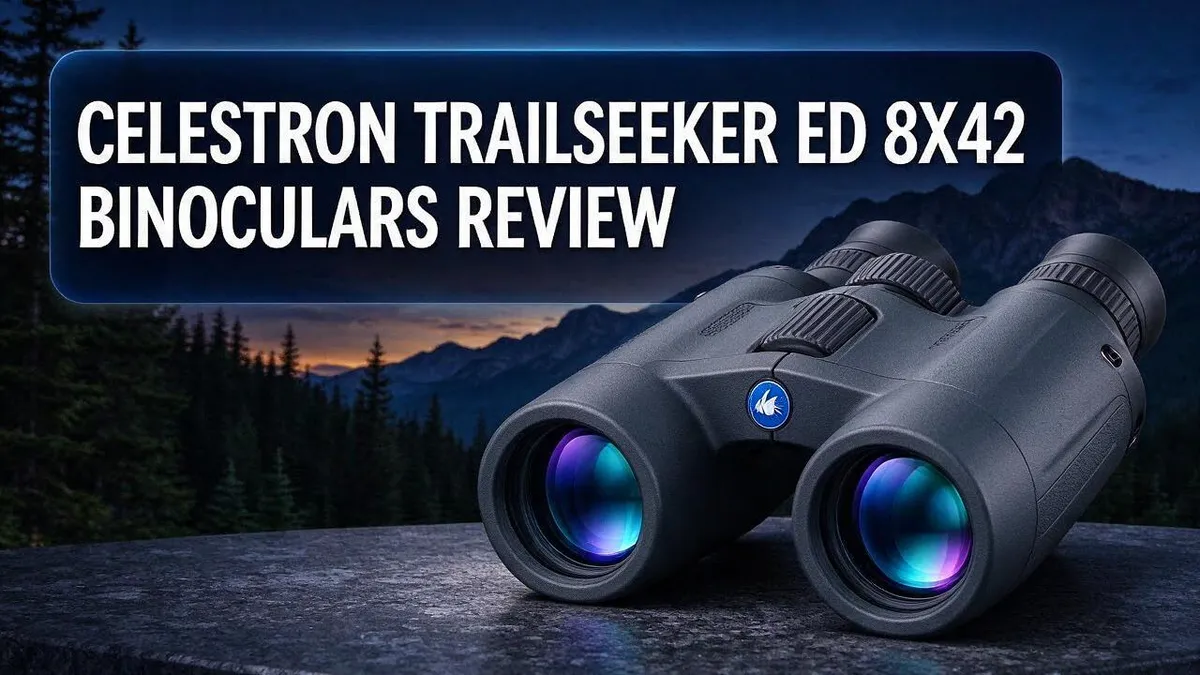
Celestron TrailSeeker ED 8×42 Binoculars Review: Is the ED Glass Worth It?
Do you want bright, sharp views without a heavy pair of binoculars around your neck? The Celestron TrailSeeker ED 8×42 aims to deliver exactly that.
This roof prism model uses ED glass for clear, natural color. It also offers a 426 ft field of view at 1,000 yards.
That makes it one of the widest views in its class. You can track birds and wildlife with ease.
The body is fully waterproof and sealed. It feels durable and compact in your hands.
Users also praise its large sweet spot and very good collimation. It is not perfect, but it performs well.
In this review, we test the optics, build, and comfort. We also compare it with rivals like the Vortex Diamondback HD and Zeiss Victory SF.
In a Nutshell
-
Best for: Birders, hikers, and all day trail users will enjoy this pair. It suits anyone who wants clear views with easy handling.
-
Build quality: The body feels durable and well made. It handles rough field use with ease.
-
Image quality: Users say the image looks crisp and lifelike. Many feel it performs above its class.
-
Main drawback: Collimation is very good but not perfect. Picky viewers may notice this, but most users will not.
-
Weight note: Forum members on BirdForum discussed a weight discrepancy. Check the listed weight before you decide.
-
Rivals to compare: The Vortex Diamondback HD 8×42, GPO Passion ED 8×42, and Bresser Pirsch ED 8×42 are worth a look. Some BirdForum users rate the SVBONY SV202 at least equal to the TrailSeeker. The Zeiss Victory SF and Nikon Prostaff P3 sit at the two ends of the market.
Optical Quality and ED Glass Performance


Last update on 2026-07-11 / Affiliate links / Images from Amazon Product Advertising API Some of the links on this website are affiliate links, which means that at no additional cost to you, I earn a commission if you click through and make a purchase. I only recommend products and services that I believe will add value to my readers. Thank you for your support!
Good optics start with the glass itself. The ED glass in this model helps control color fringing around bright edges. You notice this most when you scan a branch against a pale sky.
Contrast matters just as much as sharpness. Dark shadows under a forest canopy stay visible without looking muddy. Subtle feather patterns pop out more easily. This helps you spot a bird that blends into its surroundings.
Edge sharpness works together with the wide view. When you pan across a meadow, the image feels steady and easy to follow.
Low light performance is another strong point. The 42 millimeter objective lenses gather more light. Dawn walks and dusk birding become more rewarding. Night owls will appreciate it.
A quick test helps too. Point the pair at a detailed target in daylight before a long trip.
Focusing feels quick when you track fast movement. A quick turn of the wheel brings a bird into sharp view. This matters when a flock lands in a bush and vanishes a moment later.
Depth perception adds another layer. Good optics help your brain judge distance between branches and birds. This makes perching birds easier to place in their habitat.
Bright afternoons also demand good control. A clean image keeps the scene easy to read even in strong sun.
Careful observers notice small gains in clarity. Those gains add up over a full day in the field. Small details make a big difference. Every view feels rewarding.
Overall, the optics deliver a clear and confident view. Once you adjust the focus, the image settles quickly. Your eyes will thank you on a long day outdoors.
Field of View, Sweet Spot and Collimation
Treat the sweet spot like your home base. Keep your subject near the center of the view. The image stays sharp and flat there. Edges may soften a little when you push too far outward. Small head turns work better than wild sweeps.
Field of view also shapes how you follow birds in flight. A wide view keeps the bird in frame while your hands shake a little. That makes long trail days feel less tiring.
Collimation is simple to check at home. Pick a distant straight edge, like a rooftop or fence line. Look through both barrels with one eye closed, then switch eyes. If the lines match, the alignment feels right.
Watch for eye strain during long sessions. Slight misalignment can feel more noticeable when your eyes tire. Take short breaks every half hour.
Use a steady target for testing. A bird at rest or a sign at distance works well. Note whether the center stays crisp as you pan slowly.
Good habits make the sweet spot easier to find. Hold the pair close to your face and keep your elbows tucked. This stance reduces shake and keeps the view steady. Sitting or leaning on a tree also helps when you watch small birds for a long time.
Practice before your next trip. Spend ten minutes with the pair in your yard. You will learn your natural head movement and find your favorite focus rhythm.
Build Quality, Weight and Waterproofing
The TrailSeeker ED 8×42 has a fully waterproof, sealed body that keeps out dust and moisture. This matters more than many buyers expect. Morning dew, light drizzle, and river spray can reach a binocular on any long hike.
A sealed body also helps prevent internal fogging when temperatures change quickly. Your view stays clear when the weather shifts on the trail. Dust and grit stay outside the optics, which helps the inner parts last longer.
Sealed models suit coastal walks and rainy forests alike. Salt spray and damp air can wear down unprotected gear faster.
The pair feels compact and lightweight in the hand. It fits easily into a daypack without adding much bulk to your load.
Weight matters most on trips that last several days. Every ounce saved leaves more room for water, snacks, and a rain layer.
The exact figure still causes debate among enthusiasts. Always check the official spec sheet before you pack.
Build quality shows in the small details too. Move the focus wheel by hand and check for smooth motion without grinding or stiffness.
After a muddy hike, wipe the outer body with a damp cloth. Dry the lenses with a soft cloth and let the pair air dry.
Pick a case or pouch with a snug fit. A padded case guards the pair against bumps inside your pack. Keep the pair in a cool, dry spot at home, since heat and humidity can affect the seals over time.
Think about your usual hikes before you choose. Short day walks suit almost any build, but rough terrain calls for a tougher design. Good care keeps a waterproof pair performing for years.
Top 3 Alternatives
Nikon Monarch 5

Last update on 2026-10-28 / Affiliate links / Images from Amazon Product Advertising API Some of the links on this website are affiliate links, which means that at no additional cost to you, I earn a commission if you click through and make a purchase. I only recommend products and services that I believe will add value to my readers. Thank you for your support!
The Nikon Monarch 5 is a favorite among birders and hikers. It uses ED glass to deliver sharp, bright views with true colors. The body is waterproof and fogproof, so it handles rain, dew, and sudden temperature changes well. Many users also praise the comfortable grip, which makes long viewing sessions easier on the hands. If you spend hours outdoors, this model is a dependable companion.
Vortex Diamondback HD

Last update on 2026-08-28 / Affiliate links / Images from Amazon Product Advertising API Some of the links on this website are affiliate links, which means that at no additional cost to you, I earn a commission if you click through and make a purchase. I only recommend products and services that I believe will add value to my readers. Thank you for your support!
The Vortex Diamondback HD gives you high-definition optics that show fine detail at a distance. Its multi-layer coatings reduce glare and boost contrast, so colors look rich even in changing light. You get a wide field of view that helps you follow moving wildlife or scan a landscape quickly. Vortex also stands behind its products with a lifetime warranty, which gives buyers real peace of mind.
Athlon Midas
The Athlon Midas is a smart pick for people who want ED glass and a clean, bright image. Its fully multi-coated lenses help you see clearly in low light, such as dawn or dusk. The housing is sealed against water and fog, so it stays reliable in wet weather. Its simple, comfortable design suits beginners, kids, and anyone new to binoculars.
Focusing, Close Focus and Ease of Use
Close focus shows how near the binoculars can show a subject clearly. The TrailSeeker lists a close focus of 6.5, though the unit is not stated. Check the manual before you plan close shots of insects or flowers.
Start with the central focus knob. Turn it slowly with your dominant hand until fine lines look crisp. Then set the diopter on the right eyepiece to match your eyes.
Ease of use starts with a simple routine. Set the diopter once, then leave it alone. Refocus only when your subject moves to a new distance.
Close focus matters most for people who watch feeders or tide pools. A shorter minimum distance lets you see small details without backing away.
Test focus at three distances. Pick a nearby sign, a tree in the middle distance, and a far ridge. Notice how quickly the knob returns a sharp image each time.
Gloves can make small knobs harder to turn. Practice with gloves on before cold mornings. Relaxed fingers keep the view steady as you adjust.
Eyeglasses change the feel of focusing too. Fold down the eyecups if you wear glasses. This keeps the whole image in view while you turn the knob.
Keep the focus knob clean. Grit can make the turn feel rough. Wipe it with a dry cloth after each trip to keep it smooth.
Quick checks build confidence. Look at a sharp edge, like a door frame. Focus until the lines look clean, then step back and repeat.
Ease of use also means knowing your limits. If the image blurs at close range, move back a little. Then try the knob again.
Best Uses: Birding, Hiking and Wildlife Viewing
Birders often start their walks before sunrise. The 42mm objective lenses gather plenty of light, so songbirds remain easy to spot in dim woodland edges.
Hiking adds its own challenges. A trail may cross shady forest, open meadows, and bright water in one hour. ED glass helps control color fringing, so leaves and branches look natural in every setting.
Wildlife viewing rewards patience. Deer, elk, or waterfowl often stay well back from people. Eight times magnification brings them closer while keeping the image steady enough for quick checks.
Think about where you will use them most. Forest trails need a pair that handles low light and shifting contrast. Open wetlands reward a stable view of distant shorebirds.
Use them with a small notebook. Jot down species, time, and weather after each outing. Over a season, patterns appear in habitat and behavior.
Quick access matters on busy trails. A pair that lives in a daypack stays ready when a warbler calls from the canopy overhead.
Match the pair to your main activity. Birders who scan hedgerows may enjoy the steady 8x power. Hikers who cover many miles want a dependable companion on every route.
Comparing alternatives helps too. The Vortex Diamondback HD 8×42 and Zeiss Victory SF 8×42 show how other makers handle similar tasks. Try each pair before you decide.
Seasons change how these binoculars feel in use. Spring brings busy songbirds, while autumn offers migrating raptors overhead. Each season tests the view in new ways.
Choose outings that match your skill level. Start with feeders and parks. Then move to longer trails once you feel confident. Each step builds useful field skills.
Value for Money Compared to Competitors
Shoppers often compare the TrailSeeker ED 8×42 with other well-known models. Each rival brings its own strengths to the table. This section looks at how the pair stacks up.
The TrailSeeker offers one of the widest fields of view in its class. At 426 feet at 1,000 yards, you see more of the scene at once.
Wide views help you track birds in flight. Moving subjects stay in the frame longer. Less searching means more time watching.
Collimation is another strong point for this model. Many users praise its large sweet spot. One reviewer noted that it is very good but not perfect.
The Zeiss Victory SF 8×42 and Vortex Diamondback HD 8×42 are popular choices in this class. Shoppers often place them on the same shortlist.
The Bresser 8×42 Pirsch ED and GPO Passion ED 8×42 also use ED glass. This shared feature gives you a clear basis for comparison.
ED glass helps keep colors true in bright light. Many birders notice this detail first. Bright light also shows off fine feather patterns.
Some BirdForum members say the SVBONY SV202 matches the TrailSeeker. It deserves a closer look during your research.
The Nikon Prostaff P3 offers a simpler option for casual viewers. Its lineup fits people who want a basic pair.
Compare the sweet spot with your own eyes. Look at a tree line or a fence post. Move the image slowly across the view to spot any blur near the edges.
Try each model in person before you decide. Check edge sharpness, brightness, and comfort in your hands. Write down which features matter most to you.
Pros and Cons
Pros
- The sealed body is fully waterproof, so rain and damp trails pose no problem.
- The compact and lightweight build makes it easy to carry all day.
- Solid build quality suggests it will hold up well over years of outdoor use.
- Image quality stands out for many user reviewers.
- The roof prism design keeps the frame slim and easy to hold.
Cons
- Collimation is very good but not perfect.
- Weight figures differ between sources, so check the listed weight before you decide.
- The close focus measurement has no units listed, so confirm the exact distance with the maker.
Who Should Buy It
Some shoppers will get the most from the TrailSeeker ED 8×42. First time binocular owners often feel comfortable with 8x power. The view stays steady without much practice.
Families who share one pair will find it useful. Parents can pass it between kids at a county fair. Each person can focus quickly and enjoy the view.
Sports fans also make good candidates. Seats at outdoor soccer games or ballparks sit far from the action. A wide view helps follow fast plays across the field.
Road trippers may appreciate this model too. Scenic overlooks, lighthouses, and mountain vistas reward a closer look. Keep it in the car and grab it when the scenery opens up.
Gardeners can watch bees and butterflies without getting too close. Small blooms look clear when the focus is set well.
Night sky watchers who want deep space views should look at a larger telescope. These binoculars suit daylight scenes far better.
Concert and theater fans in upper seats may find the view helpful. Stage details become clearer without pushing forward. The mood feels closer to the performers.
Dog owners at open parks can track pets running far away. Quick scans help locate a dog in tall grass.
Buyers who need very high magnification should look at a higher power model. Those who want a tiny pocket pair may prefer a smaller size.
Anyone who wants a single pair for many activities will value that flexibility. One set can handle a park walk, a ballgame, and a sunset view. Pick the pair that fits the moments you enjoy most. Think about your usual outings before you buy.
Final Verdict
The Celestron TrailSeeker ED 8×42 earns a strong recommendation from me. It gives you a bright, sharp view and feels ready for real outdoor use. Few binoculars in this class feel so complete.
The large sweet spot makes viewing easy. Your eyes settle in fast, and the image stays clear across most of the view. Beginners will enjoy that comfort right away.
Experienced observers will notice the strengths too. The optics produce a clean picture that rewards careful looking. Fine details in feathers, bark, and distant ridgelines stand out.
The TrailSeeker does have limits. Top tier alpine glass still wins on edge sharpness and final polish. The Zeiss Victory SF 8×42 plays in that higher league. Most users will not miss that extra refinement on a normal outing.
The Nikon Prostaff P3 is another name for your shortlist if you want a simpler pair. The TrailSeeker offers a more advanced optical package, though. It feels like a clear step up in clarity and confidence.
My rating: 4.5 out of 5. It misses full marks only because premium rivals still offer slightly more refinement. I would happily keep this pair in my own bag.
I suggest a hands on test if you can find one. Check the focus feel, the grip, and how the barrels sit in your hands. Comfort matters as much as sharp optics, so trust your own eyes in the end.
Bottom line: the Celestron TrailSeeker ED 8×42 is a smart, dependable pick for anyone who wants a quality pair they can trust. It earns its place among the strongest 8×42 models in its class.
Frequently Asked Questions
Does the wide view help track moving subjects?
Yes, it helps a lot. The field of view measures 426 feet at 1,000 yards, which ranks among the widest in its class. You can follow a hawk or a running player without losing them quickly.
Why does 8x power matter for handheld use?
Lower magnification gives a steadier image when you hold binoculars by hand. Your hands shake less at 8x than at 10x. That steadiness helps during long watching sessions.
How does ED glass improve the view?
ED glass helps reduce color fringing around bright edges. This gives you a cleaner, more natural image. Colors look closer to what your eyes expect.
Which rivals should I compare before buying?
Start with the Zeiss Victory SF 8×42 and the Vortex Diamondback HD 8×42. You should also check the Bresser 8×42 Pirsch ED and the GPO Passion ED 8×42. BirdForum users say the SVBONY SV202 is at least equal to the TrailSeeker.

Hello, I’m Emily Price, the founder of Birds Affection. As a passionate bird enthusiast and spiritual seeker, I’ve always been fascinated by the symbolic meanings and mystical connections between birds and our lives. On this website, I share my knowledge and insights on the spiritual significance of various bird species, exploring their roles as messengers, guides, and teachers. Through my writing, I aim to inspire and educate others on the profound wisdom and beauty that birds bring to our world. Join me on this journey as we delve into the enchanting realm of bird symbolism and discover the hidden meanings behind these magnificent creatures.