Barska Spotting Scope 20-60×60 Review 2026: Still Worth It?
Budget spotting scopes live in a strange place. They promise big magnification for small money. Sometimes they deliver. Sometimes they frustrate you for years.
The Barska 20-60×60 sits right in the middle of that debate. It costs less than a decent pair of binoculars. It offers 60x zoom on paper. It ships with a tripod and a carry bag. For a first time buyer, that looks like a complete package.
But paper specs and real views are two different things. I spent time with this scope at the range, on a back deck, and on a cold morning at a marsh.
Key Takeaways:
- The price is the main selling point. This scope usually sits in the entry level bracket, far below brands like Vortex or Celestron. You get a 60mm objective, a zoom eyepiece, and a tripod for the cost of a cheap dinner out.
- Usable performance stops around 30x to 35x. The image looks decent at 20x. Push past 40x and the view softens noticeably. At full 60x you see a dim, hazy circle with poor contrast. This is normal for BK7 prisms and fully coated glass.
- It works well for paper targets inside 200 yards. Shooters checking .22 holes at 50 or 100 yards will be satisfied. That is the strongest use case by a wide margin.
- Birders will feel limited. Short eye relief, a narrow field of view, and dull color rendering make bird identification harder than it should be.
- There are two versions. One model is waterproof and fogproof with multi coated optics. The other is weather resistant only with fully coated optics. Check the listing carefully before you buy.
- The included tripod is a placeholder. It holds the scope upright. It does not hold it steady at high zoom.
Barska Colorado 20-60×60 Spotting Scope Overview


Last update on 2026-09-13 / Affiliate links / Images from Amazon Product Advertising API Some of the links on this website are affiliate links, which means that at no additional cost to you, I earn a commission if you click through and make a purchase. I only recommend products and services that I believe will add value to my readers. Thank you for your support!
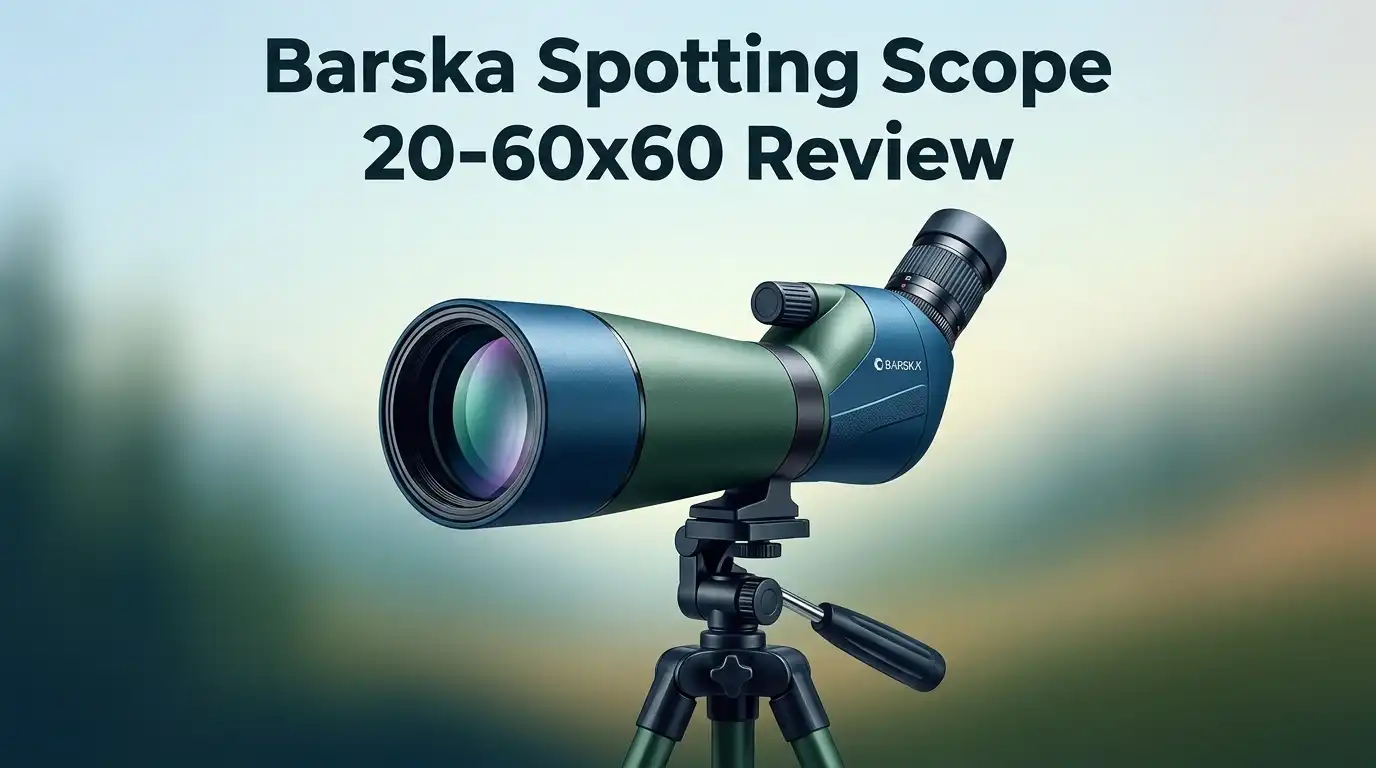
The Barska Colorado 20-60×60 is a straight body spotting scope built for casual observation. Barska markets it toward target shooters, hunters, birders, and backyard nature watchers. The company has sold versions of this design for well over a decade, which explains the huge number of listings and slightly different model codes floating around.
The core design is simple. A 60mm objective lens gathers light. A BK7 Porro prism flips the image upright. A zoom eyepiece moves you from 20x to 60x through a grooved dial. A single large focus knob sits on top of the barrel.
The straight body layout matters more than people expect. Straight scopes feel natural when you sit at a bench and look at a target. You point the tube where you want to look. Angled scopes work better for sky viewing or shared use, but they confuse beginners at first.
Barska wraps the tube in rubber armor. The flip down objective cover stays attached, so you never lose it in tall grass. The scope weighs roughly 1.5 to 2.5 pounds depending on version, which qualifies as light for a 60mm spotter.
This is not a precision instrument. It is a starter tool that lowers the barrier to entry. Judge it on that basis and the picture makes more sense.
Unboxing Experience and First Impressions
The box arrives small and light. That is the first surprise. A 60mm spotting scope sounds bulky, and this one is not.
Inside, you find the scope wrapped in thin foam or a plastic sleeve, a soft nylon carry bag, a small tabletop tripod, and a folded instruction sheet. No fancy cutouts. No premium presentation. The packaging does its job and nothing more.
Pick up the scope and you feel decent rubber armor over a plastic and metal body. The texture grips well in the hand. Seams look tidy. The zoom ring has visible grooves that your fingertips find easily, even with gloves on.
The focus knob is the first thing I tested. It turns smoothly but with very little resistance. That light action means you can overshoot focus easily until you learn the feel. After a week it became second nature.
The tripod is the low point of the unboxing. It stands about six inches tall, uses thin aluminum legs, and has a pan head with a small tightening lever. It works on a bench. It wobbles if you breathe near it.
The nylon case fits the scope snugly and includes a shoulder strap. It offers scratch protection and nothing else. Do not expect padding that survives a drop.
Overall first impression: honest budget gear that does not pretend to be premium.
Key Specifications Explained in Plain English
Specs only help when you know what they mean. Here is the translation.
Magnification 20x to 60x. You zoom by turning the eyepiece dial. Higher numbers bring objects closer but darken and soften the image.
Objective lens 60mm. This is the light collecting window. Sixty millimeters is small for a spotting scope. Serious models use 80mm or 85mm glass, which is why they cost five to ten times more.
BK7 Porro prism. BK7 is the cheaper prism glass. BAK4 performs better and produces a rounder, brighter exit pupil. This single detail explains most of the image quality gap between Barska and mid tier brands.
Exit pupil 3mm down to 1mm. At 60x, the beam of light reaching your eye shrinks to about 1mm. Your pupil is larger than that in dim light. The result is a dark, pinhole style view.
Eye relief 11mm to 14.5mm. This is the distance your eye can sit from the lens. Under 15mm is tight. Eyeglass wearers will struggle to see the full field.
Close focus 26 to 33 feet. You cannot study a bird feeder ten feet away. Plan for distance viewing only.
Field of view roughly 114 feet at 20x and 51 feet at 60x per 1000 yards. Narrow, but workable once the target is located.
Weight around 1.5 to 2.5 lbs. Genuinely portable.
Top 3 Alternative for Barska Spotting Scope 20-60×60

Last update on 2026-07-01 / Affiliate links / Images from Amazon Product Advertising API Some of the links on this website are affiliate links, which means that at no additional cost to you, I earn a commission if you click through and make a purchase. I only recommend products and services that I believe will add value to my readers. Thank you for your support!
Emarth 20-60×60 Angled Spotting Scope

Last update on 2026-09-13 / Affiliate links / Images from Amazon Product Advertising API Some of the links on this website are affiliate links, which means that at no additional cost to you, I earn a commission if you click through and make a purchase. I only recommend products and services that I believe will add value to my readers. Thank you for your support!
Gosky Updated 20-60×80 Spotting Scope with Tripod and Phone Adapter

Last update on 2026-09-13 / Affiliate links / Images from Amazon Product Advertising API Some of the links on this website are affiliate links, which means that at no additional cost to you, I earn a commission if you click through and make a purchase. I only recommend products and services that I believe will add value to my readers. Thank you for your support!
Celestron Ultima 18-55×65 Angled Spotting Scope
Optical Performance in Bright Daylight
Daylight is where this scope earns its keep. On a clear morning, the 20x view looks surprisingly pleasant. Colors read naturally. The center of the image holds decent detail. Edges soften, but your eye ignores that quickly.
At 100 yards I could count .22 caliber holes in paper without effort. At 200 yards, .223 holes stayed visible as long as the sun was behind me. That alone justifies the purchase for many range shooters.
Zoom changes the story fast. Around 30x the image stays acceptable. By 40x, contrast drops and fine detail smears. At the full 60x setting, the view turns soft and washed out, with a visible purple and yellow fringe on high contrast edges. This is chromatic aberration, and cheap glass shows plenty of it.
Heat shimmer makes the problem worse. On warm afternoons over a gravel range, the air itself ripples. Past 40x you see moving soup instead of bullet holes. That limitation affects expensive scopes too, but budget optics collapse sooner.
Focus at high zoom takes patience. The light focus knob and the shallow depth of field fight each other. Small taps on the tube also shift your view because the tripod flexes.
My practical recommendation: treat this as a 20x to 35x scope with a zoom dial that goes further for emergencies.
Low Light and Dusk Performance
Here the Barska shows its limits clearly. A 60mm objective simply does not gather much light, and BK7 prisms waste some of what it collects.
Thirty minutes before sunset, the 20x view still works. You can follow deer movement in an open field. Colors turn muted, and shadows swallow detail, but shapes stay readable.
Push the zoom and the image falls apart. At 60x the exit pupil measures about 1mm. Your dark adapted pupil opens to 5mm or more. The mismatch creates a dim tunnel that makes identification nearly impossible.
Hunters who plan dawn and dusk glassing should look elsewhere. An 80mm scope with BAK4 prisms and multi coated glass delivers dramatically more usable minutes at each end of the day. That extra performance costs money, and the gap is real.
The waterproof Colorado version uses multi coated optics rather than the plain fully coated variety. Multi coating helps. It reduces internal reflections and lifts contrast slightly. If you must choose between the two Barska variants, pick the multi coated waterproof model even if it costs a little more.
One practical tip helped me: keep both eyes relaxed and shade the eyepiece with your hand. Stray side light bouncing off the lens surface robs contrast at dusk more than people realize. A simple cupped palm restores a noticeable amount of clarity.
Build Quality and Weather Resistance
The rubber armor feels better than the price suggests. It absorbs light bumps and gives a secure grip in rain or cold. After several weeks of bench use, mine showed no cuts or peeling.
Weather sealing depends entirely on which version you own. Barska sells a standard Colorado model that is weather resistant only, and a WP model that is fully waterproof and nitrogen purged against internal fogging. The listings look almost identical, so read the product title carefully.
The waterproof model handled a light drizzle with no trouble. No internal moisture appeared. No fogging occurred when I carried it from a warm car into freezing air, which is the real test of nitrogen purging.
Durability concerns remain, and honest reviews should say so. Several long term owners report the zoom mechanism becoming gritty over time. Others mention the tripod mounting foot as a weak point, since it uses a small screw plate rather than a solid collar. I would not toss this scope loose into a truck bed.
The focus knob housing is plastic. It functions fine but does not inspire the confidence of a metal helical focus system.
Barska backs the scope with a limited warranty, typically three years on this family. That falls far short of the lifetime coverage offered by brands like Vortex, and warranty service reports are mixed.
The Included Tripod and Accessories
Let me be direct. The bundled tripod is the weakest part of this package.
It stands roughly six inches tall with legs made from thin tubing. The pan head tilts and swivels using a single lever. On a solid bench at 20x, it does the job. Raise the zoom to 40x and every touch sends the image bouncing for two full seconds.
You also cannot use it on the ground or from a standing position. Any real field use requires a proper tripod, so budget an extra amount for one.
A basic photo tripod with a fluid pan head transforms this scope. The improvement is larger than any optical upgrade you could make at this price. Suddenly the high zoom settings become semi usable, because the image finally sits still long enough for your eye to resolve detail.
The soft nylon carry bag deserves modest praise. It protects the body from scratches, includes a shoulder strap, and keeps the scope together with its caps. It is not padded, so treat it as dust protection rather than armor.
The flip down objective cover is genuinely useful. It stays attached, flips out of the way in one motion, and never gets lost.
Some bundles add a small 8×21 binocular or a phone adapter. Those extras are novelty items. The binoculars are toy grade.
Barska Blackhawk 20-60×60 Angled Alternative

Last update on 2026-09-13 / Affiliate links / Images from Amazon Product Advertising API Some of the links on this website are affiliate links, which means that at no additional cost to you, I earn a commission if you click through and make a purchase. I only recommend products and services that I believe will add value to my readers. Thank you for your support!
Barska also sells the Blackhawk 20-60×60, an angled body scope from the same family. It appears in searches beside the Colorado, and buyers often confuse the two.
The Blackhawk uses an angled eyepiece set at 45 degrees. That design helps in three situations. It reduces neck strain during long observation sessions. It lets you use a shorter, more stable tripod. It makes sharing the scope with other people much easier, since nobody has to match your exact height.
The Blackhawk is also fully waterproof and fogproof, weighs roughly 2.86 pounds, and ships with a tripod and carrying case. Optically the two scopes sit in the same class. Expect similar sharpness, similar dimming at high zoom, and similar color rendering.
So which should you pick? Choose the straight Colorado if you shoot from a bench and want the simplest possible aiming experience. Choose the angled Blackhawk if you scan wide landscapes, watch birds in trees, or occasionally point at the moon.
Beginners almost always find straight scopes easier for the first week. Experienced users usually prefer angled bodies after they adapt. Neither choice is wrong.
The price difference between the two models is usually small. If you only plan to check paper targets, save the money and take the Colorado.
Pros and Cons of the Barska 20-60×60
Pros
- Very low price. This scope costs a fraction of any mid tier spotter, which makes it an easy first purchase for a new shooter or casual nature watcher.
- Genuinely light and compact. At roughly two pounds and fifteen inches long, it travels easily in a range bag or backpack.
- Good performance at 20x to 30x. The lower half of the zoom range delivers a clear, pleasant image that handles target verification well.
- Complete starter bundle. The tripod, carry bag, and lens covers arrive in the box, so nothing blocks you from using it the same day.
- Comfortable rubber armor. The grip stays secure in wet or cold conditions and absorbs minor knocks.
- Waterproof version available. The WP model adds nitrogen purging and multi coated optics for a small premium.
- Flip down lens cover. A small feature that prevents a common annoyance.
Cons
- High zoom settings disappoint. Detail, brightness, and contrast all fall sharply past 40x, and 60x is close to unusable.
- BK7 prisms limit brightness. Better scopes use BAK4 glass, and the difference shows at dusk.
- Short eye relief. Eyeglass wearers cannot see the full field comfortably.
- Included tripod is inadequate. You need a real tripod to get value from the higher magnifications.
- Visible color fringing. Purple and yellow edges appear on high contrast subjects.
- Long focus distance. Close subjects inside 25 feet stay blurry.
- Mixed long term reliability reports. Some owners describe zoom mechanisms roughening after heavy use.
What This Scope Does Not Do Well
Authentic reviews name the failures plainly, so here they are.
It does not work as a 60x instrument. Treat the top third of the zoom range as marketing. The optics cannot support that magnification with useful clarity, and no technique fixes it.
It does not serve serious birders. Identifying a warbler requires sharp detail, accurate color, and a wide field to track movement. This scope delivers none of those at a high standard. The narrow field also makes finding small moving birds slow and frustrating.
It does not replace an astronomy telescope. You can see lunar craters and Jupiter as a tiny disc with moons. That is the ceiling. Star images bloat, and planetary detail never appears.
It does not support eyeglass wearers well. With glasses on, you lose a chunk of the field of view. Removing glasses works if your prescription is simple, but astigmatism stays uncorrected.
It does not stay steady on the included tripod. Any assessment that ignores this is incomplete.
It does not read bullet holes at long range. Small caliber holes disappear beyond about 200 yards. Reactive targets or shoot and see patches become necessary.
None of this makes the Barska a bad product. It makes it a specific product with a narrow job. Buyers get disappointed when they expect an all purpose optic.
Best Uses: Where the Barska Actually Shines
This scope has a real sweet spot, and it is worth defining.
Range work inside 200 yards is the top use. Sit at a bench, set 20x to 30x, and check your groups without walking downrange. For rimfire shooters at 50 yards, the scope feels almost luxurious. It saves time and keeps your session moving.
Backyard wildlife watching comes second. Set it on a patio table, point it at a distant treeline or field, and watch deer, hawks, or rabbits. The view satisfies curiosity even if it lacks refinement.
Casual landscape scanning works nicely. Mountain overlooks, harbor views, and lake shores all look good at lower zoom. The scope brings distant boats and ridgelines into a pleasant frame.
Teaching kids about optics is an underrated use. You will not panic if a child drops it. That freedom matters more than sharpness when you are sharing a hobby.
Testing your interest is the smartest use of all. Many buyers wonder whether spotting scopes suit them. Spending a small sum answers that question. If you use this scope weekly, you know an upgrade is justified. If it sits in a closet, you saved several hundred dollars.
Match the tool to the task and the Barska performs honestly. Ask for more and it disappoints.
Who Should Buy It and Who Should Skip It
Buy the Barska 20-60×60 if you fit these descriptions. You shoot paper at moderate distances and want to stop walking to the target. You are new to spotting scopes and unsure about the hobby. You need a cheap second scope for a truck or a shared range bench. You want a light optic for casual travel. You have a hard spending limit and a real need.
Skip it if any of these apply. You identify birds seriously and need accurate color and fine feather detail. You hunt at dawn or dusk and depend on light gathering. You wear glasses and cannot view comfortably without them. You judge trophy animals at long range. You want an optic that lasts twenty years with heavy use.
The upgrade path matters here. If your budget can stretch to a 65mm or 80mm scope with BAK4 prisms and multi coated glass, that step delivers a large jump in performance. Brands in that bracket offer better warranties too.
Here is my honest framing. The Barska is not competing with good scopes. It competes with owning no scope at all. Against that comparison it wins easily. Against a mid tier spotter it loses on every optical measure.
Know which comparison you are actually making before you order.
Price and Value in 2026
Pricing on this family of scopes shifts often, so check the current listing rather than trusting any fixed number. Historically the Barska 20-60×60 has sat in the low entry bracket, well under the cost of most mid tier optics, with the waterproof version carrying a modest premium.
At that level, value looks strong. You receive a 60mm scope, a zoom eyepiece, a tripod, and a case. Nothing else in the category undercuts it by much.
Value changes as the price climbs. When sales push competing scopes down, the calculation shifts quickly. A 65mm or 80mm scope with better prisms at a moderately higher price is usually the smarter long term buy. Watch for those deals before committing.
Also budget for a proper tripod. A basic photo tripod with a pan head costs a modest sum and doubles the usefulness of this scope. Treat that accessory as part of the real purchase price.
Resale value is essentially zero. Budget optics do not hold worth. Plan to keep it, gift it, or retire it to a spare bag.
My value verdict: strong for the specific job of close range target spotting and casual viewing, weak for anything that demands optical quality. Buy it for what it does today rather than what you might need in three years.
Final Verdict on the Barska 20-60×60
The Barska 20-60×60 is an honest budget scope with a clear personality. It gives you a usable, pleasant view from 20x to about 30x. It travels light. It survives ordinary handling. It costs very little.
It also softens badly at high zoom, struggles in dim light, and ships with a tripod that undercuts its own potential. Eyeglass wearers should look elsewhere. Birders and low light hunters should definitely look elsewhere.
My rating sits around 3.5 out of 5, with a firm asterisk. That score reflects value at the price, not absolute quality. Rated against real spotting scopes, it earns closer to 2.5.
If you are a range shooter who wants to check groups at 50 to 200 yards without walking, buy it and enjoy it. If you are a nature observer who cares about image quality, save your money and buy once at a higher tier.
Choose the waterproof multi coated version whenever possible. Add a real tripod. Keep your expectations anchored to the lower half of the zoom range. Do those three things and this scope will make you happy for years.
Ignore that advice, crank it to 60x, and you will wonder why the view looks so poor. Now you know exactly why.
FAQs
Is the Barska 20-60×60 waterproof?
It depends on the model. Barska sells a standard Colorado version that is weather resistant only, plus a WP version that is fully waterproof and fogproof with nitrogen purging. The Blackhawk angled model is also waterproof. Read the exact product title before ordering, because the listings look very similar.
Can you see bullet holes at 100 yards?
Yes. At 20x to 30x, .22 caliber holes in paper stay visible at 100 yards in good light. At 200 yards, .223 holes become difficult and depend heavily on lighting and target contrast. Shoot and see targets help a great deal at longer distances.
Is 60x magnification actually usable?
Not really. At the top of the zoom range, the exit pupil shrinks to about 1mm, contrast drops, and heat shimmer takes over. Plan on 20x to 35x for real work and treat the higher settings as a bonus you rarely use.
Does it work for bird watching?
It works for casual watching of large birds at distance. It does not work well for serious identification. Short eye relief, a narrow field of view, and muted colors make small bird work frustrating. Birders should consider a 65mm or larger scope with BAK4 prisms.
Can I use it with my glasses on?
Poorly. Eye relief measures roughly 11mm to 14.5mm, which is tight. With glasses on you will see only part of the field. Most users remove their glasses and adjust focus instead, though that does not help astigmatism.
What tripod should I use with it?
Skip the included tabletop tripod for anything beyond bench use. A basic aluminum photo tripod with a fluid pan head and a standard quarter inch screw mount works well. This single upgrade improves the viewing experience more than anything else you can do.
Can I see planets with this scope?
You can see the moon in good detail, Jupiter as a small disc with visible moons, and Saturn as an oval shape. Planetary surface detail stays out of reach. Use 20x to 30x for the best results, since higher settings only add blur.
How does it compare to the Emarth 20-60×60?
The two scopes compete directly and perform similarly. The Emarth uses an angled body, which many users find more comfortable. Optical quality between the two is close enough that price, body style, and current availability should decide your choice.

Hello, I’m Emily Price, the founder of Birds Affection. As a passionate bird enthusiast and spiritual seeker, I’ve always been fascinated by the symbolic meanings and mystical connections between birds and our lives. On this website, I share my knowledge and insights on the spiritual significance of various bird species, exploring their roles as messengers, guides, and teachers. Through my writing, I aim to inspire and educate others on the profound wisdom and beauty that birds bring to our world. Join me on this journey as we delve into the enchanting realm of bird symbolism and discover the hidden meanings behind these magnificent creatures.