Maven CS.1 Spotting Scope Review 2026: Worth It?
Spotting scopes force a hard choice. You either carry heavy glass that shows every detail, or you carry light glass that shows enough. The Maven CS.1 sits right in that gap, and it has quietly become one of the most talked about mid range spotters among backcountry hunters.
This review breaks down what the CS.1 does well, where it falls short, and who should actually spend the money. I pulled real field feedback from hunters in Alaska, the Rockies, and the high desert, plus the full manufacturer spec sheet. No marketing fluff. Just what you need before you click buy.
By the end, you will know if 40 ounces and roughly $925 buys you a scope you will love, or one you will resell in a season.
Key Takeaways:
- The sweet spot is 15x to 30x. The CS.1 delivers sharp, high contrast, color accurate images in that range. Many users report it beats their 10×42 binoculars on brightness at 15x to 20x.
- 45x is a ceiling, not a setting. Haze washes out contrast at full power, especially in flat light or shadowed draws. Go in knowing this and you will not be disappointed.
- Weight is the headline feature. At 40.4 ounces, it is roughly 20 ounces lighter than most 80mm spotters. That saves real pack space on multi day trips.
- Weatherproofing is excellent. IPX7 rating, nitrogen purged, and one tester had it submerged for ten minutes after a canoe flip with zero internal fogging.
- The single speed focus is the main weakness. No fine focus knob makes precise adjustment at high magnification fiddly and slow.
- Value is strong but not cheap. Direct to consumer pricing, an integrated Arca Swiss base, and a fully transferable unconditional lifetime warranty push the value higher than the price tag suggests.
Maven CS.1 Spotting Scope: Quick Overview

Last update on 2026-07-25 / Affiliate links / Images from Amazon Product Advertising API Some of the links on this website are affiliate links, which means that at no additional cost to you, I earn a commission if you click through and make a purchase. I only recommend products and services that I believe will add value to my readers. Thank you for your support!
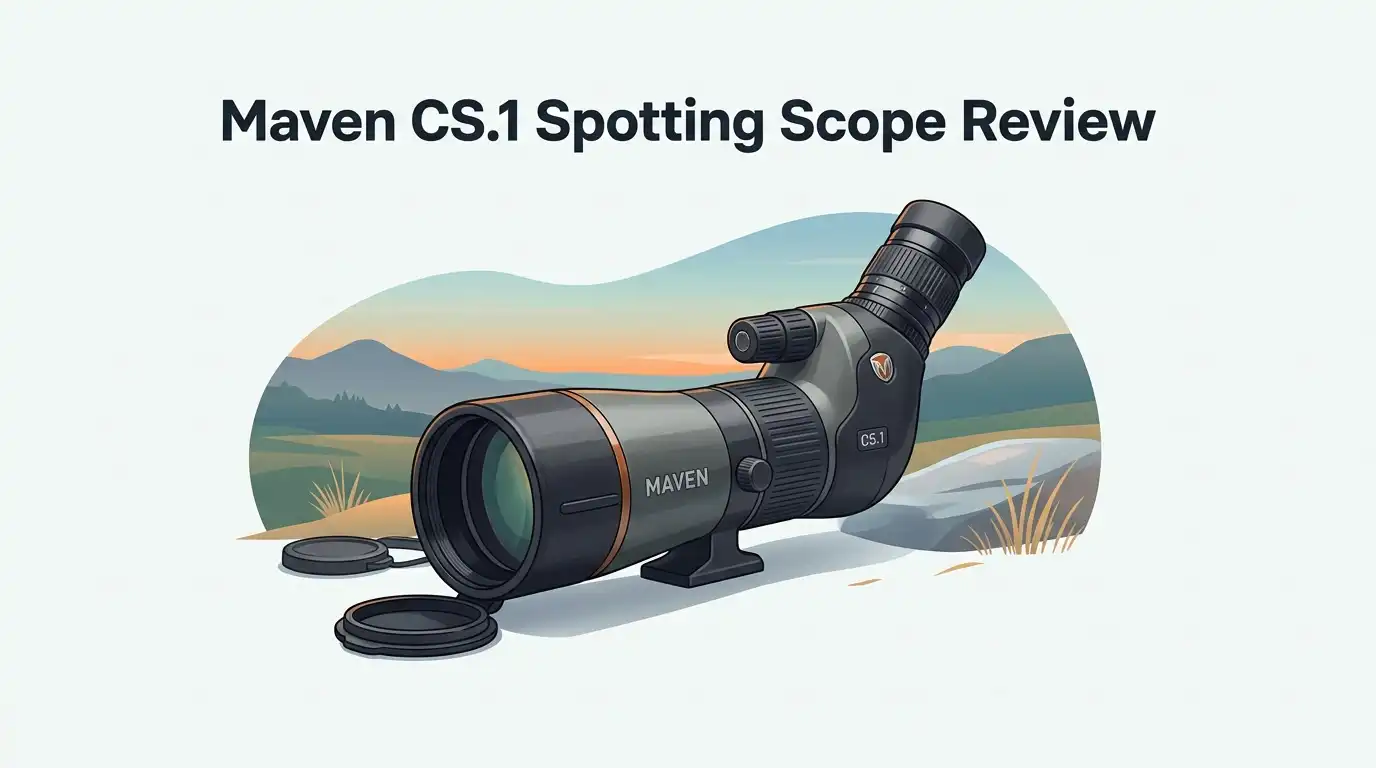
The Maven CS.1 is a 65mm spotting scope with a 15x to 45x zoom range. Maven sells it in two shapes. The CS.1A has an angled eyepiece. The CS.1S has a straight eyepiece. Both share identical glass, weight, and specs.
Inside, you get Extra Low Dispersion ED glass, Schmidt Pechan prisms, phase correction coating, and fully multicoated lenses. The frame mixes aluminum, magnesium, and polymer. Maven lists weight at 40.4 ounces and length at 11.4 inches.
Maven calls it their recommended mid range spotter for hunters, birders, and wildlife watchers who want extra reach in a small package. That is a fair description. It is not an alpha scope, and Maven never claims it is. It is the scope you carry when an 80mm unit stays home.
Unboxing the Maven CS.1
The box arrives plain and sturdy. Maven does not waste money on glossy packaging, which fits their direct to consumer model. Inside, the scope sits in a fitted foam cradle with a neoprene stay on case already wrapped around the barrel.
First impression out of the box is density. It feels heavier in the hand than the spec sheet suggests, in a reassuring way. The gray body with orange accents looks sharp without screaming for attention.
You also get objective and eyepiece caps, a lens cloth, and documentation. The eyepiece cap is tethered, which is smart. The objective cap is not, so clip it somewhere or you will lose it.
The first thing most owners notice is the magnification collar. It turns smooth and firm, with no slop. That single detail tells you where the money went.
Build Quality, Frame and Tripod Mount
The CS.1 uses an aluminum and polymer chassis with magnesium elements. Nothing creaks. Nothing rattles. The armor has enough grip to hold in wet hands without feeling sticky.
The standout build feature is the integrated Arca Swiss compatible base. You clamp the scope straight onto most modern tripod heads with no extra plate. That removes a failure point and saves a few ounces. At this price, it is a genuinely generous inclusion.
Maven is a Wyoming company. Assembly and finishing happen in the United States, though the glass and components originate overseas, which Maven lists openly as China origin on the spec sheet. Some buyers care about this. Maven does not hide it.
The focus wheel and eyecup both survived sub zero testing without stiffening. That matters more than any spec number.
Top 3 Alternative for Maven CS.1 Spotting Scope

Last update on 2026-09-13 / Affiliate links / Images from Amazon Product Advertising API Some of the links on this website are affiliate links, which means that at no additional cost to you, I earn a commission if you click through and make a purchase. I only recommend products and services that I believe will add value to my readers. Thank you for your support!
Vortex Optics Diamondback HD Spotting Scope

Last update on 2026-09-17 / Affiliate links / Images from Amazon Product Advertising API Some of the links on this website are affiliate links, which means that at no additional cost to you, I earn a commission if you click through and make a purchase. I only recommend products and services that I believe will add value to my readers. Thank you for your support!
Athlon Optics Argos HD Spotting Scope

Last update on 2026-09-13 / Affiliate links / Images from Amazon Product Advertising API Some of the links on this website are affiliate links, which means that at no additional cost to you, I earn a commission if you click through and make a purchase. I only recommend products and services that I believe will add value to my readers. Thank you for your support!
Leupold SX.2 Alpine HD Spotting Scope
Optical Clarity in Good Light
This is where the CS.1 earns its reputation. In daylight, from 15x through about 30x, the image is crisp edge to edge with excellent color fidelity. Rock texture, hair, and antler edges all resolve cleanly.
The ED glass does its job. Chromatic aberration stays minimal, even on high contrast targets like a dark animal against snow. Several testers noted the image at 15x to 20x looked brighter and sharper than their premium 10×42 binoculars.
Contrast holds up well against scopes costing a few hundred dollars more. Against Swarovski or Zeiss, the gap is visible but smaller than the price difference implies.
Field of view measures 174 feet at 1000 yards at low power. That is narrower than an 80mm scope but wide enough to scan a basin without constant panning.
How It Performs at 45x
Here is the honest part. The CS.1 does not hold up at full magnification. Push past roughly 30x and haze creeps into the image. Contrast drops. Fine detail softens.
In bright, stable conditions, 45x remains usable. You can still identify shapes and make a rough judgment call. But in flat light, early morning, or looking into shade, the top end becomes mush.
Exit pupil tells the story. At 45x it shrinks to 1.4mm. That is simply not enough light for a 65mm objective to deliver a usable high power image.
Most owners settle into 20x to 30x as their working range and stop touching the top of the dial. Treat 45x as emergency reach, not your default.
Low Light and Dawn Glassing
A 65mm objective gathers less light than an 80mm or 85mm objective. Physics decides this, not engineering. The CS.1 performs respectably at dawn and dusk for its class, but it cannot match larger scopes.
At 15x, brightness stays genuinely impressive in gray light. Maven lists a brightness value of 18.5 at low power. That low power performance is the scope’s secret weapon during the first and last twenty minutes of shooting light.
Crank the magnification in those same conditions and the image dims fast. Twilight factor drops hard as the exit pupil shrinks.
If your hunting or birding happens mostly in marginal light at high power, this is the wrong scope. Buy an 85mm instead and accept the weight.
Focus System and Its Biggest Flaw
The CS.1 uses a single speed focus wheel. There is no separate fine focus. This is the most common complaint from owners, and it is a fair one.
At 15x to 25x, the focus works fine. Depth of field is forgiving and you land on sharp quickly. At 40x and above, tiny wheel movements overshoot sharp focus repeatedly. You end up hunting back and forth.
The wheel itself feels smooth and well damped. The travel is not the problem. The gearing ratio is.
Competing scopes near this price, including the Leupold SX.2 Alpine HD, offer dual speed focus. That is a real advantage for anyone who glasses at high power. Maven chose simplicity and weight savings instead. Decide which you value.
Magnification Ring, Eyecup and Eye Relief
The rubberized magnification collar sits at the base of the eyepiece. It is high traction, smooth, and does not drift while you glass. Testers reported identical feel at 70 degrees and at negative 15 degrees Fahrenheit. That consistency is rare at any price.
Eye relief runs 16mm to 19mm. The multi position twist up eyecup has clean detents and holds position. Eyeglass wearers generally report comfortable full field viewing, though a few find it tight at maximum magnification.
Eyepiece construction uses a five group, eight element design. The eyebox is reasonably forgiving at low power and tightens up noticeably at high power.
One recurring criticism on hunting forums involves eye strain during long glassing sessions. Not everyone experiences it, but enough users mention it that it deserves a note.
Weight and Pack Space
At 40.4 ounces, the CS.1 is the lightest 45x scope Maven builds. Dimensions measure 11.4 by 5.6 by 3.1 inches. It slides into a daypack without dominating it.
Compare that to a typical 85mm spotter at 60 to 65 ounces. You save roughly 20 to 25 ounces, which translates to an extra day of food, better rain gear, or simply less misery at mile twelve.
The practical result surprises people. Owners report reaching for the CS.1 more often than their binoculars, because setup takes seconds and the scope is always within reach.
Could it be lighter? Yes. The Swarovski ATC weighs less at a similar focal length. It also costs far more than double. For most buyers, the Maven hits the better compromise.
Weatherproofing and Field Abuse
This category earns full marks. The CS.1 is nitrogen purged and rated IPX7, meaning submersion to one meter for thirty minutes.
One tester exceeded that rating by accident. His canoe flipped on a goat hunt and the scope sat underwater for roughly ten minutes strapped inside a pack. Result: no internal fogging, no water intrusion, no damage.
Storage temperature range runs from negative 40 to 158 degrees Fahrenheit. Functional range runs negative 13 to 140 degrees. Testers put it through sun, rain, snow, and sub zero cold across multiple Alaskan hunts without a failure.
The armor shows scuffs over time but nothing structural. If you need a scope that shrugs off genuinely bad weather, the CS.1 handles it.
Angled or Straight: Which Version Should You Buy?

Last update on 2026-09-13 / Affiliate links / Images from Amazon Product Advertising API Some of the links on this website are affiliate links, which means that at no additional cost to you, I earn a commission if you click through and make a purchase. I only recommend products and services that I believe will add value to my readers. Thank you for your support!
Both versions share identical optics and weight, so this decision comes down to how you glass.
Pick the angled CS.1A if you glass from a seated position for long stretches, use a shorter tripod, share the scope with others, or spend a lot of time looking uphill. The angled eyepiece reduces neck strain dramatically during extended sessions.
Pick the straight CS.1S if you glass from prone, scan downhill from ridgelines, or want faster target acquisition. Straight scopes point more intuitively because the body lines up with your view.
Most hunters choose angled. Most target shooters and prone glassers choose straight. Birders split roughly down the middle.
If you genuinely cannot decide, the angled model is the safer general purpose pick.
Pros and Cons of the Maven CS.1
Pros
- Excellent clarity from 15x to 30x with sharp contrast and accurate color from genuine ED glass.
- Light and compact at 40.4 ounces, roughly 20 ounces under comparable 85mm scopes.
- Outstanding weatherproofing with IPX7 rating and proven resistance to extended submersion.
- Integrated Arca Swiss base mounts directly to most tripod heads with no adapter plate.
- Smooth magnification collar that holds position and works identically in extreme heat and cold.
- Unconditional lifetime warranty that transfers to future owners with no receipt required.
- Direct to consumer pricing that undercuts similar glass from traditional retail brands.
Cons
- Single speed focus only, which makes precise focusing at high magnification slow and frustrating.
- Haze and contrast loss at 45x, especially in flat light or shadow.
- 65mm objective limits low light brightness compared with 80mm and 85mm competitors.
- Narrower field of view than larger scopes, which slows wide area scanning.
- Some users report eye strain during long glassing sessions.
- No objective filter thread, so you cannot add protective or polarizing filters.
What the Maven CS.1 Does Not Do Well
Let me be blunt about the limits, because honest reviews should state them plainly.
The CS.1 will not let you count tines or judge a billy from a nanny at 500 yards. The high power image simply does not resolve that level of detail reliably.
It will not replace an 85mm scope for dedicated long range target shooters checking bullet holes at 600 yards and beyond.
It will not satisfy serious birders who need to separate confusing shorebird species at distance in poor light.
It will not give you fast, precise focus at high power. You will fight the focus wheel, and that frustration does not go away with practice.
It will not thread filters, and it will not match alpha glass. Maven knows this. Their S Series exists for buyers who need more.
Who Should Buy the Maven CS.1, and Final Verdict
Buy the CS.1 if you are a weight conscious backcountry hunter who needs to decide whether an animal is worth closing distance on. That is exactly the job this scope does best.
It also suits casual wildlife watchers, hikers who want reach without bulk, and anyone replacing a heavy spotter they stopped carrying. A scope you actually bring beats a better scope left at camp.
Skip it if you glass at high power in low light, need dual speed focus, or must judge fine detail at long range.
Verdict: 4 out of 5. The Maven CS.1 is an honest, well built, genuinely portable spotter with real optical strength in its working range and a clear weakness at the top end. At roughly $925 with a lifetime warranty, it earns a recommendation for the right buyer.
Frequently Asked Questions
How much does the Maven CS.1 cost in 2026?
Maven lists the CS.1A and CS.1S at approximately $925 direct from their website. Pricing on Amazon and other retailers varies. Maven runs occasional promotions, so check both before ordering.
Is the Maven CS.1 good for bird watching?
Yes, for general wildlife and backyard birding. The 15x to 30x range is bright and sharp. Serious birders who identify distant species in poor light will want a larger objective and better high power performance.
Does the Maven CS.1 work with a phone adapter?
Yes. Maven sells a dedicated phone skin and adapter system. Third party universal adapters also fit the eyepiece. Image quality through the phone is best at lower magnifications.
What tripod should I use with the Maven CS.1?
Any tripod rated above five pounds works. The integrated Arca Swiss base clamps directly to most ball heads and pan heads. Lightweight carbon fiber tripods pair well given the scope’s modest weight.
Is the Maven warranty really unconditional?
Maven offers an unconditional lifetime warranty that is fully transferable. They repair or replace regardless of cause, with no receipt or registration required. This is among the strongest warranties in the optics market.
CS.1 or CS.2, which should I pick?
The CS.2 offers higher magnification and a larger objective at more weight and cost. Choose the CS.1 for packability. Choose the CS.2 if you glass at high power regularly and weight is less critical.

Hello, I’m Emily Price, the founder of Birds Affection. As a passionate bird enthusiast and spiritual seeker, I’ve always been fascinated by the symbolic meanings and mystical connections between birds and our lives. On this website, I share my knowledge and insights on the spiritual significance of various bird species, exploring their roles as messengers, guides, and teachers. Through my writing, I aim to inspire and educate others on the profound wisdom and beauty that birds bring to our world. Join me on this journey as we delve into the enchanting realm of bird symbolism and discover the hidden meanings behind these magnificent creatures.