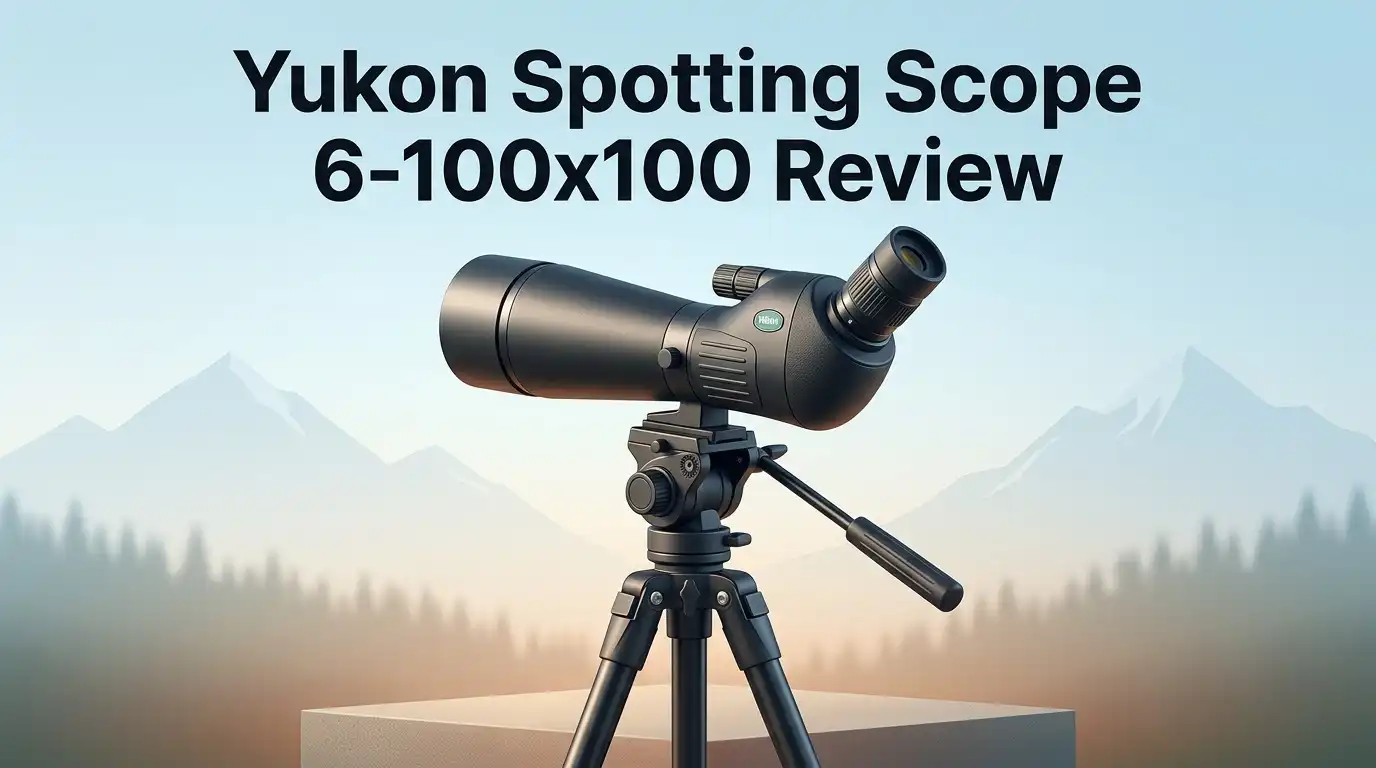
Yukon Spotting Scope 6-100×100 Review 2026: Still Worth It?
Most spotting scopes stop at 60x. The Yukon 6-100×100 keeps going all the way to 100x, and it does that with a clever trick most shooters have never seen before. Two objective lenses live inside one body. You flip a switch and the light path jumps from a small 25mm lens to a huge 100mm lens.
That sounds like marketing noise. It is not. This design has been around for years, and it still turns heads at the range because nothing else on a budget shelf looks or works quite like it.
So the real question in 2026 is simple. Does this odd looking scope still earn a spot on your tripod, or has the market passed it by? I spent time with the optics, read through owner feedback going back years, and compared it against the usual 80mm suspects.
In A Nutshell:
- The dual lens system is the main attraction. You get a 25mm objective running 6x to 25x, and a 100mm objective running 25x to 100x. A single knob switches between them. That means you can scan a wide area at 6x, then jump to serious magnification without swapping eyepieces or moving the tripod.
- It is shockingly light for a 100mm scope. The body weighs about 1.5 kg, or roughly 3.3 pounds. Comparable 100mm scopes often weigh double that. The folded light path makes this possible, and your back will notice on long walks.
- Image quality is genuinely good below 50x. Center sharpness holds up well. Contrast is solid. Colors run slightly warm. Above 60x, the picture softens and color fringing becomes obvious.
- Close focus is the biggest weakness. You need about 10 meters with the 25mm lens and around 50 meters with the 100mm lens. Backyard birders will hate this.
- It is not waterproof and has no nitrogen purge. Yukon never claimed otherwise. Treat rain as a real threat.
- Value is the whole story here. You pay budget money for features that normally cost far more.
Yukon Spotting Scope 6-100×100: What It Actually Is

Last update on 2026-09-24 / Affiliate links / Images from Amazon Product Advertising API Some of the links on this website are affiliate links, which means that at no additional cost to you, I earn a commission if you click through and make a purchase. I only recommend products and services that I believe will add value to my readers. Thank you for your support!
The Yukon 6-100×100 is a 45 degree angled spotting scope built by Yukon Advanced Optics Worldwide, a company founded in 1994 and based in Lithuania. Yukon also builds optics for other well known brands, so the engineering pedigree is real.
Here is the part that confuses people. This is technically two scopes in one housing. The label on the barrel reads 6-25×25 and 25-100×100. The small 25mm objective sits above the big one. A knob on the body redirects light from whichever lens you pick.
The prisms are BaK-4. The coatings are multi coated, though Yukon never specifies whether every surface gets treated. There is no ED or low dispersion glass, which matters at high power.
Physical dimensions run roughly 424mm long, 119mm wide, and 165mm tall. Weight sits at 1,500 grams without accessories. Field of view measures about 39 meters at 1,000 meters. Exit pupil ranges from 4mm down to 1mm as you zoom.
Tripod threads accept both 1/4 inch and 3/8 inch mounts. The eyepiece rotates so you can view comfortably from almost any body position, including flat on the ground.
The Unboxing Experience
Opening the box feels better than the price suggests. The scope arrives inside a padded protective case with a zipper closure, and the case itself is well built with a firm shell that resists crushing.
Lift the scope out and the first reaction is almost always the same. It looks like a small artillery piece. The wide flat body, the twin lens openings stacked vertically, the chunky zoom ring. Nothing else in this price range looks like it.
Then you pick it up. The lightness catches people off guard every single time. Your hands expect a heavy 100mm tube and get something closer to a pair of large binoculars instead.
In the box you get the scope body, the carrying case, a lens cleaning cloth, and the manual. Some kits historically shipped with a small tabletop tripod, though what arrives in 2026 depends on the seller and region. Do not count on a tripod being included.
The lens caps fit snugly. The screw on sunshade tucks back over the body when closed, which is a tidy touch. Fit and finish are decent, not luxurious. Plastic panels feel functional rather than premium.
Optical Performance In The Field
Last update on 2026-09-24 / Affiliate links / Images from Amazon Product Advertising API Some of the links on this website are affiliate links, which means that at no additional cost to you, I earn a commission if you click through and make a purchase. I only recommend products and services that I believe will add value to my readers. Thank you for your support!
This is where the scope earns praise and takes hits in equal measure.
Between 6x and roughly 40x, performance is genuinely satisfying. Center sharpness is good. Contrast holds. Color fringing stays modest and rarely distracts. Even people who own expensive glass admit the low and mid range views are pleasant.
Push past 50x and the story changes. Sharpness drops noticeably and chromatic aberration becomes visible right in the center of the field, not just at the edges. At 100x in bright afternoon sun, the image often looks soft and washed.
Some of that is physics rather than a Yukon flaw. Atmospheric heat shimmer destroys detail above 50x for almost every scope ever made, including flagship models costing six times more. Images literally appear to boil.
The honest working range is 6x to about 60x. Treat 100x as an occasional bonus for still mornings and cool evenings, not as a daily setting.
Field curvature is controlled reasonably well, largely because the apparent field is narrow to begin with. Edge detail stays readable in daylight.
Top 3 Alternative for Yukon 6-100×100 Spotting Scope


Last update on 2026-07-01 / Affiliate links / Images from Amazon Product Advertising API Some of the links on this website are affiliate links, which means that at no additional cost to you, I earn a commission if you click through and make a purchase. I only recommend products and services that I believe will add value to my readers. Thank you for your support!
Celestron Ultima 20-60×80 Angled Spotting Scope

Last update on 2026-09-13 / Affiliate links / Images from Amazon Product Advertising API Some of the links on this website are affiliate links, which means that at no additional cost to you, I earn a commission if you click through and make a purchase. I only recommend products and services that I believe will add value to my readers. Thank you for your support!
Vortex Diamondback HD 20-60×85 Angled Spotting Scope

Last update on 2026-09-13 / Affiliate links / Images from Amazon Product Advertising API Some of the links on this website are affiliate links, which means that at no additional cost to you, I earn a commission if you click through and make a purchase. I only recommend products and services that I believe will add value to my readers. Thank you for your support!
Gosky 20-60×80 Dual Focusing Spotting Scope
How The Dual Objective System Works
The switching mechanism deserves its own section because it shapes how you use this scope.
Turn the knob one way and light enters through the 25mm objective. Your zoom ring now delivers 6x to 25x. Turn it the other way and the 100mm objective takes over, giving you 25x to 100x.
The magnification scales proportionally in both modes. So if you are sitting at 100x on the big lens and flip the switch, you land at 25x on the small lens. The ratio stays consistent, which makes the transition predictable instead of jarring.
In practice this turns the 25mm side into a built in finder. You locate a distant deer, a target, or a raptor at 6x where the wide view makes searching easy. Then you flip and zoom.
Anyone who has hunted for a bird at 60x through a conventional scope knows how painful target acquisition can be. This design fixes that problem elegantly.
The one catch is that the two lenses have separate focus points. Switching means refocusing. You adapt quickly, but it is an extra step.
Eyepiece, Eye Relief, And Focusing
Eye relief sits between 12mm and 16mm depending on which optical path and magnification you are using. Yukon lists 16mm on spec sheets. Real world reports lean closer to 12mm at some settings.
That is tight. Eyeglass wearers will struggle, and several owners report vignetting, meaning dark shadowing around the edge of the view, until they learn exactly where to place their eye.
Removing the rubber eyecup helps glasses users get closer to the lens. It also helps with digiscoping.
Focusing happens through a ring on the eyepiece itself rather than a large knob on the body. It is a simple mechanism with no dual speed fine adjustment. At 100x, hitting perfect focus takes patience because the depth of field becomes razor thin.
The eyepiece rotates freely around the body axis. This is a genuinely useful feature. You can set a comfortable head angle whether you are standing, seated at a bench, or prone on a berm.
There is a diopter adjustment available, which helps if your eyes differ.
Close Focus And Field Of View Limits
Here is the section that will decide whether you buy or walk away.
Minimum focus distance is roughly 10 meters using the 25mm lens and around 50 meters using the 100mm lens. Those numbers are not typos.
Most quality 80mm spotting scopes focus down to 6 or 7 meters. Birders regularly watch feeders and pond edges at 15 to 20 meters. This Yukon simply cannot do that on the big lens.
If your targets sit inside 50 meters, the 100mm side is useless to you. You are effectively buying a 6-25×25 monocular for that distance.
Field of view is also narrow. About 39 meters at 1,000 meters is modest, and the apparent field feels tunnel like compared with wide angle eyepieces. This is not a wide angle instrument and Yukon does not pretend it is.
Combine narrow field with long close focus and the use case becomes clear. This scope is built for distance. Open country, shooting ranges, valleys, coastlines, airfields, and the night sky.
Weather Resistance And Durability
Read this part carefully because the spec sheet is blunt about it.
The Yukon 6-100×100 is not waterproof. It is not nitrogen purged. It is not fog proof. No official documentation, manual, or product page claims otherwise.
That places it behind almost every modern competitor at similar money. Budget scopes from Celestron, Gosky, and Vortex all seal their bodies now.
What does this mean day to day? Light mist will probably not kill it. Sustained rain might. Sharp temperature swings can fog the internal surfaces, and once moisture gets inside a non purged scope, it tends to stay.
The included case is water resistant and well made, so storage and transport are covered. Bring the case every time.
Build durability itself is reasonable. The housing resists knocks. The zoom ring turns smoothly with a clear magnification indicator printed on it. Nothing feels fragile in normal handling.
Treat this as a fair weather instrument. Plan around the limitation instead of testing it.
Tripod Requirements And Stability
The low weight helps here enormously.
At 1.5 kg, this scope does not demand a heavy duty tripod. A mid range photo tripod with a fluid pan head handles it comfortably. That saves you money and shoulder strain.
Do not skip the tripod though. At 100x, the tiniest vibration turns the image into a jelly wobble. Even at 40x, handholding is impossible.
A fluid head matters more than raw load capacity. Smooth panning lets you track moving subjects without jerky corrections. Cheap ball heads make high magnification tracking miserable.
Dual threads, 1/4 inch and 3/8 inch, mean nearly any head will attach. Some owners fit an Arca style plate for quick release.
Height matters too. Because the eyepiece sits at 45 degrees, a tripod that extends to seated eye level works well for bench shooting. For standing field use, you want full height extension.
Budget roughly one third of what you spent on the scope for a decent tripod. That ratio serves most people well.
Digiscoping And Phone Photography
Yukon offered dedicated photo adapters for this model, historically numbered 29024 and 29021, aimed at compact digital cameras. Availability in 2026 is spotty.
Universal smartphone adapters work as a practical substitute. Remove the rubber eyecup, clamp the phone holder over the eyepiece, and align the camera lens carefully.
Results are acceptable rather than impressive. Images taken around 30x look decent with visible detail and reasonable color. Push higher and the same softness you see with your eye shows up in the photo, amplified by the phone sensor.
Chromatic aberration photographs badly. Purple fringing around bright edges becomes obvious in images even when your eye barely noticed it live.
The narrow exit pupil at high magnification also creates vignetting in phone shots. You will crop a lot.
For documenting a rifle group, recording a distant animal, or sharing a moon photo, it works fine. For serious wildlife photography, buy a telephoto lens instead. Digiscoping here is a fun extra, not a core feature.
Astronomy Performance
This scope surprises people at night, and mostly in a good way.
A 100mm aperture gathers serious light. Point it at the Moon and you get dozens of craters, rim shadows, and surface texture. Lunar viewing is the standout performance.
Jupiter shows its two main equatorial cloud belts clearly. Saturn’s ring separates from the planet body. Mars reveals a hint of surface shading on good nights.
A purple halo surrounds bright objects because there is no ED glass. Jupiter and the Moon both show it. Experienced observers learn to look past it.
Star testing reveals astigmatism starting around 70 percent out from the field center. That is average performance, not embarrassing.
The 45 degree eyepiece is far more comfortable for sky viewing than a straight tube. Rotating the eyepiece lets you keep a natural neck angle as objects climb.
This will not replace a proper telescope. As a dual purpose daytime and casual astronomy instrument, though, it punches above its price.
What The Yukon 6-100×100 Does Not Do Well
Honest reviews list failures. Here are the real ones.
Close focus is poor. Fifty meters on the big lens rules out backyard birding, feeder watching, and most woodland observation.
High magnification disappoints. The 100x headline number is largely theoretical. Usable detail fades somewhere around 60x.
No weather sealing. In 2026 this is hard to forgive when competitors seal everything.
Tight eye relief. Glasses wearers get vignetting and eye placement frustration.
Narrow field of view. Scanning wide landscapes feels like looking through a tube.
No ED glass. Color fringing shows up earlier than it would on better glass.
Slow single speed focus. No fine focus knob makes precise adjustment at high power tedious.
Availability is inconsistent. Some regional distributors discontinued the model, so stock varies by seller and prices fluctuate.
None of these are dealbreakers on their own. Together they define exactly who this scope suits and who should look elsewhere.
Pros And Cons
Pros
- Unique dual objective design gives you a built in wide angle finder and a high power scope in one body
- Remarkably light at about 1.5 kg for a 100mm aperture instrument
- Strong image quality from 6x through roughly 40x with good center sharpness
- Rotating 45 degree eyepiece allows comfortable viewing from standing, seated, or prone positions
- Excellent price to performance ratio compared with conventional 100mm scopes
- Genuinely capable for casual astronomy, especially lunar and planetary viewing
- Well made protective case included
- Accepts both 1/4 inch and 3/8 inch tripod threads
- Compact folded light path makes packing easy
Cons
- Close focus of roughly 50 meters on the 100mm lens blocks most birding use
- Not waterproof, not fog proof, no nitrogen purge
- Image softens and color fringing grows above 50x to 60x
- Eye relief of 12mm to 16mm frustrates eyeglass wearers
- Narrow field of view at every magnification
- Single speed eyepiece focus lacks precision at high power
- No ED or low dispersion glass
- Switching lenses requires refocusing every time
Who Should Buy This Scope
Match the tool to the job and this scope makes sense.
Target shooters benefit most. At 100 to 300 yards you can spot bullet holes without walking downrange. The distance requirement suits the close focus limit perfectly, and the zoom flexibility helps at different range lengths.
Open country hunters will like the light weight and the fast 6x scanning mode for glassing ridgelines and open fields.
Beginner astronomers get a capable 100mm aperture that also works in daylight, which is rare value.
Landscape and panorama watchers in mountains or along coastlines have plenty of distance to work with.
Aviation and ship spotters get long reach and quick target acquisition.
Now the people who should skip it. Backyard birders, woodland naturalists, anyone who wears glasses and refuses to remove them, and anyone who observes in wet weather. Buy a sealed 80mm scope with 6 meter close focus instead.
Budget conscious buyers who want one versatile instrument will be happy. Perfectionists who count chromatic aberration will not.
Price And Value In 2026
Pricing has moved around a lot. European listings historically sat near 369 to 449 euros. Discounted deals often landed well below that.
Availability has thinned. Some distributors marked the model discontinued, while other sellers and marketplaces still carry stock. Always check current listings before assuming a price.
At anything under roughly 400 dollars, the value argument is strong. You get 100mm of aperture, a dual lens system nobody else offers at this price, and a 3.3 pound package.
At higher prices the argument weakens fast. A sealed Celestron Ultima 80 or a Gosky 20-60×80 gives you waterproofing and better close focus for similar money, though neither reaches 100x and neither has the finder trick.
Warranty coverage has been listed at two to three years depending on region and seller. Confirm this before buying.
The Yukon wins on uniqueness and weight. It loses on sealing and close focus. Decide which column matters more to you.
Frequently Asked Questions
Is the Yukon 6-100×100 waterproof?
No. The scope has no waterproof rating, no fog proof rating, and no nitrogen purge. The included carrying case is water resistant, but the scope body is not sealed. Keep it dry and store it in the case.
Does 100x magnification actually work?
It works optically, but usable detail drops sharply above 50x to 60x. Heat shimmer during daylight hours degrades the view further. Early morning, late evening, and cool stable air give the best high power results. Treat 100x as a bonus rather than a normal setting.
How close can it focus?
About 10 meters using the 25mm objective and roughly 50 meters using the 100mm objective. This is the single biggest limitation. Anyone observing subjects inside 50 meters should look at other scopes.
Can I use it for birdwatching?
Only for distant birds in open terrain such as raptors, shorebirds, and waterfowl across a lake. Woodland birding and feeder watching are impractical because of the long close focus and narrow field of view.
Does it work as a telescope?
Yes, for casual astronomy. The Moon looks excellent. Jupiter shows cloud belts, Saturn shows its ring, and brighter deep sky objects are visible. A purple halo appears around bright objects because there is no ED glass.
Do I need a special tripod?
No. At 1.5 kg, a standard mid range photo tripod handles it. Prioritize a smooth fluid pan head over raw weight capacity, since panning at high magnification is where cheap heads fail.
Is it good for eyeglass wearers?
Not really. Eye relief runs 12mm to 16mm, which is tight. Removing the rubber eyecup helps, but some vignetting may remain.
How heavy is it compared with other 100mm scopes?
Very light. At roughly 1.5 kg, it weighs about half what many conventional 100mm spotting scopes weigh. The folded light path design is the reason.
Is it still worth buying in 2026?
Yes, if you shoot at a range, glass open country, or want a light dual purpose day and night instrument at a low price. No, if you need weather sealing, close focus, or top tier glass.

Hello, I’m Emily Price, the founder of Birds Affection. As a passionate bird enthusiast and spiritual seeker, I’ve always been fascinated by the symbolic meanings and mystical connections between birds and our lives. On this website, I share my knowledge and insights on the spiritual significance of various bird species, exploring their roles as messengers, guides, and teachers. Through my writing, I aim to inspire and educate others on the profound wisdom and beauty that birds bring to our world. Join me on this journey as we delve into the enchanting realm of bird symbolism and discover the hidden meanings behind these magnificent creatures.