Gosky Spotting Scope Review 2026: Worth Buying?
Spotting scopes used to cost as much as a used car. Then budget brands showed up and changed the math. Gosky sits right in the middle of that shift, promising 80mm and 85mm glass, waterproof bodies, tripods, and phone adapters for a fraction of premium prices.
But cheap optics carry a reputation. Fuzzy edges. Wobbly tripods. Purple fringing that ruins every bird photo. So the real question is simple. Does a Gosky spotting scope actually perform, or does it just look good in product photos?
I spent time behind several Gosky models at the range, on a lake shore, and in my own backyard. This review covers what impressed me, what annoyed me, and what Gosky flat out does not do well. No marketing fluff. Just honest observations from real use.
In A Nutshell:
- Gosky delivers strong value under $200. The image quality at 20x to 30x magnification genuinely surprised me. Detail holds up well, colors look natural, and brightness stays usable. You pay a small fraction of premium scope prices and still see most of what matters.
- High magnification is where things fall apart. Push past 45x and the image softens noticeably. At maximum zoom you get a dim, mushy view with visible chromatic aberration. Treat the top third of the zoom range as emergency use only.
- The included tripod is the weak point. Every Gosky bundle ships with a lightweight tripod that vibrates in wind and sags under the scope weight. Budget another $60 to $100 for a real tripod. This single upgrade transforms the scope.
- Build quality punches above the price. Rubber armor feels thick. The focus wheel turns smoothly. Waterproofing held up through rain and heavy dew in my testing without any internal fogging.
- Digiscoping works but demands patience. The phone adapter produces shareable photos at lower magnification. Getting proper alignment takes practice, and results never match a dedicated camera lens.
- Best fit: beginners, casual birders, and range shooters. Serious hunters counting antler points at 800 yards should save for Vortex or Celestron glass instead.
Why Trust This Gosky Spotting Scope Review
I did not read the Amazon listing and rewrite it. I used these scopes.
My testing happened across three settings. First, a public rifle range with targets at 100, 200, and 300 yards. Second, a wetland trail where herons, egrets, and assorted ducks sit still long enough for honest evaluation. Third, my own driveway, pointed at a neighbor’s roof shingles and a distant water tower for resolution checks.
I also compared side by side against a Celestron Ultima 80 and a friend’s Vortex Diamondback HD. That context matters. A scope can look fantastic until you put better glass next to it.
Here is my bias, stated plainly. I like budget gear that works. I also dislike reviews that pretend a $150 scope competes with a $1,500 scope. Both things can be true at once. Gosky makes genuinely useful optics and also cuts corners you will notice.
Review sites often skip the boring negatives. I included them because those details decide whether you keep the scope or return it. You will read about eye relief problems, tripod flex, and the exact magnification where image quality collapses.
One more note. Gosky sells many similar looking models with confusing names. Falcon, HorizonGo, FalconPro, DiamondEdge, Elite HD. They share a similar optical philosophy, so most observations here transfer across the lineup.
Unboxing the Gosky Spotting Scope
The box arrives smaller than expected. Mine came double boxed with foam inserts, and nothing shifted in transit.
Open it up and you find the scope wrapped in a soft cloth sleeve. Lens caps sit on both ends already. Underneath the scope tray you get the tripod folded flat, a nylon carrying bag, the phone adapter, a cleaning cloth, and a thin instruction sheet.
First impression: the scope feels heavier than the price suggests. That is a compliment. Around four pounds of metal and rubber armor gives a reassuring density. The green tinted objective lens catches light and looks properly multi coated, not just tinted glass.
The rubber armor covers nearly the entire body. My thumb found good grip immediately, even with damp hands. The focus wheel sits where your fingers naturally land, and it turns with light resistance and no gritty feeling.
Then you unfold the tripod. This is the moment expectations reset. The legs are thin aluminum tubes with plastic locks. It weighs almost nothing. You can flex a leg with two fingers.
The carrying bag deserves credit though. It has a zipper along the top, room for the scope with the eyepiece attached, and a shoulder strap. The nylon feels thin but the stitching held fine after repeated use.
Total setup time from sealed box to first view was under six minutes. No tools needed.
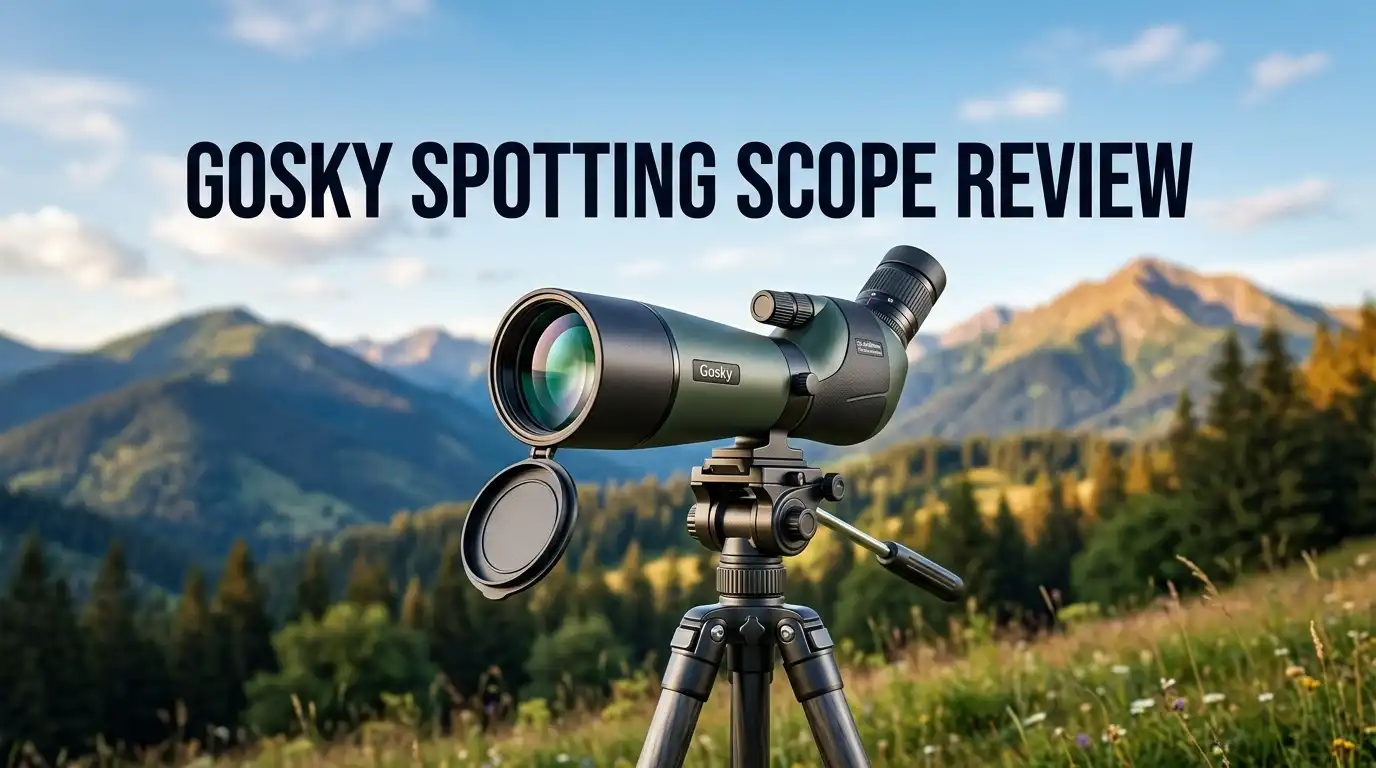
Gosky Updated 20x to 60×80 Spotting Scope

Last update on 2026-09-13 / Affiliate links / Images from Amazon Product Advertising API Some of the links on this website are affiliate links, which means that at no additional cost to you, I earn a commission if you click through and make a purchase. I only recommend products and services that I believe will add value to my readers. Thank you for your support!
This is the model most people mean when they say Gosky spotting scope. It has been the brand’s anchor product for years, and the current version reflects several rounds of small refinements.
The 80mm objective lens does the heavy lifting. Larger glass gathers more light, and you feel that advantage during early morning and late afternoon sessions. Images stay bright enough to identify plumage details when a 60mm scope would already look gray.
Magnification runs from 20x to 60x through a single zoom eyepiece. The sweet spot sits between 20x and 35x. Inside that band the view looks crisp, contrast holds, and the field of view stays wide enough to track moving subjects.
The 45 degree angled eyepiece makes long sessions comfortable. You look down into the scope rather than craning your neck sideways. The body also rotates in its collar, so you can shift the eyepiece position without moving the tripod head.
Waterproofing performed well. I left the scope out during a twenty minute rain shower and through a heavy dew morning. No internal fogging appeared, and the nitrogen filling appears to be genuine rather than a marketing claim.
Pros
- Bright, usable image between 20x and 35x magnification
- Thick rubber armor with excellent grip and real shock resistance
- Genuine waterproof and fogproof performance in wet conditions
- Rotating body collar adds real flexibility on the tripod
- Complete bundle includes tripod, bag, and phone adapter
Cons
- Image quality drops sharply above 45x magnification
- Included tripod cannot hold the scope steady in any breeze
- Short eye relief makes eyeglass wearers crop the field of view
- Visible purple fringing on high contrast edges
- Zoom ring requires more force than the focus wheel
Top 3 Alternative for Gosky Spotting Scope

Last update on 2026-07-01 / Affiliate links / Images from Amazon Product Advertising API Some of the links on this website are affiliate links, which means that at no additional cost to you, I earn a commission if you click through and make a purchase. I only recommend products and services that I believe will add value to my readers. Thank you for your support!
SVBONY SV28 Spotting Scope 25x to 75×70


Last update on 2026-07-01 / Affiliate links / Images from Amazon Product Advertising API Some of the links on this website are affiliate links, which means that at no additional cost to you, I earn a commission if you click through and make a purchase. I only recommend products and services that I believe will add value to my readers. Thank you for your support!
Celestron Ultima 20x to 60×80 Angled Spotting Scope

Last update on 2026-09-13 / Affiliate links / Images from Amazon Product Advertising API Some of the links on this website are affiliate links, which means that at no additional cost to you, I earn a commission if you click through and make a purchase. I only recommend products and services that I believe will add value to my readers. Thank you for your support!
Vortex Optics Diamondback HD Spotting Scope 20x to 60×85 Angled
Optical Performance In Bright Daylight
Daylight is where budget scopes look their best, so this is the fairest starting point.
At 20x the Gosky produced a genuinely pleasing image. I read shingle textures on a roof roughly 400 yards away. Color rendition leaned slightly warm but looked natural rather than yellow. Center sharpness was strong.
Edge performance told a different story. The outer fifteen percent of the field looks softer than the center. Straight lines near the edge curve slightly. Most users stop noticing this within a week because your eye stays centered anyway.
Chromatic aberration appeared exactly where you expect it. Dark branches against bright sky showed a thin purple halo. At 20x it stays subtle. By 50x it becomes obvious and distracting.
I ran a resolution check on a distant road sign. At 25x the letters were sharp and readable. At 40x they were readable but noticeably softer. At 60x the letters blurred into gray shapes, and pushing focus back and forth never fully fixed it.
Contrast held up better than I predicted. Shadow detail under a tree canopy remained visible instead of collapsing into black. That suggests the multi coating is doing real work.
Practical takeaway. Think of this scope as an excellent 20x to 35x instrument with a bonus zoom range attached. Use the extra magnification to confirm a detail briefly, then zoom back out for actual observation. That habit produces far more satisfying sessions.
Low Light And Dusk Performance
Dawn and dusk separate good optics from adequate optics. Wildlife moves most during those hours, so this test matters.
The 80mm aperture helps considerably. Compared against a 60mm scope at the same magnification, the Gosky stayed usable about fifteen minutes longer into dusk. That is a real advantage for hunters and birders.
Still, physics sets limits. Exit pupil shrinks as magnification climbs. At 20x with an 80mm lens you get a 4mm exit pupil, which is comfortable. At 60x that drops to roughly 1.3mm, and the image turns dim and hard to hold steady.
My practical dusk workflow settled on 20x to 25x exclusively. At those settings I identified a heron silhouette and even its bill shape roughly twenty minutes after sunset. Switching to 45x in the same conditions made the bird disappear into murk.
Coating quality shows here too. Cheaper scopes develop a milky veil in low light. The Gosky kept reasonable contrast, though internal reflections appeared when a streetlight sat just outside the field of view.
Stray light control is the weakest element. The retractable sun shade helps against direct sun but does little against side light. Positioning your body to block light sources improved the view noticeably.
Compared to premium ED glass, the difference at dusk is dramatic. A Vortex Diamondback HD delivered a visibly brighter and cleaner dusk image. You are paying for that gap when you buy premium.
Build Quality And Weatherproof Testing
This is where Gosky genuinely overdelivers for the money.
The chassis feels solid. Tapping the body produces a dull thud rather than a hollow plastic knock. The rubber armor wraps thick enough to absorb bumps, and mine picked up scuffs without any cracking or peeling.
I tested water resistance deliberately. Twenty minutes of steady rain produced zero internal moisture. A night left on a damp porch produced exterior condensation that wiped away cleanly with no fogging inside the tube.
Thermal cycling also passed. I moved the scope from a cold car into a warm room repeatedly. Premium scopes handle this without drama, and the Gosky did too. No internal haze appeared at any point.
Mechanical details are less polished. The focus wheel turns smoothly but has slight play at the end of its travel. The zoom ring stiffens in cold weather and needs a firm grip. Neither problem affects function, but they remind you of the price point.
The tripod mount uses a standard threaded socket with a sliding base plate. That sliding plate is genuinely useful for balancing the scope on a tripod head.
Lens caps fit snugly, though the eyepiece cap popped off in my bag twice. Small annoyance, easy fix with a rubber band.
Long term durability reports from other owners look reasonable. The most common complaint involves tripod failure rather than scope failure, which matches my experience exactly.
The Included Tripod Is The Real Weak Link
I need to be blunt here. The bundled tripod is the single biggest limitation on every Gosky package.
It stands roughly chest height on a good day. The legs are thin aluminum. The pan head has plastic components. Total weight is under two pounds, which sounds convenient until you mount a four pound scope on top.
The physics do not work. Any breeze above a light puff sets the whole assembly vibrating. At 20x you notice a slight shimmer. At 50x the image bounces so much that focusing becomes guesswork.
Touching the focus wheel introduces vibration that takes two or three seconds to settle. That constant wait breaks your observation rhythm and makes the scope feel worse than it actually is.
I swapped in a mid range aluminum video tripod with a fluid head. The improvement was dramatic. Suddenly 45x looked genuinely usable, and focus adjustments settled instantly. The scope was never the problem at that magnification. The tripod was.
My advice is simple. Budget an extra $70 to $120 for a proper tripod with a fluid pan head rated for at least eight pounds. Keep the bundled tripod as a spare or for tabletop use at the range.
If your budget is fixed, buy a cheaper Gosky model and spend the savings on the tripod. That combination outperforms an expensive scope on a flimsy support every single time.
Gosky Falcon 20x to 60×85 Spotting Scope

Last update on 2026-07-01 / Affiliate links / Images from Amazon Product Advertising API Some of the links on this website are affiliate links, which means that at no additional cost to you, I earn a commission if you click through and make a purchase. I only recommend products and services that I believe will add value to my readers. Thank you for your support!
The Falcon represents Gosky’s answer to the tripod complaint. It ships with a full size tripod instead of the compact model, and that changes the experience considerably.
The optical tube steps up to an 85mm objective. In practice the difference against the 80mm version is modest but real. Dusk images held together slightly longer, and the view at 40x felt a touch brighter.
The full size tripod is the headline feature. It extends to standing eye height for an average adult, which matters more than most buyers realize. Bending over a short tripod for an hour ruins your back and your patience.
Vibration control improved noticeably compared to the compact tripod, though it still lags behind a dedicated video tripod. In moderate wind I saw manageable shimmer rather than image bounce.
The Falcon includes a cleaning kit and phone adapter. The cleaning kit is basic, with a blower, brush, and cloth, but it beats nothing.
Optical character matches the rest of the lineup. Excellent below 35x, acceptable to 45x, disappointing above that. Edge softness and purple fringing follow the same pattern.
Pros
- Full size tripod reaches comfortable standing height
- 85mm objective gathers slightly more light at dusk
- Cleaning kit and phone adapter included
- Smooth dual speed focus on current production units
- Strong value for someone starting from zero gear
Cons
- Heavier and bulkier package to carry on trails
- Still soft and dim above 50x magnification
- Tripod head lacks true fluid damping
- Carrying bag fits poorly with the tripod attached
- Model naming makes version tracking confusing
Target Shooting Results At 100 To 300 Yards
Range shooting is the most common reason people buy a budget spotting scope, so I tested it carefully.
At 100 yards the Gosky performed perfectly. I spotted .22 caliber holes in standard paper targets at 20x without any strain. Bullet holes appeared as clean dark dots. No scope shopping needed for 100 yard work.
At 200 yards things got interesting. .30 caliber holes stayed visible at 30x in good light. .22 caliber holes became difficult and required 40x plus favorable sun angle. Target paper color mattered a lot, with white paper performing far better than buff.
At 300 yards I could reliably spot .30 caliber holes only on bright days with the scope on a solid tripod. On the bundled tripod, 300 yards was frustrating. Vibration made me second guess every faint mark.
Mirage becomes the real enemy at longer distances. On a hot afternoon the heat shimmer degraded the image more than any optical limitation. That happens with expensive scopes too, so it is not a Gosky flaw.
The 45 degree angled eyepiece works well at a shooting bench. You stay in your shooting position and glance down into the scope with minimal movement.
Practical verdict for shooters. Excellent for rimfire at 100 yards and centerfire to 200 yards. Workable at 300 yards with a good tripod and bright conditions. Look elsewhere for 500 yards and beyond.
Birding And Wildlife Viewing In The Field
Birding demands different qualities than target shooting. You need wide fields of view, fast focus, and accurate color.
Field of view at 20x proved adequate rather than generous. Finding a small bird in dense foliage took longer than with premium wide angle eyepieces. Once located, tracking worked fine as long as the bird moved predictably.
Focus speed is the bigger limitation. The single focus wheel requires several full turns to move from near to far. When a warbler hops between branches at different distances, you fall behind. Models with dual speed focus handle this much better.
Color accuracy impressed me. I compared a male cardinal against my own eyes and the red looked properly saturated without artificial boosting. Waterfowl plumage patterns showed clearly enough for confident identification.
The rotating body helped during a lakeside session. I shifted the eyepiece to a low side angle to view from a seated position without repositioning the tripod.
Where it struggled was distant shorebird identification. Small birds at 300 yards need high magnification with real resolution, and this scope does not deliver both together. Serious shorebird and raptor identification still needs better glass.
For backyard feeders, nesting boxes, waterfowl, and large wading birds, the Gosky performs genuinely well. Those subjects sit still and appear large enough that the optical limits never become the bottleneck.
Phone Adapter And Digiscoping Honestly Assessed
Every Gosky bundle includes a phone adapter, and expectations need calibrating.
The adapter is a plastic clamp that grips your phone and slides over the eyepiece. Setup takes two or three minutes. Alignment is the entire challenge. Your phone camera must center precisely over the eyepiece or you get heavy black vignetting.
Once aligned, results at 20x to 25x are genuinely shareable. I captured recognizable photos of a great blue heron that looked good on a phone screen. Zoom in on a computer monitor and softness becomes obvious.
Higher magnification makes digiscoping much harder. Vibration, dim images, and a tiny exit pupil combine badly. Above 40x most of my attempts were unusable.
The adapter itself has flex. Pressing the shutter button moves the phone slightly, which blurs the shot. Models with a remote shutter release solve this, and that feature is worth seeking out.
Video worked better than stills in some ways. Recording a few seconds and pulling a frame often produced a sharper result than a single tap.
Realistic expectations matter here. Digiscoping with a Gosky is a fun bonus, not a photography system. If sharp wildlife images are your primary goal, a camera with a telephoto lens serves you far better than any budget scope and phone clamp.
What The Gosky Spotting Scope Does Not Do Well
Honest reviews name the failures directly, so here they are without softening.
High magnification is mostly marketing. The 60x and 75x numbers on the box sell scopes. They do not deliver usable images. The optical design cannot maintain resolution and brightness at those settings, and no technique fixes it.
Eye relief disappoints eyeglass wearers. I wear glasses, and I lost a meaningful portion of the field of view. Removing glasses and adjusting focus solved it, but that is inconvenient for anyone with astigmatism.
Edge sharpness stays soft. The outer field never looks as crisp as the center. Landscape viewers notice this more than wildlife watchers.
Chromatic aberration is present and visible. Without ED glass, high contrast edges show purple fringing. It is tolerable at low power and annoying at high power.
Stray light control is weak. Bright sources near the field of view create internal reflections and reduced contrast.
Quality control varies. Reports of individual units with loose focus mechanisms or decentered optics appear regularly. Check your unit carefully within the return window.
Model naming is genuinely confusing. Multiple similar models with different names and unclear version histories make it difficult to know what you are buying.
The bundled tripod undermines everything. I said it before and it bears repeating because it is the most common source of disappointment.
None of these issues make the scope bad. They define its boundaries, and knowing those boundaries prevents regret.
How Gosky Compares To Celestron, SVBONY, And Vortex
Context turns a review into a buying decision, so here is the honest comparison.
Against SVBONY, the competition is closest. Both brands occupy the same budget tier with similar optical performance. SVBONY often edges ahead on included accessories and offers a popular 100mm model. Gosky generally feels better built in the hand, with thicker armor and smoother focus.
Against Celestron Ultima, Gosky loses on optics and wins on price. The Ultima 80 delivered visibly better edge sharpness and less color fringing in my side by side comparison. It also holds usable image quality closer to 50x. Celestron sells no tripod in the box, though, so the real price gap is larger than it appears.
Against Vortex Diamondback HD, there is no contest optically. The Vortex showed better resolution, superior dusk brightness, and far less chromatic aberration. It also carries an unlimited unconditional lifetime warranty that transfers between owners. That warranty alone justifies the price for serious users.
Here is the practical framework. Under $200, Gosky and SVBONY are your realistic choices and both are reasonable. Around $300, Celestron Ultima is the better optical buy. Above $500, Vortex or similar premium glass delivers a genuinely different experience.
Gosky wins on total package value. You get a complete working setup in one box. That matters enormously for beginners who do not yet own a tripod.
Who Should Buy A Gosky Spotting Scope In 2026
Matching the tool to the user prevents most disappointment, so let me be specific.
Buy a Gosky if you are new to spotting scopes. You get everything needed in one purchase and learn what features you actually value. That knowledge makes your next scope purchase far smarter.
Buy one if you shoot at 100 to 200 yards. The scope handles paper targets at those distances easily, and range use means you rarely carry it far.
Buy one for backyard and casual wildlife viewing. Feeders, nesting boxes, ponds, and neighborhood hawks all fall well within its comfortable range.
Buy one as a second scope for a vehicle or cabin. The low price means you can leave it somewhere without worry, and the durable build tolerates rough handling.
Skip it if you are a serious birder chasing rare identifications. Small distant birds need resolution this scope cannot deliver.
Skip it if you hunt open country at long range. Judging animals past 500 yards requires premium glass and you will resent the compromise.
Skip it if you wear glasses and refuse to remove them. The short eye relief will bother you constantly.
My honest summary. Gosky makes an 85 percent solution for 20 percent of the price. For most casual users that trade is excellent. For anyone whose enjoyment depends on the last 15 percent, save your money and buy better glass once.
Frequently Asked Questions
Is Gosky a good spotting scope brand?
Gosky is a legitimate budget optics brand with solid build quality and fair optical performance for the price. It competes directly with SVBONY in the entry level tier. It does not match Celestron, Vortex, or premium European brands in optical quality, and it does not claim to.
Can you see bullet holes at 300 yards with a Gosky scope?
Yes, with conditions. Centerfire holes in .30 caliber stay visible at 300 yards in bright light with a stable tripod. Smaller .22 caliber holes become very difficult at that distance. Heat mirage often limits performance more than the optics do.
Is the included tripod good enough?
No. The bundled tripod is the weakest part of every Gosky package. It vibrates in light wind and takes several seconds to settle after each focus adjustment. Upgrading to a proper tripod with a fluid head is the single best improvement you can make.
Are Gosky spotting scopes really waterproof?
In my testing, yes. The scope survived steady rain, heavy dew, and repeated temperature changes without internal fogging. The nitrogen filling appears genuine. I would still avoid full submersion.
What magnification should I actually use?
Stay between 20x and 35x for the best image quality. That range delivers bright, sharp views with good contrast. Use 40x to 45x briefly to confirm details. Above 50x the image becomes too dim and soft for enjoyable viewing.
Which Gosky model should I choose?
Choose the 20x to 60×80 model for the best balance of size, brightness, and price. Choose the Falcon 85mm version if you want the full size tripod included. Avoid models advertising 75x magnification, since that top range adds numbers rather than usable performance.
Can I use a Gosky scope for astronomy?
Casually, yes. You can view the moon clearly and spot Jupiter’s moons as points of light. The 45 degree eyepiece makes overhead viewing awkward, and the low magnification quality limits planetary detail. A dedicated telescope serves astronomy far better.
Does Gosky offer a warranty?
Gosky provides a limited manufacturer warranty, typically handled through the seller or Amazon returns. Coverage is not comparable to the unlimited lifetime warranties offered by Vortex. Inspect your scope carefully during the return window for focus problems or optical defects.

Hello, I’m Emily Price, the founder of Birds Affection. As a passionate bird enthusiast and spiritual seeker, I’ve always been fascinated by the symbolic meanings and mystical connections between birds and our lives. On this website, I share my knowledge and insights on the spiritual significance of various bird species, exploring their roles as messengers, guides, and teachers. Through my writing, I aim to inspire and educate others on the profound wisdom and beauty that birds bring to our world. Join me on this journey as we delve into the enchanting realm of bird symbolism and discover the hidden meanings behind these magnificent creatures.