Celestron Ultima Spotting Scope Review 2026: Still Worth It?
Spotting scopes confuse a lot of first time buyers. The prices swing from under one hundred dollars to over three thousand. Somewhere in the middle sits the Celestron Ultima line, a family of scopes that has quietly sold for two decades without much fanfare.
People keep buying them. Birders keep recommending them on forums. Range shooters keep hauling them to the 300 yard line.
I spent time with the Ultima 80 and the Ultima 100, compared them against newer rivals, and dug through hundreds of owner reports. This review covers the good glass, the honest flaws, and the models worth skipping.
In a Nutshell:
- The Ultima line delivers strong value under 300 dollars. You get a fully coated 65mm, 80mm, or 100mm objective, a waterproof nitrogen filled body, and a zoom eyepiece in one box. Few competitors match that package at the same price without cutting corners on sealing or glass.
- Image quality is very good at low power and soft at maximum power. Expect crisp, bright views through roughly 60 percent of the zoom range. Push past that and the picture dims, contrast drops, and fine detail smears. This is normal for non ED glass, but you should know it before buying.
- Weight is the biggest hidden cost. The Ultima 80 weighs 57 ounces. The Ultima 100 stretches 22 inches long. You will need a genuinely sturdy tripod, and that purchase often costs as much as the scope itself.
- Color fringing shows up on high contrast edges. Dark branches against bright sky produce a faint purple or green halo. Birders who chase subtle plumage detail will notice it. Target shooters checking bullet holes will not care.
- Celestron backs the Ultima with a limited lifetime warranty. Service reports from US owners are mostly positive, which matters more than spec sheets when a focus collar seizes after three seasons.
- The sweet spot is the Ultima 80. It balances brightness, weight, and price better than the 65mm or the 100mm siblings.
Celestron Ultima 80 Angled Spotting Scope


Last update on 2026-07-01 / Affiliate links / Images from Amazon Product Advertising API Some of the links on this website are affiliate links, which means that at no additional cost to you, I earn a commission if you click through and make a purchase. I only recommend products and services that I believe will add value to my readers. Thank you for your support!
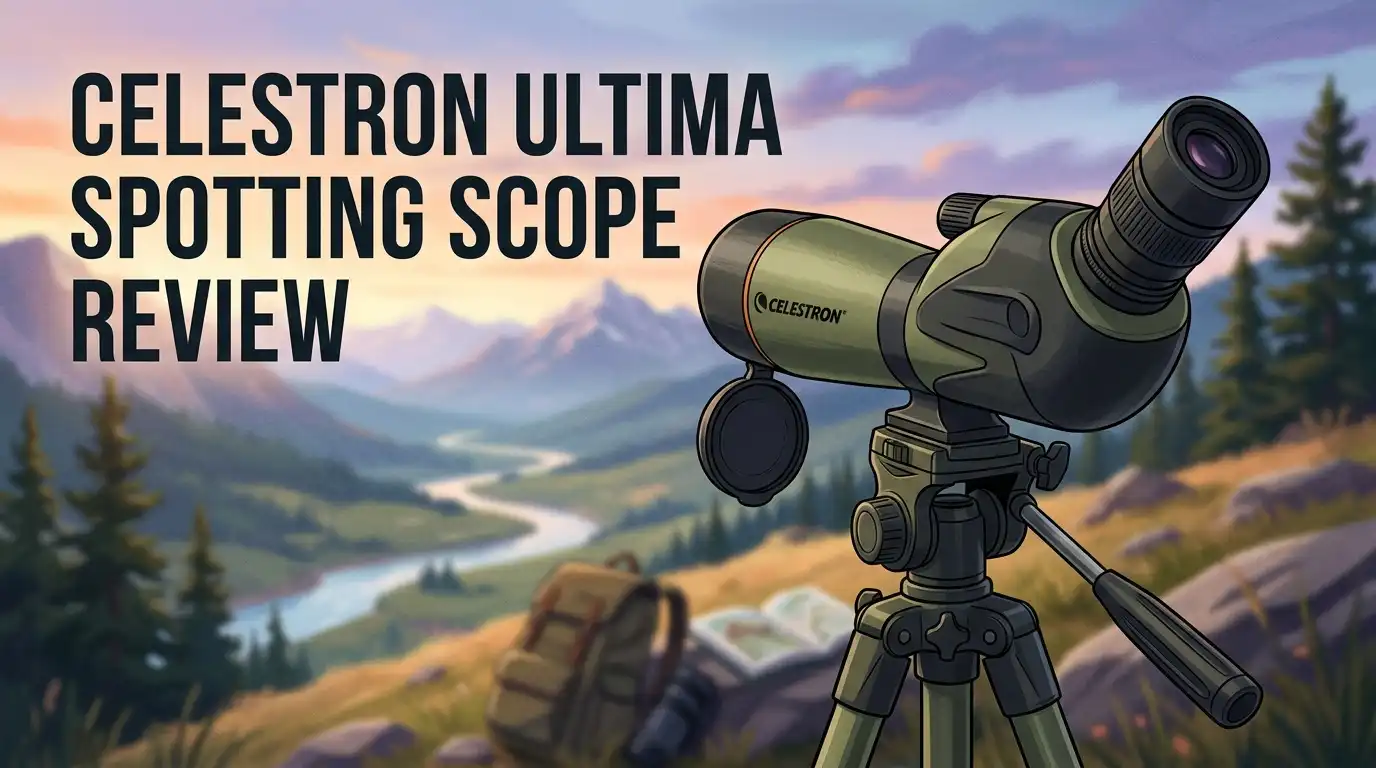
The Ultima 80 is the model most people mean when they say “Celestron Ultima.” It pairs an 80mm objective with a 20x to 60x zoom eyepiece and a 45 degree angled body. Celestron rates the field of view at 2.0 degrees wide open, narrowing to about 53 feet at 1000 yards when you crank the zoom. Eye relief sits at 18mm, which is generous enough for glasses wearers at lower magnifications.
The body wears a green rubber armor coat. It feels grippy in rain and hides you reasonably well in brush. The tube is waterproof and nitrogen purged, so interior fogging has not been a common complaint among owners.
What sells this model is simple math. An 80mm lens gathers 77 percent more light than a 60mm lens. In early morning woods, that difference is immediately visible.
Unboxing the Ultima 80: What Actually Arrives
The box is plain cardboard with a product photo on the front. Nothing premium about it. Inside you find the scope already wrapped in its soft nylon carrying case, a separate zoom eyepiece in a small plastic tube, lens caps, a cleaning cloth, and a thin printed manual.
Assembly takes under a minute. You unscrew the dust cover from the eyepiece port, thread the zoom eyepiece in, and tighten by hand. That is the whole setup.
The soft case deserves a mention because it is better than expected. It zips open at the top and side, which means you can leave the scope inside while it sits on the tripod. Rain protection without unpacking is a real convenience.
The disappointment is the lens caps. They are loose fitting rubber and pop off inside a backpack. Most owners replace them within a month.
Celestron Ultima 100 Angled Spotting Scope

Last update on 2026-09-24 / Affiliate links / Images from Amazon Product Advertising API Some of the links on this website are affiliate links, which means that at no additional cost to you, I earn a commission if you click through and make a purchase. I only recommend products and services that I believe will add value to my readers. Thank you for your support!
The Ultima 100 is the heavyweight of the family. It carries a 100mm objective with a 22x to 66x zoom eyepiece, a 540mm focal length, and 18mm of eye relief. Field of view runs 94 feet down to 52 feet at 1000 yards. Close focus is roughly 33 feet, which is far too long for butterfly watching but fine for everything else.
Testers consistently praise the brightness. That 100mm front element pulls in serious light, and dusk viewing holds up well past the point where smaller scopes go muddy.
The cost is bulk. At 22 inches long and over 2 kilograms, this is not a scope you carry on a ridge hike. Think of it as a vehicle based or backyard instrument. Set it up, leave it, and enjoy the view.
Optical Performance in Daylight
Daylight is where the Ultima line looks best. At 20x through about 35x, images are bright, sharp across most of the field, and pleasantly neutral in color. Feather barring on a hawk at 200 yards resolves clearly. Bullet holes in paper at 200 yards show up without guesswork.
Edge sharpness falls off in the outer 15 percent of the field. You notice it if you look for it. Most people simply recenter the subject.
Contrast is the weaker trait. Compared against ED glass scopes, the Ultima renders slightly flatter images with less separation between similar tones. A grey bird against grey bark is harder to pick out here than through a premium scope.
Chromatic aberration appears on backlit edges as thin purple fringing. It grows worse as magnification climbs.
Top 3 Alternative for Celestron Ultima Spotting Scope

Last update on 2026-09-13 / Affiliate links / Images from Amazon Product Advertising API Some of the links on this website are affiliate links, which means that at no additional cost to you, I earn a commission if you click through and make a purchase. I only recommend products and services that I believe will add value to my readers. Thank you for your support!
Athlon Optics Talos 20 to 60×80 Spotting Scope

Last update on 2026-10-07 / Affiliate links / Images from Amazon Product Advertising API Some of the links on this website are affiliate links, which means that at no additional cost to you, I earn a commission if you click through and make a purchase. I only recommend products and services that I believe will add value to my readers. Thank you for your support!
Gosky 20 to 60×80 Spotting Scope with Smartphone Adapter

Last update on 2026-09-13 / Affiliate links / Images from Amazon Product Advertising API Some of the links on this website are affiliate links, which means that at no additional cost to you, I earn a commission if you click through and make a purchase. I only recommend products and services that I believe will add value to my readers. Thank you for your support!
Vortex Optics Diamondback HD Spotting Scope 20 to 60×85
Low Light and Dusk Performance
Low light is where objective size earns its keep. The Ultima 80 produces a 4mm exit pupil at 20x. The Ultima 65 manages 3.6mm. The human pupil can open to 7mm in darkness, so none of these scopes fully saturate your eye, but the larger models clearly stretch your usable minutes at dawn and dusk.
In practice, the Ultima 80 at 20x stays workable for roughly 20 to 30 minutes after sunset. Push to 40x and that window shrinks fast.
The Ultima 100 is the low light champion of the line. Its 4.5mm exit pupil at 22x holds brightness noticeably longer.
Here is the honest limit. Coated BK7 prisms transmit less light than premium glass. A good 65mm ED scope will beat the Ultima 80 at twilight despite the smaller lens.
Build Quality and Weather Sealing
The Ultima feels solid in hand. The aluminum tube resists flex, the rubber armor absorbs knocks, and the whole assembly has a density that cheap scopes lack. Owners report dropping these from tripod height onto dirt with no optical damage.
Waterproofing holds up. Multiple long term users describe full days in steady rain and coastal spray without water intrusion or internal fogging.
The rotating tripod collar is a standout feature. Loosen the ring, rotate the body, and you can view comfortably whether your tripod sits high or low. The detent clicks are firm.
The weak point is the focus collar. Several owners report it stiffening over years of use, and a smaller number report it binding entirely. Celestron warranty service usually resolves it.
The Zoom Eyepiece and Focus Collar
The Ultima uses a single speed focus collar wrapped around the tube just behind the objective. You rotate it with your whole hand rather than a fingertip knob. This design has fans and critics.
The upside is that you can grab it anywhere around the circumference, even with gloves on. The downside is that there is no fine focus mechanism. At 60x, the difference between sharp and soft is a hair of rotation, and nailing it takes patience.
Zoom happens at the eyepiece. You twist a knurled ring and magnification climbs smoothly. Image shift during zooming is minimal, which is better than many budget rivals manage.
The eyepiece unscrews completely, so you can swap in other Celestron eyepieces if you want a fixed wide angle option.
Ultima 65 vs Ultima 80 vs Ultima 100
Three sizes, three different buyers.
The Ultima 65 weighs 37 ounces and runs 18x to 55x. It is the travel model. If you hike with your optics or want something a lightweight tripod can hold, this is your pick. You trade brightness for portability.
The Ultima 80 is the balanced choice. It weighs 57 ounces, reaches 60x, and gathers 50 percent more light than the 65mm. Most buyers should start here.
The Ultima 100 is the stationary powerhouse. Brightest views, longest reach, and genuine astronomy ability, but 22 inches of length and real heft.
Each size comes in straight or 45 degree angled form. Angled suits shared viewing and upward angles. Straight suits quick target acquisition.
Tripod Requirements You Cannot Skip
This section matters more than the glass discussion. A wobbly tripod ruins any spotting scope, and the Ultima is heavy enough to expose weak support instantly.
At 20x, small vibrations are tolerable. At 60x, a breeze against a flimsy aluminum tripod makes the image dance so badly that you cannot judge detail. Many one star reviews of the Ultima line are really tripod complaints in disguise.
For the Ultima 65, a mid weight photo tripod rated for 5 pounds works. For the Ultima 80, look for something rated at 10 pounds or more with a fluid pan head. For the Ultima 100, use a tripod built for telephoto camera work.
Budget 100 to 200 dollars for support. It transforms the scope.
Digiscoping and Phone Photography
All Ultima models accept a T mount adapter, which lets you attach a DSLR or mirrorless camera body directly to the scope. The scope then works as a long telephoto lens. Results are soft at the corners but usable for documentation shots of distant birds.
Phone digiscoping works too, though Celestron does not include an adapter in every package. A third party universal phone bracket clamps over the eyepiece.
The 18mm eye relief helps here because phone lenses need space to find the exit pupil.
Expect vignetting. You will see a dark circle around your image unless you zoom the phone camera slightly. Image quality at 60x through a phone is poor. Stick to 20x or 30x for photos and the results improve dramatically.
Using the Ultima for Astronomy
Celestron builds telescopes, so it is fair to ask how the Ultima performs on the night sky. The answer is better than you expect, within limits.
The Ultima 100 shows lunar craters with real texture. Jupiter resolves as a small disc with its four bright moons strung alongside. Saturn shows rings as a distinct shape rather than a blur. Bright star clusters like the Pleiades look lovely in the wide field.
Deep sky objects are a stretch. Galaxies and faint nebulae need more aperture and a darker sky than most backyards offer.
The terrestrial design works against you in one way. The image is correctly oriented, which is convenient, but the extra prism surfaces cost you a little light compared with a dedicated astronomical scope.
What the Celestron Ultima Does Not Do Well
Honest reviews name the flaws, so here they are plainly.
Maximum magnification is largely marketing. The top 20 percent of the zoom range is soft enough that experienced users avoid it. Treat the Ultima 80 as a 20x to 45x scope and you will be happy.
Color fringing is visible. Non ED glass shows purple edges on high contrast subjects. Serious birders notice this constantly.
The scope is heavy for its class. Modern competitors hit similar apertures at lower weight.
Close focus is long. Roughly 20 feet on the 65mm and 33 feet on the 100mm rules out insect watching.
The lens caps are genuinely bad. Small thing, but it reflects where the cost savings happened.
Pros and Cons
Pros
- Excellent brightness for the price thanks to large objectives and fully coated optics
- Genuinely waterproof and nitrogen purged body that survives hard weather
- Rotating tripod collar makes shared and awkward angle viewing easy
- Removable eyepiece accepts upgrades and T mount camera adapters
- 18mm eye relief works well for eyeglass wearers at moderate power
- Limited lifetime warranty from a long established US based brand
- Soft case allows use while the scope stays partly packed
Cons
- Soft, dim image in the top third of the zoom range
- Visible purple fringing on high contrast edges due to non ED glass
- Heavy compared with newer scopes of the same aperture
- Single speed focus collar lacks fine adjustment for high power work
- Long close focus distance limits nearby subjects
- Cheap lens caps that fall off during transport
- Demands an expensive tripod to perform properly
Who Should Buy the Celestron Ultima in 2026
The Ultima makes sense for a specific buyer. You want serious aperture without spending serious money. You observe mostly in daylight. You value durability over the last 10 percent of optical refinement.
Target shooters are the happiest Ultima owners. Spotting holes at 200 to 300 yards needs light gathering and reliability, not perfect color correction.
Casual birders and backyard nature watchers do well here too. So do parents buying a first real optic for a curious teenager.
Skip the Ultima if you are a competitive birder chasing subtle field marks, or if you hike long distances with your gear. In those cases, save longer and buy an ED scope.
The price to performance ratio remains strong in 2026. Few scopes under 300 dollars offer this combination of aperture, sealing, and warranty support.
Price, Warranty, and Long Term Value
Street prices in 2026 generally run roughly 180 to 240 dollars for the Ultima 65, 250 to 320 dollars for the Ultima 80, and 350 to 430 dollars for the Ultima 100. These figures shift with sales, so check current listings before buying.
Celestron covers the Ultima with a limited lifetime warranty for the original owner in the US. Owner reports describe reasonable turnaround on focus mechanism repairs, which is the most common failure.
Resale value holds up well. Used Ultimas move quickly on forums and classified boards, often at 60 to 70 percent of retail after years of use.
That resilience tells you something. A product people still want secondhand after a decade is usually a product that worked.
Final Verdict
The Celestron Ultima is not the sharpest spotting scope you can buy. It never was. What it offers instead is a large, bright objective in a tough weatherproof body at a price that does not hurt.
I would buy the Ultima 80 angled model for most uses. It hits the balance point between light gathering and portability, and the 45 degree eyepiece makes long sessions comfortable.
Go bigger with the Ultima 100 only if your scope will live in a vehicle or on a deck. Go smaller with the Ultima 65 only if weight genuinely limits you.
Pair whichever you choose with a solid tripod, use the lower half of the zoom range, and this scope will serve you for years. That is a fair deal in 2026.
Frequently Asked Questions
Is the Celestron Ultima good for bird watching?
Yes, for casual and intermediate birders. The large objective delivers bright images, and the angled models are comfortable for long sessions. Serious birders who identify species by subtle plumage detail will want ED glass instead, because the Ultima shows color fringing on high contrast edges.
Does the Celestron Ultima come with a tripod?
No. The package includes the scope, zoom eyepiece, lens caps, and a soft carrying case. You must buy a tripod separately, and a sturdy one matters enormously for image stability at higher magnifications.
What is the real usable magnification of the Ultima 80?
Roughly 20x to 45x in good light. The scope reaches 60x, but image sharpness and brightness drop noticeably above 45x. Most experienced owners park the zoom around 30x for everyday viewing.
Can I attach my phone to the Celestron Ultima?
Yes, with a universal smartphone adapter that clamps over the eyepiece. Results are best at lower magnifications. Expect some vignetting and reduced sharpness compared with a dedicated camera setup.
Is the Celestron Ultima waterproof?
Yes. All Ultima models are waterproof and nitrogen purged against internal fogging. Owners report full days of rain and coastal spray without water intrusion.
Straight or angled, which should I choose?
Choose angled if you share the scope, view upward often, or use a shorter tripod. Choose straight if you need fast target acquisition or view from a seated position at the shooting range.
How does the Ultima compare to the Celestron Regal M2?
The Regal M2 uses ED glass and dual speed focus, which produces sharper images with far less color fringing. It costs significantly more. The Ultima is the value pick, the Regal is the performance upgrade.

Hello, I’m Emily Price, the founder of Birds Affection. As a passionate bird enthusiast and spiritual seeker, I’ve always been fascinated by the symbolic meanings and mystical connections between birds and our lives. On this website, I share my knowledge and insights on the spiritual significance of various bird species, exploring their roles as messengers, guides, and teachers. Through my writing, I aim to inspire and educate others on the profound wisdom and beauty that birds bring to our world. Join me on this journey as we delve into the enchanting realm of bird symbolism and discover the hidden meanings behind these magnificent creatures.