Leupold Mark 4 Spotting Scope Review 2026: Still Worth It?
The Leupold Mark 4 spotting scope has a reputation that arrived long before most of us picked one up. Military spotters carried it. Police marksmanship units trusted it.
Precision rifle shooters argued about it on forums for two decades. So the question in 2026 is simple. Does this flat black, reticle equipped spotter still earn its price tag against a flood of newer glass?
I spent time behind the Mark 4 at the range, on a hillside, and in mediocre light. This review covers the unboxing, the optics, the reticle, the honest weak points, and who actually needs one. No marketing fluff. Just what the scope does and where it falls short.
In a Nutshell:
- The optics are genuinely excellent. Edge to edge sharpness, strong color contrast, and easy mirage reading. Trace pickup at 40x is where this scope shines hardest.
- The reticle is the real selling point. Leupold stripped the thick stadia and left only the milling marks, so the TMR sits in the field of view without blocking your target. It lives in the first focal plane, so ranging works at any magnification.
- Build quality is tank grade. Nitrogen filled, fully waterproof, rubber armored, and covered by Leupold’s lifetime guarantee. This thing shrugs off abuse that would fog cheaper glass.
- Eye relief is unusually generous. Roughly 30mm means glasses wearers get a full sight picture, which many spotters cannot deliver.
- The price is the biggest objection. MSRP now sits near the $2,700 to $2,900 range depending on model and reticle. Competitors offer brighter, wider glass for less money, just without the milling reticle.
- It is not a birding scope. No interchangeable eyepieces, modest low light punch from the 60mm objective, and a design tuned for tactical work rather than casual nature viewing.
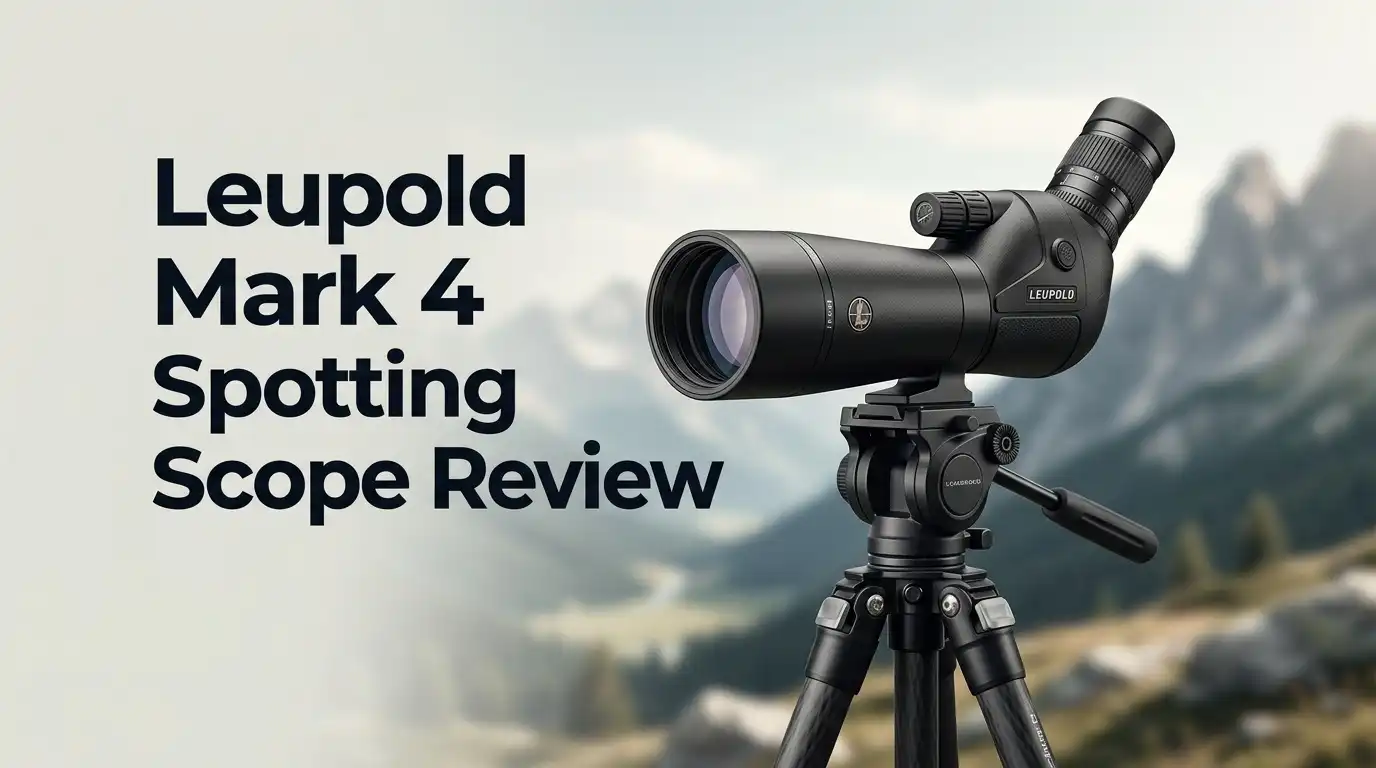
Leupold Mark 4 12-40x60mm Spotting Scope

Last update on 2026-09-18 / Affiliate links / Images from Amazon Product Advertising API Some of the links on this website are affiliate links, which means that at no additional cost to you, I earn a commission if you click through and make a purchase. I only recommend products and services that I believe will add value to my readers. Thank you for your support!
The Mark 4 12-40x60mm is the model most people mean when they say “Mark 4 spotter.” It uses a folded light path design, which is the reason a 60mm objective scope feels so short in your hands. Leupold squeezed the optical path into a compact body, and the payoff is a spotter that slides into the top of a ruck instead of hanging off it.
Actual magnification runs about 12.7x to 38.1x, slightly under the badged numbers. Field of view measures roughly 168 feet down to 52 feet at 1,000 yards. That wide end is more useful than it sounds, because finding your target fast matters more than staring at it.
Three reticle options exist: TMR, Mil Dot, and the Inverted H-32. The TMR is the most popular choice for precision rifle work. Lenses carry index matched coatings plus DiamondCoat 2, an ion assist treatment that resists scratches better than standard coatings.
The whole package is built in the USA and backed by Leupold’s lifetime guarantee. That warranty matters on a purchase this size.
Unboxing Experience: What Arrives in the Box
Leupold packs its high end optics well, and the Mark 4 follows that pattern. The box is plain, the foam is snug, and the scope sits inside its cover rather than loose. No wasted flourish.
Open it and you get the scope, a form fitted padded cover, a detachable carry strap, warranty documentation, and lens caps. That is the whole list. No tripod. No phone adapter. No cleaning kit. At this price, the missing tripod stings a little.
Pick the scope up and the first thing you notice is the texture. The armor is soft and matte, with real grip even in wet hands. There is zero gold ring branding, unlike Leupold’s hunting line. Everything is flat black for a reason.
The cover deserves its own mention. It is designed to stay on the scope permanently. Front flap folds down, rear zips open over the eyepiece, side panels velcro back. There is even a flap covering the tripod socket. It works beautifully.
One honest gripe from the first minute: that velcro is loud. Anyone who cares about noise discipline will notice immediately.
Key Specifications at a Glance
Numbers tell part of the story, so here is the summary in plain language.
The 12-40x60mm model weighs roughly 2.3 pounds and measures about 12.4 inches long. The larger 20-60x80mm version adds significant bulk and glass. Both use a folded light path to stay shorter than their objective size suggests.
Eye relief sits near 1.18 inches, or 30mm. This is a standout figure. Most spotting scopes force glasses wearers to choose between a full picture and comfort. The Mark 4 does not.
Construction is nitrogen filled, armored, and 100% waterproof and fogproof. The eyecup folds down rubber style. A built in quarter twenty swiveling tripod socket sits underneath, so any standard tripod head works without an adapter.
Magnification and focus rings sit in a row, with the zoom forward and focus closest to your eye. Leupold gave them different textures on purpose. The zoom ring is wide and smooth. The focus ring is narrow and ridged. You can tell them apart by feel alone, without breaking your sight picture.
Optical Performance in the Field
This is where the Mark 4 justifies itself. Image quality is clean, sharp, and consistent all the way to the edge of the frame. There is no mushy outer ring where detail falls apart, which is a common failure in mid tier spotters.
Color contrast impressed me most. Reading mirage became almost effortless, and bullet trace popped clearly enough to call corrections at distance. That is the actual job of a tactical spotter, and the Mark 4 performs it without argument.
Longtime testers have ranked this glass close to premium European spotters at similar objective sizes, with the European option holding a slight edge for noticeably more money. For tactical use, the Mark 4 trades that sliver of brightness for features the others lack.
Where does it lag? Low light. A 60mm objective simply gathers less light than the 80mm and 85mm scopes dominating the market now. At dusk, newer ED glass competitors pull ahead visibly.
Chromatic aberration is controlled but not eliminated. Push to 40x on a high contrast edge and you will spot faint color fringing.
Top 3 Alternative for Leupold Mark 4 Spotting Scope

Last update on 2026-09-13 / Affiliate links / Images from Amazon Product Advertising API Some of the links on this website are affiliate links, which means that at no additional cost to you, I earn a commission if you click through and make a purchase. I only recommend products and services that I believe will add value to my readers. Thank you for your support!
Vortex Diamondback HD Spotting Scope 20-60×85

Last update on 2026-07-25 / Affiliate links / Images from Amazon Product Advertising API Some of the links on this website are affiliate links, which means that at no additional cost to you, I earn a commission if you click through and make a purchase. I only recommend products and services that I believe will add value to my readers. Thank you for your support!
Vortex Razor HD Spotting Scope 27-60×85 Angled

Last update on 2026-07-25 / Affiliate links / Images from Amazon Product Advertising API Some of the links on this website are affiliate links, which means that at no additional cost to you, I earn a commission if you click through and make a purchase. I only recommend products and services that I believe will add value to my readers. Thank you for your support!
Athlon Optics Cronus G2 20-60×86 Spotting Scope
TMR and Mil Dot Reticles Explained
A reticle inside a spotting scope sounds obvious today. It was not obvious when Leupold did it. The Mark 4 was the scope that made reticle equipped spotters mainstream.
Here is why it matters. Ranging with a 10x riflescope gives you coarse mil readings. Ranging at 40x gives you fine ones. More magnification means smaller measurement error, which means a better firing solution.
The clever part is what Leupold removed. Earlier attempts at reticle spotters used full mil dot patterns with thick stadia lines, and those heavy lines blocked mirage and trace. Leupold deleted the fat stadia and kept only the milling portion. The result barely intrudes on the view, especially at lower power.
The TMR uses hash marks with half mil subdivisions instead of dots. Hash marks are easier to read against a target than round dots.
Critically, the reticle sits in the first focal plane. It grows and shrinks with magnification, so your mil values stay true at 12x, 25x, or 40x. You never have to zoom to a specific power to range.
Build Quality and Weather Resistance
Leupold built the Mark 4 to survive things owners do not plan for. Drops onto rock. Rain that lasts all day. Truck beds. Helicopter rides.
The body carries thick rubber armor over an aluminum chassis. That armor absorbs impact and adds grip at the same time. Nitrogen purging seals the internals against moisture, so the scope will not fog when you move from a cold morning to a warm vehicle.
Waterproofing is absolute rather than splash rated. Submersion does not kill it. The DiamondCoat 2 lens treatment resists the scratches that come from field cleaning with whatever cloth you happen to have.
In practice, the Mark 4 feels noticeably more solid than similarly priced hunting spotters. There is no creak, no flex, and no slop in the rings after years of use. Used examples on the secondhand market usually still work perfectly, which tells you something.
The lifetime guarantee covers the mechanical scope regardless of who owned it first. Leupold’s service reputation is one of the better ones in optics.
Handling, Controls, and Ergonomics
The Mark 4 is pleasant to operate, and that is not a given in this category. Compact size makes a real difference when you carry gear on your back.
Both rings turn with even resistance. No gritty spots, no dead zones. The texture difference between zoom and focus is the smartest small design choice on the scope. You keep your eye on target and adjust by touch, which is exactly what a spotter needs during a string of fire.
The fold down rubber eyecup works with or without glasses. Combined with that long eye relief, head position becomes forgiving instead of fussy. You are not hunting for the sweet spot every time you get behind it.
Straight body design means prone use is natural. Angled spotters are more comfortable for standing observation, and Leupold does not offer the Mark 4 in an angled configuration. That is a genuine limitation for range use from a bench or chair.
Focus throw is moderate. Going from 100 yards to 1,000 takes a deliberate turn rather than a flick.
Leupold Mark 4 20-60x80mm Spotting Scope

Last update on 2026-09-18 / Affiliate links / Images from Amazon Product Advertising API Some of the links on this website are affiliate links, which means that at no additional cost to you, I earn a commission if you click through and make a purchase. I only recommend products and services that I believe will add value to my readers. Thank you for your support!
If the 12-40x60mm feels too small, Leupold sells the same concept with more glass. The 20-60x80mm delivers higher top end magnification and a larger objective, which means better brightness and more detail at extreme distance.
Reticle options include TMR and Mil Dot, using the same stripped down milling pattern. Everything else carries over: folded light path, rubber armor, nitrogen filling, DiamondCoat 2, and the quarter twenty tripod socket.
The tradeoffs are real. The 80mm body is heavier, longer, and more awkward to pack. It also demands a sturdier tripod, because a big scope on a wobbly head at 60x produces a shaking mess. Budget for good support if you choose this model.
Who should pick it? Shooters working past 1,000 yards, observers on fixed positions, and anyone who values low light performance over portability. Field of view at the wide end is narrower than the 60mm at 12x, so target acquisition takes slightly longer.
For most users, the 12-40x60mm remains the smarter buy.
Pros and Cons of the Leupold Mark 4
Pros
- Exceptional edge to edge sharpness with strong color contrast that makes trace and mirage reading easy
- First focal plane TMR reticle stays accurate at every magnification setting
- Reticle design avoids blocking the target, unlike thick stadia mil dot patterns
- Generous 30mm eye relief delivers a full sight picture with glasses on
- Compact folded light path body packs far smaller than the objective size suggests
- Tactile difference between zoom and focus rings allows adjustment without breaking sight picture
- Fully waterproof, fogproof, and armored with a lifetime guarantee
- Included form fitted cover offers real protection and stays on during use
- Built in swiveling tripod socket needs no adapter
- Made in the USA with proven long term service support
Cons
- Price is high compared to modern competitors with similar or better glass
- 60mm objective loses ground to 80mm and 85mm scopes in low light
- No interchangeable eyepieces limits flexibility
- Straight body only, with no angled option available
- Velcro on the cover is noisy, which undermines quiet observation
- No tripod included despite the premium cost
- Faint chromatic aberration appears at maximum magnification
- Frequent stock shortages on popular reticle configurations
What the Mark 4 Does Not Do Well
Honest reviews name the failures, so here they are without softening.
Low light is the weakest area. The 60mm objective and older coating generation cannot match 2026 era ED glass at dusk. If you glass for game in the last twenty minutes of legal light, a modern 85mm scope will show you more.
It is a poor birding scope. No interchangeable eyepieces means no wide angle option and no fixed power upgrade. The reticle you love for ranging becomes clutter when you just want to watch a hawk.
The straight body punishes bench users. Long sessions from a chair leave your neck sore in a way an angled scope avoids.
Value per dollar is questionable for non tactical buyers. You are paying a premium for a reticle, American manufacturing, and legendary durability. Strip the reticle requirement away and cheaper scopes win the optical comparison.
Digiscoping is awkward. Phone adapters fit, but the straight body and reticle make composition clumsy.
Availability frustrates buyers too. Certain reticle and finish combinations vanish for months at a time.
Who Should Buy the Mark 4 in 2026
The Mark 4 makes sense for a specific person, and that person is easy to describe.
Precision rifle shooters who work in pairs get the most value. One person ranges with the spotter while the other ranges with the riflescope, and two independent readings beat one. The 40x magnification makes those mil measurements meaningfully tighter.
Military and law enforcement teams remain the core audience. Durability, packability, and reticle utility outrank brightness for that work. A spotter that survives a bad year matters more than one that gains five minutes of dusk.
Long range competitors benefit too, especially for wind and trace calling between stages.
Who should skip it? Hunters who prioritize low light glassing. Birders. Anyone who wants maximum optical quality per dollar. Casual range shooters who just want to see holes in paper at 300 yards will be happier spending a third as much.
If you need a reticle and refuse to compromise on toughness, the Mark 4 still has few real rivals.
Tripod and Accessory Pairings
A spotting scope is only as steady as what holds it. The Mark 4 ships without a tripod, so plan for that expense.
Leupold sells a compact tripod that pairs well, with a leveling bubble, multi angle legs, and a quick release plate. It works great for standing or seated observation. The catch is height. Most full size tripods sit too tall for prone shooting positions.
For prone work, choose a short tabletop tripod or a dedicated low profile shooting tripod. Ball heads with a panning base are the best match, since you need smooth horizontal tracking to follow trace.
Arca Swiss plates make switching between tripods painless. The quarter twenty socket accepts almost any plate on the market.
Other worthwhile additions include a lens pen for field cleaning, a sunshade if you glass toward bright horizons, and a phone adapter if you want to record calls.
Skip the aftermarket cover. The included one is better than most upgrades you could buy.
Price and Value in 2026
Let us talk money plainly. Leupold lists the 12-40x60mm around $2,825 and the 20-60x80mm near $2,700 depending on reticle. Street prices run lower, and the used market is where smart buyers shop.
Secondhand Mark 4 spotters regularly appear between $1,200 and $1,800. Given the lifetime guarantee and the fact that these scopes rarely break, buying used carries less risk here than with almost any other optic.
Is new money well spent? Only if you need the reticle. A Vortex Razor HD or Athlon Cronus G2 delivers brighter, wider views for less cash. Neither offers a first focal plane milling reticle.
Value therefore depends entirely on your use case. For a sniper team, the Mark 4 is a bargain because nothing else combines this reticle, this durability, and this packability. For a weekend hunter, it is an expensive way to get 60mm of glass.
Think of it as specialist equipment priced like specialist equipment.
Final Verdict
The Leupold Mark 4 remains a very good spotting scope with one clearly defined purpose. Two decades after launch, the reticle execution still has not been beaten, and the durability still sets a standard.
Optically it is excellent but no longer class leading. Newer 85mm scopes with ED glass beat it for brightness and detail, and they cost less. That is simply what happened to the market.
What Leupold kept is the stuff that does not show up on spec sheets. The tactile controls. The huge eye relief. The cover that actually works. The compact body. The warranty that never expires.
Buy the Mark 4 if you range with mils and need glass that will not quit. Buy something else if you want the brightest possible image for your dollar.
Rating: 4.3 out of 5. Deductions for price, low light performance, and the missing angled option. Everything else still earns full marks in 2026.
Frequently Asked Questions
Is the Leupold Mark 4 spotting scope still in production?
Yes. Leupold continues to list Mark 4 spotting scopes in both 12-40x60mm and 20-60x80mm configurations. Availability varies by reticle choice, and popular options go out of stock regularly. Blemished units also appear periodically at reduced prices on Leupold’s own site.
Which reticle should I choose for the Mark 4?
The TMR is the best all around pick for precision rifle shooters, since hash marks with half mil subdivisions read cleanly against targets. Choose Mil Dot if your team already standardizes on that pattern. The Inverted H-32 suits users who prefer a hanging style reticle for holdovers.
Is the reticle in the first or second focal plane?
The Mark 4 reticle sits in the first focal plane. It scales with magnification, so mil values stay accurate at every zoom setting. This is ideal for a spotting scope because you can range at whatever power gives you the clearest view.
Does the Mark 4 come with a tripod?
No. The box includes the scope, the padded cover, a detachable strap, and documentation only. You must buy a tripod separately. Plan on a short tripod for prone use and a taller one for standing observation.
How does the Mark 4 compare to the Vortex Razor HD?
The Razor HD offers a larger objective, brighter low light performance, and a lower price. The Mark 4 offers a first focal plane milling reticle, a more compact body, and longer eye relief. Pick the Razor for image quality and the Mark 4 for ranging capability.
Can I use the Mark 4 for birding or wildlife viewing?
You can, but it is not the right tool. The reticle clutters casual viewing, the 60mm objective limits brightness, and there are no interchangeable eyepieces. A dedicated birding scope in the same price range will deliver a better experience.
Is the Leupold Mark 4 worth buying used?
Often yes. These scopes hold up remarkably well, and Leupold’s lifetime guarantee transfers to any owner. Used prices commonly land well below new retail. Inspect the lenses for scratches and confirm both rings turn smoothly before committing.

Hello, I’m Emily Price, the founder of Birds Affection. As a passionate bird enthusiast and spiritual seeker, I’ve always been fascinated by the symbolic meanings and mystical connections between birds and our lives. On this website, I share my knowledge and insights on the spiritual significance of various bird species, exploring their roles as messengers, guides, and teachers. Through my writing, I aim to inspire and educate others on the profound wisdom and beauty that birds bring to our world. Join me on this journey as we delve into the enchanting realm of bird symbolism and discover the hidden meanings behind these magnificent creatures.