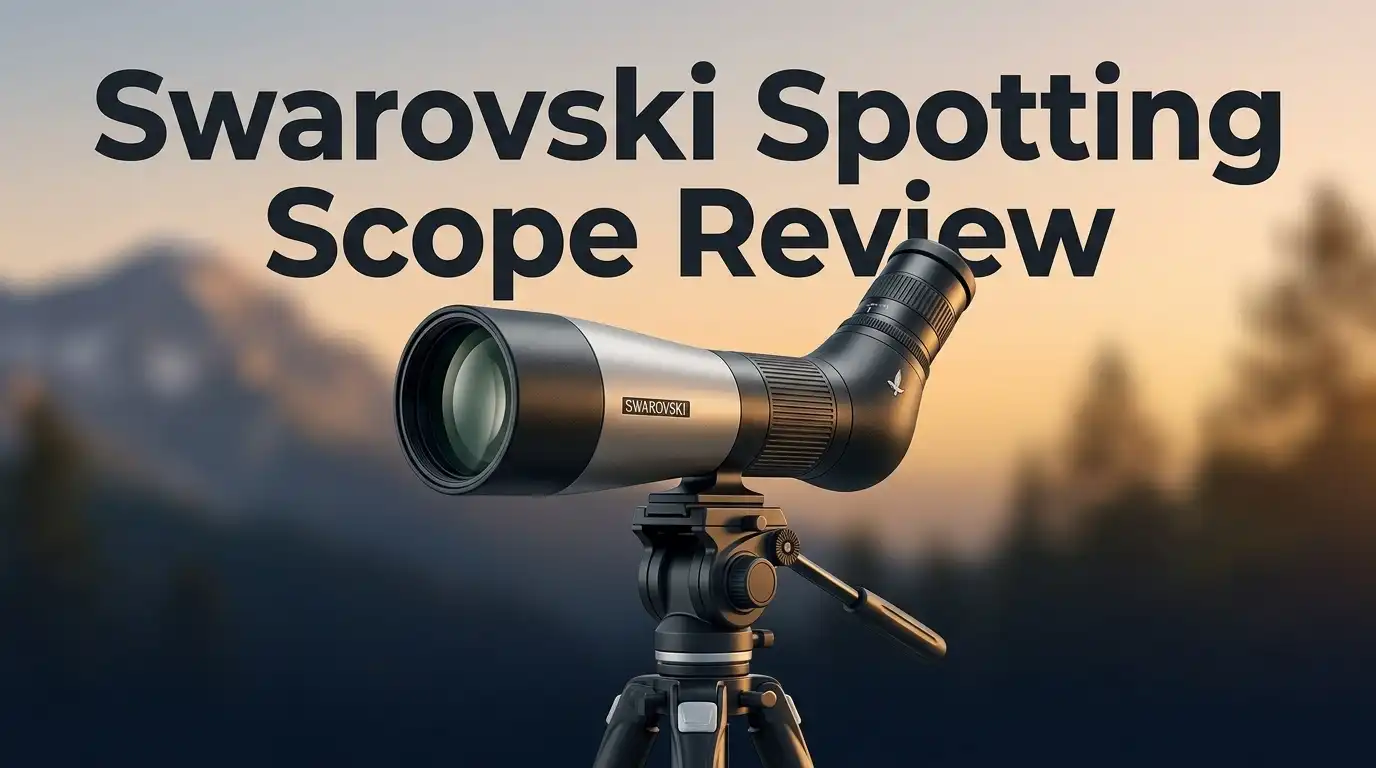
Swarovski Spotting Scope Review 2026: Worth It?
Buying a spotting scope at this price feels like a big decision. You are not spending a few hundred dollars. You are spending the cost of a used car on glass, and you want to know that the view justifies it.
Swarovski Optik has sat at the top of the optics pile for decades, and the 2026 lineup keeps that reputation intact. But reputation alone does not help you glass a bedded buck at 1,200 yards or pick out a warbler in bad light.
This review covers the models people actually buy in 2026, the real unboxing experience, the field performance, and the flaws nobody mentions in the brochure.
In A Nutshell:
- Swarovski still wins on image quality. The ATX, STX, and ATC deliver edge to edge sharpness, almost zero chromatic aberration, and neutral color. At 60x, the image holds together when rivals start to mush.
- The ATC 17 to 40×56 is the smartest buy for most people. It weighs 34.6 ounces, measures about 10 inches, and still resolves detail that shames bigger scopes. It is the travel and backcountry pick.
- The ATX modular system is the flagship. You buy one eyepiece module and swap 65mm, 85mm, 95mm, or 115mm objectives. Flexible, brilliant, and very expensive once you own two modules.
- The weak points are real. Weight climbs fast on the 95mm and 115mm setups, some ATC units show stiff focus travel near infinity, and the BTX dual eyepiece needs a serious tripod.
- Price remains the biggest barrier. Expect roughly $2,000 for an ATC and $4,000 or more for a full ATX build. Prices shift, so check current listings.
- Competitors have closed the gap, but not the last 10 percent. Kowa, Leica, Maven, and Athlon all offer strong value. Swarovski still owns the final sliver of performance.
The Unboxing Experience: What Actually Arrives

Last update on 2026-09-20 / Affiliate links / Images from Amazon Product Advertising API Some of the links on this website are affiliate links, which means that at no additional cost to you, I earn a commission if you click through and make a purchase. I only recommend products and services that I believe will add value to my readers. Thank you for your support!
The box is not flashy. Swarovski ships in a plain cardboard outer with a printed sleeve, and the restraint feels deliberate. Inside sits a fitted foam cradle holding the scope in a stay on carrying case that most owners never remove.
You get a functional package. There is a bayonet cover for the objective, an eyepiece cap, a soft cleaning cloth, the warranty card, and a short manual printed in several languages. No tripod. No adapter. Those cost extra.
The first thing you notice is the finish. The green rubber armour feels dense and slightly tacky, not slippery. Metal parts are machined clean. Nothing rattles, nothing creaks, and the focus wheel turns with a smooth, damped resistance that feels engineered rather than assembled.
Pulling the scope out and putting an eye to it for the first time is the actual event. Owners consistently describe a short pause followed by a laugh. The view looks brighter and flatter than expected, even indoors, even across a living room.
Swarovski ATC 17 to 40×56 Compact Spotting Scope Review
The ATC changed the conversation about compact scopes. It packs a 56mm objective into a body just over 10 inches long and 34.6 ounces in weight. That is roughly a pound lighter than a traditional 65mm scope.
Magnification runs 17x to 40x. Field of view stretches from 186 feet down to 102 feet at 1,000 yards, which is genuinely wide for this class. Eye relief measures 20mm, so glasses wearers see the full field.
The star feature is the HD field flattener lens. It pushes sharpness to the outer edge of the image, where most compact scopes go soft. Color fringing on high contrast targets stays almost invisible.
The focus ring wraps the body and moves in a smooth arc. You can find sharp focus with one gloved finger. Waterproofing is rated to 13 feet of submersion, and the nitrogen fill keeps the interior fog free.
Is 40x enough? For birding, scoring antlers, and spotting bullet holes at 300 yards, yes. For counting hairs at a mile, no.
Pros
- Very light at 34.6 ounces, so it travels in a daypack without complaint
- Wide field of view helps you find moving subjects fast
- Field flattener keeps edges sharp, which reduces eye fatigue
- Full 20mm eye relief works well with eyeglasses
- Close focus is short enough for butterflies and nearby feeders
Cons
- Maximum 40x limits extreme long range detail work
- Some units show stiff or jerky focus travel near infinity
- The focus ring can rub the rubber armour on a few samples
- No eyepiece protection beyond a simple push on cap
- Price sits far above compact scopes with similar specifications
Swarovski ATX 25 to 60×85 Modular Spotting Scope Review

Last update on 2026-09-20 / Affiliate links / Images from Amazon Product Advertising API Some of the links on this website are affiliate links, which means that at no additional cost to you, I earn a commission if you click through and make a purchase. I only recommend products and services that I believe will add value to my readers. Thank you for your support!
The ATX is the flagship. It splits into two parts: an angled eyepiece module and a separate objective module. You twist them together in about two seconds.
Objective choices are 65mm, 85mm, 95mm, and 115mm. On the 65mm and 85mm you get 25x to 60x. On the 95mm and 115mm the same eyepiece delivers 30x to 70x, because the longer focal length multiplies magnification.
The 85mm hits the sweet spot. It weighs around 3 pounds 12 ounces, measures about 14.6 inches, and gathers plenty of light for dawn and dusk work. Field of view runs roughly 104 feet to 57 feet at 1,000 yards.
Optical performance is the reason people pay. The image is bright, flat, high contrast, and free of visible color fringing at any magnification. Detail at 60x stays usable rather than becoming a soft guess.
The single wrap around focus wheel handles both coarse and fine adjustment. It sounds like a compromise. In practice it works better than dual wheel systems.
Pros
- Best in class resolution and contrast at high magnification
- Modular design lets you swap objectives for weight or reach
- Single focus wheel is fast, precise, and easy with gloves
- Excellent low light performance thanks to high light transmission
- Strong resale value protects part of your investment
Cons
- Total system cost climbs past $4,000 quickly
- Heavy enough to demand a serious tripod and head
- The 95mm and 115mm modules are awkward to carry on foot
- Accessories such as phone adapters and DSLR adapters cost extra
- Overkill for casual users who glass a few times a year
Top 3 Alternatives for Swarovski Spotting Scopes
If the Swarovski price tag stings, these three deliver strong performance for less money.

Last update on 2026-09-20 / Affiliate links / Images from Amazon Product Advertising API Some of the links on this website are affiliate links, which means that at no additional cost to you, I earn a commission if you click through and make a purchase. I only recommend products and services that I believe will add value to my readers. Thank you for your support!
Leica APO Televid 82 Angled Spotting Scope

Last update on 2026-09-13 / Affiliate links / Images from Amazon Product Advertising API Some of the links on this website are affiliate links, which means that at no additional cost to you, I earn a commission if you click through and make a purchase. I only recommend products and services that I believe will add value to my readers. Thank you for your support!
Maven CS.1 15 to 45x65mm Spotting Scope

Last update on 2026-07-25 / Affiliate links / Images from Amazon Product Advertising API Some of the links on this website are affiliate links, which means that at no additional cost to you, I earn a commission if you click through and make a purchase. I only recommend products and services that I believe will add value to my readers. Thank you for your support!
Athlon Optics Cronus G2 20 to 60×86 Spotting Scope
Optical Performance In Real Field Conditions
Lab numbers only tell part of the story. What matters is how the scope behaves at first light, in heat shimmer, and against a glaring snowfield.
Swarovski scopes hold color neutrality better than almost anything else. Grays stay gray. A distant deer hide shows actual texture rather than a brown smear. Birders report picking out feather edges that simply vanish in cheaper glass.
Low light is where the money shows. At legal shooting light, the 85mm and 95mm modules keep delivering usable detail for several extra minutes. Those minutes decide hunts.
Heat shimmer still beats physics. On a hot afternoon at 1,000 yards, no scope wins, including this one. You will drop to 30x or 35x and wait for cooler air.
Glare control is excellent. The coatings suppress veiling flare when you glass toward the sun, though a sunshade still helps on the ATC, which lacks a deep extendable hood.
Build Quality And Weather Resistance
These scopes get treated badly and keep working. The magnesium and aluminium chassis resists dents, and the rubber armour absorbs knocks against rock.
Waterproofing is rated to 13 feet of submersion. That is not a marketing figure for rain. It means you can drop the scope in a creek, fish it out, and keep glassing.
Nitrogen purging prevents internal fogging across a wide temperature range. Owners in Alaska and Arizona report the same result, which is no fogging and no seal failure.
The stay on case deserves credit. It protects the body without blocking the focus wheel, the eyepiece, or the tripod foot. Most owners leave it on permanently.
Long term durability is the quiet selling point. Twenty year old Swarovski scopes still trade actively on the used market, and the service department repairs old models. That matters when you calculate cost per year rather than cost per purchase.
Focus System And Ergonomics
The focus mechanism separates good scopes from great ones. Swarovski uses a wide rubberized ring that circles the body just ahead of the eyepiece.
You reach it without moving your head off the eyecup. One finger spins it. The travel is long enough for precision and short enough that you are not cranking forever between near and far.
Resistance is consistent in cold weather. Many scopes stiffen badly below freezing. These stay usable with gloves on.
The twist up eyecup clicks into several positions and holds firm. Eyeglass wearers screw it all the way down and still see the full field.
One honest complaint appears repeatedly. A small number of ATC units arrive with uneven focus resistance near infinity, described as stiff or jerky. Swarovski service handles it under warranty, but you should test yours immediately after delivery.
Digiscoping With A Swarovski Scope
Phone photography through a spotting scope has become a core use case, and Swarovski built for it.
The Variable Phone Adapter clamps most phones over the eyepiece and holds alignment well. It costs extra, around $199, which annoys people who just spent thousands.
Image quality through the ATX and ATC is genuinely impressive. The flat field means your phone sensor records sharp detail across the whole frame rather than a sharp center with mushy corners.
For serious camera work, the TLS APO adapter turns the scope into a long telephoto lens for a DSLR or mirrorless body. It is expensive and it is heavy, but the results rival dedicated super telephoto lenses costing far more.
Two practical tips help. Use the lowest magnification that frames your subject, and trigger the shutter with a timer or remote. Vibration ruins more digiscoped photos than optics ever will.
ATX vs STX vs BTX: Which Module Suits You
Three eyepiece modules share the same objective lenses, and choosing between them confuses new buyers.
The ATX is angled. You look down into it at 45 degrees. This suits tripod sharing, uphill glassing, and long sessions, because your neck stays neutral.
The STX is straight. You look through it in line with the target. This suits hunters glassing from prone, shooters at a bench, and anyone who wants faster target acquisition.
The BTX is the dual eyepiece module. You use both eyes. The comfort difference over long glassing sessions is dramatic, and depth perception improves noticeably.
BTX has real costs. It is heavy, it demands a strong tripod, and magnification is fixed at 30x on the 65mm and 85mm modules and 35x on the 95mm and 115mm. There is no zoom. Many owners buy BTX plus an ATX eyepiece and swap as needed, which doubles the expense.
What Swarovski Scopes Do Not Do Well
Honest reviews list the failures, so here they are.
Price is indefensible for casual users. If you glass twice a year, you will not extract value from this glass. A $700 scope shows you the same elk.
Weight becomes punishing at 95mm and above. The 95mm module plus eyepiece pushes past 4 pounds before you add a tripod. Backcountry hunters regularly downgrade to the 85mm or the ATC after one hard season.
Accessories are sold separately and priced high. Tripod, head, phone adapter, and sunshade all cost extra. Budget another $700 to $1,500 for a setup that actually works in the field.
The ATC lacks an extendable sunshade. You will want one in bright side light.
BTX strap design draws complaints. Owners report the supplied straps struggle to hold the weight securely.
Zoom range is conservative. Competitors advertise 20x to 60x or 20x to 70x. Swarovski starts at 25x on the ATX, which slightly narrows your widest field.
Price And Value In 2026
Let us talk actual numbers, with the caveat that street prices move.
The ATC and STC sit near $2,000 to $2,400. The ATS and STS 65 HD bodies run roughly $1,600 to $2,000 before you add an eyepiece.
The modular system prices per part. An 85mm objective module runs around $1,700 to $1,900. A 95mm module runs around $2,000 to $2,400. The ATX or STX eyepiece module adds roughly $1,800 to $2,200.
A complete ATX 85 build therefore lands near $4,000. A BTX 95 build can exceed $5,500.
Is that value? It depends entirely on hours of use. Spread across 20 years of ownership and strong resale, the cost per hour drops sharply for serious users. For everyone else, a Kowa, Leica, or Maven delivers most of the experience for considerably less.
Tripod And Accessory Pairings That Actually Work
A world class scope on a weak tripod produces a shaky, disappointing view. This is the mistake buyers make most often.
For the ATC, a lightweight carbon tripod rated above 8 pounds works fine. Pair it with a compact ball head or a small fluid head.
For the ATX 85, step up. You want a carbon tripod with 28mm or larger leg sections and a proper fluid pan head. Expect to spend $500 to $1,000.
For the BTX or a 95mm build, go heavier still. Anything less and you will fight vibration at every magnification above 40x.
Add an Arca Swiss compatible foot or rail so you can mount and dismount quickly. A simple lens cloth, a rain cover, and a sunshade round out the kit. Skip the cheap universal phone adapters, because alignment drift will frustrate you.
Who Should Buy A Swarovski Spotting Scope
This purchase makes sense for a specific group of people.
Serious birders who log hundreds of hours a year benefit most. Identification often hinges on subtle plumage detail at distance, and this glass reveals it.
Western hunters who judge animals across canyons gain real advantage. Extra minutes of shooting light and accurate antler assessment save wasted stalks.
Competitive shooters who need to see bullet holes at 600 yards in mirage will appreciate the resolution.
Digiscopers who want publishable images get a genuine tool rather than a novelty.
Who should skip it? Casual backyard observers, occasional range visitors, and anyone buying primarily for status. The performance gap over a good midpriced scope is real but small, and it only pays off with heavy use.
Final Verdict: Is It Worth It In 2026?
Yes, for the right buyer. Swarovski still makes the sharpest, brightest, most comfortable spotting scopes available, and the 2026 lineup gives you a genuine choice between compact portability and modular power.
The ATC 17 to 40×56 is the model I recommend to most people. It is light, it is sharp, and it removes the excuse of leaving the scope at home.
The ATX 85 modular system is the one to buy if image quality outranks every other concern and your budget allows it.
The flaws are honest ones. High price, high accessory costs, heavy top end configurations, and a small number of focus quality control issues. None of these undermine the core product.
Buy it if you will use it hard for a decade. Skip it if you will use it occasionally. The glass is worth the money only when you spend enough hours behind it to notice the difference.
Frequently Asked Questions
Which Swarovski spotting scope is best for beginners?
The ATC 17 to 40×56 is the easiest starting point. It is light, simple, and requires no module decisions. You get one scope that works for birding, hunting, and range use without extra purchases beyond a tripod.
Is the ATX better than the ATC?
The ATX resolves more detail and reaches higher magnification. The ATC weighs half as much and costs roughly half as much. For backpack use the ATC usually wins, and for maximum performance from a vehicle or blind the ATX wins.
Should I choose angled or straight?
Choose angled for tripod comfort, uphill glassing, and long sessions with multiple viewers. Choose straight for prone shooting positions, faster target acquisition, and glassing from a vehicle window.
Do Swarovski spotting scopes come with a tripod?
No. The scope ships with a carrying case, lens covers, and a cleaning cloth only. You must buy a tripod and head separately, and a quality support makes a large difference in perceived image quality.
How long is the Swarovski warranty?
Swarovski offers a limited lifetime warranty on optical components and a shorter period on mechanical and electronic parts. Coverage terms vary by region, so confirm details with the retailer before purchase.
Can I use a Swarovski spotting scope for astronomy?
Yes, within limits. You will see lunar craters, Jupiter moons, and Saturn rings clearly. Deep sky viewing is limited because the aperture is small compared with dedicated telescopes.
Is 65mm or 85mm the better objective size?
Choose 65mm for portability and 85mm for light gathering. The 85mm shows more detail at dawn and dusk. The 65mm saves nearly a pound, which matters on long hikes.

Hello, I’m Emily Price, the founder of Birds Affection. As a passionate bird enthusiast and spiritual seeker, I’ve always been fascinated by the symbolic meanings and mystical connections between birds and our lives. On this website, I share my knowledge and insights on the spiritual significance of various bird species, exploring their roles as messengers, guides, and teachers. Through my writing, I aim to inspire and educate others on the profound wisdom and beauty that birds bring to our world. Join me on this journey as we delve into the enchanting realm of bird symbolism and discover the hidden meanings behind these magnificent creatures.