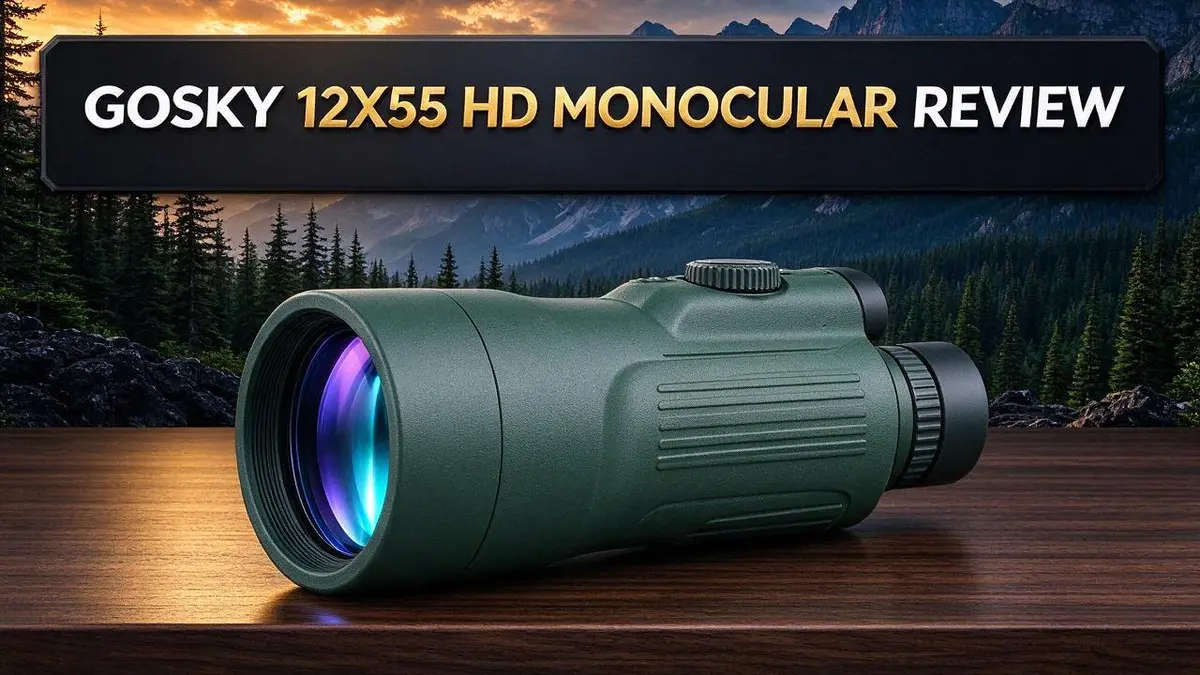
Gosky 12×55 HD Monocular Review: Specs, Performance and Who It’s For
Do you want a sharper view of distant birds, ridgelines, or the moon? The Gosky 12×55 HD Monocular promises just that in a compact body.
This monocular offers 12x magnification and a 55mm objective lens. Its BAK4 prism and fully multi coated glass help produce bright, clear images.
It also delivers a wide field of view for its power. The twist up eyecup gives long eye relief, so glasses wearers can look through it comfortably.
The body is waterproof and fog proof. A rubberized grip keeps it secure in your hand. Some users even compare its build quality to Oberwerk.
In this review, we cover the specs, pros, cons, and top rivals. Let’s see if this monocular fits your outdoor adventures.
In a Nutshell
- Best for: Birders, hikers, and moon watchers who want a close look at faraway scenes. The unit stays compact enough for a daypack, so you can carry it on long trips.
- Optics: A BAK4 prism and an FMC coated lens work together. They deliver bright images with strong contrast, even in lower light.
- Comfort: The long eye relief and twist up eyecup help eyeglass wearers. Users without glasses can fold the cup down for a snug fit.
- Handling: The rubberized grip feels secure in your hand. The focus turns smoothly, and the monocular stays steady when you hold it by hand or mount it on a tripod.
- Build: One source compares the build quality favorably to Oberwerk. The argon purged body also helps resist internal fogging.
- Watch outs: Our research found little detailed criticism. Still, some users report an unspecified issue. Close focus sits near 2.5 meters. Main rivals include the Gosky Titan 12×50, Bushnell 8×42, and Vortex Optics 8×25.
Optical Quality and Magnification


Last update on 2026-10-13 / Affiliate links / Images from Amazon Product Advertising API Some of the links on this website are affiliate links, which means that at no additional cost to you, I earn a commission if you click through and make a purchase. I only recommend products and services that I believe will add value to my readers. Thank you for your support!
Optical quality decides whether you see a crisp image or a blurry blob. The Gosky 12×55 gives you a close look at distant targets. But power alone does not tell the whole story.
Magnification at 12x means small hand shakes show up fast. Your hands move a little, and the image moves with them. Many people rest their elbows on a fence or tree. A tripod helps even more during long watching sessions.
The exit pupil measures 4.2 mm. This size matters when light fades at dusk or dawn. A larger exit pupil sends more light to your eye. Your pupil opens wider in dim light, so the two work well together.
The field angle is 6.5 degrees. That number tells you how much of the scene fits in view. You can spot a bird, then follow it across the sky without losing it. A wider view makes tracking moving targets much easier.
The minimum focus distance is 2.5 meters. You cannot focus on anything closer than that. Plan for this limit if you want to study insects or flowers. Pick a different tool for tiny subjects nearby.
Contrast depends on how light moves through the glass. Good coatings cut glare and ghosting inside the lens. Strong contrast helps you spot shadows on a mountain face or the pattern on a bird’s wing. Test the view in your own yard before a big trip.
Pay attention to the center of the view. Most sharp detail appears there. Let your subject sit in the middle, then adjust focus slowly for the best result you can get.
Clear optics reward patient viewing. Take a few seconds to settle your eye. The image will sharpen as you adjust.
Field of View and Eye Relief
Field of view tells you how much of a scene fits inside your circle of sight. A wide view helps you find a bird fast. You spend less time searching and more time watching.
Panning feels smoother with a wide view. You can follow a hawk across a ridge without losing it. Moving subjects stay in frame longer, which helps beginners too.
Eye relief is the distance between your eye and the lens. Good eye relief lets the full image appear without pressing your face against the glass. Your eyelashes and nose stay clear of the lens.
Finding your sweet spot matters. Move your eye slowly across the lens until the whole circle looks bright. If you see black edges, shift your eye a little or adjust the eyecup.
Start with the eyecup fully down. Then twist it up step by step until the edges look sharp. Each person has different eyes, so take time to adjust it for yourself.
Shared use calls for a simple trick. Mark the eyecup setting with a small strip of tape. Next time, you can return to your setting in seconds.
Edge softness is normal at higher power. The sharpest part sits near the center of the view. Expect the outer rim to blur a little when you pan quickly.
Comfort and view work as a team. A wide view with good eye relief makes long sessions easier. Your neck and eyes will thank you after an hour outside. Take breaks often, even with a relaxed setup.
Try the monocular in daylight first. Practice finding the view with both hands steady. Skill grows fast with a few sessions.
Build Quality and Weatherproofing
Good build quality matters more than many buyers expect. A monocular takes bumps from backpacks, rocks, and car seats. This section looks at how the Gosky holds up over time.
The inside of the tube is argon purged. This gas pushes out moisture and helps keep the glass clear. Think of it as a dry air bubble for your optics.
Sealed optics also resist internal fogging when temperatures shift. Cold mornings and warm hands can cause condensation. A well sealed tube handles those changes much better.
The focus mechanism feels smooth in use. Smooth focus matters when you track a bird across the sky. Stiff focus rings slow you down and tire your fingers.
Stability plays a role too. A solid body helps you hold steady at 12x. Wobbly tubes make every view jump. Mount it on a tripod for the calmest image.
Check the joints before each trip. A twist up eyecup should click firmly into each stop. Loose parts can drift over time, so inspect them after rough outings.
Lens caps matter as much as the optics. Caps can fall off inside a pocket or bag. A cap with a cord keeps it attached and ready to use.
Care tips help the monocular last longer. Wipe lenses with a soft microfiber cloth. Rinse off salt or sand after beach trips. Store it dry in a padded case.
Rain or snow should not stop your fun. The seals keep most weather out. Still, avoid submerging the unit or leaving it in a hot car. Gentle handling keeps it working for years.
Our research did not include many detailed durability reports. Long term owner tests would give more proof. Until then, treat the Gosky with normal care and it should serve you well.
Top 3 Alternatives
Occer 12×42 Monocular

Last update on 2026-10-31 / Affiliate links / Images from Amazon Product Advertising API Some of the links on this website are affiliate links, which means that at no additional cost to you, I earn a commission if you click through and make a purchase. I only recommend products and services that I believe will add value to my readers. Thank you for your support!
Want a light and simple option? The Occer 12×42 Monocular fits easily in a pocket. Its 12x zoom brings distant birds, boats, and trail markers much closer.
The 42mm lens lets in good light. This helps during early mornings and evening walks. Setup is quick. You just twist, focus, and look.
Vortex Solo Monocular

Last update on 2026-10-31 / Affiliate links / Images from Amazon Product Advertising API Some of the links on this website are affiliate links, which means that at no additional cost to you, I earn a commission if you click through and make a purchase. I only recommend products and services that I believe will add value to my readers. Thank you for your support!
Prefer a trusted name in optics? The Vortex Solo Monocular offers strong build quality. Its sturdy body handles bumps, dust, and light rain.
Its lenses deliver sharp images with good contrast. Outdoor fans often choose it for wildlife watching and stargazing trips. The compact design fits in a jacket, so you can carry it all day without strain.
Celestron UpClose Monocular

Last update on 2026-10-31 / Affiliate links / Images from Amazon Product Advertising API Some of the links on this website are affiliate links, which means that at no additional cost to you, I earn a commission if you click through and make a purchase. I only recommend products and services that I believe will add value to my readers. Thank you for your support!
Need a fun, beginner-friendly pick? The Celestron UpClose Monocular keeps things simple. It works well for kids, students, and first-time explorers.
Its clear glass shows fine details on birds, boats, and mountain peaks. The eyepiece adjusts smoothly. Many buyers enjoy this easy focus. It also suits casual use at home or on a day trip.
Handheld Stability and Tripod Use
Steady hands make a big difference with any monocular. Here is how to get the most from the Gosky 12×55 when you hold it by hand.
Brace your body before you look. Tuck your elbows close to your ribs. Lean against a tree, a fence post, or a car roof. This simple move gives your arms a solid base.
Breathe slowly and pause between breaths. Many people find the view settles when they hold their breath for a moment. Try this during the gentle pause at the end of each exhale.
Your stance matters too. Stand with your feet apart and your weight even. Shift your weight slightly if you start to wobble.
Long watching sessions can tire your arms. Rest the monocular on a backpack or a stone wall between views. Short breaks keep your focus sharp and your grip calm.
Think about your target before you raise the monocular. Find the bird or boat first with your naked eye, then lift the monocular to your face. This habit saves time and keeps your movements calm.
Use a tripod when you need a locked view. A tripod removes nearly all hand motion. It works well for birds that sit still or for slow scenes on a hillside. Set the tripod on firm ground before you attach the monocular.
Check whether your model includes a standard tripod socket. If it does, screw the monocular onto a compatible mount. Tighten it firmly but do not force it.
Small changes make a clear difference. Good posture, a braced stance, and a tripod can turn a shaky view into a steady one. Practice these steps at home first.
Focusing and Close-Range Performance
Focusing starts with a simple habit. Pick a distant object first, then turn the knob slowly until the edges look crisp.
Tree lines, rooftops, and fence posts make good practice targets. Turn the knob in small steps and stop when the edges look sharp.
Close range viewing needs a different approach. The minimum focus distance sits at about 2.5 meters. Objects nearer than that stay blurry, no matter how hard you turn the knob.
This limit matters for insects, flowers, and garden birds at a feeder. Step back a little, then refocus for much more detail.
Focus also depends on your eyesight. Test with the eye you use most, then adjust the knob for your own vision.
Watch for drift during long sessions. Temperature changes and hand pressure can nudge the focus ring. Check sharpness every few minutes so details stay clear.
A quick sharpness check helps too. Look at a sign or a fence post, then move to a leaf or a bird. If both look crisp, your focus is set well.
Bright light helps you judge focus. Dim scenes hide small blur, so practice in daylight first. Learn the knob before dusk arrives.
Patience pays off at every distance. Rushing the knob often leads to overshooting the sharp point. Small turns let you land on the best image.
Set a focus memory for favorite views. Note the knob position for a spot you revisit often. Next time, turn to that mark first and fine tune from there.
Practice makes focusing quick. After a few sessions, your hands learn the right turn. Clear images then arrive in a second or two.
Best Uses and Viewing Scenarios
The Gosky 12×55 suits many outdoor plans. Think about where you spend your free time and which views matter most to you.
Birdwatching on a trail. Hikers often spot a bird high in a pine tree. The monocular lets you check its colors before it flies away. Its wide view also helps you find the bird quickly.
Tracking moving wildlife. Deer, foxes, and elk cross open fields fast. The wide view gives you room to follow them. You can keep the animal in sight as it walks.
Watching sports from the sidelines. Young players look tiny on a distant field. This monocular helps you see faces and jersey numbers. It slips into a jacket pocket for every game.
Boating and coastal trips. Sailors scan the water for buoys, markers, and passing boats. The rubberized grip feels secure in wet hands on deck.
Stargazing and moon viewing. The moon shows craters along its edge at 12x power. Bright stars look crisp, but very faint objects stay hard to spot. Plan for clear skies and a dark spot.
Camping and hiking trips. Campers can scan distant ridges for elk or deer at dusk. Hikers can check trail markers before they reach a fork. The monocular fits in a small daypack without fuss.
Glasses wearers. Long eye relief lets you see the full view with eyeglasses on. The eyecup twists up for a comfortable fit.
Bringing it along. Pick the use that matches your plans most closely. Then pack the monocular, grab your gear, and head outside for a fresh look at the world.
Pros and Cons
Pros
– Wide view for its 12x power
– Long eye relief with a twist up eyecup
– Rubber grip feels secure in the hand
– Lightweight design makes hand holding easy
– Smooth focus that is simple to adjust
Cons
– Few detailed complaints appear in published reviews
– Some users report being unhappy with an unspecified issue
– High power makes hand shake easier to notice
– Steady viewing takes practice without a tripod
Who Should Buy It
This monocular suits people who want strong power without a heavy setup. Many buyers prefer a single tube over bulky binoculars. It packs into a daypack and comes out fast when something catches your eye.
Beginners to optics often find it a good first step. A monocular has one eyepiece, so there is less to align. New users can learn the basics of magnification and focus without feeling overwhelmed.
Gift shoppers also have a reason to consider it. It feels practical and thoughtful for a nature lover, a hiker, or a grandparent who enjoys watching the sky. It arrives ready to use, so there is no complicated setup.
Buyers who already own binoculars may want a second optic. Many people keep a monocular in a car, boat, or backpack as a backup. It gives a quick look at distant details without pulling out the main pair.
Shoppers comparing the Gosky Titan 12×50 or Bushnell 8×42 should think about their main goal. Lower power models suit wide scenes and relaxed scanning.
This 12x model suits people who need reach more than a broad sweep of the landscape. Buyers who look at Oberwerk models may find the build quality compares well. That matters for people who plan to carry the monocular on rough trips.
People who want quick checks rather than long sessions will feel right at home. Short looks at a bird, a boat, or a trail sign suit this design well.
Who should skip it? Readers who need a wide field for fast moving subjects may prefer a lower power option.
Anyone who wants detailed long term durability data should check newer user feedback. The research offers limited detail on that point.
Final Verdict
The Gosky 12×55 HD Monocular earns a strong recommendation from us. It offers a clear picture, comfortable handling, and dependable construction. Few single tube optics balance those qualities so well.
Build quality is a real highlight. Reviewers compare it favorably to Oberwerk, a name that serious hobbyists respect. That comparison shows the care behind this unit.
Who should buy it: Choose this monocular if you want strong reach in a simple package. It suits patient users who enjoy long, relaxed looks at faraway subjects.
Who should skip it: Pass on it if you want the smallest pocket optic. A compact model like the Vortex Optics 8×25 fits that need better. Buyers who prefer a calmer, lower power image may like the Bushnell 8×42 more.
Published reviews offer little detailed criticism. That is a good sign, but it also means we cannot rule out every flaw. Test the monocular during your return window, and check it in the places you plan to use it.
Our best tip is to add support when you can. A fence post, a tree trunk, or a tripod makes the image much steadier. A bit of support turns a good monocular into a great one.
Bottom line: The Gosky 12×55 HD is a smart pick for people who value reach, comfort, and solid craftsmanship. It earns a place in a pack, a boat, or a glove box. We feel confident calling it a worthy choice.
Frequently Asked Questions
Can I use it for bird watching?
Yes, the 12x power helps you spot birds in tall trees or on far fence lines. The wide field of view also makes it easier to follow birds that move quickly. Many people use it to check feeders from a porch or window.
Does it work in rain or cold weather?
Yes, it handles wet and cool conditions well. The tube resists water and fog, so moisture does not cloud the view. You can keep watching during a light rain or a chilly morning.
How close can it focus?
The minimum focus distance is about 2.5 meters, which is roughly eight feet. This lets you look at nearby objects like a trail map or a plant. You do not need to hold it far away to see detail.
Is it useful for watching sports?
Yes, it works well at ball fields, race tracks, and outdoor events. The 12x power brings players and action closer. The view stays steady enough to follow a play from the bleachers.
Can I use it with glasses or contact lenses?
Yes, the eyecup design fits many viewing styles. You can twist the eyecup up if you wear glasses. Contact lens wearers can keep the eyecup down and still enjoy a clear, wide picture.

Hello, I’m Emily Price, the founder of Birds Affection. As a passionate bird enthusiast and spiritual seeker, I’ve always been fascinated by the symbolic meanings and mystical connections between birds and our lives. On this website, I share my knowledge and insights on the spiritual significance of various bird species, exploring their roles as messengers, guides, and teachers. Through my writing, I aim to inspire and educate others on the profound wisdom and beauty that birds bring to our world. Join me on this journey as we delve into the enchanting realm of bird symbolism and discover the hidden meanings behind these magnificent creatures.