Vanguard Endeavor Spotting Scope Review 2026: Still Worth It?
Choosing a spotting scope feels harder every year. Prices climb, brands multiply, and marketing pages all promise the same crisp views. The Vanguard Endeavor line sits in an interesting spot.
It costs far less than premium European glass, yet it uses ED elements, magnesium bodies, and dual focus wheels that usually appear on scopes priced twice as high.
This review shares what the glass actually delivers, where the design frustrates, and whether the Endeavor still earns your money in 2026. You will get honest weaknesses, not just a spec sheet rewrite. By the end, you will know if this scope fits your eyes, your tripod, and your budget.
In A Nutshell:
- Image quality punches above the price. The 82mm ED objective produces a bright, sharp, and neutral image with only faint color fringing at high power. Most users compare it favorably to scopes costing hundreds more.
- The body feels premium. A magnesium chassis, exposed textured metal finish, and sealed nitrogen filled construction give the scope a serious, tool grade feel that cheap polycarbonate models never match.
- Dual focus wheels are the standout feature. One wheel moves fast across distance, the second fine tunes the view. Once you use this system, single wheel scopes feel clumsy.
- Weight is the biggest compromise. At roughly 63 ounces, the 82A is heavy for backpack hunting. Serious hikers should look at the 65mm version instead.
- Accessories add real value. The included stay on cover, shoulder sling, cleaning cloth, and lens caps mean you spend nothing extra on day one.
- It is not a giant killer. Above 50x the image softens slightly and dims in poor light. Alpine scopes still hold an edge in the last hour of daylight.
Vanguard Endeavor HD 82A Spotting Scope Overview

Last update on 2026-09-20 / Affiliate links / Images from Amazon Product Advertising API Some of the links on this website are affiliate links, which means that at no additional cost to you, I earn a commission if you click through and make a purchase. I only recommend products and services that I believe will add value to my readers. Thank you for your support!
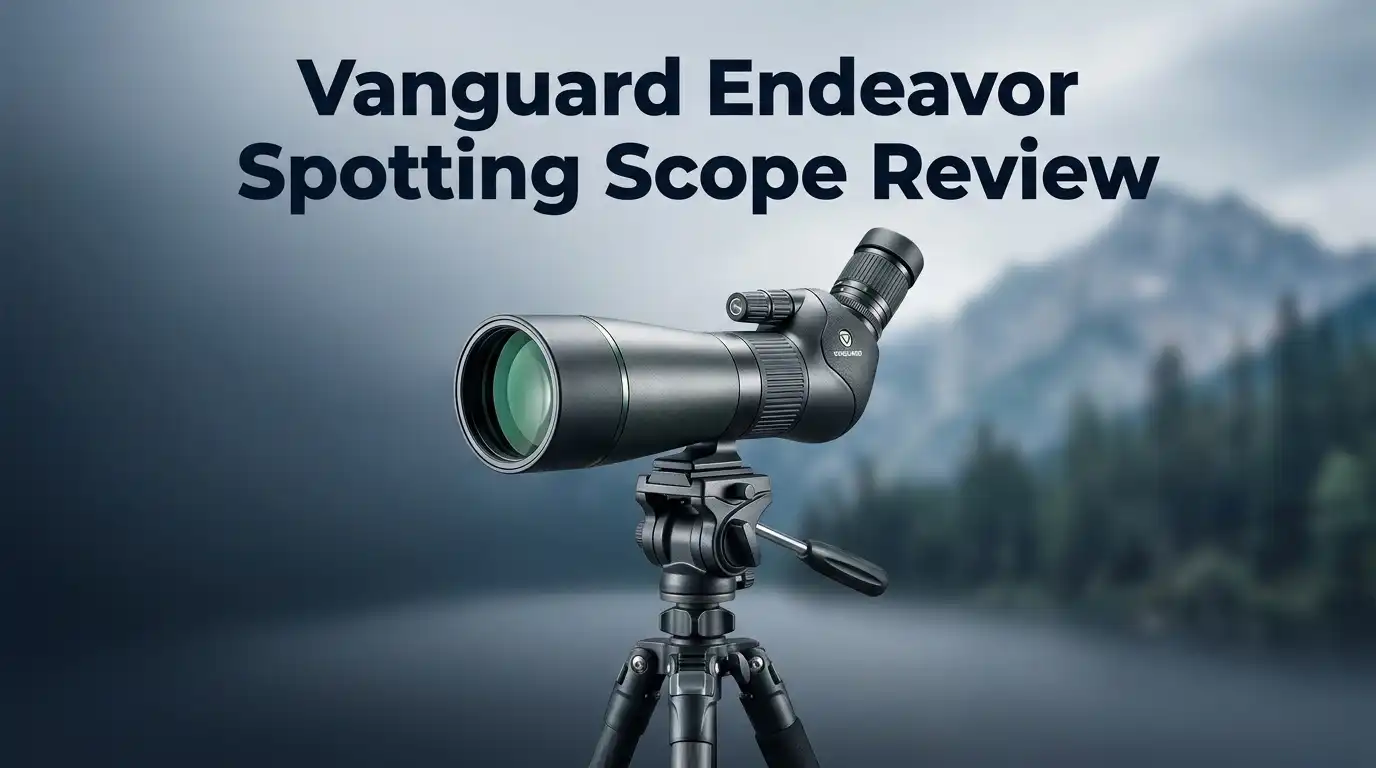
The Endeavor HD 82A is the flagship of Vanguard’s spotting scope range. It pairs an 82mm objective containing extra low dispersion glass with a removable 20 to 60x zoom eyepiece. The angled 45 degree body suits tripod work, group viewing, and long observation sessions where a straight scope would force you to crouch.
Vanguard builds the chassis from magnesium alloy rather than plastic. That choice explains both the reassuring density in your hands and the weight on your shoulder. The optics are fully multi coated, and the BaK4 roof prisms carry phase correction coatings.
The scope is fully waterproof and nitrogen purged, so internal fogging during temperature swings simply does not happen. Dimensions measure about 15 inches long with the sunshade retracted, stretching to roughly 16 inches when extended.
Vanguard aims this model at birders, target shooters, and wildlife watchers who want serious glass without paying alpine prices. That target is met, with a few caveats I cover below.
Unboxing Experience And What Comes In The Box
The box arrives plain and sturdy, with dense foam cradling the scope. There is no theatrical presentation, no magnetic flap, no printed lifestyle photography. Vanguard spent the money on glass instead, which honestly feels like the right call.
Lifting the scope out, the first thing you notice is heft. It settles into your palms with real density. The exposed magnesium has a fine sandpaper texture that grips well even with damp hands.
The stay on cover comes already fitted on most units. Peeling it back to inspect the body feels a little like unwrapping a camera lens. Underneath, the finish is clean, with no rough seams or glue marks.
Also inside you find the 20 to 60x eyepiece already mounted, a spring loaded objective cap, a soft ocular cap, a shoulder sling with quick release clips, a microfiber cloth, and a warranty card.
Setup takes under two minutes. Clamp it to a tripod, twist the eyecup, and you are viewing.
Build Quality And Body Design
The construction is where this scope quietly justifies its price. Most competitors in this bracket wrap a plastic tube in thick rubber armor. Vanguard leaves much of the magnesium exposed and adds rubber only near the eyepiece and focus area.
That decision has trade offs. The metal looks and feels expensive, but it offers slightly less impact cushioning than a fully armored scope. The included padded cover solves this, so leave it on in the field.
The extendable sunshade slides out about 1.5 inches and blocks both glare and light drizzle. Two raised sighting lines run along the top, and they genuinely help you aim at a distant bird before looking through the eyepiece.
The tripod foot measures roughly 2.5 inches long with grooves for a secure clamp. A collar lets you rotate the barrel after loosening a small lever, which matters on uneven ground.
One design gripe stands out. There is only one threaded socket on the foot, so digiscopers without a sliding plate will fight balance issues.
Top 3 Alternative for Vanguard Endeavor HD 82A


Last update on 2026-09-17 / Affiliate links / Images from Amazon Product Advertising API Some of the links on this website are affiliate links, which means that at no additional cost to you, I earn a commission if you click through and make a purchase. I only recommend products and services that I believe will add value to my readers. Thank you for your support!
Celestron Regal M2 80ED Spotting Scope

Last update on 2026-09-17 / Affiliate links / Images from Amazon Product Advertising API Some of the links on this website are affiliate links, which means that at no additional cost to you, I earn a commission if you click through and make a purchase. I only recommend products and services that I believe will add value to my readers. Thank you for your support!
Athlon Optics Argos HD 20 to 60×85 Spotting Scope

Last update on 2026-09-20 / Affiliate links / Images from Amazon Product Advertising API Some of the links on this website are affiliate links, which means that at no additional cost to you, I earn a commission if you click through and make a purchase. I only recommend products and services that I believe will add value to my readers. Thank you for your support!
SVBONY SV406P 20 to 60×80 ED Spotting Scope
Optical Performance And Image Quality
This is the reason to buy the Endeavor. The 82mm objective gathers plenty of light, and the ED element does real work rather than serving as a marketing badge.
At 20x the view is bright, wide, and clean edge to edge. Detail stays crisp through roughly 45x, which covers most birding and range work. Colors look natural with no artificial warm or cool tint, a common flaw in budget glass.
Chromatic aberration is controlled well. Point the scope at a dark branch against bright sky and you may spot a faint blue line, but only if you hunt for it deliberately. Compared to non ED scopes, the difference is obvious.
Edge softening exists but stays minor, confined to the outer rim of the field. Contrast holds up in overcast conditions better than I expected.
Push past 50x and the honesty begins. The image dims, softens, and heat shimmer becomes the limiting factor on warm days.
Zoom Eyepiece, Field Of View And Eye Relief
The bayonet mounted eyepiece locks with a small slider and a twist. It is fully sealed, so removing it in light rain does not worry me, though I still avoid it.
Field of view measures about 110 feet at 1000 yards at 20x, narrowing to roughly 52 feet at 60x. That wide low power view is genuinely useful, because finding a small warbler at 60x with a narrow field is an exercise in frustration.
Eye relief runs 19mm to 20mm across the zoom range. Glasses wearers get the full image with the eyecup twisted down. I tested this with sunglasses and saw no dark rings.
The zoom ring turns smoothly with firm resistance, and it does not creep when you carry the scope.
The limitation is choice. Vanguard offers no fixed power eyepiece for this range. A 30x wide angle option would sharpen the view for dedicated birders, and its absence is a genuine gap.
Dual Focus Wheels In Real Use
Two separate focus wheels sit on top of the barrel, centrally placed so left and right handed users get equal access. Both are wide, grooved, and rubber covered.
The rear wheel is the coarse control. It travels from close focus to infinity in under four turns, letting you jump from a nearby hedge to a distant ridge quickly.
The front wheel handles fine adjustment. This is where the system shines at high magnification, because nudging focus at 60x with a single geared wheel usually overshoots.
Both wheels turn with thick gloves on, which I confirmed during a cold morning session where my fingers stopped cooperating.
Close focus sits around 20 feet, useful for butterflies, dragonflies, and garden feeders.
Once you adapt to dual focus, going back feels like a downgrade. The only learning curve is muscle memory. New users occasionally grab the wrong wheel for the first week, then never think about it again.
Vanguard Endeavor HD 65A For Lighter Loads
Last update on 2026-09-20 / Affiliate links / Images from Amazon Product Advertising API Some of the links on this website are affiliate links, which means that at no additional cost to you, I earn a commission if you click through and make a purchase. I only recommend products and services that I believe will add value to my readers. Thank you for your support!
Not everyone needs an 82mm objective. The Endeavor HD 65A uses the same ED glass philosophy, the same magnesium construction, and the same dual focus design in a smaller 65mm package with a 15 to 45x eyepiece.
Weight drops dramatically. This is the version I recommend for anyone who walks more than a mile to their viewing spot, or who packs a scope into a hunting pack alongside other gear.
Image quality at 15x through 30x is excellent, with a wide bright sweet spot. Beyond 35x the smaller objective shows its limits faster than the 82A does, especially in dim light.
The 65A also pairs better with lighter tripods. An 82mm scope demands a serious support system, while the 65A behaves well on a mid weight travel tripod.
Choose based on your legs, not your ego. A 65mm scope you actually carry beats an 82mm scope you leave in the truck every single time.
Weatherproofing And Field Durability
Vanguard seals the entire body and purges it with dry nitrogen. In practice, this means two things that matter outdoors.
First, rain does not end your session. I have used this scope through steady drizzle with the cover on and found zero moisture intrusion. Vanguard does not publish a specific IPX rating, which I would prefer to see, but real world sealing has held up.
Second, internal fogging never occurs. Moving from a heated car into freezing air produces condensation on external glass only, which wipes away in seconds.
The dry internal atmosphere also prevents corrosion on internal surfaces, extending the useful life of the scope considerably.
Durability wise, the magnesium shell resists dents better than aluminum. The exposed finish will show scuffs over years of use, purely cosmetic.
Keep the stay on cover fitted. It dampens sound, reduces reflective shine that spooks wildlife, and absorbs the knocks that exposed metal would otherwise take directly.
Digiscoping And Phone Adapters
Photographing through this scope works well, with realistic expectations. Vanguard sells the PA 202 adapter that fits both Endeavor HD and Endeavor XF models, plus universal smartphone brackets.
The adapter slides over the eyepiece and screws onto the barrel with a 58mm thread, and a 52mm step down ring is included. Side cutouts let you adjust zoom while the adapter stays attached.
Results are strongest between 20x and 35x. Push higher and you fight vignetting, motion blur, and atmospheric distortion.
Smartphone digiscoping gives surprisingly shareable results for documentation shots, rare bird records, and target verification. Professional wildlife photography is a different pursuit entirely.
The balance problem returns here. Adding a camera behind the eyepiece shifts the center of gravity rearward, and the single tripod socket cannot compensate.
Buy a sliding quick release plate if digiscoping matters to you. It costs little and transforms the setup from wobbly to stable.
Tripod Requirements And Portability
This scope will expose a weak tripod instantly. At 82mm and nearly four pounds, vibration at 60x turns a sharp image into jelly.
Look for a tripod rated well above the scope weight, ideally carbon fiber for a balance of stiffness and portability. A fluid head or pistol grip head makes tracking moving subjects far easier than a standard ball head.
Budget roughly the same amount for support as you spend on optics if you plan serious high magnification work. That advice sounds excessive until you compare a stable image to a shaky one.
Portability is honest rather than impressive. The included sling lets you carry the scope over one shoulder and the tripod over the other, which works for walks of a mile or two.
For longer treks, this combination becomes a chore. The 65mm model or a smaller travel tripod solves the problem without sacrificing much usable image quality.
What The Endeavor Does Not Do Well
Every honest review needs this section, so here are the real weaknesses.
The scope dims noticeably in the final thirty minutes of daylight at high magnification. Premium alpine scopes stretch that window longer, and if dawn and dusk viewing defines your hobby, you will feel the gap.
Weight is a genuine problem for mobile users. Backpack hunters and long distance hikers should look elsewhere.
There is no fixed power eyepiece option, limiting your ability to optimize sharpness for specific uses.
The single tripod socket frustrates digiscopers, as mentioned.
The exposed metal finish reflects more light than rubber armor, which occasionally matters when stalking cautious wildlife.
Finally, edge sharpness and resolution above 50x are merely acceptable rather than excellent. You can use 60x, but you will rarely want to.
None of these flaws are dealbreakers at this price. They simply mark the line between very good glass and the tier above it.
Pros And Cons
Pros
- Excellent ED glass delivers bright, sharp, and color accurate images that rival scopes costing significantly more.
- Dual focus wheels make focusing fast at low power and precise at high power, a feature rare in this price bracket.
- Magnesium chassis feels durable and premium, well beyond plastic bodied competitors.
- Generous eye relief of 19mm to 20mm keeps glasses wearers comfortable across the full zoom range.
- Wide field of view at 20x makes locating small, fast moving subjects far easier.
- Genuinely useful included accessories, especially the padded stay on cover and shoulder sling.
- Fully waterproof and fogproof sealing performs reliably in wet and cold conditions.
Cons
- Heavy at roughly 63 ounces, which limits its appeal for hiking and backpack hunting.
- Image dims and softens above 50x, so full zoom is situational rather than routine.
- Only one eyepiece option exists, with no fixed magnification alternative available.
- Single tripod socket complicates balance during digiscoping setups.
- Exposed metal finish reflects more light than fully armored bodies.
- Demands a sturdy tripod, which adds meaningful cost to the total setup.
Who Should Buy The Vanguard Endeavor
This scope suits specific people extremely well and others poorly. Clarity here saves you money.
Buy it if you observe from fixed positions. Backyard birders, hide and blind users, shooting range regulars, and car based wildlife watchers get maximum value from the big objective without suffering the weight penalty.
Buy it if you want near premium glass on a mid range budget. The optical performance genuinely competes with scopes priced far higher, and that value gap is the whole reason this model has stayed popular for years.
Buy it if you already own a capable tripod. That removes the hidden cost that catches many first time scope buyers.
Skip it if you hike long distances with your optics. Skip it if dawn and dusk performance at maximum magnification drives your purchase. Skip it if you need multiple eyepiece options.
Consider the 65mm version instead if portability ranks above raw light gathering in your priorities. It preserves most of the optical character in a far friendlier package.
Price And Value In 2026
Pricing shifts constantly, so treat figures as guidance rather than gospel. The Endeavor HD 82A has historically sat in the mid hundreds range, with the 65A noticeably cheaper.
That positioning is the whole story. You are paying roughly a third of alpine scope prices for perhaps eighty percent of the performance. For most users, that remaining twenty percent never justifies the extra spend.
Competitors have closed the gap since this model launched. Athlon, Celestron, and SVBONY all offer capable ED scopes in similar territory, and some undercut Vanguard on price.
What keeps the Endeavor competitive is the combination of magnesium build, dual focus, included cover, and proven optical consistency. Few rivals deliver all four together.
Check current pricing before buying, because discounts on this line appear regularly and change the value equation significantly. At a discounted price, it becomes one of the strongest buys in its class.
Final Verdict
The Vanguard Endeavor HD 82A remains a smart purchase in 2026. It delivers image quality that satisfies demanding users, build quality that survives real field use, and a focus system that genuinely improves the viewing experience.
It is not perfect and it does not pretend to be. The weight limits mobility, high magnification performance tails off, and the lack of eyepiece choice frustrates enthusiasts who want to optimize.
Weighed against price, those compromises look entirely reasonable. Very few scopes in this bracket combine ED glass, magnesium construction, and dual focus wheels in one package.
My recommendation splits by use case. Static observers should choose the 82A without hesitation. Mobile users should take the 65A and enjoy the weight savings.
If your budget stretches far beyond this range, alpine glass will reward you in marginal light. For everyone else, the Endeavor offers something more practical: performance you can afford, in a scope you will actually use.
Frequently Asked Questions
Is the Vanguard Endeavor good for astronomy?
It works for casual astronomy. Moon views are genuinely impressive, and bright planets show as small discs. The 82mm objective gathers decent light for star clusters. However, spotting scopes lack the magnification range and interchangeable eyepieces of a dedicated telescope, so serious stargazing needs different equipment.
Should I choose angled or straight?
Angled bodies suit tripod viewing, shared use among people of different heights, and upward observation into trees. Straight bodies work better for scanning from a vehicle window or viewing downhill from elevated positions. Most birders prefer angled, while many hunters prefer straight.
Does the Endeavor come with a tripod?
No. The scope ships with a stay on cover, shoulder sling, lens caps, and a cleaning cloth, but no tripod. Budget separately for a sturdy support system, because a weak tripod will undermine even excellent optics at high magnification.
What magnification is actually usable?
Realistically, 20x through 45x delivers the best combination of brightness and sharpness. You can use 60x on calm, clear days for identification details, but heat shimmer and reduced brightness make it less practical than the specification suggests.
Is the warranty worth considering?
Vanguard offers strong warranty support on the Endeavor line, though terms vary by region and retailer. Check the specific coverage where you purchase, because warranty length and transferability differ between markets.

Hello, I’m Emily Price, the founder of Birds Affection. As a passionate bird enthusiast and spiritual seeker, I’ve always been fascinated by the symbolic meanings and mystical connections between birds and our lives. On this website, I share my knowledge and insights on the spiritual significance of various bird species, exploring their roles as messengers, guides, and teachers. Through my writing, I aim to inspire and educate others on the profound wisdom and beauty that birds bring to our world. Join me on this journey as we delve into the enchanting realm of bird symbolism and discover the hidden meanings behind these magnificent creatures.