Celestron 80mm Spotting Scope Review 2026: Still Worth It?
Big glass used to cost big money. The Celestron 80mm spotting scope changed that math years ago, and it keeps showing up in birding hides, shooting benches, and backyard driveways in 2026.
The Ultima 20x to 60x 80mm is the model most buyers mean when they say “the Celestron 80.” It sits under $300 most weeks, carries an 80mm objective, and ships with a zoom eyepiece plus a stay on case.
This review covers the unboxing, the honest optical limits, the alternatives worth comparing, and the buyers who should walk away. No marketing fluff. Just what you see through the eyepiece.
In a Nutshell:
- The value is the aperture. An 80mm objective gathers roughly 77% more light than a standard 60mm scope. That extra light is what helps you name a duck at dusk instead of guessing.
- Optics are multicoated, not fully multicoated. Celestron applied coatings to the key surfaces only. Images stay bright and sharp through the middle of the zoom range, but contrast softens next to ED glass scopes.
- Color fringing appears past 30x. Below that point it is nearly invisible. Above 40x, high contrast edges like bullet holes on white paper show a faint violet halo.
- The field of view is narrow at 20x. You get 105 feet at 1000 yards. That is tight, and finding small birds takes patience until you learn the built in sighting tube.
- Accessories add real value. A 20x to 60x zoom eyepiece, a water shedding stay on case with a shoulder strap, and built in T threads for camera work all come standard.
- It needs a proper tripod. The scope weighs about 3.6 pounds. A flimsy tripod ruins the view at 60x, and Celestron does not include one in the base kit.
Why the Celestron 80mm Spotting Scope Still Sells in 2026


Last update on 2026-10-13 / Affiliate links / Images from Amazon Product Advertising API Some of the links on this website are affiliate links, which means that at no additional cost to you, I earn a commission if you click through and make a purchase. I only recommend products and services that I believe will add value to my readers. Thank you for your support!
The Ultima 80 keeps selling because nothing else delivers this aperture at this price with this warranty. Newer budget brands undercut it on paper. Few match the no fault lifetime warranty Celestron offers to buyers in the United States and Canada.
Birders like the 45 degree eyepiece. It saves your neck during treetop scanning, and it lets a tall adult and a short child share one tripod height. Target shooters like the 27 foot close focus, which works for air rifle and archery lanes.
The design is deliberately plain. There is no fancy dual speed focuser, no ED element, no fluorite marketing sticker. You get a metal tube, a Porro prism system, BaK4 glass, and a 480mm focal length at f/6.
That plainness is the point. Fewer air to glass surfaces means fewer places to lose light. Simple optics done competently often beat complicated optics done cheaply.
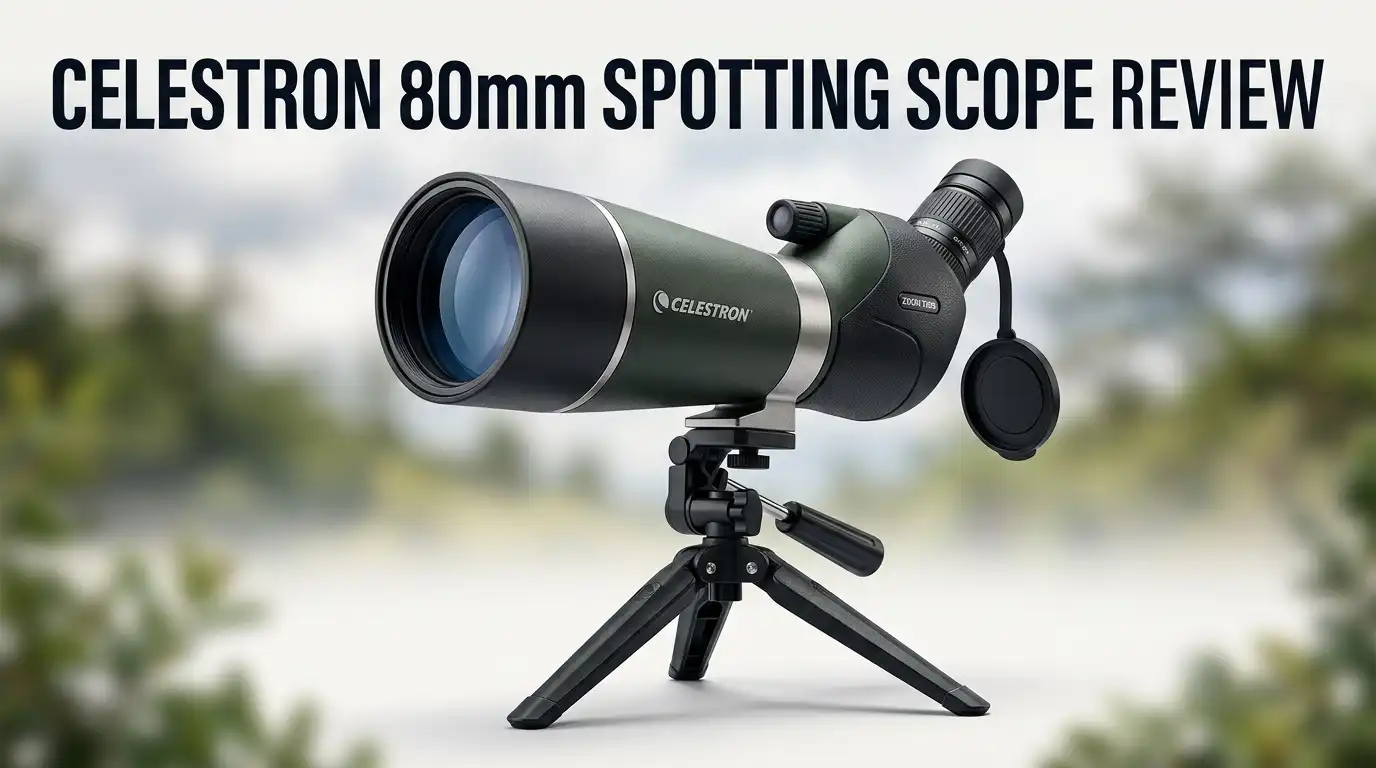
Celestron Ultima 20x to 60x 80mm Angled Spotting Scope
This is the core model, item number 52250. The tube measures about 16 inches long and tips the scale near 3.6 pounds with the eyepiece attached. Celestron finishes it in a satin green gray paint that blends into brush and reflects heat well in full sun.
The prism housing wears a thick rubber armor collar. The rest of the tube is bare metal, which is why the included soft case matters so much. Leave the case on and your scope stays scratch free.
Specifications worth knowing: 4mm exit pupil at 20x, 18mm stated eye relief at 20x, 105 feet field of view at 1000 yards, and 53 feet at 60x. Twilight factor sits at 40 when set to 20x.
The scope is fully waterproof. I left it out in steady rain for forty minutes with no fogging and no water ingress. The lens hood is fixed and does not retract, which is a small annoyance on bright days.
Unboxing Experience: What Actually Arrives
The box is modest. Celestron does not spend your money on foam sculpture or magnetic flaps. Inside you find the scope wrapped in the stay on soft case already fitted, which is a nice touch since you can use it straight away.
The zoom eyepiece ships separately in a hard plastic screw top container. A zippered soft eyepiece pouch with a snap ring rides along too. Most owners never use that pouch, because the main case covers the scope with the eyepiece installed.
A snap in lens cap protects the objective. A short printed manual covers basic setup. That is the whole kit.
First impressions are honest ones. The paint looks better than the price suggests. The focus knob feels stiff out of the box and loosens slightly after a week of use. Threading the eyepiece in takes a clockwise quarter turn and seats with a reassuring stop. Nothing rattles. Nothing feels hollow.
Top 3 Alternative for Celestron Ultima 80 Spotting Scope

Last update on 2026-09-22 / Affiliate links / Images from Amazon Product Advertising API Some of the links on this website are affiliate links, which means that at no additional cost to you, I earn a commission if you click through and make a purchase. I only recommend products and services that I believe will add value to my readers. Thank you for your support!
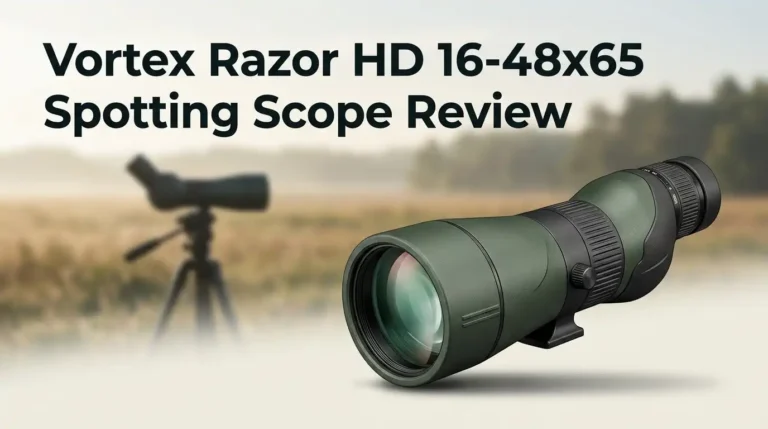
Celestron TrailSeeker 20x to 60x 80mm Spotting Scope

Last update on 2026-09-17 / Affiliate links / Images from Amazon Product Advertising API Some of the links on this website are affiliate links, which means that at no additional cost to you, I earn a commission if you click through and make a purchase. I only recommend products and services that I believe will add value to my readers. Thank you for your support!
Celestron Regal M2 80ED Spotting Scope

Last update on 2026-09-13 / Affiliate links / Images from Amazon Product Advertising API Some of the links on this website are affiliate links, which means that at no additional cost to you, I earn a commission if you click through and make a purchase. I only recommend products and services that I believe will add value to my readers. Thank you for your support!
Gosky Updated 20x to 60x 80mm Spotting Scope with Tripod
Optical Performance in Daylight
Daylight is where this scope earns its reputation. At 20x through roughly 35x, images look sharp, bright, and pleasantly warm in tone. Greens read slightly richer than neutral. Most birders like that rendering.
I resolved individual feather barbs on a great blue heron at 90 yards at 30x. Detail held firm. Contrast stayed clean because the simple optical layout keeps stray light low.
Ghosting and internal reflections are minimal. With few lens elements, there is little to bounce light around. Pointing near the sun still washes the view, and the fixed hood cannot help much, so shade the objective with your hand.
Center sharpness stays usable all the way to 60x on a calm day. A resolution chart test at 35 meters confirmed the scope uses its full aperture rather than running out of detail at 40x. Edge performance is respectable too, with about 85% of the field holding maximum sharpness at low power.
Low Light and Dawn Birding Results
The 80mm objective exists for this moment. Thirty minutes before sunrise, the difference between this scope and a 60mm is obvious and immediate.
At 20x the exit pupil measures 4mm, which feeds your dilated pupil enough light for real color perception. I identified a green winged teal by its wing patch at 120 yards in light too dim for my 8×42 binoculars.
Push past 40x in low light and the picture collapses quickly. The exit pupil shrinks under 2mm, and the image turns dim and gray. Stay near 20x to 30x at dawn and dusk.
Compared to fully multicoated rivals, the Ultima gives up some transmission. Celestron uses multicoated optics, not fully multicoated. In practice you lose perhaps the last five minutes of usable shooting light against a pricier scope. For most birders, that tradeoff is acceptable at this price.
The Zoom Eyepiece: Strengths and Limits
The included 8mm to 24mm zoom eyepiece is a genuine value add. Buying a comparable zoom separately would cost a meaningful slice of the scope price.
Zoom action is short and smooth. You travel from 20x to 60x in just over a quarter turn of the knurled ring. Marked detents sit at 20x, 30x, 40x, 50x, and 60x, though you can park anywhere between them.
The apparent field of view is the weak spot. At 20x you see roughly 40 degrees of apparent field, which feels like looking down a soda straw. It widens to about 60 degrees at 60x, an unusual and welcome behavior.
Eye relief is listed at 18mm at 20x. Real usable relief measures a millimeter or two less once the rubber eyecup rolls down. Eyeglass wearers will notice slight vignetting at the widest setting. The eyepiece uses a proprietary bayonet, so standard 1.25 inch astronomy eyepieces will not fit.
Build Quality, Weatherproofing, and Handling
The chassis is aluminum under that satin paint. It feels dense and cold in hand, more like a tool than a toy. My sample weighed closer to 3.2 pounds on a kitchen scale without caps, slightly under the published figure.
Waterproofing is real, not splash resistant marketing. The scope survived rain, fog, and a humid dawn without internal condensation.
The rotating tripod foot is the handling highlight. Loosen the collar, spin the body, and you can shift the eyepiece to the side for prone shooting or comfortable seated viewing. The foot accepts any standard quarter inch twenty tripod screw.
A small sighting tube molded into the left side of the body helps you aim. It works better than you expect and saves real frustration with a narrow field of view. The lack of full rubber armor is the main build compromise, so keep the soft case fitted during transport.
Focusing System: Speed and Feel
Celestron used a single long focus knob positioned at the top right front of the prism housing. You can reach it with either hand, and it works while wearing gloves.
The knob is grooved, semi recessed, and long enough to turn with two fingers. Rotation requires more force than a premium scope demands. It never feels gritty, just firm.
Travel is brisk. Roughly four and a half turns carry you from close focus to infinity. That is fast compared to many scopes, which cuts hunting time on a moving bird.
The tradeoff is precision. A fast focuser makes fine adjustment at 60x fiddly, since a tiny nudge overshoots. There is no fine focus wheel, and that absence shows most at maximum magnification. Close focus lands near 27 feet, or about 9 meters in testing. That is tight enough for butterflies, feeder birds, and indoor archery lanes.
Digiscoping and Smartphone Photography

Last update on 2026-07-01 / Affiliate links / Images from Amazon Product Advertising API Some of the links on this website are affiliate links, which means that at no additional cost to you, I earn a commission if you click through and make a purchase. I only recommend products and services that I believe will add value to my readers. Thank you for your support!
This scope handles casual photography better than its price suggests. Peel off the soft rubber eyecup and standard photographic T threads sit exposed underneath.
Thread on an inexpensive T ring, attach a camera body, and the scope becomes a 480mm f/6 telephoto lens. No extra adapter is required. That is a genuinely useful feature for the price.
The smartphone kit version bundles a phone adapter that clamps over the eyepiece. Alignment takes a minute of fiddling. Once centered, phone video of targets and wildlife comes out watchable.
Expect limits. Vignetting appears at 20x with most phone cameras. Color fringing shows up clearly in photos taken above 40x, more visibly than your eye perceives it live. Digiscoping here is for documentation and identification records, not for gallery prints. Serious photographers should budget for an ED scope instead.
Range Use for Target Shooters
Shooters buy this scope for one job: seeing holes in paper without walking downrange. It performs that job well within sensible distances.
At 100 yards, .22 caliber holes appear obvious at 30x on a clean white target. At 200 yards, .223 holes stay visible at 40x to 50x in decent light, without straining.
Push toward 300 yards and conditions decide everything. On a cool, calm morning the scope shows holes. On a hot afternoon with mirage rolling off the ground, no scope at this price wins that fight.
Beyond 300 yards, buy better glass or use an electronic target system. That is honest advice rather than a knock on Celestron.
The 45 degree eyepiece suits bench shooting nicely. You glance sideways rather than lifting off the rifle. The rotating collar lets you angle the eyepiece for prone positions too. The 27 foot close focus also covers pistol bays and air rifle lanes.
Astronomy Use After Dark
An 80mm f/6 refractor is a real telescope, and this one moonlights nicely. Images arrive right side up and correctly oriented left to right, which makes terrestrial and lunar viewing intuitive.
The moon at 60x looks genuinely impressive. Craters along the terminator show shadow detail and rim structure. Saturn shows its rings as a separate ring, not just an oval bulge. Jupiter reveals two cloud belts and all four Galilean moons.
Star fields behave well. Coma and astigmatism stay controlled thanks to the simple eyepiece design. Stars stay pinpoint across most of the field at 20x and degrade only slightly at 60x.
The ceiling is the fixed 60x limit. You cannot swap in a 6mm astronomy eyepiece for higher power because of the proprietary bayonet mount. Deep sky targets beyond bright clusters and the brightest nebulae stay out of reach. Treat astronomy as a bonus, not a reason to buy.
What the Celestron 80mm Spotting Scope Does Not Do Well
Every honest review names the failures. Here are this scope’s real ones.
The narrow field of view at 20x frustrates new users. At 105 feet per 1000 yards, locating a warbler in a hedge takes several attempts. Practice with the sighting tube helps, but the limit remains.
Color fringing shows up above 35x on high contrast edges. Dark branches against bright sky pick up a violet edge. It is not ruinous. It is visible.
The coatings are multicoated, not fully multicoated. Against a similarly priced ED scope, images look slightly flatter and a touch warmer.
The focuser is stiff and offers no fine adjustment. Dialing exact focus at 60x tests your patience.
No tripod is included with the base model. Budget another $60 to $150 for a stable head and legs, or the scope cannot perform.
Finally, the bare metal tube scratches. Lose the soft case and the finish suffers within a season.
Pros and Cons
Pros
- Huge aperture for the money. The 80mm objective delivers roughly 77% more light gathering and 33% higher resolution than a 60mm scope at a similar price point.
- Zoom eyepiece included. The 20x to 60x eyepiece would cost a meaningful sum purchased separately, and it performs decently across the range.
- Fully waterproof and fogproof. Rain, humidity, and cold mornings caused zero internal fogging during testing.
- Built in T threads. You can attach a camera body with a cheap T ring and get a 480mm f/6 lens with no extra adapter.
- Close focus at 27 feet. Butterflies, feeder birds, and 10 meter air rifle targets all stay in reach.
- No fault lifetime warranty for buyers in the United States and Canada from authorized dealers.
- Useful accessories included, such as the stay on soft case with zippered flaps and shoulder strap.
Cons
- Narrow apparent field at low power, around 40 degrees at 20x, which slows target acquisition.
- Chromatic aberration appears above 35x on high contrast subjects.
- Multicoated only, not fully multicoated, so transmission trails ED rivals slightly.
- Stiff single speed focuser with no fine focus wheel.
- Proprietary eyepiece bayonet blocks standard 1.25 inch eyepieces.
- No tripod included in the base package.
- Partial rubber armor leaves painted metal exposed to scratches.
Who Should Buy It and Who Should Skip It
Buy it if you are a beginning or intermediate birder who wants maximum aperture per dollar. The Ultima 80 shows you more than any 60mm scope at this price, and the lifetime warranty removes long term risk.
Buy it if you shoot at 100 to 200 yards and want to see holes without walking. Buy it if you want one scope that handles wildlife by day and the moon by night.
Skip it if you wear glasses and demand comfortable full field viewing. The eye relief is adequate, not generous.
Skip it if you plan serious digiscoping or wildlife photography. Color fringing above 40x will show in every frame, and an ED scope solves that problem properly.
Skip it if you scan wide landscapes and need a broad field of view. The TrailSeeker 80 or an ED model serves you better there. Skip it if you refuse to buy a tripod, because this scope simply will not work handheld.
Final Verdict
The Celestron 80mm spotting scope remains a strong value buy in 2026, with clear limits you should accept before ordering. It delivers honest 80mm performance, a usable zoom, real waterproofing, and a lifetime warranty for under $300.
It does not compete with ED glass, and Celestron never claimed it would. The company sells the Regal M2 80ED for buyers who want that level.
What you get here is a competent, durable, simple instrument that shows you far more than binoculars ever will. For a first serious scope, that is exactly the right trade.
My score lands at 4 out of 5 for the money. Deduct half a star for the narrow low power field and half for the stiff focuser. Add a full star back for the price to aperture ratio, which almost nothing else matches.
Frequently Asked Questions
Is the Celestron Ultima 80 good for bird watching?
Yes, with one caveat. The 80mm aperture excels at dawn and dusk identification, and the 45 degree eyepiece keeps your neck comfortable during long sessions. The narrow field of view at 20x makes finding small, fast birds harder than with a wide field scope. Learn the built in sighting tube and the problem largely disappears.
Does the Celestron 80mm spotting scope come with a tripod?
The standard Ultima 80 package does not include a tripod. You receive the scope, the zoom eyepiece, a lens cap, an eyepiece container, a soft eyepiece pouch, and a stay on soft carry case. Any photo tripod with a standard quarter inch twenty mounting screw fits. Choose a sturdy model, since a light tripod shakes badly at 60x.
What magnification is actually usable on this scope?
All of it, in good conditions. Resolution testing shows the scope uses its full aperture, and image detail holds at 60x on calm days. In practice, most users settle between 30x and 45x. Heat shimmer, wind, and low light degrade the view at maximum power far more than the optics do.
Can I use the Celestron Ultima 80 for astronomy?
Yes, as a capable secondary instrument. The moon looks excellent, Saturn’s rings separate clearly, and Jupiter shows cloud belts with all four bright moons. You cannot exceed 60x because the eyepiece mount is proprietary, so deep sky work stays limited to bright clusters and the brightest nebulae.
How does the Ultima 80 compare to the Regal M2 80ED?
The Regal M2 80ED adds extra low dispersion glass, fully multicoated optics, dual speed focusing, and a standard 1.25 inch eyepiece mount. It removes nearly all color fringing and improves contrast. It also costs several times more. Choose the Ultima for value, the Regal for image quality and photography.
Is the angled or straight version better?
Angled suits birding, astronomy, and bench shooting. It reduces neck strain during upward viewing and lets people of different heights share one tripod setting. Straight suits scanning from a vehicle window or tracking across flat water. Both versions share identical optics, so the choice comes down to how you observe.

Hello, I’m Emily Price, the founder of Birds Affection. As a passionate bird enthusiast and spiritual seeker, I’ve always been fascinated by the symbolic meanings and mystical connections between birds and our lives. On this website, I share my knowledge and insights on the spiritual significance of various bird species, exploring their roles as messengers, guides, and teachers. Through my writing, I aim to inspire and educate others on the profound wisdom and beauty that birds bring to our world. Join me on this journey as we delve into the enchanting realm of bird symbolism and discover the hidden meanings behind these magnificent creatures.