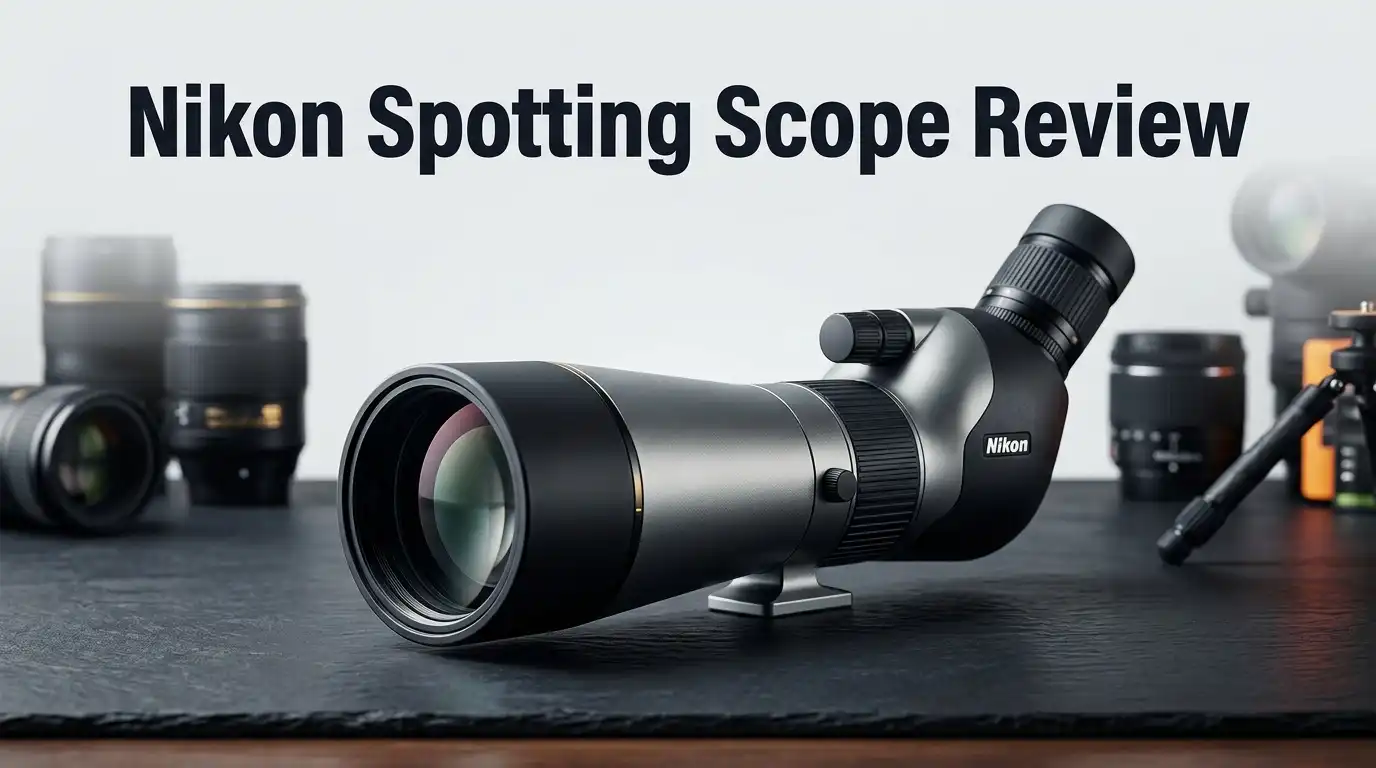
Nikon Spotting Scope Review 2026: Still Worth It?
Nikon sits in a strange spot in 2026. The company quietly trimmed its sport optics catalog, yet the scopes that survived the cut are some of the best value buys on the market.
Birders still rave about the Monarch fieldscope. Long range shooters still spot bullet holes at 600 yards with the Prostaff 5. Meanwhile Vortex and Leupold keep pushing cheaper glass into the same price brackets.
This review covers what the glass actually delivers, what the marketing skips, and where Nikon loses to rivals. No fluff. Just the details you need before you tap buy.
In a Nutshell:
- The Monarch 20 to 60×82 ED is the standout. It beats similarly priced ED scopes in sharpness tests and costs hundreds less than Swarovski or Zeiss. Image quality at 20x to 40x is genuinely excellent.
- Sharpness drops noticeably past 45x. This happens on almost every zoom eyepiece, but it shows up early on the Monarch. Plan to spend most of your viewing time in the lower half of the range.
- The Prostaff 5 82mm remains the smart budget choice. No ED glass, but the big objective pulls in plenty of light for hunting and range work at a fraction of the Monarch price.
- Build quality is a strong point. Rubber armor, nitrogen purging, waterproof bodies, and sliding sunshades come standard across the range.
- Accessories feel dated. The ocular lens cap slips off easily, the carry case rubs against the focus collar, and Nikon sells no tripod in the box on most models.
- Nikon’s US warranty support has shrunk. Service still exists, but turnaround reports vary, and that matters on a scope you plan to keep for twenty years.
Nikon Monarch 20 to 60×82 ED Fieldscope Review

Last update on 2026-09-18 / Affiliate links / Images from Amazon Product Advertising API Some of the links on this website are affiliate links, which means that at no additional cost to you, I earn a commission if you click through and make a purchase. I only recommend products and services that I believe will add value to my readers. Thank you for your support!
This is the scope most buyers land on. The Monarch fieldscope pairs an 82mm extra low dispersion objective with a field flattener lens system. In plain language, that means sharp detail from the middle of the view all the way to the edge.
The scope measures about 15.75 inches long with the 20 to 60x zoom eyepiece mounted. It weighs roughly 4.6 pounds. That puts it right in the middle for full size scopes, so it is not the heaviest option in your pack.
Colors look natural and neutral. I noticed no warm or cool bias, which matters if you photograph birds or judge animal coat color at distance. Contrast is high. Detail at 30x on a distant hawk was clean enough to count feather edges.
Nikon prices this around the 1,500 to 1,700 dollar range depending on sales. Compared against alpha glass costing three times more, the gap in performance is far smaller than the gap in price.
Pros
- ED glass with field flattener lenses delivers sharp edge to edge views
- Variable speed helical focus makes distant and close subjects easy to dial in
- Available in both angled and straight bodies at the same price
- Padded view through case included, so you can glass without removing it
- Excellent sliding sunshade that stays exactly where you set it
Cons
- Image quality falls off above 45x even in perfect conditions
- Focus collar feels stiff when new and shakes lighter tripods
- Depth of field is shallower than some buyers expect
- Eyepiece is not rated waterproof on its own
- No tripod included at a premium price point
Unboxing the Monarch 82ED
The box is plain. Nikon does not chase the premium presentation that some brands do, and honestly that is fine. Inside you find the scope body, the 20 to 60x zoom eyepiece already attached on most kits, both lens caps, the neoprene and cordura view through case, and a padded shoulder strap.
First thing you notice lifting it out is the density. The matte rubber armor feels grippy and serious. It does not squeak or shift under your hand.
Mounting the eyepiece takes seconds. Twist, seat, lock. The objective lens cover uses a double pinch clasp that snaps on firmly and stays put, which is a small detail I came to appreciate in wind.
The ocular cap is the weak link. It is semi flexible plastic and sits loosely over the eyecup rubber. Expect to lose it eventually. There is a tiny hole in the flange for a tether, but nothing obvious on the body to tie it to.
Nikon Prostaff 5 Proscope 82mm Review

Last update on 2026-09-18 / Affiliate links / Images from Amazon Product Advertising API Some of the links on this website are affiliate links, which means that at no additional cost to you, I earn a commission if you click through and make a purchase. I only recommend products and services that I believe will add value to my readers. Thank you for your support!
The Prostaff 5 is the workhorse. Nikon skipped ED glass here and leaned on fully multicoated optics with a porro prism design and a large 82mm objective.
Does that matter? Yes and no. You will see slightly more color fringing around high contrast edges, especially at the top of the zoom range. For hunters glassing brown animals on brown hillsides, the difference is minor. For birders studying warbler plumage, it is more noticeable.
What you get in exchange is a much lower price and a lighter wallet hit if the scope takes a tumble. The built in sliding sunshade cuts glare and keeps rain off the front glass. The body is waterproof and fogproof.
The 20 to 60x zoom eyepiece comes included. Target shooters report clean bullet hole spotting at 300 to 500 yards in decent light. This is the scope I would recommend to a first time buyer who is not certain how often they will use it.
Pros
- Large 82mm objective gathers plenty of light for the money
- Waterproof and fogproof construction holds up to real weather
- Zoom eyepiece included, no extra purchase needed
- Straight and angled bodies both offered
- Simple controls with very little to break
Cons
- No ED glass, so chromatic aberration shows at high power
- Heavy for its price class at over 4 pounds
- Edge sharpness softens compared to the Monarch
- Included accessories are basic
- Availability has become spotty as stock runs down
Top 3 Alternative for Nikon Monarch 20 to 60×82 ED Fieldscope

Last update on 2026-09-13 / Affiliate links / Images from Amazon Product Advertising API Some of the links on this website are affiliate links, which means that at no additional cost to you, I earn a commission if you click through and make a purchase. I only recommend products and services that I believe will add value to my readers. Thank you for your support!
Vortex Diamondback HD Spotting Scope 20 to 60×85 Angled

Last update on 2026-09-13 / Affiliate links / Images from Amazon Product Advertising API Some of the links on this website are affiliate links, which means that at no additional cost to you, I earn a commission if you click through and make a purchase. I only recommend products and services that I believe will add value to my readers. Thank you for your support!
Leupold SX 2 Alpine HD Spotting Scope Angled

Last update on 2026-09-18 / Affiliate links / Images from Amazon Product Advertising API Some of the links on this website are affiliate links, which means that at no additional cost to you, I earn a commission if you click through and make a purchase. I only recommend products and services that I believe will add value to my readers. Thank you for your support!
Vortex Crossfire HD Spotting Scope
Optical Performance in Real Conditions
Lab charts tell you one story. Field use tells another. I judged these scopes on distant license plates, tree bark texture, and bird detail at first and last light.
The Monarch handled low light better than I expected for a mid priced scope. At dawn, the 82mm objective and ED glass combination held usable brightness roughly fifteen minutes longer than a non ED competitor in the same class.
Heat shimmer is the enemy nobody warns you about. On a hot afternoon over open ground, no scope at any price fixes mirage. You will drop to 25x or 30x and live with it.
The Monarch’s real advantage is resolution in the lower two thirds of its zoom range. Detail there is crisp and contrast is high. Push past 45x and the view gets dimmer and softer.
The Prostaff 5 stays respectable to about 35x, then softens faster. Both scopes benefit hugely from a stable tripod, more than most buyers realize.
Angled Versus Straight Body: Which One Fits You
Nikon sells both configurations at the same price, so the choice comes down to how you use the scope.
Pick the angled body if you share the scope with people of different heights, if you watch from a seated position, or if you scan upward at cliffs and treetops. The angled eyepiece lets you keep the tripod lower, which improves stability and reduces wind shake.
Pick the straight body if you hunt from a prone position, spot from a truck window, or need to track a moving animal quickly. Straight scopes point more intuitively. You aim the body where your eyes already look.
Birders lean angled. Western hunters and range shooters lean straight. Neither choice is wrong.
One practical note. The angled model rotates within its mounting collar and locks with a set screw. That flexibility is genuinely useful when the terrain is uneven and you cannot level the tripod properly.
The Variable Speed Focus System
This feature deserves its own section because Nikon rarely advertises it well. The Monarch uses a helical collar that wraps around the scope body, and the focus speed changes based on subject distance.
Three speeds operate automatically. Distant subjects focus fast and coarse. Middle distance subjects slow down. Close subjects get very fine control.
Once your hands learn it, the system is excellent. You snap onto a distant ridge quickly, then refine detail on a bird twenty feet away without endless spinning.
The downside is resistance. A brand new Monarch focus collar is stiff. Stiff enough that turning it shakes a mid weight tripod, which makes finding peak sharpness annoying. It loosens with use over a few weeks.
The included view through case makes this worse. The case edge rubs against the ribbed collar and adds friction. I ended up rolling the case back slightly before extended viewing sessions.
What Nikon Spotting Scopes Do Not Do Well
Honest reviews say the uncomfortable part, so here it is.
Nikon has pulled back from sport optics in several markets. Product lines have vanished, and the legendary EDG fieldscope is hard to source new. That shrinking catalog creates real risk around future accessories and service.
The eyepiece ecosystem is limited. Nikon offers a 38mm wide angle and a 30 to 60x zoom for the Monarch. That is it. Swarovski and Kowa offer far deeper eyepiece and adapter selections.
Digiscoping support has aged. Adapters exist, but third party universal phone clamps often work better than Nikon’s own solutions in 2026.
Included accessories feel like an afterthought on scopes costing well over a thousand dollars. No tripod. A loose ocular cap. A case that interferes with focusing.
Finally, close focus on the Monarch sits just over 16 feet. Butterfly and dragonfly watchers will find that restrictive compared to scopes focusing under 10 feet.
Nikon Prostaff 3 Fieldscope Outfit for Beginners
If your budget lives under 400 dollars, this is where Nikon still competes hard.
The Prostaff 3 pairs a 60mm objective with a 16 to 48x zoom eyepiece, and the outfit version includes a compact tripod and a carry case. Total weight is low. The body runs about 12.3 inches long.
It is genuinely portable. You can drop it in a daypack without planning your whole trip around it. Nikon rates the body waterproof, fogproof, and shockproof.
Optically, do not expect miracles. A 60mm objective gathers far less light than an 82mm one, and detail at 48x is soft. This scope shines between 16x and 30x, where views stay bright and usable.
The included tripod is small and wobbly. Treat it as a starter and upgrade when you can. Even so, for a beginner birder, a casual target shooter, or a family looking at the moon from the backyard, the value here is hard to argue with.
Nikon Versus Vortex and Leupold in 2026
This comparison decides most purchases, so let us be direct.
Vortex wins on warranty. The unlimited unconditional lifetime warranty is transferable and requires no receipt. That peace of mind is worth real money on gear you take into rough country. The Diamondback HD 20 to 60×85 competes directly with the Monarch and costs less.
Nikon wins on glass at the mid price tier. Head to head sharpness tests consistently favor the Monarch over similarly priced ED scopes, including Vortex options.
Leupold sits in between with the SX 2 Alpine HD. Solid build, American brand support, decent glass, and a lighter body than either rival.
My honest take is this. Buy the Monarch if image quality matters most and you will keep it carefully. Buy Vortex if you are hard on gear and want the warranty safety net. Buy Leupold if weight is your top concern.
Tripods and Setup That Actually Matter
Here is the advice nobody wants to hear. Your tripod affects your view more than a 300 dollar upgrade in glass.
An 82mm scope at 60x magnifies every vibration. A flimsy aluminum tripod turns a sharp image into a shaking mess. Budget at least 200 dollars for a carbon fiber or heavy aluminum tripod rated well above the scope weight.
The head matters equally. A fluid video head lets you pan smoothly across a ridgeline. A cheap ball head fights you constantly.
Set the tripod lower than you think you need. Shorter legs mean less flex and less wind sway. Sit on a stool instead of standing.
Use the sunshade every single time, not just in bright sun. It reduces flare, and more importantly it absorbs the impact if your rig tips over. Breaking a plastic shade beats replacing an 82mm ED objective lens.
Who Should Buy a Nikon Spotting Scope This Year
The Monarch fits the birder or hunter with a moderate budget who wants performance close to premium glass without the premium invoice. If you spend hours behind a scope and notice image quality, this is your pick.
The Prostaff 5 fits the occasional user. Someone who spots at the range a few weekends a year, or scouts before hunting season, will not miss the ED glass.
The Prostaff 3 outfit fits beginners and travelers who value packability over peak sharpness.
Skip Nikon entirely if you need extensive eyepiece options, plan to digiscope heavily, or want the strongest warranty available. Those buyers should look at Vortex, Kowa, or the alpha European brands.
Availability is the wild card. Stock on some Nikon models has thinned through 2026, so prices fluctuate and popular configurations sell out. Check current listings before you set your heart on one.
Frequently Asked Questions
Is Nikon still making spotting scopes in 2026?
Nikon continues to sell fieldscopes, including the Monarch ED line, though the catalog is smaller than it was five years ago. Some regions have seen models discontinued. Check retailer stock and current listings, since availability shifts month to month.
Is the Monarch 82ED worth the extra money over the Prostaff 5?
If image quality matters to you, yes. The ED glass and field flattener lenses produce noticeably sharper, cleaner views with less color fringing. If you use a scope a few times a year, the Prostaff 5 saves you a lot and still performs well.
What magnification do I actually use most?
Most users spend their time between 20x and 40x. Higher power looks impressive on the box, but heat shimmer, tripod shake, and dimmer images limit real world use above 45x.
Do I need ED glass?
ED glass reduces chromatic aberration and improves contrast. Birders and photographers benefit clearly. Hunters and casual target shooters often find non ED glass sufficient for the price difference.
Should I buy angled or straight?
Choose angled for shared use, seated viewing, and upward angles. Choose straight for prone shooting, vehicle spotting, and quickly tracking moving animals.
Can I attach my phone to a Nikon fieldscope?
Yes. Nikon sells digiscoping adapters, and universal third party phone clamps work well. Expect some trial and error to center the phone camera over the eyepiece.
How does Nikon compare on warranty?
Nikon offers service support, but Vortex and Leupold both provide stronger no questions asked lifetime coverage. If warranty matters most, factor that into your decision.

Hello, I’m Emily Price, the founder of Birds Affection. As a passionate bird enthusiast and spiritual seeker, I’ve always been fascinated by the symbolic meanings and mystical connections between birds and our lives. On this website, I share my knowledge and insights on the spiritual significance of various bird species, exploring their roles as messengers, guides, and teachers. Through my writing, I aim to inspire and educate others on the profound wisdom and beauty that birds bring to our world. Join me on this journey as we delve into the enchanting realm of bird symbolism and discover the hidden meanings behind these magnificent creatures.