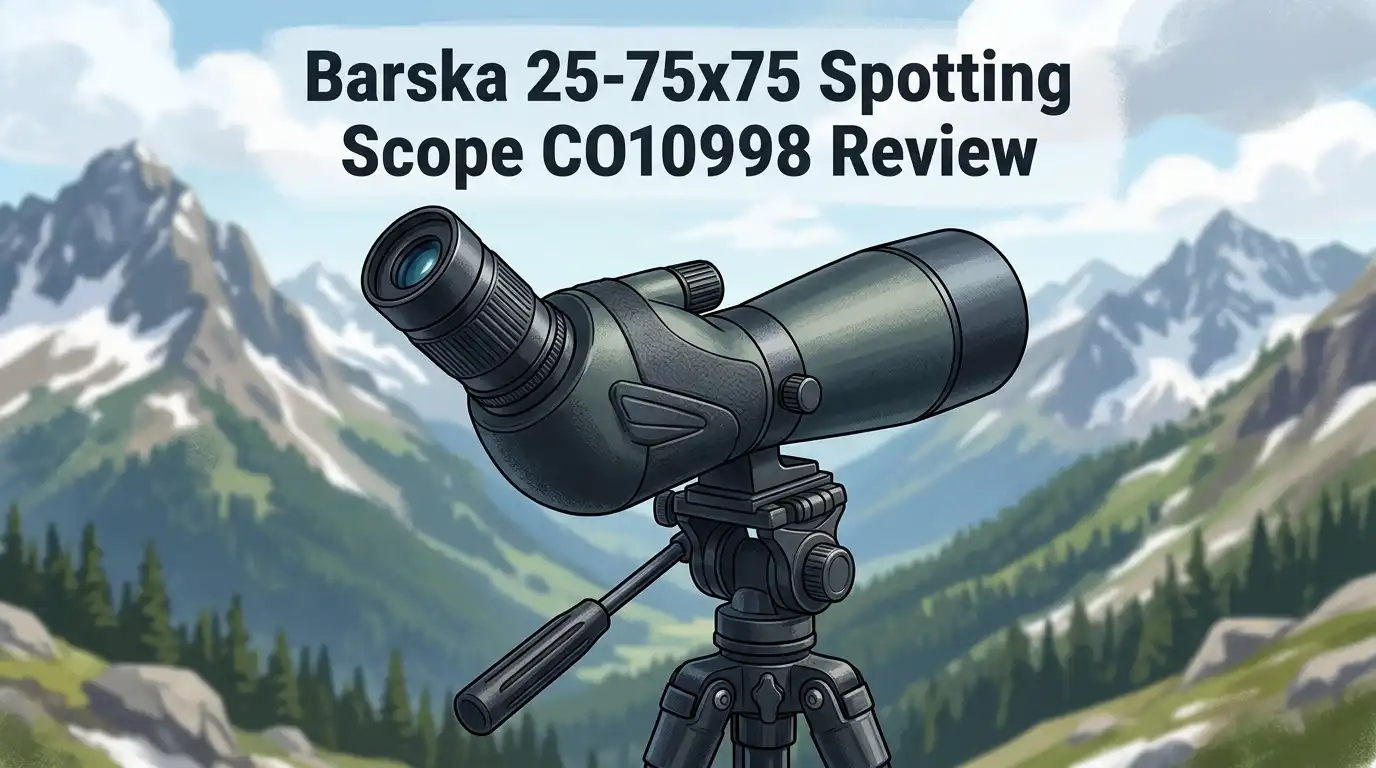
Barska 25-75×75 Spotting Scope CO10998 Review 2026: Worth Buying?
Buying your first spotting scope feels like a gamble. You see a 75mm objective lens, a 75x zoom, a free tripod, and a price tag under $150. Then you wonder what the catch is. The Barska CO10998 sits right in that confusing budget zone where marketing numbers look amazing and real world results vary a lot.
I spent time with this scope at the rifle range, in the backyard, and on a few early morning bird walks. This review covers what the scope actually delivers, where it falls short, and who should skip it entirely.
No fluff. No recycled spec sheets. Just honest observations from someone who has looked through a lot of glass. Let me show you what you get for your money.
In a Nutshell:
- The 75mm objective lens is the real star. It gathers a lot of light for this price class. Images at 25x look bright, sharp, and genuinely pleasant. This is where the CO10998 earns its keep.
- The top end of the zoom is mostly marketing. Usable detail drops off hard past 45x. Above 60x you get a dim, soft, shaky image. Treat this as a 25x to 45x scope and you will be happy.
- The included tripod is the weakest part of the package. It is a lightweight aluminum table tripod that wobbles under any wind or finger pressure. Budget another $40 for a real tripod.
- Build quality punches above the price. Rubber armor, a grooved zoom dial, a flip down lens cover, and 41 ounces of solid weight. It feels like a tool, not a toy.
- Weather resistance is not full waterproofing. Barska calls it weather resistant. Light rain is fine. Submersion is not. Do not confuse this with nitrogen purged sealing.
- Best value for target shooters at 100 to 200 yards. You can call .22 holes at 100 yards in good light. That alone justifies the cost for many buyers.
Barska 25-75×75 Spotting Scope CO10998


Last update on 2026-09-25 / Affiliate links / Images from Amazon Product Advertising API Some of the links on this website are affiliate links, which means that at no additional cost to you, I earn a commission if you click through and make a purchase. I only recommend products and services that I believe will add value to my readers. Thank you for your support!
The CO10998 belongs to the Barska Colorado series. It is a straight body spotting scope with a 75mm objective lens and a 25x to 75x zoom eyepiece. The optical system uses BK7 Porro prisms with fully coated lenses. Barska lists the weight at 41 ounces, which is about 2.5 pounds of scope body alone.
Close focus sits at 32.8 feet. Field of view runs 92 feet at 1000 yards at the low power setting, dropping to 42 feet at the top of the zoom. Eye relief measures 13mm at 25x and 11mm at 75x. The exit pupil shrinks from 3mm down to 1mm across the zoom range.
The package includes a soft carrying case, a lens cloth, and a tabletop tripod. Barska backs it with a limited lifetime warranty. That warranty matters more than you might think at this price.
The Unboxing Experience
The box arrived plain and functional. Barska does not spend money on presentation, and honestly that is fine. Inside, the scope sits in a molded foam cradle with the tripod and case tucked beside it.
First impression: this thing is heavier than expected. The green rubber armor has a slightly tacky grip texture that feels reassuring in cold hands. The flip down objective cover is attached, so you will not lose it in tall grass.
The soft case surprised me. It has a shoulder strap, a zipper that actually works, and enough padding to survive a truck bed. Many budget scopes ship with a sack. This is a real case.
The tripod was the letdown. It weighs almost nothing. Pulling the legs out revealed thin aluminum tubes and plastic locking collars. You can feel the flex before you even mount the scope.
Design and Build Quality
The straight body design splits opinion. I like it for range work because you can aim the scope by sighting along the barrel. You point, look, and you are already close to your target. Angled scopes require more hunting around.
The rubber armor covers the full tube. It absorbs small knocks and reduces noise if you bump it against a bench or rock. After a few weeks the armor still showed no peeling or lifting at the seams.
The grooved zoom dial sits just forward of the eyepiece. It turns with firm, even resistance. No gritty spots, no slop. The focus ring is a wide band around the middle of the body, and it also turns smoothly.
A rotating tripod collar lets you shift the scope between horizontal and vertical orientation. Useful if you want to glass a cliff face or a tall tree. Small feature, genuinely handy.
Optical Performance and Image Clarity
Here is where honesty matters most. The CO10998 uses BK7 glass and fully coated optics. Fully coated means a single antireflection layer on some surfaces. It is the entry level of lens coating. Multicoated and fully multicoated scopes transmit noticeably more light.
At 25x the image looks bright and reasonably sharp across the center 70 percent of the field. Edges soften. Colors lean slightly cool. On high contrast edges, like a dark branch against bright sky, you will see purple and green fringing. That is chromatic aberration, and it is expected at this price.
At 100 yards in midday sun, I could resolve .22 caliber holes in a white target at roughly 35x. Pushing higher made the holes fuzzier, not clearer.
Verdict on optics: good at low power, average at medium power, poor at high power. That is a fair trade for the money.
Top 3 Alternatives for Barska 25-75×75 Spotting Scope CO10998

Last update on 2026-07-01 / Affiliate links / Images from Amazon Product Advertising API Some of the links on this website are affiliate links, which means that at no additional cost to you, I earn a commission if you click through and make a purchase. I only recommend products and services that I believe will add value to my readers. Thank you for your support!
Celestron Ultima 20 to 60×80 Angled Spotting Scope

Last update on 2026-10-07 / Affiliate links / Images from Amazon Product Advertising API Some of the links on this website are affiliate links, which means that at no additional cost to you, I earn a commission if you click through and make a purchase. I only recommend products and services that I believe will add value to my readers. Thank you for your support!
Gosky 20 to 60×80 Spotting Scope with Smartphone Adapter

Last update on 2026-07-01 / Affiliate links / Images from Amazon Product Advertising API Some of the links on this website are affiliate links, which means that at no additional cost to you, I earn a commission if you click through and make a purchase. I only recommend products and services that I believe will add value to my readers. Thank you for your support!
Emarth 20 to 60×60 Angled Spotting Scope
Magnification Range Tested in the Field
Let me break the zoom range into honest zones based on what I actually saw.
25x to 35x is the sweet spot. The image stays bright, the exit pupil remains large enough for comfortable viewing, and heat shimmer stays manageable. This is where you will spend most of your time.
35x to 50x is usable with effort. You need a stable tripod and decent light. Detail holds up well enough to read mid size target scoring rings at 100 yards or identify a bird species at 60 yards.
50x to 75x is mostly decorative. The exit pupil drops near 1mm. The image dims, contrast collapses, and every tiny vibration becomes an earthquake. On hot days, atmospheric shimmer destroys any benefit.
This is not a Barska flaw alone. Almost every budget 60x and 75x zoom behaves this way. The difference is that better scopes stay usable longer into the range.
The Included Tripod Problem
I need to be blunt. The included tripod is the single biggest limitation of this package, and it is not an optics issue at all.
The tripod stands roughly 14 inches tall. It is meant for tabletop or bench use. The legs are thin, the pan head has noticeable play, and the mounting plate flexes under the scope’s 41 ounce weight.
At 25x you can work around it. At 50x, a light breeze turns your view into a shaky mess. Touching the focus ring causes several seconds of bounce before the image settles.
My recommendation: treat the tripod as a throwaway bonus. Spend $40 to $70 on a proper photo tripod with a fluid pan head. The optical improvement you perceive will be dramatic, even though the glass never changed.
Eye Relief and Comfort for Glasses Wearers
Eye relief ranges from 13mm at low power to 11mm at high power. That is tight. For reference, comfortable glasses friendly optics usually offer 15mm or more.
If you wear eyeglasses, you will see a reduced field of view with your glasses on. You will notice black edges creeping in around the image circle. Folding down or rolling back the rubber eyecup helps a little, but it does not solve the problem.
If your vision correction is mostly spherical, you can remove your glasses and use the focus ring to compensate. That works well and gives you the full field.
For astigmatism, you need your glasses, and the experience will feel cramped. This is a genuine drawback. Budget scopes rarely prioritize long eye relief, and this one is no exception.
Low Light Performance
Barska markets low light capability. The reality is more nuanced.
The 75mm objective collects plenty of light. That is physics and it works in your favor. But the fully coated BK7 optical system loses a meaningful amount of that light to internal reflection. A fully multicoated scope with the same objective size will look brighter.
At 25x, the 3mm exit pupil gives you decent performance during the last 30 minutes before sunset. You can still identify large animals and read terrain. Dawn and dusk glassing at low power works acceptably.
Push the zoom up and low light performance falls apart fast. At 60x the 1.25mm exit pupil leaves you squinting at a dim gray scene.
For serious low light hunting, look at a fully multicoated scope with ED glass. This one is a daylight instrument.
Weather Resistance Explained Honestly
Barska describes the CO10998 as weather resistant. Some retailers have listed it as waterproof and fogproof. Those claims do not match the manufacturer’s own specification page, which stops at weather resistant.
Weather resistant means the rubber armor and body seals will shrug off light rain, snow, and humidity. It does not mean the scope is nitrogen or argon purged. Without inert gas purging, internal fogging becomes possible during sharp temperature swings.
In practice I used it in light drizzle with no issue. I also moved it from a cold car into a warm room and got exterior condensation that wiped off cleanly. No internal fog appeared, but I would not test that repeatedly.
Practical advice: keep the case handy, avoid submersion, and store it dry. Treat it carefully and it will last years.
Best Uses for This Spotting Scope
This scope has a clear lane, and it performs well inside it.
Rifle and pistol range work at 100 to 200 yards is the strongest use case. Calling shots on paper targets is exactly what the magnification and the straight body design support.
Backyard and casual birding works nicely at 25x to 35x. You will identify feeder birds, hawks on poles, and waterfowl at moderate distance without trouble.
Basic lunar observation is surprisingly fun. The moon is bright enough that the optical limitations matter less. You can see craters, maria, and the terminator line clearly.
Scenic viewing from overlooks, cabins, and campsites is enjoyable.
What it does not suit: serious long range hunting, competitive 600 yard shooting, digiscoping, or professional field ornithology. Those demand better glass.
What This Scope Does Not Do Well
Authentic reviews name the flaws, so here they are without softening.
The top third of the magnification range does not deliver usable images. Marketing a 75x scope that works best at 35x is misleading, even if the whole category does it.
The included tripod cannot support the scope properly. It undermines the optics it is meant to serve.
Eye relief is too short for comfortable eyeglass use. Glasses wearers lose a chunk of field of view.
Chromatic aberration shows clearly on high contrast edges. Purple and green fringing appears regularly.
Edge sharpness falls off noticeably. The outer portion of the image stays soft at every magnification.
Fully coated optics limit light transmission compared to multicoated competitors at similar prices.
None of these are deal breakers at $130. They are deal breakers at $300, which is why the price matters so much here.
Pros and Cons
Pros
- Large 75mm objective lens gathers plenty of light for the price
- Solid rubber armored build feels durable and grips well in cold weather
- Smooth grooved zoom dial and wide focus ring operate without grit or slop
- Straight body design makes target acquisition fast at the rifle range
- Quality padded soft case with shoulder strap included
- Rotating tripod collar adds real flexibility for odd viewing angles
- Limited lifetime warranty from Barska
- Excellent image quality in the 25x to 35x range
- Strong value under $150
Cons
- Magnification above 50x produces dim and soft images
- Included tabletop tripod is too flimsy for the scope’s weight
- Short eye relief of 11mm to 13mm frustrates eyeglass wearers
- Visible chromatic aberration on high contrast subjects
- Edge of field softness at all magnifications
- Fully coated optics transmit less light than multicoated rivals
- Weather resistant only, not fully waterproof or fogproof
- At 41 ounces it is heavy for backcountry hiking
Price and Value in 2026
The CO10998 lists around $132 direct from Barska and often sells lower through online retailers. In 2026 that price lands it squarely in the entry level tier.
At that number, the value equation works. You get a genuine 75mm objective, real rubber armor, a usable case, and a lifetime warranty. Competitors at the same price often use 60mm objectives or plastic bodies.
The honest comparison point is the $200 to $250 tier. Scopes like the Celestron Ultima 80 bring fully multicoated optics, better low light performance, and a sturdier build. If you can stretch your budget, that jump delivers a visible improvement.
If your budget is firm at $150, the Barska represents fair money for fair performance. You are buying a competent daylight scope, not a premium optic, and the price reflects that accurately.
Who Should Buy the Barska CO10998
Buy this scope if you shoot at a 100 yard range and want to stop walking downrange to check targets. It solves that problem well.
Buy it if you are new to spotting scopes and want to learn what features matter before spending real money. This is a good teaching tool.
Buy it if you need a stationary scope for a deck, a cabin window, or a backyard setup where weight and tripod quality are easy to fix.
Skip it if you wear glasses and cannot use the scope without them. The eye relief will annoy you daily.
Skip it if you hunt at dawn and dusk in heavy cover. You need better light transmission.
Skip it if you plan to digiscope or photograph wildlife. The optical quality will limit your results before your camera does.
Final Verdict
The Barska CO10998 is an honest budget spotting scope wrapped in slightly dishonest marketing. The 75x figure on the box will not serve you. The 75mm objective absolutely will.
Judge it as a 25x to 45x spotting scope with a big front lens, and it performs well above its price point. The build quality is genuinely good. The warranty is genuinely reassuring. The included case is genuinely useful.
Swap the tripod immediately. That single $50 upgrade transforms the experience more than any other change you can make.
Rating: 3.8 out of 5 for value, 3.2 out of 5 for optical quality.
If you want a capable first spotting scope and you understand its limits before you buy, you will not regret this purchase. If you expect premium glass performance, spend more.
Frequently Asked Questions
Is the Barska CO10998 waterproof?
No. Barska lists it as weather resistant, not waterproof. The rubber armor and body seals handle light rain, snow, and humidity without trouble. The scope is not nitrogen purged, so internal fogging remains possible during extreme temperature changes. Do not submerge it and do not leave it exposed to heavy rain for long periods.
Can you see bullet holes at 100 yards with this scope?
Yes, in good light. I could resolve .22 caliber holes in a white paper target at 100 yards at roughly 35x magnification. Larger calibers are easier. Light conditions matter a lot. On overcast days or late afternoon, resolving small holes becomes much harder. A stable tripod makes a bigger difference than extra magnification.
Does the included tripod work well?
Not really. The included tabletop tripod stands about 14 inches tall and uses thin aluminum legs with plastic locks. It flexes under the scope’s 41 ounce weight and vibrates with any breeze or touch. Most owners replace it quickly. A $40 to $70 photo tripod with a fluid pan head transforms the usable performance of this scope.
Is 75x magnification actually usable?
Rarely. At 75x the exit pupil shrinks to about 1mm, which produces a dim and low contrast image. Atmospheric shimmer and tripod vibration both become severe. Most users find 25x to 45x delivers the best balance of brightness, detail, and stability. Treat the upper zoom range as an occasional tool, not a daily setting.
Is this scope good for birdwatching?
It works for casual birding at moderate distances. At 25x to 35x you can identify feeder birds, raptors, and waterfowl comfortably. Serious birders will notice the chromatic aberration, soft edges, and limited low light performance. Dedicated birding scopes with multicoated or ED glass produce noticeably better color accuracy and detail, but they cost considerably more.
What is the difference between straight and angled spotting scopes?
Straight scopes let you point and aim quickly by sighting along the body, which suits rifle range use and viewing from a vehicle window. Angled scopes offer more comfortable viewing at upward angles and work better when sharing with people of different heights. The CO10998 uses a straight body design. Barska also sells angled Colorado series models.

Hello, I’m Emily Price, the founder of Birds Affection. As a passionate bird enthusiast and spiritual seeker, I’ve always been fascinated by the symbolic meanings and mystical connections between birds and our lives. On this website, I share my knowledge and insights on the spiritual significance of various bird species, exploring their roles as messengers, guides, and teachers. Through my writing, I aim to inspire and educate others on the profound wisdom and beauty that birds bring to our world. Join me on this journey as we delve into the enchanting realm of bird symbolism and discover the hidden meanings behind these magnificent creatures.