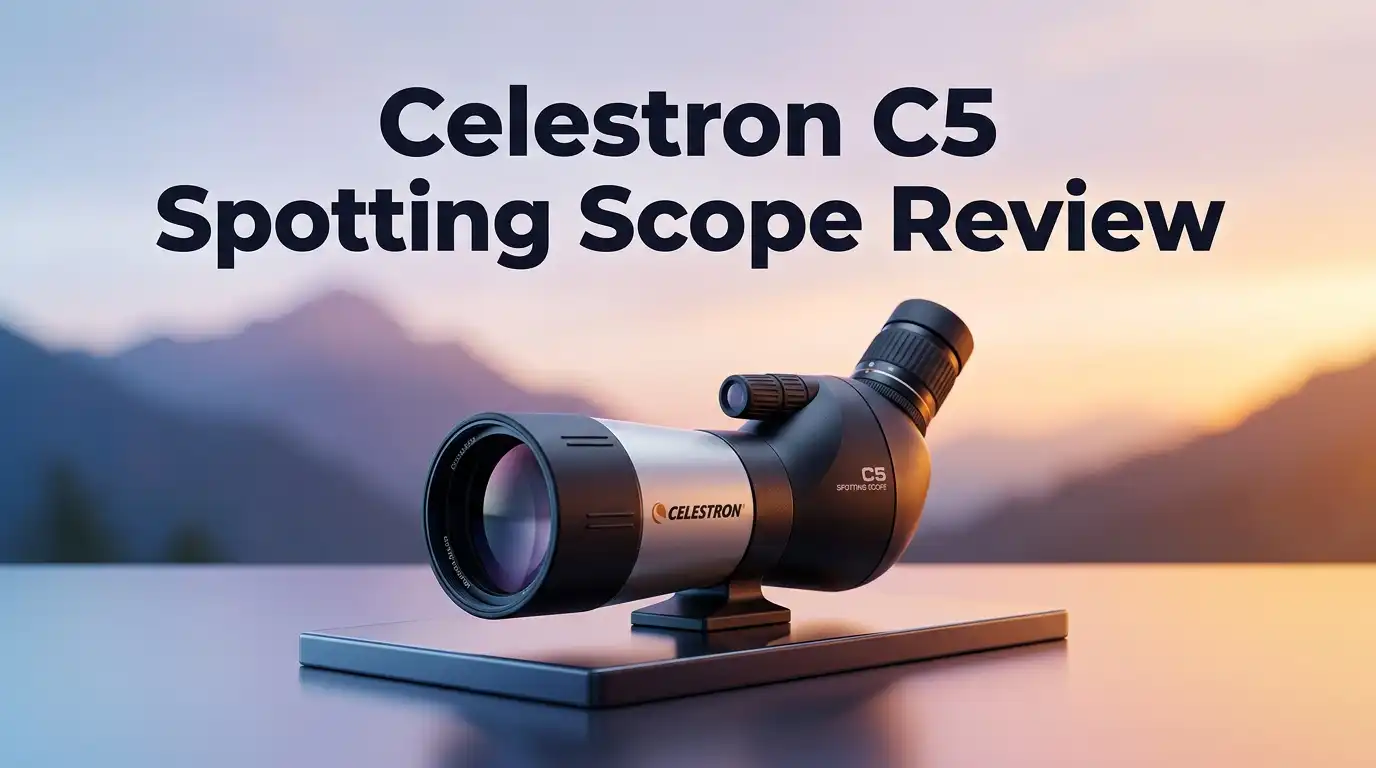
Celestron C5 Spotting Scope Review 2026: Still Worth It?
Most spotting scopes ask you to pick a side. You either get portability or you get power. The Celestron C5 refuses to play that game. It packs a five inch mirror into a tube shorter than a loaf of bread, and it has been quietly doing this since the late 1970s.
I spent weeks with this scope on a tripod in my backyard, at a lake, and pointed at the Moon. Some moments left me grinning. Others left me frustrated.
This review covers both. If you want honest talk about what the C5 nails and where it stumbles, keep reading. By the end you will know whether this compact catadioptric belongs in your kit bag in 2026.
In a Nutshell:
- The C5 gathers serious light. Its 127mm aperture pulls in roughly 2.5 times more light than an 80mm spotting scope and about 4.5 times more than a 60mm model. Low light birding at dusk becomes genuinely usable.
- Portability is the headline feature. The tube weighs around six pounds and measures about eleven inches long. It fits in a backpack. The included padded soft case passes as carry on luggage.
- Daytime views are excellent. Sharpness at the center of the field holds up beautifully past 100x. Colour fringing is essentially absent thanks to the mirror based design.
- It doubles as a telescope. Star clusters, globular clusters, and bright galaxies look genuinely impressive. This is the C5’s secret strength.
- It has real flaws. The 38 percent central obstruction makes it very sensitive to unstable air. Planetary views suffer more than they should. Edge sharpness drops off, and bright stars outside the field can throw reflection arcs into your view.
- Best suited for patient users. Casual users who want instant grab and look convenience may prefer a conventional 80mm refractor style spotter.
Celestron C5 Spotting Scope Overview


Last update on 2026-09-24 / Affiliate links / Images from Amazon Product Advertising API Some of the links on this website are affiliate links, which means that at no additional cost to you, I earn a commission if you click through and make a purchase. I only recommend products and services that I believe will add value to my readers. Thank you for your support!
The Celestron C5 is a Schmidt Cassegrain optical system sold as a spotting scope. Celestron gives it a 127mm aperture and a 1250mm focal length at f/10. That focal length is enormous for a spotter. Most 80mm birding scopes sit near 500mm. The C5 more than doubles that.
Light travels through a thin corrector plate at the front, bounces off the primary mirror, reflects off a secondary mirror, then passes back through a hole in the primary. This folded light path is why a 1250mm scope fits into an eleven inch tube.
Celestron applies its StarBright XLT coatings across the optics. The company claims around 83.5 percent light transmission, a solid jump over older coating generations. The result is a bright, high contrast image with accurate colour.
The C5 also carries a genuine bragging right. A version of this optical design flew on a NASA space shuttle mission. Few spotting scopes can say that.
Unboxing the Celestron C5
The box arrives smaller than you expect. That is the first surprise. Inside sits a grey soft carry case, well padded with dense foam cutouts. Celestron does not treat this case as an afterthought. It measures roughly 39 x 29 x 20 cm and protects the scope properly.
Unzip it and the C5 sits nestled in its cradle. The black tube feels dense in your hands. Cool metal castings sit at the front and rear. The corrector plate looks almost invisible under the coatings, with a faint purple sheen when you tilt it toward a light.
The accessory pockets hold a 25mm Plossl eyepiece, an erect image diagonal, and a 6×30 finderscope with its bracket. A plastic dew cap presses onto the front.
Assembly takes under two minutes. Slide in the diagonal, drop in the eyepiece, clip on the finder. No tools needed. The whole experience feels closer to unpacking a camera lens than a telescope.
Key Specifications Explained Simply
Numbers tell part of the story. Here is what each one means for you in the field.
The 127mm aperture determines light gathering and resolution. Bigger aperture means brighter images and finer detail. The 1250mm focal length sets your magnification. Divide it by your eyepiece focal length to get power. The bundled 25mm eyepiece gives 50x.
The f/10 focal ratio is slow. Slow ratios make eyepiece design easier, so cheap Plossls perform well here. You do not need expensive glass to get good results.
The close focus distance is about 20 feet. That is impressive for a scope of this size and makes butterfly and insect watching realistic.
Weight lands near six pounds for the tube. Length sits at roughly eleven inches without the dew cap.
One number matters more than the marketing suggests. The central obstruction measures 48mm, or about 38 percent of the aperture. Keep that figure in mind. It explains several of this scope’s quirks.
Daytime Optical Performance
This is where the C5 earns its keep. Point it at something 200 metres away and the image snaps into focus with real authority. Birds in a distant treeline look like they are sitting on your fence.
There is no chromatic aberration worth mentioning. Mirrors do not split colours the way lenses do, so white feathers stay white and dark branches stay dark. Refractor owners often fight purple fringing on high contrast edges. C5 owners do not.
Centre field sharpness is excellent. The scope handles 100x comfortably in decent air, and pushes beyond that on good days. Most 80mm spotters run out of steam around 60x.
The edges are a different story. Sharpness falls away toward the field boundary due to field curvature and coma. You learn to keep your subject centred.
Contrast holds up well in bright conditions. Feather detail, fur texture, and licence plate style fine print all resolve cleanly at moderate power.
Top 3 Alternatives for Celestron C5 Spotting Scope

Last update on 2026-09-24 / Affiliate links / Images from Amazon Product Advertising API Some of the links on this website are affiliate links, which means that at no additional cost to you, I earn a commission if you click through and make a purchase. I only recommend products and services that I believe will add value to my readers. Thank you for your support!
Celestron Regal M2 100ED Spotting Scope

Last update on 2026-09-24 / Affiliate links / Images from Amazon Product Advertising API Some of the links on this website are affiliate links, which means that at no additional cost to you, I earn a commission if you click through and make a purchase. I only recommend products and services that I believe will add value to my readers. Thank you for your support!
Celestron Ultima 100 Angled Spotting Scope

Last update on 2026-09-24 / Affiliate links / Images from Amazon Product Advertising API Some of the links on this website are affiliate links, which means that at no additional cost to you, I earn a commission if you click through and make a purchase. I only recommend products and services that I believe will add value to my readers. Thank you for your support!
Celestron NexStar 5SE Computerized Telescope
Night Sky and Deep Sky Performance
Here comes the part nobody expects from a spotting scope. The C5 is a capable deep sky instrument, and this may be its finest quality.
Open clusters look wonderful. M35, M36, M37, and M38 fill the field with crisp pinpoint stars. Star colour comes through clearly. Globular clusters benefit hugely from the extra aperture. M15 shows as a bright fuzzy ball at low power, then begins resolving into individual stars near 114x.
Galaxies work too. The core of M31 stands out clearly against the star field. Bode’s Galaxy and its companion show hints of real structure under dark skies.
The Ring Nebula floats in a rich star field and shows its shape even at 39x. M42 reveals structure and a touch of colour.
The 1.25 inch eyepiece holder caps your widest field at roughly one degree of usable sky. That limits sweeping views of large objects, but most deep sky targets fit comfortably.
Build Quality and Handling
The C5 feels solid without feeling luxurious. The aluminium tube joins to cast metal front and rear cells. Paint coverage is even. The dovetail bar runs along the bottom and includes two standard tripod threads.
Look closely and you see the cost savings. Assembly screws are not always seated perfectly. The dew cap is a simple push fit that can work loose. The overall finish sits a step below Celestron’s larger C8, which feels more carefully assembled.
None of this affects the view. It affects the feeling of ownership. This is a tool, not jewellery.
Handling is a genuine pleasure. You can carry it one handed. You can set it up on a picnic table. You can hand it to a friend without a nervous speech about weight distribution.
Balance sits toward the rear because of the thin corrector plate. Keep that in mind when mounting. Slide the scope slightly forward on your tripod head.
The Focuser and Close Focus Ability
The C5 focuses by moving its primary mirror. A knob near the rear cell drives the mechanism. This design keeps the tube sealed against dust and gives a huge focus range.
Mirror focusers have a reputation for image shift. That is the annoying jump you see when you reverse focus direction. The modern C5 largely avoids it. Movement is minimal and settles quickly. Focus out and back again, and your target sits where you left it.
The action feels smooth and precise. Fine focus at 100x takes small, controlled turns rather than nervous fiddling.
Close focus at roughly 20 feet opens up fun possibilities. Dragonflies on a pond edge. Bark texture on a nearby tree. Hummingbirds at a feeder across the garden.
One habit to build: always finish your focus turn in the same direction. It keeps the mirror seated consistently and gives you the sharpest possible result every time.
Digiscoping and Camera Use
The C5 works as a long telephoto lens, and it does this job well. Remove the visual back, thread on a T adapter and T ring, and your camera body attaches directly to the rear cell.
At 1250mm with an APS C sensor, you get an effective reach near 1875mm. Lenses at that focal length cost many thousands. The C5 costs a fraction.
Daytime results look genuinely sharp in the centre. Bird portraits, distant architecture, and wildlife shots all come out clean.
Smartphone adapters work too. The long focal length makes phone digiscoping surprisingly easy since you are already at high magnification.
Astrophotography is where problems appear. Field curvature and coma soften the corners. Bright stars just outside the frame throw arcing reflections into your image. A field flattener helps. Flocking the inside of the baffle tube helps more.
Lunar photography works reasonably well. Planetary imaging is possible but demands very steady air.
What the Celestron C5 Does Not Do Well
Honest reviews name the weaknesses. Here are the C5’s real ones.
Seeing sensitivity is the big one. That 38 percent central obstruction makes the scope unusually vulnerable to turbulent air. On unsteady nights the Moon turns mushy while smaller refractors nearby still deliver clean detail. This is not a defect. It is physics.
Planetary views underperform the aperture. Jupiter in good air shows belts, polar hoods, and sometimes the Great Red Spot. That is roughly what a fine 70mm apochromatic refractor gives. You paid for 127mm.
Cooldown takes time. Bring the scope from a warm house and expect 20 to 40 minutes before images settle. Refractors are ready faster.
Low power views show secondary shadow. Using a 32mm eyepiece on the bright Moon produces an unpleasant darkening effect in the centre.
Edge sharpness is mediocre. Keep subjects centred.
The C5 is a specialist wearing a generalist label.
Pros and Cons of the Celestron C5
Pros
- Huge 127mm aperture in a package that fits a backpack, weighing only about six pounds
- Zero chromatic aberration thanks to the mirror based Schmidt Cassegrain design
- Excellent centre field sharpness that holds up past 100x magnification in daylight
- Smooth, precise focuser with almost no image shift or mirror flop
- Outstanding deep sky performance for the size, especially on clusters and small bright galaxies
- Close focus near 20 feet allows detailed insect and plant observation
- Well padded carry case included, sized for airline cabin travel
- Standard tripod threads and a Vixen dovetail give flexible mounting options
- Works as an affordable 1250mm telephoto lens for cameras
Cons
- Large 38 percent central obstruction hurts performance badly in unsteady air
- Planetary and lunar detail falls short of what 127mm should deliver
- Cooldown time is slower than a refractor of similar size
- Field of view maxes out near one degree, limiting wide sweeps
- Off axis coma and field curvature soften the edges
- Bright stars outside the field create distracting reflection arcs
- External build quality is functional rather than premium
- Requires a sturdy tripod, which adds cost and weight
Tripod Requirements and Setup Tips
Do not underestimate this part. A six pound scope at 100x magnification punishes weak tripods. Every tiny vibration gets multiplied by the magnification.
Skip lightweight travel tripods. Look for a model rated well above the scope weight. A fluid video head works beautifully because it gives smooth, damped panning. Photo ball heads tend to drift under this load.
Budget roughly the same amount for your tripod as you might expect to spend on a decent eyepiece set. It is not a place to economise.
Position the scope so it balances slightly forward of centre on the head. The rear heavy design otherwise causes slow droop.
For seated observing, a 45 degree diagonal helps enormously. Long sessions at a straight through eyepiece hurt your neck.
Let the scope sit outside for half an hour before serious use. Place it in shade during daytime to avoid tube currents from direct sun heating.
Who Should Buy the Celestron C5 in 2026?
This scope suits specific people extremely well and disappoints others.
Buy it if you are a birder who wants extreme reach, a traveller who needs aperture in a small bag, a deep sky observer with limited storage space, or a photographer who wants an affordable super telephoto. Digiscopers will love the native magnification.
Skip it if your main interest is planets and the Moon. A 127mm Maksutov delivers noticeably better planetary images for less money. Also skip it if you observe from a location with consistently turbulent air.
Casual users who want to glance at a bird for ten seconds may find the setup ritual tiresome. Conventional 80mm spotters with zoom eyepieces are faster to deploy.
The C5 rewards patience. People who enjoy the process of observing get the most from it. People who want instant results sometimes feel let down.
Final Verdict on the Celestron C5
Last update on 2026-09-24 / Affiliate links / Images from Amazon Product Advertising API Some of the links on this website are affiliate links, which means that at no additional cost to you, I earn a commission if you click through and make a purchase. I only recommend products and services that I believe will add value to my readers. Thank you for your support!
The Celestron C5 remains a genuinely useful and genuinely flawed instrument in 2026. Nearly fifty years after its debut, nothing quite matches its combination of aperture and pocketable size.
As a daytime spotting scope it performs superbly. Sharp, colour accurate, and capable of magnifications most spotters cannot touch. As a travel telescope for clusters and galaxies it punches far above its weight.
As a planetary instrument it disappoints. The large central obstruction costs it too much on nights with average air.
My recommendation comes with a condition. Buy the C5 if you understand what you are buying. It is a light bucket in a small box, not a precision planetary tool.
Pair it with a solid tripod and a couple of quality eyepieces. Give it time to cool. Keep your target centred. Do those things and the C5 will reward you with views that seem impossible from something this small.
Frequently Asked Questions
Is the Celestron C5 a telescope or a spotting scope?
It is both. Celestron sells it as a spotting scope with an erect image diagonal for terrestrial viewing. The optical tube is identical in concept to their astronomical Schmidt Cassegrain telescopes. Swap the diagonal and it becomes a proper astronomy instrument.
What magnification does the Celestron C5 come with?
The included 25mm Plossl eyepiece gives 50x magnification. You can change this by using different eyepieces. Divide 1250 by the eyepiece focal length to calculate the power. A 12mm eyepiece gives roughly 104x.
Does the C5 need collimation?
Occasionally, yes. Schmidt Cassegrain scopes can drift out of alignment after rough transport. Adjustment happens through three screws on the secondary mirror. Most users go years without touching them.
Can I use the Celestron C5 for astrophotography?
For lunar and planetary imaging, yes. For deep sky imaging, results are limited by field curvature, coma, and internal reflections. A field flattener improves things considerably. A tracking mount is essential for any exposure longer than a fraction of a second.
How does the C5 compare to a 127mm Maksutov?
The Maksutov usually gives sharper planetary images because of its smaller central obstruction. The C5 is shorter, lighter, and cools faster. Choose the Maksutov for planets and the C5 for portability and deep sky work.
Is the C5 waterproof?
No. The tube is sealed against dust but it is not rated waterproof or nitrogen purged like dedicated birding scopes. Keep it dry and store it in the supplied case.
What tripod thread does the C5 use?
The dovetail bar includes standard quarter twenty threads. This fits most photographic tripod heads directly. The Vixen style dovetail also mounts on common astronomical mounts.

Hello, I’m Emily Price, the founder of Birds Affection. As a passionate bird enthusiast and spiritual seeker, I’ve always been fascinated by the symbolic meanings and mystical connections between birds and our lives. On this website, I share my knowledge and insights on the spiritual significance of various bird species, exploring their roles as messengers, guides, and teachers. Through my writing, I aim to inspire and educate others on the profound wisdom and beauty that birds bring to our world. Join me on this journey as we delve into the enchanting realm of bird symbolism and discover the hidden meanings behind these magnificent creatures.