Diamondback Spotting Scope Review 2026: Worth It?
Spotting scopes split hunters into two camps. One camp spends thousands on alpha glass. The other camp wants solid performance without emptying a savings account. The Vortex Diamondback HD sits right in the middle of that argument, and it has stayed there for years.
This review covers the Diamondback HD 20 to 60×85 angled model in real field use. You will read about sharpness at 200 yards, performance at last light, the honest weight penalty, and the problems nobody mentions in the product listing.
By the end you will know whether this scope belongs on your tripod in 2026 or whether your money belongs somewhere else.
In a Nutshell:
- Optical quality punches above the price. The HD glass delivers clean, color accurate images from 20x to roughly 40x. Chromatic aberration stays low in the center of the view, which is rare at this cost level.
- Low light performance is the real strength. The 85mm objective pulls in enough light to keep animals visible for an extra ten to fifteen minutes after sunset. That window often decides a hunt.
- High magnification softens noticeably. Past 45x the image loses contrast and resolution. This is physics plus glass limits, not a defect, but it matters if you planned to count bullet holes at 400 yards.
- Weight is the biggest complaint. At 60.9 ounces the scope alone is heavy, and a stable tripod adds more. Backpack hunters feel every ounce on a steep climb.
- The warranty changes the math. Vortex offers an unlimited, unconditional lifetime warranty with no receipt and no registration. That coverage adds real long term value.
- Best fit: western hunters, range shooters, and casual birders who want 80 percent of premium performance for about 25 percent of premium cost.
What Makes the Diamondback HD Different?

Last update on 2026-09-13 / Affiliate links / Images from Amazon Product Advertising API Some of the links on this website are affiliate links, which means that at no additional cost to you, I earn a commission if you click through and make a purchase. I only recommend products and services that I believe will add value to my readers. Thank you for your support!
Vortex rebuilt the Diamondback line a few years back, and the HD version is the result. The older Diamondback scopes used basic glass and earned mixed reviews. The HD model added select glass elements that reduce color fringing and improve resolution across the field.
The body also changed. Vortex switched to a helical focus collar instead of a protruding focus knob. The barrel now carries an integrated Arca Swiss foot, so it clamps straight onto most quality tripod heads with no adapter plate.
The practical result is a scope that feels purpose built for hunting rather than astronomy. It is sealed with argon gas, wrapped in rubber armor, and shaped to slide into a pack without snagging. That focus on field use explains why so many guides carry one as a backup spotter.
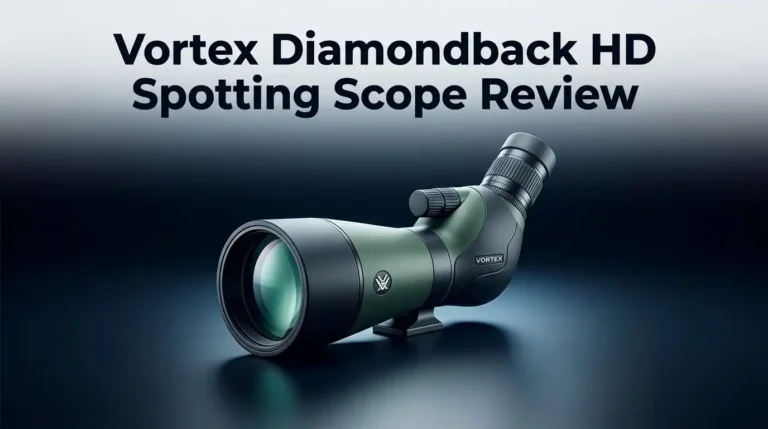
Vortex Diamondback HD 20 to 60×85 Angled Spotting Scope
This is the flagship of the Diamondback HD family. The 85mm objective is the largest in the line, and the 20x to 60x eyepiece covers almost every glassing situation a hunter meets.
The angled body sits lower on a tripod, which saves back strain during long glassing sessions. It also lets two people share one scope without changing tripod height. Straight body fans will disagree, and Vortex sells a straight version for them.
Street pricing has hovered around the 500 to 700 dollar mark, with the official MSRP at 699.99 dollars. Sales appear often. At 500 dollars this scope becomes very hard to argue against, since competing 85mm scopes with HD glass usually start near 900 dollars.
Length measures 16 inches, and weight lands at 60.9 ounces. Those numbers tell you this is a truck and tripod scope, not a pocket optic.
Unboxing Experience and First Impressions
The box arrives plain and sturdy. Inside, the scope sits in molded foam already wearing its neoprene cover. That cover is a nice touch, because many brands sell it separately for 60 dollars.
You also get a tethered objective lens cover, a tethered ocular cover, and a small lens cloth. No tripod. No carry case. No phone adapter. Plan to spend another 150 to 300 dollars on a tripod before this scope does anything useful.
First impressions lean positive. The rubber armor feels dense and grippy. The helical focus collar turns with smooth, even resistance straight out of the box, with no gritty spots. The eyecup twists up and down with a firm click.
One small letdown: the lens cloth is thin and nearly useless. Buy a proper microfiber cloth and a lens pen on day one.
Key Specifications at a Glance
Numbers help you compare this scope against anything else on your shortlist.
Magnification runs 20x to 60x. The objective lens measures 85mm, and the eyepiece measures 2.103 inches across. Eye relief sits between 18.3mm and 20.3mm, which is generous enough for eyeglass wearers in most cases.
Angular field of view spans 2.1 degrees at low power down to 1.1 degrees at full zoom. That translates to 108 feet at 20x and 60 feet at 60x, measured at 1000 yards. Close focus arrives at 24.6 feet, so butterflies in the yard are out of reach.
Length is 16 inches and weight is 60.9 ounces for the angled version. The straight version measures 15.8 inches and weighs 61.3 ounces.
The field of view figures are modest. Premium scopes in this class often reach 120 feet or more at the low end.
Top 3 Alternatives for Vortex Diamondback HD Spotting Scope

Last update on 2026-09-13 / Affiliate links / Images from Amazon Product Advertising API Some of the links on this website are affiliate links, which means that at no additional cost to you, I earn a commission if you click through and make a purchase. I only recommend products and services that I believe will add value to my readers. Thank you for your support!
Vortex Viper HD 20 to 60×85 Spotting Scope


Last update on 2026-09-22 / Affiliate links / Images from Amazon Product Advertising API Some of the links on this website are affiliate links, which means that at no additional cost to you, I earn a commission if you click through and make a purchase. I only recommend products and services that I believe will add value to my readers. Thank you for your support!
Celestron TrailSeeker 20 to 60×80 Angled Spotting Scope

Last update on 2026-09-13 / Affiliate links / Images from Amazon Product Advertising API Some of the links on this website are affiliate links, which means that at no additional cost to you, I earn a commission if you click through and make a purchase. I only recommend products and services that I believe will add value to my readers. Thank you for your support!
Athlon Optics Talos 20 to 60×80 Spotting Scope with Tripod
Optical Performance in Daylight
Set this scope on a steady tripod at midday and the image looks genuinely impressive. At 20x to 30x, edges stay sharp and colors look natural rather than yellow or blue shifted.
Testing on a resolution chart at 100 yards, the Diamondback HD resolved fine detail cleanly through about 40x. Text on distant signs stayed readable. Deer hair patterns showed clear separation at 300 yards.
Center sharpness is the highlight here. Edge sharpness drops off a little, which shows the gap between this scope and alpha glass from European makers. Most users never notice, because the eye naturally centers on the subject.
Chromatic aberration shows up as faint purple fringing on high contrast edges, such as a dark branch against bright sky. It is present but controlled. The older non HD Diamondback was far worse in this area.
Low Light and Dawn to Dusk Testing
This is where the 85mm objective earns its weight. Large objectives gather more light, and that advantage shows exactly when game moves.
In side by side testing against a 65mm scope at legal light, the Diamondback HD kept animals identifiable for roughly twelve minutes longer. That extra window is the single best reason to choose the 85mm over the smaller 65mm model.
The fully multi coated lenses help too. Every air to glass surface carries anti reflective coating, which reduces light loss and cuts internal glare.
Backing the magnification down to 20x or 25x in dim conditions improves the view further, because exit pupil grows and the image brightens. Learn this habit and the scope performs far better at dusk than its price suggests.
Harsh backlight does cause some veiling glare. A lens hood extension helps.
Zoom Range and Image Quality at High Power
Honest talk about 60x: it is usable, but it is not pretty. Image brightness drops, contrast fades, and fine detail smears.
Heat shimmer makes this worse. On a warm afternoon, mirage ruins the view past 40x regardless of which scope you own. Even premium glass struggles there.
Treat 60x as a short term identification tool rather than a glassing setting. Scan at 20x, locate movement, then zoom to 40x for detail. Push to 60x only to check antler points or score hits.
Target shooters hoping to see .22 caliber holes at 200 yards will feel disappointed. The scope shows splash and dirt impacts well, but small paper holes beyond 150 yards are inconsistent. Buyers who need that specific job should look at the Viper HD or a dedicated target scope.
Helical Focus System Explained
The helical focus design replaces a traditional knob with a wide collar wrapped around the scope body. You grip the collar and rotate it.
Benefits are real. The body stays snag free, which matters when sliding the scope into a pack. The collar also works from any position, so you never fumble for a knob in the dark.
Focus speed is fast. A short rotation moves from close focus to infinity, which helps when switching between a near ridge and a far basin.
The drawback is precision. Because travel is short, fine focusing at 60x requires a delicate touch. Dual focus systems on pricier scopes handle this better by separating coarse and fine adjustment. Cold weather with thick gloves also makes the collar harder to turn accurately.
Most users adapt within a day. Precision shooters may never fully love it.
Build Quality, Weight and Field Durability
The chassis feels solid. Rubber armor covers the main tube and provides a secure grip even with wet hands. The ArmorTek coating on exterior lenses resists scratches, oil, and dirt, which keeps cleaning simple.
Argon gas purging and O ring seals deliver waterproof and fogproof performance. Scopes left out in rain and dragged through snow have come back dry inside. Internal fogging complaints are rare across owner reports.
Durability holds up to normal abuse. Owners report drops from truck beds and tripod tip overs with no loss of collimation.
The honest negative is mass. At 60.9 ounces, this scope demands a tripod rated for real weight. A flimsy 80 dollar tripod turns this scope into a vibrating mess. Add a carbon fiber tripod and ball head and your total carry weight approaches eight pounds.
Tripod Mounting and Arca Swiss Compatibility
The integrated Arca Swiss foot is a genuinely smart feature. You clamp the scope directly into any Arca compatible head with no extra plate.
That saves money and removes a failure point. Older scopes needed a separate quick release plate, which could loosen and wobble at the worst moment.
The foot rotates, so you can switch the eyepiece between horizontal and vertical positions. This matters for digiscoping and for glassing from awkward positions. Lock the collar firmly, because the tension ring can loosen with vibration.
Three spirit levels on the body help you level the scope for panning. Birders appreciate this more than hunters do.
One gripe: the Arca foot is fairly short. Very large clamps grip it fine, but some narrow clamps allow slight play. Check your head before buying.
Digiscoping and Phone Adapter Use
Phone photography through a spotting scope has become standard practice for scoring animals and sharing finds. The Diamondback HD handles it acceptably.
The eyepiece diameter of 2.103 inches fits most universal phone adapters. Vortex sells its own adapter, and third party clamps work too. Expect to spend 50 to 100 dollars.
Image results look best between 20x and 35x. Vignetting appears as a dark ring at higher magnifications, and image quality degrades quickly past 40x.
Do not expect wildlife photography results. Phone through scope images look soft, show color fringing, and suffer from any tripod vibration. They work well for documentation and for showing a friend the buck across the canyon. They will not satisfy anyone chasing print quality photos.
Video stabilization on modern phones helps a surprising amount.
What the Diamondback HD Does Not Do Well
Every honest review needs this section.
The scope is soft above 45x. Anyone expecting crisp 60x views will feel let down. The marketing emphasizes the zoom range more than the usable range.
Field of view is narrow. At 108 feet per 1000 yards at the low end, scanning large areas takes longer than it should. Competing scopes with wider views find animals faster.
Close focus at 24.6 feet blocks backyard and garden use entirely. Birders who watch feeders should look elsewhere.
Weight hurts on long hikes. Sixty ounces plus tripod is a real commitment, and many backcountry hunters eventually trade down to a 65mm model.
Accessories are thin. No case, no tripod, and a nearly useless lens cloth in the box. Budget for extras.
Pros and Cons
Pros
- HD glass delivers sharp, color accurate images from 20x through about 40x
- The 85mm objective excels in low light, adding real minutes at dawn and dusk
- Long eye relief between 18.3mm and 20.3mm suits eyeglass wearers
- Integrated Arca Swiss foot mounts directly with no separate plate
- Argon purged and O ring sealed for reliable waterproof and fogproof use
- Helical focus keeps the body snag free and packs cleanly
- Neoprene cover and tethered lens caps included at no extra cost
- Unlimited, unconditional lifetime warranty with no receipt required
- Frequent sales push the price into genuine bargain territory
Cons
- Image softens clearly above 45x magnification
- Narrow field of view slows down wide area scanning
- Heavy at 60.9 ounces, demanding a sturdy and costly tripod
- Close focus of 24.6 feet rules out backyard birding
- Helical focus lacks fine precision at high power
- No case or tripod included in the box
- Edge sharpness trails premium competitors
- Some veiling glare in harsh backlight
Who Should Buy This Scope?
Western big game hunters are the target audience. If you glass basins for mule deer, elk, or sheep from a stationary position, this scope does the job well and survives the conditions.
Range shooters at 100 to 300 yards also benefit, as long as expectations stay realistic about seeing small holes.
Casual birders who watch open water, shorelines, and raptor ridges will enjoy it. Dedicated birders chasing warblers in dense woods should buy a wider, lighter 65mm scope instead.
Skip it if you count ounces on multi day backcountry trips. The 65mm Diamondback HD saves significant weight with only a modest loss in low light performance.
Also skip it if you already own quality 15x binoculars on a tripod and rarely need more reach.
Price and Warranty Value in 2026
MSRP sits at 699.99 dollars, and real street prices often drop to the mid 500s during sale events. At that figure the value proposition gets strong.
Compare that to the Vortex Viper HD at roughly double the cost. The Viper brings better coatings, improved high power performance, and a dual focus option. It is a better scope, and the price reflects that.
The warranty deserves separate mention. Vortex covers the scope for life, transfers coverage to new owners, and asks no questions about cause of damage. Drop it off a cliff and Vortex repairs or replaces it. No other factor in this price bracket matches that peace of mind.
Last update on 2026-09-13 / Affiliate links / Images from Amazon Product Advertising API Some of the links on this website are affiliate links, which means that at no additional cost to you, I earn a commission if you click through and make a purchase. I only recommend products and services that I believe will add value to my readers. Thank you for your support!
Final Verdict
The Diamondback HD 85mm remains one of the smartest buys in spotting scopes for 2026. It gives hunters usable 85mm light gathering, honest HD glass, and bulletproof warranty support for a fraction of alpha glass pricing.
It is not perfect. The soft high power view, narrow field, and heavy body are genuine compromises. Anyone who ignores those tradeoffs will feel disappointed.
Buy it if you want a durable, bright, well built spotter for stationary glassing and you accept 40x as your practical ceiling. Spend more on a Viper HD if high magnification clarity drives your purchase. Spend less on a 65mm model if weight rules your pack.
For most hunters, this scope hits the sweet spot between performance and price. That is exactly why it keeps showing up on tripods across the West.
FAQs
Is the Diamondback HD good enough for seeing bullet holes?
It shows rifle holes in paper reliably out to about 150 yards in good light. Beyond that, .223 and smaller holes become inconsistent. Dirt splash and steel impacts remain visible much farther. Precision load development at 300 yards calls for a Viper HD or an electronic target system.
Should I choose the angled or straight body?
Angled bodies suit tripod glassing, sharing with partners, and viewing uphill. Straight bodies suit window mounts, quick target acquisition, and shooters who track moving animals. Most hunters prefer angled after a short adjustment period.
What tripod does this scope need?
Choose a tripod rated for at least ten pounds with a fluid or quality ball head. Carbon fiber models from Vortex, Sirui, and Leofoto work well. Undersized tripods cause vibration that ruins the image.
Is the 65mm version a better choice?
The 65mm model weighs noticeably less and costs less. It loses about ten minutes of usable light at dusk. Backpack hunters usually prefer the 65mm, while truck and day hunters prefer the 85mm.
Does the warranty really cover everything?
Vortex covers damage, defects, and accidents for life, with no receipt and no registration required. Coverage transfers to future owners. Theft and intentional damage are the only common exclusions.
How does it compare to the Celestron TrailSeeker?
The TrailSeeker offers interchangeable eyepieces and dual focus at a lower price. The Diamondback HD delivers better low light performance, a tougher body, and far better warranty support. Hunters should pick Vortex, while budget birders may prefer Celestron.

Hello, I’m Emily Price, the founder of Birds Affection. As a passionate bird enthusiast and spiritual seeker, I’ve always been fascinated by the symbolic meanings and mystical connections between birds and our lives. On this website, I share my knowledge and insights on the spiritual significance of various bird species, exploring their roles as messengers, guides, and teachers. Through my writing, I aim to inspire and educate others on the profound wisdom and beauty that birds bring to our world. Join me on this journey as we delve into the enchanting realm of bird symbolism and discover the hidden meanings behind these magnificent creatures.