Vortex Diamondback HD Spotting Scope Review 2026
Long range glassing punishes cheap optics. You set up on a ridge, spot a shape at 900 yards, and then squint through a blurry mess trying to decide if it is a buck or a burnt stump. That moment is where a spotting scope earns its price tag.
The Vortex Diamondback HD sits in a sweet spot that a lot of shooters and hunters care about. It costs a few hundred dollars, carries the Vortex lifetime warranty, and promises HD glass without asking for rifle money. But budget optics always trade something away, and this one is no exception.
I spent time with both sizes, on paper targets, on deer, and on birds. This review covers the unboxing, the glass, the focus system, the weight problem, and the honest weak spots that marketing pages skip.
In A Nutshell:
- The price to performance ratio is the main selling point. The 20x60x85 model lands near $499 and the compact 16x48x65 sits around $399. Very few 85mm spotting scopes with HD glass compete at that number, and the Vortex VIP warranty adds real value.
- Daylight image quality is genuinely good up to about 40x. Colors look natural, edges stay sharp in the center, and you can count points on antlers or read bullet holes on paper at 100 yards without strain.
- Image quality drops noticeably past 45x. You get purple fringing on high contrast edges, softer detail, and a dimmer picture. This is normal for scopes under $1000, but buyers expecting alpha glass will feel let down.
- It is heavy. The 85mm version weighs 60.9 ounces, which is nearly four pounds. Backpack hunters will feel every mile of that. The 65mm model at 49.8 ounces travels much better.
- The helical focus collar splits opinions. It is smooth and snag free, but it is slower than a dedicated knob when a bird moves.
- You must budget for a solid tripod. A flimsy tripod ruins this scope completely.
Vortex Diamondback HD Spotting Scope 20x60x85: Quick Look

Last update on 2026-09-13 / Affiliate links / Images from Amazon Product Advertising API Some of the links on this website are affiliate links, which means that at no additional cost to you, I earn a commission if you click through and make a purchase. I only recommend products and services that I believe will add value to my readers. Thank you for your support!
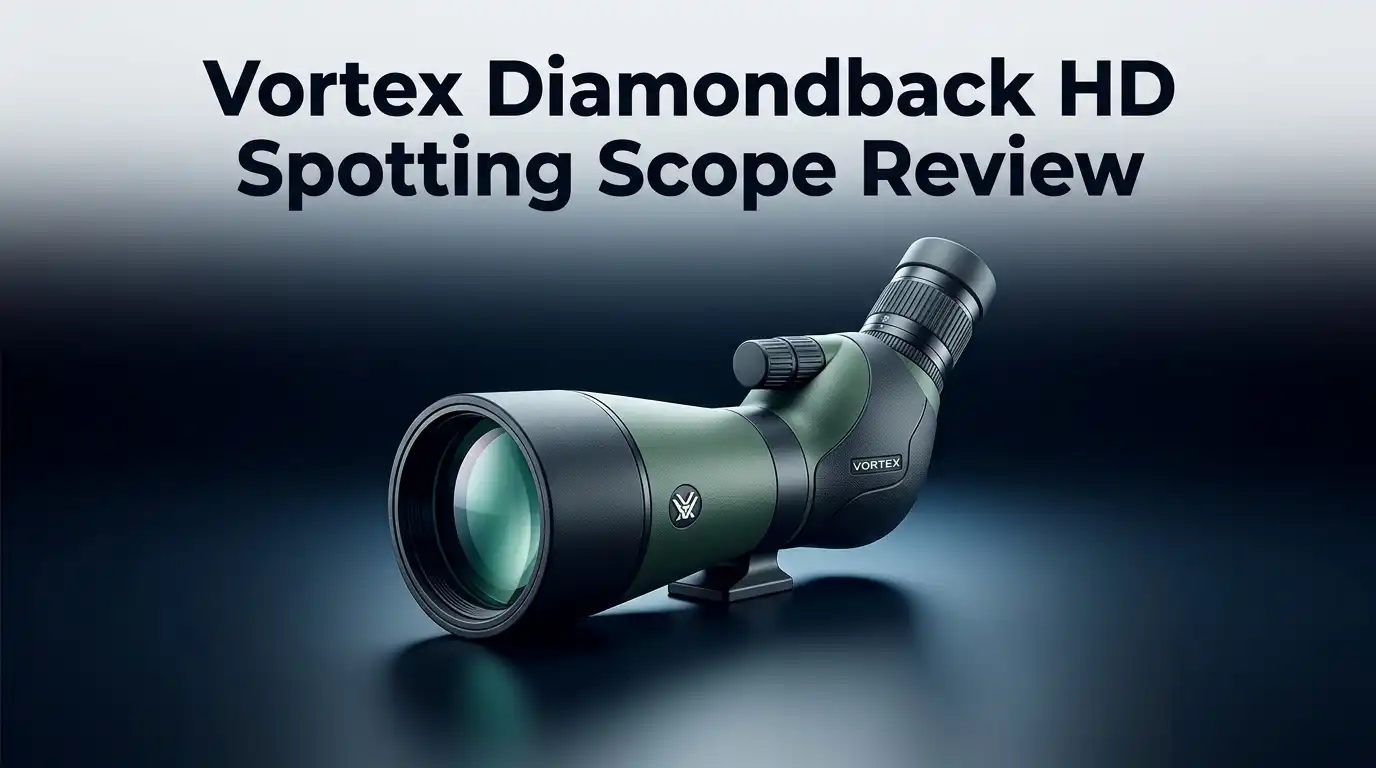
The 20x60x85 is the full size flagship of the Diamondback HD line. Vortex redesigned this series with an 85mm objective lens, up from the 80mm on the older Diamondback, and the extra glass shows in brightness.
Core numbers matter here. Magnification runs from 20x to 60x. Eye relief measures 18.3mm to 20.3mm, which works fine for eyeglass wearers. The linear field of view spans 108 feet at 20x down to 60 feet at 60x at 1000 yards. Close focus sits at 24.6 feet, and total length reaches 16 inches.
The body is argon purged and O ring sealed, so fog and rain are not a concern. ArmorTek coatings guard the exterior lenses against scratches and oil. Rubber armor wraps the barrel for grip.
Vortex built this one for hunters, not birders, and that design intent explains most of its strengths and most of its compromises. You can buy it in angled or straight configuration.
Unboxing Experience And First Impressions
The box is plain. Vortex ships the Diamondback HD in a simple cardboard carton with foam inserts, and there is no premium theater here. Open it and you find the scope, a neoprene stay on cover, a tethered objective lens cap, a tethered ocular lens cap, and a lens cloth.
The first thing you notice is weight. Lifting the 85mm out of the foam feels like picking up a small dumbbell. The second thing you notice is the finish. The rubber armor has a slightly tacky texture that grips well even with cold hands.
One disappointment arrives immediately. There is no hard case and no padded carry bag. Vortex sells a padded case separately for about $46. At this price point, a basic soft case should be included, and plenty of buyers say the same thing.
The neoprene cover fits snugly and stays on during use. The tethered caps dangle a bit, which is mildly annoying in wind.
Build Quality And Field Handling
The Diamondback HD feels solid in hand. There is no wobble in the eyepiece, no creaking in the barrel, and the rotating tripod collar turns with firm, even resistance. It clicks into detents at useful angles so you can switch from standing to sitting without repositioning your whole setup.
The built in sunshade extends smoothly and does real work. It cuts glare in morning light and keeps raindrops off the objective lens. This small feature saves more shots than people realize.
Twist up eyecups offer three positions. They hold their setting, which is not always true on budget optics.
The zoom ring turns with moderate stiffness. It is not buttery, but it does not slip either. Some users report the zoom feeling gritty in very cold weather, and I noticed slight stiffness below freezing.
Arca Swiss compatibility is the standout build feature. The foot mounts directly to Arca Swiss heads with no adapter plate, and it still accepts standard quarter twenty threads.
Optical Performance In Daylight
This is where the Diamondback HD earns its keep. From 20x to roughly 40x, the image is bright, sharp, and pleasantly neutral in color. Grass looks like grass. Deer hide looks like deer hide. No heavy warm or cold cast distorts what you see.
At 100 yards on a paper target, you can spot .22 caliber holes at 30x in good light without guessing. At 300 yards, 6.5mm holes become visible under favorable conditions. That performance satisfies most range users.
Center sharpness is strong. Edge sharpness softens toward the outer twenty percent of the field, which is typical at this price. Most people ignore it because you naturally look at the center.
Contrast is the honest weak point. Compared with a Viper HD, shadows lose some separation, and detail in dark timber flattens out. You can still identify animals, but you work harder for it.
Top 3 Alternative for Vortex Diamondback HD Spotting Scope

Last update on 2026-09-17 / Affiliate links / Images from Amazon Product Advertising API Some of the links on this website are affiliate links, which means that at no additional cost to you, I earn a commission if you click through and make a purchase. I only recommend products and services that I believe will add value to my readers. Thank you for your support!
Athlon Optics Argos HD 20x60x85 Spotting Scope

Last update on 2026-09-13 / Affiliate links / Images from Amazon Product Advertising API Some of the links on this website are affiliate links, which means that at no additional cost to you, I earn a commission if you click through and make a purchase. I only recommend products and services that I believe will add value to my readers. Thank you for your support!
Vortex Viper HD 20x60x85 Spotting Scope


Last update on 2026-09-17 / Affiliate links / Images from Amazon Product Advertising API Some of the links on this website are affiliate links, which means that at no additional cost to you, I earn a commission if you click through and make a purchase. I only recommend products and services that I believe will add value to my readers. Thank you for your support!
Celestron Regal M2 65ED Spotting Scope
Low Light Performance At Dawn And Dusk
Hunters live in the first and last thirty minutes of legal light. The 85mm objective helps a lot here, and this is the main reason to pick the big model over the compact.
At 20x to 25x, the exit pupil measures roughly 4.25mm to 3.4mm, which feeds your eye enough light to keep the image usable well past sunset. I could identify antlers on a feeding deer at 600 yards about fifteen minutes after sundown.
Push the magnification up and the picture collapses fast. At 60x, the exit pupil shrinks to about 1.4mm, and low light viewing becomes dim and mushy. Stay between 20x and 35x when the sun goes down and the scope performs far above its price.
The fully multi coated lenses handle glare reasonably. Bright backlighting produces some veiling flare, especially when glassing toward a low sun. Using the sunshade reduces that problem noticeably.
The Helical Focus Collar: Love It Or Hate It
Vortex dropped the traditional focus knob on this generation and installed a helical collar that wraps the barrel. You rotate the whole band to focus.
The upside is a clean, snag free profile. Nothing sticks out to catch on pack straps or brush. The collar travels smoothly and the throw is long enough for fine adjustment at high power.
The downside is speed. When a bird lands and takes off three seconds later, a barrel collar loses to a knob every time. Birders will feel this constantly. Target shooters and hunters, who focus once and then watch, barely notice it.
There is a second issue. Turning the collar shifts the whole scope body slightly. On a light tripod, that movement rocks your view and you fight the image instead of studying it.
A heavy, stable tripod fixes almost all of this complaint.
Vortex Diamondback HD 16x48x65: The Compact Sibling

Last update on 2026-09-13 / Affiliate links / Images from Amazon Product Advertising API Some of the links on this website are affiliate links, which means that at no additional cost to you, I earn a commission if you click through and make a purchase. I only recommend products and services that I believe will add value to my readers. Thank you for your support!
If the 85mm feels like too much scope, the 16x48x65 solves the weight problem. It weighs 49.8 ounces and measures 14.25 inches long, which is a meaningful difference on a mountain.
Field of view is wider at 138 feet to 72 feet at 1000 yards, and close focus improves dramatically to 16.4 feet. That close focus number makes it far more useful for butterflies, reptiles, and backyard birds.
Eye relief matches the big model at 18.3mm to 20.3mm. Optical coatings and construction are identical. It carries the same Arca Swiss foot and the same argon purged sealing.
The tradeoff is light gathering. A 65mm objective simply collects less light than an 85mm one, so dusk performance drops. Chromatic aberration also appears a touch earlier in the zoom range.
Buy this one if you hike with your scope. Buy the 85mm if you glass from a truck, a blind, or a shooting bench.
What The Diamondback HD Does Not Do Well
Honest reviews list the failures, so here they are without sugar coating.
Purple fringing is real. Point it at a dark branch against bright sky and you will see color edges. New birders often notice this within minutes of first use and assume the scope is defective. It is not defective. It is a budget scope.
Maximum magnification is mostly marketing. Usable, pleasant viewing tops out near 45x. The last fifteen power exists on the label more than in the field.
It is too heavy for serious backcountry hunting. Nearly four pounds plus a tripod adds up quickly.
No case is included, which feels cheap at this price.
Digiscoping results are mediocre. Phone photos come out soft and show visible color fringing, so do not buy this scope planning to publish wildlife photography.
The zoom ring stiffens in cold weather for some users.
Tripod, Mounting, And Digiscoping Notes
Your tripod matters more than you think. A 60 ounce scope on a $60 tripod produces a shaking image that no amount of glass quality can rescue. Plan to spend at least $150 to $250 on a tripod and fluid head.
The Arca Swiss foot is a genuine convenience. Most modern tripod heads use that standard, so you clamp the scope directly and skip adapter plates. Setup takes seconds.
For truck based glassing, a window mount works well and adds stability without carrying legs. Vortex sells one for around $49.
Digiscoping requires a separate phone adapter, which is not included. Results are acceptable for documentation and social posts at lower magnification. Past 40x, images get soft and fringed.
Keep your expectations grounded. This scope is a viewing instrument first, and a camera accessory a distant second.
Diamondback HD vs Crossfire HD vs Viper HD
Vortex stacks three tiers, and choosing between them confuses a lot of buyers.
The Crossfire HD 16x48x65 costs about $249. It shares the body style and the warranty but uses simpler glass. Color fringing appears earlier and low light performance is weaker. It works for casual range use and occasional wildlife watching.
The Diamondback HD sits in the middle at $399 to $499. You get better resolution, better low light ability, and the bigger 85mm option. For most hunters and shooters, this tier delivers the best value in the lineup.
The Viper HD runs $699 to $899. It adds XR Plus lens coatings and better glass elements. The difference shows in contrast, in shadow detail, and in how far you can push magnification before quality falls apart.
If you glass for hours at a time, the Viper upgrade is worth saving for. If you glass occasionally, the Diamondback HD is plenty.
Pros And Cons Of The Vortex Diamondback HD
Here is the balanced summary.
Pros:
- Strong price to performance value, with the 85mm model near $499 and the 65mm near $399, which undercuts most HD competitors.
- Bright, natural colors and sharp center resolution from 20x through roughly 40x in good light.
- Excellent dusk performance on the 85mm model when you keep magnification low.
- Arca Swiss compatible foot mounts directly to modern tripod heads with no adapter plate needed.
- Argon purged, O ring sealed, waterproof, fogproof, and shockproof construction that survives hard seasons.
- Generous eye relief of 18.3mm to 20.3mm that works well for eyeglass wearers.
- Unlimited, unconditional, fully transferable VIP lifetime warranty from Vortex.
- Snag free helical focus and a built in sunshade that reduces glare and rain intrusion.
Cons:
- Visible chromatic aberration and purple fringing on high contrast edges.
- Image quality and brightness drop significantly above 45x magnification.
- The 85mm model weighs 60.9 ounces, which is heavy for backpack hunting.
- No carrying case included at any price tier.
- Helical focus is slower than a knob for fast moving subjects like birds.
- Edge softness appears in the outer field of view.
- Mediocre digiscoping results with soft, fringed phone photos.
Price, Warranty, And Value In 2026
Street pricing in 2026 holds steady. The 20x60x85 angled model sells near $499, down from a $699 MSRP. The 16x48x65 lands near $399. Sales around hunting season occasionally push these lower.
The warranty deserves real weight in your decision. Vortex covers the scope for life, unconditionally, with no receipt required and full transferability. Drop it off a cliff and Vortex repairs or replaces it. That policy is not marketing fluff, and thousands of owners have used it successfully.
Factor in the total cost though. Add a tripod at $150 to $250, a case at $46, and a phone adapter if you want photos. Your real spend lands closer to $700 than $499.
Compared with the competition, the Athlon Argos HD delivers similar glass at a lower price with a less generous warranty. The Leupold SX2 Alpine competes closely. Value remains strong here.
Who Should Buy It And Who Should Skip It
Buy the Diamondback HD if you hunt from stands, blinds, trucks, or short hikes and need reliable long range identification. Buy it if you shoot at a range and want to see your groups without walking downrange. Buy it if you want HD glass and a lifetime warranty without spending $900.
Skip it if you are a serious birder chasing fast moving subjects, because the focus collar and the color fringing will frustrate you daily. A Celestron Regal M2 65ED with true ED glass serves birders better.
Skip it if you hike deep backcountry with weight limits. Look at the 65mm version or a lighter compact scope instead.
Skip it if you have looked through alpha glass from Swarovski, Zeiss, or the Vortex Razor line. Once your eyes know that standard, budget optics feel disappointing, and no amount of value talk changes that feeling.
Final Verdict: A Smart Buy With Clear Limits
The Vortex Diamondback HD does exactly what an entry level HD spotting scope should do. It gives you bright, usable, honest images at moderate magnification, it survives rough treatment, and it costs a fraction of premium glass.
It does not pretend to be a Razor. The color fringing is there, the top end of the zoom range is soft, and the 85mm model is heavy enough to make you think twice about long hikes. Those are fair trades at this price, not defects.
My recommendation is simple. Pick the 20x60x85 if you glass from fixed positions and want maximum light gathering. Pick the 16x48x65 if you carry your gear.
Spend real money on the tripod. A great tripod makes this scope look better than it is, and a bad one makes it look worse.
For hunters and shooters on a budget in 2026, this remains one of the smartest optics purchases available.
Frequently Asked Questions
Is the Vortex Diamondback HD good for bird watching?
It works, but it is not ideal. The helical focus collar is slower than a knob when birds move quickly, and the chromatic aberration shows up clearly on high contrast subjects like dark birds against bright sky. The 16x48x65 model performs better for birding thanks to its wider field of view and 16.4 foot close focus. Dedicated birders usually prefer scopes with true ED glass and a fast focus knob.
What is the difference between Diamondback and Diamondback HD?
The HD version adds the HD optical system with select glass elements that reduce color fringing and improve resolution. Vortex also redesigned the body with a streamlined profile, replaced the focus knob with a helical collar, added Arca Swiss compatibility, and increased the large model objective from 80mm to 85mm. The HD version is noticeably better optically and noticeably heavier.
Can you see bullet holes at 300 yards?
Yes, under good conditions. With bright, even light and calm air, you can spot 6.5mm and .30 caliber holes at 300 yards on white paper at around 40x. Mirage, heat shimmer, and poor lighting will stop you well before the glass does. At 100 yards, .22 caliber holes are easy to see.
Should I choose angled or straight?
Choose angled if you share the scope, glass uphill, or use a tripod while seated, because angled bodies reduce neck strain and allow shorter tripod height. Choose straight if you glass from a vehicle window mount, scan quickly across flat terrain, or prefer pointing the scope like a rifle. Both configurations have identical optics.
Does the Vortex Diamondback HD come with a tripod?
No. The box includes only the scope, a neoprene stay on cover, tethered lens caps, and a lens cloth. You must buy a tripod separately, and a stable one is essential. Budget at least $150 for a tripod and head that can handle the 60.9 ounce weight of the 85mm model without shaking.
How does the Vortex warranty actually work?
Vortex offers an unlimited, unconditional, lifetime VIP warranty. You do not need a receipt, registration, or proof of purchase. The coverage transfers to future owners. Vortex repairs or replaces damaged or defective products regardless of fault. It does not cover loss, theft, deliberate damage, or cosmetic marks that do not affect performance.

Hello, I’m Emily Price, the founder of Birds Affection. As a passionate bird enthusiast and spiritual seeker, I’ve always been fascinated by the symbolic meanings and mystical connections between birds and our lives. On this website, I share my knowledge and insights on the spiritual significance of various bird species, exploring their roles as messengers, guides, and teachers. Through my writing, I aim to inspire and educate others on the profound wisdom and beauty that birds bring to our world. Join me on this journey as we delve into the enchanting realm of bird symbolism and discover the hidden meanings behind these magnificent creatures.